
 100% FREE ACCESS
12th Standard Syllabus & Materials
12th Standard
TN 12th Computer Applications மின்னணு தரவு பரிமாற்றம் Sample Question Papers Study Material - QB365 Set A
NEW12th Standard
TN 12th Computer Applications மின் - வணிக பாதுகாப்பு அமைப்புகள் Sample Question Papers Study Material - QB365 Set A
NEW12th Standard
TN 12th Computer Applications மின்னணு செலுத்தல் முறைகள் Sample Question Papers Study Material - QB365 Set A
NEW12th Standard
TN 12th Computer Applications மின் - வணிகம் Sample Question Papers Study Material - QB365 Set A
NEW12th Standard
TN 12th Computer Applications திறந்த மூல கருத்துருக்கள் Sample Question Papers Study Material - QB365 Set A
NEW12th Standard
TN 12th Computer Applications வலையமைப்பு வடமிடல் Sample Question Papers Study Material - QB365 Set A

Published on: 01/10/2019
Differential Equations
Download Tamil Nadu 12th Standard Business Maths and Statistics question papers, model tests, one-mark questions, important questions, and public exam papers in PDF format. Free study materials and answer keys for TN State Board students.
Questions + Answers key
Take MCQ Business Maths and Statistics Test
1.
Solve \(\frac { { d }^{ 2 }y }{ d{ x }^{ 2 } } -4\frac { dy }{ dx } +5y\) = 0
2.
Find the order and degree of the following differential equations.
\(\frac { dy }{ dx } +2y={ x }^{ 3 }\)
3.
Find the curve whose gradient at any point P(x, y) on it is \(\frac { x-a }{ y-b } \) and which passes through the origin.
4.
Solve: \(\frac { dy }{ dx } ={ ae }^{ y }\)
5.
Solve sec2x tan y dx + sec2y tan x dy = 0
6.
7.
Form the differential equation by eliminating α and β from (x − α)2 + (y − β)2 = r2
8.
Solve: (3D2 + D - 14)y = 4 - 13\({ e }^{\frac{-7}{3}x}\)
9.
Solve the following:
\(\frac { dy }{ dx } +\frac { y }{ x } ={ xe }^{ x }\)
10.
Solve (x2 + 1)\(\frac { dy }{ dx } \) + 2xy = 4x2
11.
The slope of the tangent to a curve at any point (x, y) on it is given by (y3−2yx2)dx + (2xy2−x3)dy = 0 and the curve passes through (1, 2). Find the equation of the curve.
12.
Solve the differential equation \(\frac { dy }{ dx } =\frac { x-y }{ x+y } \)
13.
The sum of Rs. 2,000 is compounded continuously, the nominal rate of interest being 5% per annum. In how many years will the amount be double the original principal? (loge2 = 0.6931)
14.
The solution of the differential equation \(\frac { dy }{ dx } =\frac { y }{ x } +\frac { f\left( \frac { y }{ x } \right) }{ f'\left( \frac { y }{ x } \right) } \) is ______.
\(f\left( \frac { y }{ x } \right) =k.x\)
\(xf\left( \frac { y }{ x } \right) =k\)
\(f\left( \frac { y }{ x } \right) =ky\)
\(yf\left( \frac { y }{ x } \right) =k\)
15.
A homogeneous differential equation of the form \(\frac { dx }{ dy } \) = f\(\left( \frac { y }{ x } \right) \) can be solved by making substitution,______.
x = v y
y = v x
y = v
x = v
16.
The differential equation of x2 + y2 = a2 ______.
xdy + ydx = 0
ydx – xdy = 0
xdx – ydx = 0
xdx + ydy = 0
17.
If sec2 x is an integrating factor of the differential equation \(\frac { dy }{ dx } \) + Py Q then P = ______.
2 tan x
sec x
cos2 x
tan2 x
18.
The complementary function of (D2+ 4)y = e2x is ______.
(Ax +B)e2x
(Ax +B)e−2x
A cos 2x + B sin 2x
Ae−2x+ Be2x
19.
The degree of the differential equation \(\frac { { d }^{ 4 }y }{ { dx }^{ 4 } } { -\left( \frac { { d }^{ 2 }y }{ { dx }^{ 2 } } \right) }^{ 4 }+\frac { dy }{ dx } =3\) ______.
1
2
3
4
20.
I.F. of \(\frac { dy }{ dx } \)+Py = Q
21.
y = mx
22.
y = mx+ c
23.
\(\frac { d^{ 3 }y }{ dx^{ 3 } } -\left( \frac { dy }{ dx } \right) ^{ \frac { 1 }{ 2 } }\)= 0
24.
\(\frac { d^{ 2 }x }{ dt^{ 2 } } \) + m2x = 0
1.
Given \(\frac { { d }^{ 2 }y }{ d{ x }^{ 2 } } -4\frac { dy }{ dx } +5y\) = 0
(D2−4D+5)y = 0
The auxiliary equation is m2−4m + 5 = 0
⇒ (m−2)2−4 + 5 = 0
(m− 2)2 = –1
m - 2 = 土\(\sqrt{-1}\)
m = 2 土 i , it is if the form α 土 iβ
∴ C.F = e2x[A cos x + B sin x]
The general solution is y = e2x[A cos x + B sin x]
2.
The highest derivative is first order and its power is one
∴ order : 1
degree : 1
3.
Given Gradient = \(\frac { x-a }{ y-b } \)
⇒ \(\frac { dy }{ dx } =\frac { x-a }{ y-b } \)
Separating the variables we get,
(y - b) dy = (x - a) dx
Integrating both sides we get,
\(\int { (y-b) } dy=\int { (x-a) } \)dx
\(\frac { { y }^{ 2 } }{ 2 } -by=\frac { { x }^{ 2 } }{ 2 } -ax\)+c ......(1)
Since the curve passes through the origin (0, 0), we get
0-0 = 0-0+c ⇒ c=0
∴ (1) be comes,
\(\frac { { y }^{ 2 } }{ 2 } -by=\frac { { x }^{ 2 } }{ 2 } -ax\)
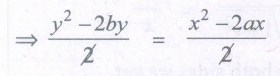
y2-2by = x2- 2ax
Adding and subtracting b2 in the L.H.S and a2 in the R.H.S we get

(y-b)2-b2 = (x-a)2-a2
⇒ (y-b)2 = (x-a)2+b2-a2
4.
Given \(\frac { dy }{ dx } \) = ae7
Separating the variables we get,
\(\frac { dy }{ { e }^{ y } } \) =adx ⇒ e-y dy = adx
Integrating both sides we get,
\(\int { e^{ -y }dy } =a\int { dx } \)
-e-y= ax+c
ax + e-y+ c = 0
5.
Separating the variables, we get
\(\frac { { \sec }^{ x }x }{ \tan x } dx+\frac { { \sec }^{ 2 } }{ { \tan y } } dy=0\)
Integrating, we get
ഽ\(\frac { { \sec }^{ x }x }{ \tan x } \)dx + ഽ\(\frac { { \sec }^{ 2 } }{ { \tan y } } dy\) = c
log tan x + log tan y = log c
log(tan x tan y) = log c
tan x tan y = c
6.
7.
Given equation is (x - α)2 + (y - β)2 = r2
Differentiating w.r.t. 'x' we get,
2 (x - α)2 + (y - β)\(\frac { dy }{ dx } \) = r2
⇒ (x - α) + (y - β)\(\frac { dy }{ dx } \) = 0....(2)
Differentiating again w.r.t. 'x' we get
1+(y-β) \(\frac { d^{ 2 }y }{ dx^{ 2 } } +\frac { dy }{ dx } .\frac { dy }{ dx } \) = 0
⇒ 1+(y-β) \(\frac { d^{ 2 }y }{ dx^{ 2 } } +\left( \frac { dy }{ dx } \right) ^{ 2 }\)= 0
⇒ y-β = \(\frac { -1\left( 1+\left( \frac { dy }{ dx } \right) ^{ 2 } \right) }{ \frac { d^{ 2 }y }{ dx^{ 2 } } } \) .....(3)
Substituting this value in (2) we get
(x-α) = \(\left( \frac { 1+\left( \frac { dy }{ dx } \right) ^{ 2 }\frac { dy }{ dx } }{ \frac { d^{ 2 }y }{ dx^{ 2 } } } \right) \) ......(4)
Substituting (3) and (4) in (1) we get
\(\frac { \left\{ 1+\left( \frac { dy }{ dx } \right) ^{ 2 }\left( \frac { dy }{ dx } \right) ^{ 2 } \right\} }{ \left( \frac { d^{ 2 }y }{ dx^{ 2 } } \right) ^{ 2 } } +\frac { \left\{ 1+\left( \frac { dy }{ dx } \right) ^{ 2 } \right\} ^{ 2 } }{ \left( \frac { d^{ 2 }y }{ dx^{ 2 } } \right) ^{ 2 } } \)
=\(\left( \frac { d^{ 2 }y }{ dx^{ 2 } } \right) ^{ 2 }\)
⇒ \(\left[ 1+\left( \frac { dy }{ dx } \right) ^{ 2 } \right] \left[ \left( \frac { dy }{ dx } \right) ^{ 2 }+1 \right] ={ r }^{ 2 }\left( \frac { d^{ 2 }y }{ dx^{ 2 } } \right) \)
⇒ \(\left[ 1+\left( \frac { dy }{ dx } \right) ^{ 2 } \right] ^{ 3 }\)
= \({ r }^{ 2 }\left( \frac { d^{ 2 }y }{ dx^{ 2 } } \right) ^{ 2 }\)
8.
(3D2 + D - 14)y = 4 - 13\({ e }^{\frac{-7}{3}x}\)
The auxiliary equation is
3m2 + m − 14 = 0
(3m+7)(m−2) = 0
m = \(\frac{-7}{3}\),2
C.F = \({ Ae }^{ \frac { -7 }{ 3 } x }+{ Be }^{ 2x }\)
\(=\frac { 1 }{ 3{ D }^{ 2 }+D-14 } (4)+\frac { 1 }{ { 3D }^{ 2 }+ } \left( { 4-13e }^{ \frac { -7 }{ 3 } x } \right) \)
= PI1+ PI2
P.I1 = \(\frac { 1 }{ 3{ D }^{ 2 }+D-14 } 4{ e }^{ 0x }\)
=\(\frac { 1 }{ 0+0-14 } { 4 }e^{ 0x }\)(Replace D by 0)
P.I1 = \(\frac{-4}{14} =\frac{-2}{7} \)
P.I2 = \(\frac { 1 }{ 3{ D }^{ 2 }+D-14 } \times { (-13)e }^{ \frac { -7 }{ 3 } x }\)
Replace D by \(\frac{-7}{3}\) Here 3D2 + D − 14 = 0 when D = −\(\frac{7}{3}\)
∴ P.I2 = x.\(\frac { 1 }{ 6D+1 } \left( -{ 13e }^{ \frac { -7 }{ 3 } x } \right) \)
Replace D by \(\frac{-7}{3}\)
∴ P.I2 = \(x\frac { 1 }{ 6\left( \frac { -7 }{ 3 } \right) +1 } \left( -{ 13 }e^{ \frac { -7 }{ 3 } x } \right) \)
= x\(e^{ \frac { -7 }{ 3 } x }\)
The general solution is y = C.F. + P.I1 + P.I2
y = \({ Ae }^{ \frac { -7 }{ 3 } x }+B{ e }^{ 2x }-\frac { 2 }{ 7 } +{ xe }^{ \frac { -7 }{ 3 } x }\)
9.
The given differential equation is of the form
\(\frac { dy }{ dx } \)+ Py = Q where
P = \(\frac { 1 }{ x } \); Q = xex
∴ \(\int { p } dx=\int { \frac { 1 }{ x } } \) = log x
∴ Integrating factor (I. F) = \(e^{ \int { p } dx }=e^{ logx }=x\)
Hence the solution is
\(ye^{ \int { p } dx }=\int { Q } .e^{ \int { p } dx }dx+c\)
⇒ yx = \(\int { x{ e }^{ x }dx+c } \)
⇒ xy =\(\int { x{ e }^{ x }dx+c } \)....(1)
Let u = x2; dv = ex
u' = 2x; v = ex
u" = 2; v1 = ex
v2 = ex
Using Bernoulli's formula,
\(\int { u } dv\) = uv-u'v1+u"v2
∴ (1) becomes
xy = x2ex - 2xex + 2ex+c
⇒ xy = ex(x2-2x+2) + c
10.
The given equation can be reduced to
\(\frac { dy }{ dx } +\frac { 2x }{ { x }^{ 2 }+1 } y=\frac { 4{ x }^{ 2 } }{ { x }^{ 2 }+1 } \)
It is of the form \(\frac { dy }{ dx } \) + Py = Q
Here P \(=\frac { 2x }{ { x }^{ 2 }+1 } ,Q=\frac { 4{ x }^{ 2 } }{ { x }^{ 2 }+1 } \)
ഽPdx = ഽ\(\frac { 2x }{ { x }^{ 2 }+1 } \)dx = log(x2 +1)
I.F = eഽpdx = elog(x2+1) = x2 + 1
The required solution is y(IF) = ഽQ(I.F)dx + c
y(x2 +1) = ഽ\(\frac { 4{ x }^{ 2 } }{ { x }^{ 2 }+1 } \)(x2 + 1)dx + c
y(x2 +1) = \(\frac { 4{ x }^{ 3 } }{ 3 } \) + c
11.
Given (y3−2yx2)dx + (2xy2−x3)dy = 0
(y3−2yx2)dx = - (2xy2−x3)dy
(y3−2yx2)dx = - (x3-2xy2)dy
⇒ \(\frac { dy }{ dx } =\frac { { y }^{ 3 }-2yx^{ 2 } }{ { x }^{ 3 }-2xy^{ 2 } } \)
Since the numerator and denominator are homogeneous functions of degree 3,
put y = vx and \(\frac { dy }{ dx } =v+x\frac { dv }{ dx } \)

⇒ \(v+x\frac { dv }{ dx } =\frac { { v }^{ 3 }-2v }{ 1-2v^{ 2 } } \)
⇒ \(x\frac { dv }{ dx } =\frac { { v }^{ 3 }-2v }{ 1-2v^{ 2 } } -v=\frac { { v }^{ 3 }-2v-v(1-2v^{ 2 }) }{ 1-2v^{ 2 } } \)
⇒ \(x\frac { dv }{ dx } =\frac { { v }^{ 3 }-2v-v+2v^{ 3 } }{ 1-2v^{ 2 } } =\frac { { v }^{ 3 }+2v^{ 3 }-3v }{ 1-2v^{ 2 } } \)
= \(\frac { 3v^{ 3 }-3v }{ 1-2v^{ 2 } } \)
Separating the variables we get,
\(\frac { 1-2v^{ 2 } }{ 3v^{ 3- }3v } dv=\frac { dx }{ x } \)
⇒ \(\frac { 1-2v^{ 2 } }{ { v }^{ 3 }-v } dv=3\frac { dx }{ x } \)
\(\frac { 1-2v^{ 2 } }{ { v }^{ 3 }-v } =\frac { 1-2v^{ 2 } }{ v({ v }^{ 3 }-1) } \)
= \(\frac { 1-2v^{ 2 } }{ v(v+1)(v-1) } \)
= \(\frac { A }{ v } +\frac { B }{ v+1 } +\frac { C }{ v-1 } \)
1-2v2 = A(v+1)(v-1)+Bv(v-1)+Cv(v+1)
put v = 1 ⇒ -1 = 2c ⇒ c = -\(\frac { 1 }{ 2 } \)
put v = -1 ⇒ -1 = -B = -\(\frac { 1 }{ 2 } \)
put v = -1 ⇒ -1 = -B(-2)
⇒ -1 = 2B ⇒ B = -\(\frac { 1 }{ 2 } \)
put v = 0 ⇒ 1 = -A + 0 + 0
⇒ A = -1
⇒ \(\int { \left( \frac { -1 }{ v } \frac { -\frac { 1 }{ 2 } }{ v+1 } \frac { -\frac { 1 }{ 2 } }{ v-1 } \right) } dv=3\int { \frac { dx }{ x } } \)
⇒ -log v -\(\frac { 1 }{ 2 } \)log(v+1) -\(\frac { 1 }{ 2 } \)log(v-1)
= 3log x + log c
⇒ -\(\frac { 1 }{ 2 } \)log(v-1) = 3log x + log c
⇒ log v+\(\frac { 1 }{ 2 } \)log(v+1)+\(\frac { 1 }{ 2 } \)log(v-1)
= -3log x + log c
⇒ log v.\(\sqrt { v+1 } \sqrt { v-1 } =log\left( \frac { 1 }{ x^{ 3 } } \right) \).c
⇒ v\(\sqrt { v^{ 2 }-1 } =\frac { c }{ { x }^{ 3 } } \)
Replace v by \(\frac { y }{ x } \) we get,
\(\frac { y }{ x } \sqrt { \frac { { y }^{ 2 } }{ x^{ 2 } } -1 } =\frac { c }{ { x }^{ 3 } } \)
⇒ \(\frac { y }{ x } \sqrt { \frac { { y }^{ 2 }-{ x }^{ 2 } }{ x } } =\frac { c }{ { x }^{ 3 } } \)
⇒ \(\sqrt { { y }^{ 2 }-x^{ 2 } } =\frac { c }{ x } \Rightarrow \sqrt { { y }^{ 2 }-x^{ 2 } } \)= c (1)
Since the curve passes through (1, 2) we get
(1) (2) \(\sqrt { 4-1 } =c\Rightarrow c=2\sqrt { 3 } \)
Substituting c = \(2\sqrt { 3 } \) in (1) we get
\(xy\sqrt { { y }^{ 2 }-x^{ 2 } } =2\sqrt { 3 } \).
12.
\(\frac { dy }{ dx } =\frac { x-y }{ x+y } \) ..... (1)
This is a homogeneous differential equation.
Now put y = vx and \(\frac { dy }{ dx } =v+x\frac { dv }{ dx } \)
∴ (1) ⇒ \(v+x\frac { dv }{ dx } =\frac { x-vx }{ x+vx } \)
\(=\frac { 1-v }{ 1+v } \)
\(x\frac { dv }{ dx } =\frac { 1-v }{ 1+v } -v\)
\(=\frac { 1-2v-{ v }^{ 2 } }{ 1+v } \)
\(\frac { 1+v }{ { v }^{ 2 }+2v-1 } dv=\frac { -dx }{ x } \)
Multiply 2 on both sides
\(\frac { 2+v }{ { v }^{ 2 }+2v-1 } dv=-2\frac { -dx }{ x } \)
On Integration
ഽ\(\frac { 2+v }{ { v }^{ 2 }+2v-1 } \)dv = -2ഽ\(\frac { -dx }{ x } \)
log(v2+2v − 1) = −2log x + log c
v2+2v − 1 = \(\frac { c }{ { x }^{ 2 } } \)
x2(v2+2v−1) = c
Now, Replace \(v=\frac { y }{ x } \)
\({ x }^{ 2 }\left[ \frac { { { y }^{ 2 } } }{ { x }^{ 2 } } +\frac { 2y }{ x } -1 \right] =c\)
y2 + 2xy − x2 = c is the solution
13.
Let P be the principal at time ‘t’
\(\frac { dP }{ dt } =\frac { 5 }{ 100 } P=0.05P\)
⇒ ഽ\(\frac { dP }{ P } \) = ഽ0.05 dt + c
loge P = 0.05t + c
P = e0.05tec
P = c1e0.05t (1)
Given P = 2000 when t = 0
⇒ c1 = 2000
∴ (1) ⇒ P = 2000e0.05t
To find t , when P = 4000
(2) ⇒ 4000 = 2,000e0.05t
2 = e0.05t
0.05t = log2
t = \(\frac { 0.0931 }{ 0.05 } \) = 14 years (approximately)
14.
(a)
\(f\left( \frac { y }{ x } \right) =k.x\)
15.
(a)
x = v y
16.
(d)
xdx + ydy = 0
17.
(a)
2 tan x
18.
(c)
A cos 2x + B sin 2x
19.
(a)
1
20.
\(e^{ \int { pdx } }\)
21.
Family of lines
22.
Family of parabolas having origin as vertex
23.
order 3, degree 2
24.
order 2, degree 1

12th Standard Syllabus & Materials
12th Standard
TN 12th Computer Applications களப்பெயர் முறைமை (DNS) Sample Question Papers Study Material - QB365 Set A
NEW12th Standard
TN 12th Computer Applications வலையமைப்பு எடுத்துக்காட்டுகள் மற்றும் நெறிமுறைகள் Sample Question Papers Study Material - QB365 Set A
NEW12th Standard
TN 12th Computer Applications கணினி வலையமைப்பு ஓர் அறிமுகம் Sample Question Papers Study Material - QB365 Set A
NEW12th Standard
TN 12th Computer Applications PHP-உடன் MySQL-ஐ இணைத்தல் Sample Question Papers Study Material - QB365 Set A



Tamilnadu Stateboard 12th Standard Subjects

Maths

Chemistry

Physics

Biology

Computer Science
Business Maths and Statistics

Economics

Commerce

Accountancy

History

Computer Applications
Biology
Computer Technology
Computer Applications
Computer Science
Business Maths and Statistics
Commerce
Economics
Maths
Chemistry
Physics
Computer Technology
History
Accountancy

Tamil

English

French
Tamilnadu Stateboard Standards
