
 100% FREE ACCESS
12th Standard Syllabus & Materials
12th Standard
TN 12th Computer Applications மின்னணு தரவு பரிமாற்றம் Sample Question Papers Study Material - QB365 Set A
NEW12th Standard
TN 12th Computer Applications மின் - வணிக பாதுகாப்பு அமைப்புகள் Sample Question Papers Study Material - QB365 Set A
NEW12th Standard
TN 12th Computer Applications மின்னணு செலுத்தல் முறைகள் Sample Question Papers Study Material - QB365 Set A
NEW12th Standard
TN 12th Computer Applications மின் - வணிகம் Sample Question Papers Study Material - QB365 Set A
NEW12th Standard
TN 12th Computer Applications திறந்த மூல கருத்துருக்கள் Sample Question Papers Study Material - QB365 Set A
NEW12th Standard
TN 12th Computer Applications வலையமைப்பு வடமிடல் Sample Question Papers Study Material - QB365 Set A

Published on: 21/02/2020
12th Standard Chemistry Book Back and Creative Important Questions All Chapter II 2019-2020
Download Tamil Nadu 12th Standard Chemistry question papers, model tests, one-mark questions, important questions, and public exam papers in PDF format. Free study materials and answer keys for TN State Board students.
Questions + Answers key
Take MCQ Chemistry Test
1.
The decarboxylating agent is ___________.
soda lime
lime water
quick lime
lime of milk
2.
When two half cells of Daniel cell is connected, a spontaneous ________ reaction takes place resulting in the flow of electrons from anode to cathode.
reduction
oxidation
redox
hydration
3.
The test to distinguish HCOOH and CH3COOH is/are ________.
Tollens reagent test
Litmus test
Sodium bicarbonate test
Both (b) and (c)
4.
Reduction of ketone gives _______.
Primary alcohol
Secondary alcohol
Primary amide
Secondary amide
5.
The specific conductance of a 0.01 M solution of KCI is 0.0014 ohm-1 em-1 at 25°C. Its equivalent conductance is ______.
14 ohm-1 cm2eq-1
140 ohm-1 cm2eq-1
1.4 ohm-1 cm2eq-1
0.14 ohm-1 cm2eq-1
6.
Faraday's laws of electrolysis are related to ______.
atomic number of the cation
atomic number of the anion
equivalent weight of the electrolyte
speed of the cation
7.
The platinum catalyst used in the oxidation of SO2 by contact process is poisoned by _______.
As2O3
V2O5
Fe2O3
CuCl2
8.
The ionic product of water at 25°C is ________.
1 x 10⁻⁷
1 x 10⁷
1 x 10-14
1 x 10¹⁴
9.
A drop of hydrochloric acid is added to pure water, its pH _____.
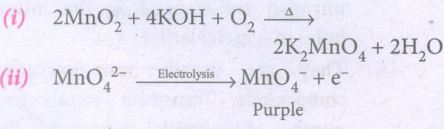
increases
decreases
increases and then decreases
resist the change in pH and so remains unaltered
10.
Among the following compounds strongest acid is _______.
HC≡CH
C6H6
C2H6
CH3OH
11.
An aqueous solution with pH value zero is _______.
acidic
basic
amphoteric
neutral
12.
The number of secondary alcoholic group in glycerol is _______.
1
2
3
0
13.
Predict the structure of propane-1,2 diol ______.
CH2 (OH) - CH2CH2OH
HOCH2 - CH2OH
CH3CH (OH) CH2OH
None of these
14.
The combination of the two layers of charges around the sol particle is called _______.
Brownian movement
Tyndall effect
Helmholtz double layer
None of these
15.
In case of physical adsorption, there is desorption when _______.
temperature increases
temperature decreases
pressure increases
concentration increases
16.
The reagent used to distinguish between acetaldehyde and benzaldehyde is _______.
Tollens reagent
Fehling’s solution
2,4 – dinitrophenyl hydrazine
semicarbazide
17.
Benzoic acid \(\overset { i){ NH }_{ 3 } }{ \underset { ii)\Delta }{ \longrightarrow } } A\overset { NaOBr }{ \longrightarrow } B\overset { NaN{ O }_{ 2 }/HCl }{ \longrightarrow } \) C 'C' is ______.
anilinium chloride
O – nitro aniline
benzene diazonium chloride
m– nitro benzoic acid
18.
Which of the following compound can be used as antifreeze in automobile rediators?
methanol
ethanol
Neopentyl alcohol
ethan -1, 2-diol
19.
Match the following
| a | Pure nitrogen | i | Chlorine |
| b | Haber process | ii | Sulphuric acid |
| c | Contact process | iii | Ammonia |
| d | Deacons Process | iv | Sodium azide (or) Barium azide |
Which of the following is the correct option?
| A | B | C | D |
| i | ii | iii | iv |
| A | B | C | D |
| ii | iv | i | iii |
| A | B | C | D |
| iii | iv | ii | i |
| A | B | C | D |
| iv | iii | ii | i |
20.
Adsorption of a gas on solid metal surface is spontaneous and exothermic, then ______.
ΔH increases
ΔS increases
ΔG increases
ΔS decreases
21.
How many faradays of electricity are required for the following reaction to occur MnO4-→ Mn2+
5F
3F
1F
7F
22.
The molar conductivity of a 0.5 mol dm-3 solution of AgNO3 with electrolytic conductivity of 5.76 ×10⁻³ S cm−1at 298 K is______.
2.88 S cm2mol-1
11.52 S cm2mol-1
0.086 S cm2mol-1
28.8 S cm2mol -1
23.
Using Gibb’s free energy change, ∆Go=57.34 kJ mol-1, for the reaction, X2Y(s)⇌2X++Y2- (aq), calculate the solubility product of X2Y in water at 300 K_______. (R = 8.3 J K-1Mol-1)
10-10
10-12
10-14
can not be calculated from the given dat
24.
pH of a saturated solution of Ca(OH)2 is 9. The Solubility product (Ksp) of Ca(OH)2 _______.
0.5 × 10⁻¹⁵
0.25 × 10⁻¹⁰
0.125 × 10⁻¹⁵
0.5 × 10⁻¹⁰
25.
Activation energy is equal to _______.
Threshold energy + Energy of colliding molecules
Threshold energy
Threshold energy x Energy of colliding molecules
Threshold energy - Energy of colliding molecules
26.
During a chemical reaction, the concentration of reaction _____.
increases
decreases
remains constant
first increases and then decreases
27.
How much time will be taken for 20 gm to reduce 5 g? [R = 2 x 10⁻³s-1 (I order reaction)]
693.1 s
693.1 s-1
6.931 s
6.931 s-1
28.
Orthophosphorus acid on heating gives______.
Hypophosphorous
Orthophosphoric acid
Phosphine gas
both (b) and (c)
29.
Oxalic acid on heating with cone H2SO4 gives ______.
CO only
CO2 only
CO2 + H2O
CO + CO2 + H2O
30.
Which is dibasic?
Orthophosphoric acid
Pyrophosphoric acid
Orthophosphorus acid
Hypophosphorous acid
31.
Structure of B2O3 is _____.
trigonal planar
tetrahedral
octahedral
cubic
32.
The number of cesium ion per unit cell in CsCI crystal system is________.
4
8
6
1
33.
The mass of unit cell of Na2O is ______.
Twice the formula mass of Na2O
Four times the formula mass of Na2O
Six times the formula mass of Na2O
Thrice the formula mass of Na2O
34.
Group 14 elements have general electronic configuration _______.
ns2
ns2np4
ns2np6
ns2np2
35.
Aluminium is used for making alloys because of its _____
resistance to corrosion
poor conductivity
heaviness
all of these
36.
Graphite has _______.
2-d sheet structure
Vander waals force between successive layers of carbon sheets
Sp2 hybridised carbon linked with other three carbon atoms in hexagonal planar structure
all the above
37.
FeSO4 on heating gives _______.
SO2 and O2
SO2 and SO3
SO2
SO3
38.
Which of the following ions will exhibit colour in aqueous solutions?
SC3+(Z=21)
Ti3+(Z =22)
La3+(Z=57)
Lu3+(Z=71)
39.
Ce (Z=58) and Yb (Z=70) exhibits stable +4 and +2 oxidation states respectively. This is because_______.
Ce4+ and Yb2+acquire f7 configuration
Ce4+ and Yb2+ acquire f0 configuration
Ce4+ and Yb2+acquire f7 and f14 configuration
Ce4+and Yb2+ acquire f0 and f14 configuration
40.
Ignition mixture used in aluminothermic process is ________.
Cr + AI2O3
Mg + BaO2
AI + Cr2O3
Ba + MgO
41.
Identify the halide ore among the following
Epsom Salt
Pyrolusite
Anglesite
Rock Salt
42.
Name the process by which elements such as germanium, silicon and gallium are refined.
Vapour phase method
Electrolytic refining
Zone refining
Van-Arkel method
43.
The structure of hexaaquatitanium (III) ion is _______.
[Ti(H2O)6]3+
[Ti(H2O)6]3-
[Ti(H2O)5]H2O
[Ti(H2O)6]
44.
According to IUPAC, No is _________.
nitro
nitrosyl
nitrate
nitrito
45.
Which of the following co-ordination compounds would exhibit optical isomerism?
Pemtaamminenitrocobalt (III) iodide
Diamminedichloropaltinum (II)
Tris-(ethylenediamine) cobalt (III) bromide
Transdicyanobis( ethylenediamine) chromium (III) chloride
46.
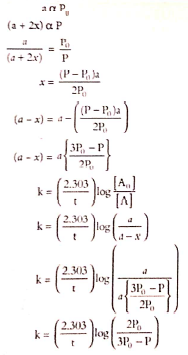
In a homogeneous reaction A⟶B+C+D, the initial pressure was P0 and after time t it was P expression for rate constant in terms of P0, P and t will be _____.
\(k=\left( \frac { 2.303 }{ t } \right) \log\left( \frac { 2{ P }_{ 0 } }{ { 3P }_{ 0 }-P } \right) \)
\(k=\left( \frac { 2.303 }{ t } \right) \log\left( \frac { { 2P }_{ 0 } }{ { P }_{ 0 }-P } \right) \)
\(k=\left( \frac { 2.303 }{ t } \right) \log\left( \frac { 3{ P }_{ 0 }-P }{ 2P_{ 0 } } \right) \)
\(k=\left( \frac { 2.303 }{ t } \right) \log\left( \frac { 2{ P }_{ 0 } }{ { 3P }_{ 0 }-2P } \right) \)
47.
Consider the following statements:
(i) increase in concentration of the reactant increases the rate of a zero order reaction.
(ii) rate constant k is equal to collision frequency A if Ea = 0
(iii) rate constant k is equal to collision frequency A if Ea = ∞
(iv) a plot of ln (k) vs T is a straight line.
(v) a plot of ln (k) vs \(\left( \frac { 1 }{ T } \right) \) is a straight line with a positive slope.
Correct statements are
(ii) only
(ii) and (iv)
(ii) and (v)
(i), (ii) and (v)
48.
If ‘a’ stands for the edge length of the cubic system sc, bcc, and fcc. Then the ratio of radii of spheres in these systems will be respectively ________.
\(\left( \frac { 1 }{ 2 } a;\frac { \sqrt { 3 } }{ 2 } a;\frac { \sqrt { 2 } }{ 2 } a \right) \)
\(\left( \sqrt { 1a } :\sqrt { 3a } :\sqrt { 2a } \right) \)
\(\left( \frac { 1 }{ 2 } a:\frac { \sqrt { 3 } }{ 4 } a:\frac { 1 }{ 2\sqrt { 2 } } a \right) \)
\(\frac { 1 }{ 2 } a:\sqrt { 3 } a:\frac { 1 }{ \sqrt { 2 } } a\)
49.
Which of the following is paramagnetic in nature?
[Zn(NH3)4]2+
[Co(NH3)6]3+
[Ni(H2O)6]2+
[Ni(CN)4]2-
50.
A complex in which the oxidation number of the metal is zero is_______.
K4[Fe(CN)6]
[Fe(CN)3(NH3)3]
[Fe(CO)5]
both (b) and (c)
51.
Which of the following compounds is colourless?
Fe3+
Ti4+
Co2+
Ni2+
52.
Among the transition metals of 3d series, the one that has highest negative \(\left( \frac { M^{ 2+ } }{ M } \right) \) standard electrode potential is _______.
Ti
Cu
Mn
Zn
53.
On oxidation with iodine, sulphite ion is transformed to _______.
S4O62-
S2O62-
SO42-
SO32-
54.
P4O6 reacts with cold water to give _______.
H3PO3
H4P2O7
HPO3
H3PO4
55.
Oxidation state of carbon in its hydrides _______.
+4
-4
+3
+2
56.
57.
Which of the following is not true with respect to Ellingham diagram?
Free energy changes follow a straight line. Deviation occurs when there is a phase change.
The graph for the formation of CO2 is a straight line almost parallel to free energy axis.
Negative slope of CO shows that it becomes more stable with increase in temperature.
Positive slope of metal oxides shows that their stabilities decrease with increase in temperature.
58.
Considering Ellingham diagram, which of the following metals can be used to reduce alumina?
Fe
Cu
Mg
Zn
59.
What is acidity constant? How is it expressed.
60.
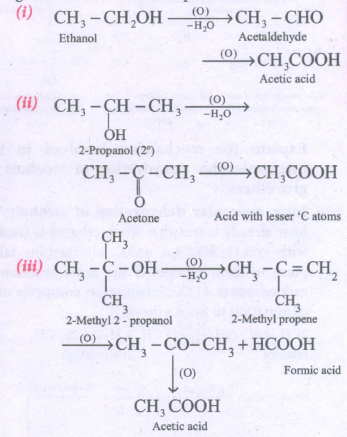
How do primary, secondary and tertiary alcohols differ in terms of their oxidation?
61.
Name various techniques by which a colloid can be deemulsified.
62.
Write the cell representation of the galvanic cell in which the following reaction take place
\({ Zn }_{ (s) }+Cu{ SO }_{ 4 }\rightarrow { ZnSO }_{ 4 }+{ Cu }_{ (s) }\)
For the above cell. Identify the anode and cathode half cell.
63.
What do you mean by buffer action?
64.
Write the mechanism of acid catalysed dehydration of ethanol to give ethene.
65.
State Faraday’s Laws of electrolysis
66.
Describe the electrolysis of molten NaCl using inert electrodes
67.
Calculate the pH of 0.04 M HNO3 Solution.
68.
What is the effect of temperature on the rate constant of a reaction? How can this temperature effect on rate constant be represented quantitatively?
69.
Write chemical equations for the reactions involved in the manufacture of potassium permanganate from pyrolusite ore.
70.
Explain the commercial method of preparation of nitric acid.
71.
State Bragg's law.
72.
What happens to boranes at high temperatures?
73.
How oxides of metals are reduced by hydrogen?
74.
Aqueous copper sulphate solution (blue) gives
(i) a green precipitate with aqueous potassium fluoride.
(ii) a bright green solution with aqueous potassium chloride. Explain these experimental results.
75.
The rate law for a reaction of A, B and C has been found to be rate = k[A]2[B][L]3/2 How would the rate of reaction change when
(i) Concentration of [L] is quadrupled
(ii) Concentration of both [A] and [B] are doubled
(iii) Concentration of [A] is halved
(iv) Concentration of [A] is reduced to \(\left(\frac{1}{3}\right)\) and concentration of [L] is quadrupled.
76.
Explain the rate determining step with an example.
77.
What are transition metals? Give four examples.
78.
79.
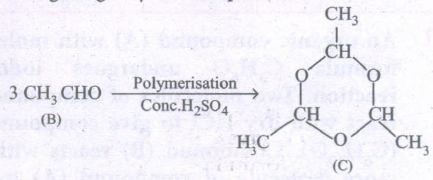
An organic compound (A) C2H3OCI on treatment with Pd and BaSO4 gives (B) C2H4O which answers iodoform test. (B) when treated with cone.H2SO4 undergoes polymerisation to give (C) a cyclic compound. Identify (A), (B) and (C) and explain the reactions.
80.
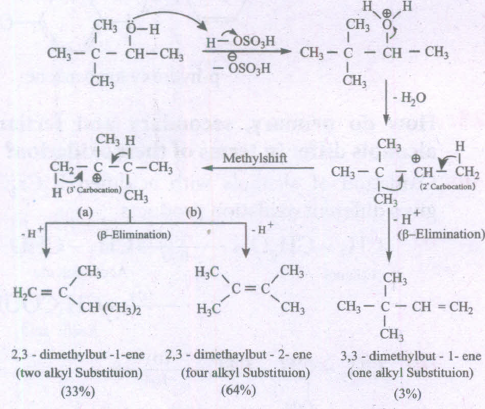
What is major product formed when 3,3-dimethyl-2-butanol is heated in the presence of H2SO4.
81.
Write any five applications of colloids in day - to day life.
82.
The emf values of the cell reactions Fe3++ e- ⇾ Fe2+ and Ce2+ ⇾ Ce3+ e- are 0.61 V and -0.85 V respectively. Construct the cell such that the free energy of the cell is negative. Calculate the emf of the cell.
83.
Calculate the pH of 0.02 MHCl.
84.
What are enzymes? Write a brief note on the mechanism of enzyme catalysis.
85.
The conductivity of a 0.01M solution of a 1 :1 weak electrolyte at 298K is 1.5\(\times\)10-4 S cm−1.
i) molar conductivity of the solution
ii) degree of dissociation and the dissociation constant of the weak electrolyte
Given that
\(\lambda^{0}_{cation}=248.2 \ S\) cm2 mol-1
\(\lambda^{0}_{anlon}=51.8 \ S\) cm2 mol-1
86.
A first order reaction completes 25% of the reaction in 100 mins. What are the rate constant and half life values of the reaction?
87.
Justify the following statement.
"Elements of the first transition series possess many properties different from those of heavier transition elements".
88.
Explain the oxidising property of sulphuric acid.
89.
An element with molar mass 2.7 x 10⁻² kg mol forms a cubic unit cell with edge length 405 pm. If its density is 2.7 x 10³ kg m-3, What is the nature of the cubic unit cell?
90.
How are silicates classified? Give an example for each type of silicate.
91.
List the applications of iron.
92.
What are the postulates of valance bond theory? Give its limitations.
93.
Using the Ellingham diagram,
(A) Predict the conditions under which
(i) Aluminium might be expected to reduce magnesia.
(ii) Magnesium could reduce alumina.
(B) it is possible to reduce Fe2O3 by coke at a temperature around 1200K
94.
Give any three uses of benzoic acid.
95.
Write short note on Kolbe's electrolytic reaction.
96.
Adsorption of a gas on the surface of solid is generally accompanied by decrease in entropy. Still it is a spontaneous process. Explain.
97.
What are promoters? Give an example.
98.
Write the oxidation, reduction and overall redox reaction taking place in the Lithium ion battery.
99.
Explain the function of a salt bridge in an electrochemical cell.
100.
Which of the following does not give iodoform reaction?

101.
What happens when ethylene reacts with alkaline KMnO4 solution?
102.
Magnesium is not precipitated from a solution of its salt by a mixture of NH4OH and NH4Cl. Explain
103.
What are the two types of buffer? Give an example for each.
104.
Define pH.
105.
What are Lewis acids and bases? Give two example for each.
106.
A poster suggests the following life style on the part of families / individuals.
(i) Which environmental values are promoted through these life style?
(ii) Suggest one additional life style action for promotion of green chemistry.
(iii) Give reason for the bleaching action of KMnO4
107.
The reaction A + 2B ⟶ C obeys the rate equation. Rate = \(K{ \left[ A \right] }^{ \frac { 1 }{ 2 } }{ \left[ B \right] }^{ \frac { 3 }{ 2 } }\) What is the order of the reaction?
108.
Rate of chemical reaction is not uniform throughout. Justify you answer:
109.
Give reason for the following:
F2 is more reactive than CIF3 but CIF3 is more reactive than Cl2
110.
There is a huge difference between the melting and boiling points of oxygen and sulphur. Why?
111.
What is point defect in crystals?
112.
Why do solids have a definite volume?
113.
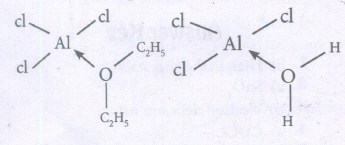
Which one is more soluble in diethyl ether, anhydrous Alcl3 or hydrated Alcl3? Explain in terms of bonding.
114.
Name the building block of zeolites. Why zeolites have high porosity?
115.
Arrange the following in increasing order of acidic character?
CrO3, CrO, Cr2O3
116.
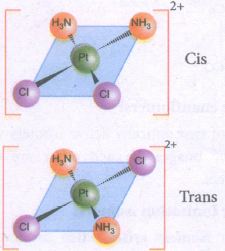
Draw the Cis and trans isomer of MA2B2 type
117.
What are stereoisomers?
118.
Why is the froth flotation method selected for the concentration of sulphide ores?
119.
Name the two steps involved in the extraction of crude metal
120.
A gas phase reaction has energy of activation 200 kJ mol-1. If the frequency factor of the reaction is 1.6 x 10¹³s-1. Calculate the rate constant at 600 K.(e-40.09 = 3.8 x 10-48)
121.
What are interstitial compounds?
122.
Explain the oxidation states of 4d series elements.
123.
Classify the following ligands based on the number of donor atoms.
a) NH3
b) en
c) ox2-
d) pyridine
124.
Calculate the ratio of \(\frac { \left[ { Ag }^{ + } \right] }{ \left[ Ag\left( NH_{ 3 } \right) _{ 2 } \right] ^{ + } } \) in 0.2 M solution of NH3. If the stability constant for the complex \([Ag(NH_{ 3 })_{ 2 }]^{ + }\) is 1.7 x 10⁷
125.
Write the IUPAC names for the following complexes.
126.
127.
Explain why fluorine always exhibit an oxidation state of -1?
128.
What is inert pair effect?
129.
What is catenation ? describe briefly the catenation property of carbon.
130.
Write a short note on anomalous properties of the first element of p-block.
131.
Assertion: Phenol is more reactive than benzene towards electrophilic substitution reaction
Reason: In the case of phenol, the intermediate arenium ion is more stabilized by resonance
Codes:
a) if both assertion and reason are true and reason is the correct explanation of assertion.
b) if both assertion and reason are true but reason is not the correct explanation of assertion.
c) assertion is true but reason is false
d) both assertion and reason are false.
if both assertion and reason are true and reason is the correct explanation of assertion.
if both assertion and reason are true but reason is not the correct explanation of assertion.
assertion is true but reason is false
both assertion and reason are false.
132.
1.
(a)
soda lime
2.
(c)
redox
3.
(a)
Tollens reagent test
4.
(b)
Secondary alcohol
5.
(a)
14 ohm-1 cm2eq-1
6.
(c)
equivalent weight of the electrolyte
7.
(a)
As2O3
8.
(c)
1 x 10-14
9.
(b)
decreases
10.
(d)
CH3OH
11.
(a)
acidic
12.
(a)
1
13.
(c)
CH3CH (OH) CH2OH
14.
(c)
Helmholtz double layer
15.
(a)
temperature increases
16.
(b)
Fehling’s solution
17.

18.
(d)
ethan -1, 2-diol
19.
(d)
| A | B | C | D |
| iv | iii | ii | i |
20.
ΔS is -ve
21.
7MnO4- + 5e- → Mn2+ + 4H2O
5 moles of electrons i.e., 5F charge is required.
22.
Λ = k/W x 10−3 mol−1 dm3
\(=\frac{ 5.76 \times 10^{−3} S cm^{−1} \times 10^{−3}}{0.5} = mol^{-1} dm^{3}\)
\(=\frac{ 5.76 \times 10^{−3} S cm^{−1} \times 10^{−3}}{0.5}\) S cm-1 mol−1 dm3
= 11.52 S cm2mol-1
23.
(a)
10-10
24.
Ca(OH)2 ⇌ Ca2+ + 2OH-
Given that pH = 9
pOH = 14 - 9 = 5
[pOH = - log10 [OH]]
[OH-] = 10 [pOH]
[OH] = 10-5 M
Ksp = [Ca2+] [OH-]
= 10-5/2 x (10-5)2 = 0.5 x 10⁻¹⁵
25.
(a)
Threshold energy + Energy of colliding molecules
26.
(b)
decreases
27.
(a)
693.1 s
28.
(d)
both (b) and (c)
29.
(d)
CO + CO2 + H2O
30.
(c)
Orthophosphorus acid
31.
(a)
trigonal planar
32.
(d)
1
33.
(b)
Four times the formula mass of Na2O
34.
(d)
ns2np2
35.
(a)
resistance to corrosion
36.
(d)
all the above
37.
(b)
SO2 and SO3
38.
(b)
Ti3+(Z =22)
39.
(d)
Ce4+and Yb2+ acquire f0 and f14 configuration
40.
(b)
Mg + BaO2
41.
(d)
Rock Salt
42.
(c)
Zone refining
43.
(a)
[Ti(H2O)6]3+
44.
(b)
nitrosyl
45.
(c)
Tris-(ethylenediamine) cobalt (III) bromide
46.
| A | ⟶ | B | C | D | |
| Initial rate (M s-1) | a | 0 | 0 | 0 | |
| Reaction number | x | - | - | - | - |
| After time t | (a - x) | x | x | x | |
| Total number of moles | = (a + 2x) |
47.
(rate constant K is equal to collision frequency A if Ea = 0)
In zero order reactions, increase in the concentration of reactant does not alter the rate.
So statement (i) is wrong.
\(k=A{ e }^{ -\left( \frac { { E }_{ a } }{ RT } \right) }\)
if Ea = 0 so, statement (ii) is correct, and statement (iii) is wrong
k = Ae0
k = A
In k = In A - \({ \left( \frac { { E }_{ a } }{ R } \right) }\) \(\left( \frac { 1 }{ T } \right) \)
This equation is of the form of a straight line y = mx+c
A plot of In k Vs \(\left( \frac { 1 }{ T } \right) \) gives a straight line with a negative slope
So statement (iv) and (v) are wrong.
48.
sc ⇒ 2r = a
⇒ r = a/2
bcc ⇒ 4r = \( \sqrt{3a} \) ⇒ r = \(\frac { \sqrt{3a}} {4}\)
fcc ⇒ 4r ⇒ \( \sqrt{2a} \) ⇒ r = \(\frac { \sqrt{2a}} {4} = \frac { a} {2\sqrt{2a}}\)
\(\left( \frac { a }{ 2 } :\frac { \sqrt { 3 } }{ 4 } a:\frac { a }{ 2\sqrt { 2 } } \right) \)
49.
a) Zn2+ (d10 ⇒ diamagnetic)
b) Co3+ (d6 Low spain ⇒ t2g6 e0g ; diamagnetic)
c) Ni2+ (d8 Low spain ⇒ t2g6 e2g ; paramagnetic)
d) [Ni(CN)4]2+ (dsp2 ; square planar, diamagnetic)
50.
a) Fe2+ b) Fe3+ c) Fe0
51.
(b)
Ti4+
52.
(a)
Ti
53.
(c)
SO42-
54.
(a)
H3PO3
55.
(a)
+4
56.
(d)
57.
(b)
The graph for the formation of CO2 is a straight line almost parallel to free energy axis.
58.
(c)
Mg
59.
(i) The dissociation constant is generally called acidity constant because it measures the relative strength of an acid. The stronger the acid, the large will be its Ka value.
(ii) The strength of carboxylic acid can be expressed in terms of the dissociation constant(K):
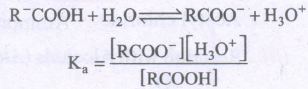
(iii) The dissociation constant of an acid can also be expressed in terms of pKa value
pKa = -log ka,
60.
Oxidation of alcohols with acidified K2Cr2O2 gives different oxidation products.
61.
Various demulsification techniques are given below:
(i) Distilling of one component.
(ii) Adding an electrolyte to destroy the charge.
(iii) Destroying the emulsifier using chemical methods.
(iv) Using solvent extraction to remove one component.
(v) By freezing one of the components.
(vi) By applying centrifugal force.
(vii) Adding dehydrating agents for water in oil.
(viii) Type.
(viii) Using ultrasonic waves.
(ix) Heating at high pressures.
62.
The galvanic cell is represented as
\({ Zn }_{ (s) }|{ Zn }_{ (aq) }^{ 2+ }||{ Cu }_{ (aq) }^{ 2+ }|{ Cu }_{ (s) }\)
The anode half cell is \({ Zn }_{ (s) }|{ Zn }_{ (aq) }^{ 2+ }\)
The cathode half cell is \({ C }u_{ (Aq) }^{ 2+ }|{ Cu }_{ (s) }\)
63.
(i) To resist changes in its pH on the addition of an acid (or) a base, the buffer solution should contain both acidic as well as basic components so as to neutralize the effect of added acid (or) base and at the same time, these components should not consume each other.
(ii) Let us explain the buffer action in a solution containing CH3COOH and CH3COONa.
(iii) The dissociation of the buffer components occurs as below.
\(\mathrm{CH}_{3} \mathrm{COOH}_{(\mathrm{aq})} \rightleftharpoons \mathrm{CH}_{3}-\mathrm{COO}_{(\mathrm{aq})}^{-}+\mathrm{H}_{3} \mathrm{O}_{(\mathrm{aq})}^{+} \)
\(\mathrm{CH}_{3} \mathrm{COONa}_{(\mathrm{s})} \stackrel{\mathrm{H}_{2} \mathrm{O}_{(\mathrm{l})}}{\longrightarrow} \mathrm{CH}_{3}-\mathrm{COO}_{(\mathrm{aq})}^{-}+\mathrm{Ha}_{(\mathrm{aq})}^{+}\)
64.
\({ CH }_{ 3 }-{ CH }_{ 2 }-OH\overset { { H }_{ 2 }{ SO }_{ 4 } }{ \underset { 443k }{ \longrightarrow } } { CH }_{ 2 }={ CH }_{ 2 }+{ H }_{ 2 }O\)
Mechanism
Primary alcohols undergo dehydration by E2 mechanism

65.
First law:
The mass of the substance (m) liberated at an electrode during electrolysis is directly proportional to the quantity of charge (Q) passed through the cell.
m α Q \(\left[\because \mathrm{I}=\frac{\mathrm{Q}}{\mathrm{t}} \Rightarrow \mathrm{Q}=\mathrm{It}\right]\)
m α It
m = ZIt
Where Z = electro chemical equivalent of the substance
I = current
t = time of passage of current
Second law:
When the same quantity of charge is passed through the solutions of different electrolytes, the amount of substances liberated at the respective electrodes are directly proportional to their electrochemical equivalents.
m α Z
\(\frac{m_{1}}{Z_{1}}=\frac{m_{2}}{Z_{2}}\)
m = mass of the metal deposited
Z = electro chemical equivalent
66.
(i) The electrolytic cell consists of two iron electrodes dipped in molten sodium chloride and they are connected to an external DC power supply via a key as shown in the figure. The electrode which is attached to the negative end of the power supply is called the cathode, and the one which attached to the positive end is called the anode. Once the key is closed, the external DC power supply drives the electrons to the cathode and at the same time pull the electrons from the anode.
Cell reactions:
Na+ ions are attracted towards cathode, where they combines with the electrons and reduced to liquid sodium.
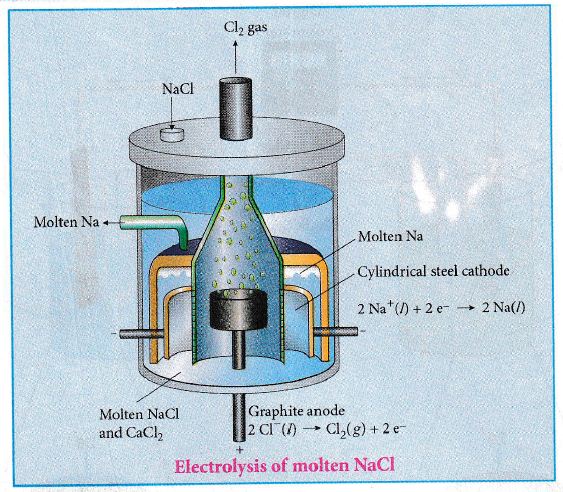
Cathode (reduction)
\(N a_{(l)}^{+}+e^{-} \rightarrow N a_{(l)} \quad ; \quad E^{0}=-2.71 V\)
Similarly, Cl- ions are attracted towards anode where they lose their electrons and oxidised to chlorine gas.
Anode (oxidation)
2CI-(l) ⟶ CI2(g) + 2e- E0 = -1.36V
The overall reaction is
2Na+(l) + 2Cl-(l)➝ 2Na(l) + Cl2(g) ; E° = - 4.07V
(ii) The negative E° value shows that the above reaction is a non-spontaneous one.
(iii) Hence, we have to supply a voltage greater than 4.07V to cause the electrolysis of molten NaCI.
(iv) In electrolytic cell, oxidation occurs at the anode and reduction occur at the cathode as in a galvanic cell.
(v) But the sign of the electrodes is the reverse i.e., in the electrolytic cell cathode is -ve and anode is +ve.
67.
\(\text { Normality }=\text { Molarity } \times \text { Basicity } \)
\(=0.04 \times 1 \)
\({\left[\mathrm{H}_{3} \mathrm{O}\right]^{+}=0.04=4 \times 10^{-2} } \)
\(\mathrm{pH} =-\log _{10}\left[\mathrm{H}_{3} \mathrm{O}^{+}\right] \)
\(=-\log \left[4 \times 10^{-2}\right] \) log10 10 =1
\(=-\left[\log _{10} 4+\log _{10} 10^{-2}\right] \)
\(=-\left[\log _{10} 4-2 \log _{10} 10\right]=2-\log _{10} 4 \)
= 2 - 0.6021
= 1.3979 \(\simeq\) 1.40
68.
(i) The rate constant is nearly doubled with a rise in temperature by 10oC for a chemical reaction.
(ii) The temperature effect on the rate constant can be represented quantitatively by Arrhenius equation.
\(k=A{ e }^{ \frac { -{ E }_{ a } }{ RT } }\)
69.
70.
Commercial method of preparation
(i) Nitric acid prepared in large scales using Ostwald's process. In this method ammonia from Haber's process is mixed about 10 times, of air.
(ii) This mixture is preheated and passed into the catalyst chamber where they come in contact with platinum gauze.
(iii) The temperature rises to about 1275 K and the metallic gauze brings about the rapid catalytic oxidation of ammonia resulting in the formation of NO, which then oxidised to nitrogen dioxide.
\({ 4NH }_{ 3 }+{ 5O }_{ 2 }\longrightarrow 4NO+6{ H }_{ 2 }O+120KJ\)
\(2NO+{ O }_{ 2 }\longrightarrow { 2NO }_{ 2 }\)
(iv) The nitrogen dioxide produced is passed through a series of adsorption towers. It reacts with water to give nitric acid. Nitric acid formed is bleached by blowing air.
\({ 6NO }_{ 2 }+3{ H }_{ 2 }O\longrightarrow { 4HNO }_{ 3 }+2NO+{ H }_{ 2 }O\)
71.
The fundamental equation that gives a simple relation between the wavelength of the X-rays, the interplanar distance in the crystal and the angle of reflection is known as Bragg's equation.
nλ = 2dsinθ
Where n is the order of reflection
λ is the wavelength of X-rays
d is the interplanar distance in the crystal
θ is the angle of reflection
72.
At high temperatures it forms higher boranes liberating hydrogen.
\(5{ B }_{ 2 }{ H }_{ 6 }\overset { 388K }{ \underset { U-tube }{ \longrightarrow } } 2{ B }_{ 5 }{ H }_{ 11 }+4{ H }_{ 2 }\)
\(2{ B }_{ 2 }{ H }_{ 6 }\overset { 198-373K }{ \longrightarrow } { B }_{ 4 }{ H }_{ 10 }+{ H }_{ 2 }\)
\(5{ B }_{ 2 }{ H }_{ 6 }\overset { 373K }{ \underset { sealed\ tube }{ \longrightarrow } } { B }_{ 10 }{ H }_{ 14 }+8{ H }_{ 2 }\)
\(5{ B }_{ 2 }{ H }_{ 6 }\overset { 473-523K }{ \longrightarrow } 2{ B }_{ 5 }{ H }_{ 9 }+6{ H }_{ 2 }\)
\(10{ B }_{ 2 }{ H }_{ 6 }\overset { 523K }{ \longrightarrow } 2{ B }_{ 5 }{ H }_{ 9 }+2{ B }_{ 5 }{ H }_{ 10 }+11{ H }_{ 2 }\)
\({ B }_{ 2 }{ H }_{ 6 }\overset { Red \ hot }{ \longrightarrow } 2B+3{ H }_{ 2 }\).
73.
(i) This method can be applied to the oxides of the metals (Fe, Pb, Cu) having less electropositive character than hydrogen
\(\mathrm{Ag}_{2} \mathrm{O}_{(s)}+\mathrm{H}_{2(g)} \longrightarrow 2 \mathrm{Ag}_{(s)}+\mathrm{H}_{2} \mathrm{O}_{(l)}\)
(ii) Nickel oxide can be reduced to nickel by using a mixture of hydrogen and carbon monoxide (water gas)
(iii) \({ 2NiO }_{ (s) }+{ CO }_{ (g) }+{ H }_{ 2(g) }\longrightarrow 2{ Ni }_{ (s) }+{ CO }_{ 2(g) }+{ H }_{ 2 }{ O }_{ (l) }\)
74.
Aqueous copper sulphate (blue) is [Cu(H2O)4] SO4.
[Cu(H2O)4]SO4 ⟶ [Cu(H2O)4]2+ + SO42-
[Cu(H2O4)]2+ is a liable complex in which H2O ligand get easily replaced by F- ions of KF and by Cl- ions of KCI.
(i) [Cu(H2O)4]2+(aq) + 4F- ⟶ \(\underset { Green \ ppt }{ { \left[ Cu{ F }_{ 4 } \right] }^{ 2- } } +4{ H }_{ 2 }O\)
(ii) [Cu(H2O)4]2+(aq) +4Cl-(aq) ⟶ \(\underset { Bright \ green\ ppt }{ { \left[ Cu{ F }_{ 4 } \right] }^{ 2- } } +4{ H }_{ 2 }O\)
75.
(i) Reaction Rate = \(k{ \left[ A \right] }^{ 2 }{ \left[ B \right] }{ \left[ L \right] }^{ 3/2 }\) ...(1)
When [L] = [4L]
Rate = \(k{ \left[ A \right] }^{ 2 }{ \left[ B \right] }{ \left[ 4L \right] }^{ 3/2 }\)
The Reaction Rate = \(8(k{ \left[ A \right] }^{ 2 }{ \left[ B \right] }{ \left[ L \right] }^{ 3/2 })\) ...(2)
Comparing (1) and (2) rate is increased by 8 times
(ii) [A] = [2A] and [B] = [2B]
Reaction Rate = \(k{ \left[ 2A \right] }^{ 2 }\left[ 2B \right] { \left[ L \right] }^{ 3/2 }\)
Reaction Rate = \(\\ 8(k{ \left[ A \right] }^{ 2 }{ \left[ B \right] }{ \left[ L \right] }^{ 3/2 })\) ...(3)
Comparing (1) and (3) rate is increased by 8 times
(iii) \(\left[ A \right] =\left[ \frac { A }{ 2 } \right] \)
Reaction Rate = \(k{ \left[ \frac { A }{ 2 } \right] }^{ 2 }{ \left[ B \right] }{ \left[ L \right] }^{ 3/2 }\)
Reaction Rate = \(\frac { 1 }{ 4 } \left( k\left[ { A }^{ 2 } \right] { \left[ B \right] }{ \left[ L \right] }^{ 3/2 } \right) \) ...(4)
Comparing (1) and (4); rate is reduced to (1/4) times.
(iv) \(\left[ A \right] =\left[ \frac { 1 }{ 3 }A \right] and\left[ L \right] =\left[ 4L \right] \)
Rate = \(k{ \left[ \frac { 1 }{ 3 }A \right] }^{ 2 }{ \left[ B \right] }{ \left[ 4L \right] }^{ 3/2 }\)
Rate = \(\left( \frac { 8 }{ 9 } \right) \left( k{ \left[ A \right] }^{ 2 }{ \left[ B \right] }{ \left[ L \right] }^{ 3/2 } \right)\) ...(5)
Comparing (1) and (5); rate is reduced to \(\frac { 8 }{ 9 } \) times.
76.
(i) The step which has the lowest rate value among the other steps of the reaction is called as the rate determining step (or) rate limiting step: (or)
(ii) The overall rate of a reaction is controlled by the slowest step in a reaction called the rate determining step.
Example:
\(2 \mathrm{~A}+\mathrm{B} \rightarrow \mathrm{C}+\mathrm{D}\) going by two steps like,
\( \mathrm{A}+\mathrm{B} \stackrel{\mathrm{k}_{1}}{\longrightarrow} \mathrm{C}+\mathrm{Z}-(1) \text { Step }(\text { slow }) \)
\(Z+A \stackrel{k_{2}}{\longrightarrow} D-(2) \text { Step }(\text { fast }) \)
Over all reaction: \(2 \mathrm{~A}+\mathrm{B} \rightarrow \mathrm{C}+\mathrm{D}\)
Here \(A+B \underset{\text { Slow }}{\stackrel{K_{1}}{\longrightarrow}} C+Z\), step is the rate determining step. For the decomposition of hydrogen peroxide catalysed by I-.
2H2O2(aq)\(\rightarrow\) 2H2O(I) + O2(g)
It is experimentally found that the reaction is first order with respect to both H2,O2, and I-, which indicates that I- is also involved in the reaction. The mechanism involves the following steps.
Step: 1
H2O2(aq)+I-1(aq) \(\rightarrow\) H2O(l)+OI-1(aq)
Step: 2
H2O2(aq)+OI-1(aq)\(\rightarrow\) H2O + I-(aq) + O(g)
Overall reaction is
2H2O2(aq) \(\rightarrow\) 2H2O(l) + O2(g)
These two reactions are elementary reactions. Adding equation (1), and (2) gives the overall reaction. Step 1 is the rate determining step, since it involves both H2,O2 and I-, the overall reaction is bimolecular.
77.
IUPAC defines transition metal as an element whose atom has an incomplete d-sub shell or which can give rise to cations with an incomplete d-sub shell. They occupy the central position of the periodic table, between s and p-block elements.
Examples: Fe, Cu, Ag, Au
78.
79.
(i) Compound (A) must be acetyl chloride which undergoes Rosenmund's reduction giving acetaldehyde.
\(\underset { (A) }{ { CH }_{ 3 }COCl } \overset { Pd/BaS{ O }_{ 4 } }{ \longrightarrow } \underset { (B) }{ { CH }_{ 3 }CHO } \)
(B) undergoes iodoform reaction
\(\underset { (B) }{ { CH }_{ 3 }COH } \overset { { I }_{ 2 }/NaOH }{ \longrightarrow } \underset { Iodoform }{ { CHI }_{ 3 } } +HCOONa\)
(ii) Acetaldehyde (B) undergoes polymerisation giving a cyclic compound.
| Compound | Compound name | Formula |
| A | Acetyl chloride | CH3COCI |
| B | Acetaldehyde | CH3CHO |
| C | Paraldehyde | 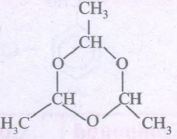 |
80.
Saytzeff's rule: During intramolecular dehydration, if there is a possibility to form a carbon-carbon double bond at different locations, the preferred location is the one that gives the more (highly) substituted alkene l.e., the stable alkene.
For example, the dehydration of 3,3 - dimethyl - 2- butanol gives a mixture of alkenes. The secondary carbocation formed in this reaction undergoes rearrangement to form a more stable tertiary carbocation.
81.
Food:
Food stuffs like milk cream, butter, etc are present in colloidal form.
Medicines:
Antibodies such as penicillin and streptomycin are produced in colloidal form for suitable injections. Colloidal gold and colloidal calcium are used as tonics. Milk of magnesia is used for stomach troubles. Silver sol protected by gelatine known as Argyrol is used as eye lotion.
In Industry:
Colloids find many applications in industries
(i) Water purification:
Purification of drinking water is activated by coagulation of suspended impurities in water using alums containing Al3+.
(ii) In washing:
The cleansing action of soap is due to the formation of emulsion of soap molecules with dirt and grease.
(iii) Tanning of leather:
Skin and hides are protein containing positively charged particles which are coagulated by adding tannin to give hardened leather for further application. Chromium salts are used for the purpose. Chrome tanning can produce soft and polishable leather.
(iv) Rubber industry:
Latex is the emulsion of natural rubber with negative particles. By heating rubber with sulphur, vulcanized rubbers are produced for tyres, tubes, etc.
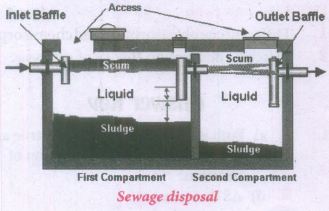
(v) Sewage disposal:
Sewage contains dirt, mud and wastes dispersed in water. The passage of electric current deposits the wastes materials which can be used as a manure.
(vi) Cortrell's precipitator:
Carbon dust in air is solidified by Cottrell's precipitator. In it, a high potential difference of about 50,000V is used. The charge on carbon is neutralized and solidified. Thus the air is free from carbon particles.
(vii) The blue colour of the sky in nature is due to Tyndall effect of air particles.
(viii) Formation of delta:
The electrolyte in sea and river water coagulates the solid particles in river water at their intersection. So, the earth becomes a fertile land.
(ix) Analytical application:
Qualitative and quantitative analysis are based on the various properties of colloids.
82.
Given:
EoFe3+/Fe2+ = 0.61V
EoCe3+ / Ce2+ = 0.85 V (after reversing)
Solution:
Eo = ER - EL
= 0.85 - 0.61 = 0.24 V
Cell is,
Fe3+ I Fe2+ II Ce3+ I Ce2+
Left Right
Eocell = 0.24 V
ΔGo = - nFEo
ΔGo = - (1 x 96495 x 0.24)
= -ve value
83.
(HCI strong acid fully ionised)
\(pH=\log\frac { 1 }{ { H }^{ + } } =\log\frac { 1 }{0 .01 } \)
\(=\log\frac { 100 }{ 2 } =1.6990\)
84.
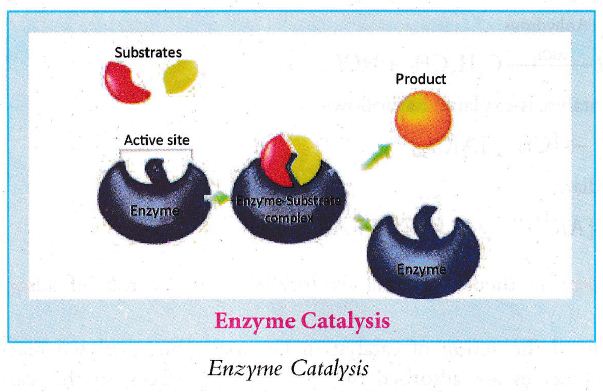
(i) Enzymes are complex protein molecules with three dimensional structures. They catalyse the chemical reaction in living organism. They are often present in colloidal state and extremely specific in catalytic action. Each enzyme produced in a particular living cell can catalyse a particular reaction in the cell.
Some common examples for enzyme catalysis:
(ii) The peptide glycyl L-glutamyl L-tyrosin is hydrolysed by an enzyme called pepsin.
(iii) The enzyme diastase hydrolyses starch into maltose
\(2\left(\mathrm{C}_{6} \mathrm{H}_{10} \mathrm{O}_{5}\right)_{\mathrm{n}}+\mathrm{nH}_{2} \mathrm{O} \rightarrow \mathrm{nC}_{12} \mathrm{H}_{22} \mathrm{O}_{11}\)
(iv) The yeast contains the enzyme zymase which converts glucose into ethanol.
\(\mathrm{C}_{6} \mathrm{H}_{12} \mathrm{O}_{6} \rightarrow 2 \mathrm{C}_{2} \mathrm{H}_{5} \mathrm{OH}+2 \mathrm{CO}_{2}\)
(v) The enzyme micoderma aceti oxidises alcohol into acetic acid.
\(\mathrm{C}_{2} \mathrm{H}_{5} \mathrm{OH}+\mathrm{O}_{2} \rightarrow \mathrm{CH}_{3} \mathrm{COOH}+\mathrm{H}_{2} \mathrm{O}\)
(vi) The enzyme urease present in soya beens hydrolyses the urea.
\(\mathrm{NH}_{2}-\mathrm{CO}-\mathrm{NH}_{2}+\mathrm{H}_{2} \mathrm{O} \rightarrow 2 \mathrm{NH}_{3}+\mathrm{CO}_{2}\)
Mechanism of enzyme catalysed reaction
(vii) The following mechanism is proposed for the enzyme catalysis
\(\mathrm{E}+\mathrm{S} \rightleftharpoons \mathrm{ES} \rightarrow \mathrm{P}+\mathrm{E}\).
(viii) Where E is the enzyme, S the substrate (reactant), ES represents activated complex and P the products.
85.
i) Molar conductivity
Given : C = 0.01 M;
\(\kappa=1.5 \times 10^{-4} \mathrm{~S} \mathrm{~cm}^{-1} \)
\(=1.5 \times 10^{-2} \mathrm{~S} \mathrm{~m}^{-1} \)
\(\lambda_{\text {cation }}^{0}=248.2 \mathrm{~S} \mathrm{~cm}^{2} \mathrm{~mol}^{-1} \)
\(\lambda_{\text {anion }}^{0}=51.8 \mathrm{~S} \mathrm{~cm}^{2} \mathrm{~mol}^{-1} \)
\(\Lambda_{m}^{0}=\frac{\kappa \times 10^{-3}}{C} \mathrm{~S} \mathrm{~m}^{2} \mathrm{~mol}^{-1} \)
\(=\frac{1.5 \times 10^{-2} \times 10^{-3}}{0.01} \)
\(=1.5 \times 10^{-3} \mathrm{~S} \mathrm{~m}^{2} \mathrm{~mol}^{-1}\)
ii) \(\alpha=\frac{\Lambda_{m}}{\Lambda_{m}^{0}}\)
\(\Lambda_{\mathrm{m}}^{0}=\lambda_{\text {cation }}^{0}+\lambda_{\text {anion }}^{0} \)
\(=(248.2+51.8) \mathrm{S} \mathrm{cm}^{2} \mathrm{~mol}^{-1} \)
\(=300 \mathrm{~S} \mathrm{~cm}^{2} \mathrm{~mol}^{-1}\)
\(=300 \times 10^{-4} \mathrm{Sm}^{2} \mathrm{~mol}^{-1} \)
\(\alpha =\frac{1.5 \times 10^{-3}}{300 \times 10^{-4}}=0.05\)
iii) \(\mathrm{K}_{\mathrm{a}} =\frac{\alpha^{2} \mathrm{C}}{1-\alpha} \)
\(\mathrm{K}_{\mathrm{a}} =\frac{(0.05)^{2} \times(0.01)}{1-0.05}=2.6 \times 10^{-5} \)
(or)
\(\mathrm{K}_{\mathrm{a}} =\alpha^{2} \mathrm{C} \)
\(=(0.05)^{2} \times(0.01) \)
\(\mathrm{K}_{\mathrm{a}} =2.5 \times 10^{-5}\)
86.
Given data: Time taken for 25% completion of the reaction = 100 mins
a = 100; x = 25 and a - x = 75; t = 100min
Formula: \(k=\frac { 2.303 }{ t } \log { \frac { a }{ a-x } } ;{ t }_{ \frac { 1 }{ 2 } }=\frac { 0.693 }{ k } \)
Solution:
\(k=\frac { 2.303 }{ 100 } \log\frac { 100 }{ 100-25 } \)
\(=\frac { 2.303 }{ 100 } \log\frac { 100 }{ 75 } =\frac { 2.303 }{ 100 } \log\frac { 4 }{ 3 } \)
\(=\frac { 2.303 }{ 100 } \times 0.1249\)
Rate constant(k) = 2.8773 x 10⁻³ min-1
\({ t }_{ \frac { 1 }{ 2 } }=\frac { 0.693 }{ k } =\frac { 0.693 }{ 2.8773\times { 10 }^{ -3 }{ ,min }^{ -1 } } \)
\(=\frac { 693 }{ 2.8773 } =240.85\)
Half-life period (t1/2) = 240.85 minutes
87.
The heavier transition elements belong to fourth (4d), fifth (Sd) and sixth (6d) transition series. Their properties are expected to be different form the elements belonging to the first (3d) series due to the following reasons.
(i) Atomic radii: Size of the transition elements 94d and Sd series are larger than those of the corresponding elements of the first transition series though those of 4d and Sd series are very close to each other.
(ii) Ionisation enthalpy of Sd series are higher than the corresponding elements of 3d and 4d series.
(iii) Atomisation enthalpy of 4d and Sd series are higher than the corresponding elements of the first series.
(iv) Melting and boiling points of heavier transition elements are greater than those of the first transition series due to stronger intermetallic bonding.
(v) The elements of the first transition series generally form low or high spin complexes, depending upon the higher of ligand field. However, the heavier transition elements form low spin complexes irrespective of the strength of the ligand filed.
88.
Oxidising property of H2SO4:
Sulphuric acid is an oxidising agent as it produces nascent oxygen as shown below.
\({ H }_{ 2 }{ SO }_{ 4 }\longrightarrow { H }_{ 2 }O+\underset { nascentoxygen }{ { SO }_{ 2 } } +\left( O \right) \)
Sulphuric acid oxidises elements such as carbon, sulphur and phosphorus. It also oxides bromide and iodide to bromine and iodine respectively.
C + 2H2SO4 \(\longrightarrow \) 2SO2 + 2H2O + CO2
S + 2H2SO4 \(\longrightarrow \) 3SO2 + 2H2O
P4 + 10H2SO4 \(\longrightarrow \) 4H3PO4 + 10SO2 + 4H2O
H2S + H2SO4 \(\longrightarrow \) SO2 + 2H2O + S
H2SO4 + 2HI \(\longrightarrow \) SO2 + H2O + I2
H2SO4 + 2HBr \(\longrightarrow \) 2SO2 + 2H2O + Br2
89.
Density of the element, d = 2.7 x 10³ kg m-3
Molar mass, M = 2.7 x 10⁻² kg mol-1
Edge length, a = 405 pm
= 405 x 10-12 m
= 4.05 x 10⁻¹⁰ m
Avogadro's number, NA= 6.022 x 10²³ mol-1
\(\therefore d=\frac { Z\times M }{ { a }^{ 3 }\times { N }_{ A } } \)
\(\Rightarrow Z=\frac { d\times { a }^{ 3 }{ N }_{ A } }{ M } \)
\(=\frac { 2.7\times { 10 }^{ 3 }kg\quad { m }^{ -3 }{ (4.05\times { 10 }^{ -10 }m) }^{ 3 }\times 6.022\times { 10 }^{ 23 }{ mol }^{ -1 } }{ 2.7\times { 10 }^{ -2 }kg\quad { mol }^{ -1 } } \)
= 4.004 = 4.
This implies that four atoms of the element are present per unit cell. Hence the unit cell is face centred cubic.
90.
Silicates are classified into various types based on the way in which the tetrahedral units, [SiO4]4- are linked together.
(i) Ortho silicates (Neso silicates):
The simplest silicates which contain discrete [SiO4]4- tetrahedral units are called ortho silicates or nesosilicates.
Examples: Phenacite - Be2SiO4 (Be2+ ions are tetrahedrally surrounded by O2- ions)
(ii) pyro silicate (or) Soro silicates: Silicates:
Which contain [Si2O7]6- ions are called pyro silicates (or) Soro silicates.
Example: Thortveitite - Sc2Si2O7
(iii) Cyclic silicates (or Ring silicates):
Silicates which contain (SiO3)32n- ions which are formed by linking three or more tetrahedral SiO44- units cyclically are called cyclic silicates.
Example: Beryl [Be3Al2 (SiO3)6] (an aluminosilicate with each aluminium is surrounded by 6 oxygen atoms octahedrally)
(iv) Inosilicates: Silicates which contain 'n':
number of silicate units liked by sharing two or more oxygen atoms are called inosilicates.
Example: They are further classified as chain silicates and double chain silicates.
(v) Chain silicates (or pyroxenes):
These silicates contain [(SiO3)n]2n- ions formed: by linking 'n' number of tetrahedral [SiO4]4- units linearly. Each silicate unit shares two of its oxygen atoms with other units.
Example: Spodumene - LiAl(SiO3)2·
(vi) Double chain silicates (or amphiboles):
These silicates contains \(\left[ { Si }_{ 4 }{ O }_{ 11 } \right] _{ n }^{ 6n- }\) ions. In these silicates there are two different types of tetrahedra:
(a) Those sharing 3 vertices
(b) those sharing only 2 vertices.
Example:
Asbestos: These are fibrous and non-combustible silicates.
(vii) Sheet or phyllo silicates:
Silicates which contain \(({ Si }_{ 2 }{ O }_{ 5 })_{ n }^{ 2n- }\) are called sheet or phyllo silicates. In these, Each [SiO4]4- tetrahedron unit shares three oxygen atoms with others and thus by forming two dimensional sheets.
Example: Talc, Mica etc.
(viii) Three dimensional silicates (or tectosilicates):
Silicates in which all the oxygen atoms of [SiO4]4- tetrahedra are shared with other tetrahedra to form three dimensional network are called three dimensional or tectosilicates.
Example: Quartz.
91.
(i) Iron is one of the most useful metals and its alloys are used everywhere including bridges, electricity pylons, bicycle chains, cutting tools and rifle barrels.
(ii) Cast iron is used to make pipes, valves and pumps stoves etc.
(iii) Magnets can be made from iron and its alloys and compounds.
(iv) An important alloy of iron is stainless steel, and it is very resistant to corrosion. It is used in architecture, bearings, cutlery, surgical instruments and jewellery.
(v) Nickel steel is used for making cables, automobiles and aeroplane parts.
(vi) Chrome steels are used for manufacturing cutting tools and crushing machines.
92.
The postulates of valence bond theory
(i) The central metal atom/ion makes available a number of vacant orbitals equal to its coordination number.
(ii) These vacant orbitals form covalent bonds with the ligand orbitals.
(iii) A covalent bond is formed by the overlap of a vacant metal orbital and filled ligand orbitals. This complete overlap leads to the formation of a metal ligand, σ (sigma) bond.
(iv) A strong covalent bond is formed only when the orbitals overlap to the maximum extent.
(v) This maximum overlapping is possible only when the metal vacant orbitals undergo a process called 'hybridisation'.
(vi) A hybridised orbital has a better directional characteristic than an unhybridized one. The following table gives the coordination number, orbital hybridisation, and geometry of the complexes.
| Coordination number | Types of hybridisation | Geometry |
|---|---|---|
| 2 | sp | linear |
| 4 | sp3 | tetrahedral |
| 4 | dsp3 | square planer |
| 6 | d2sp3 | octahedral |
| 6 | sp3d2 | octahedral |
Magnetic moment
The paramagnetic moment is given by the following spin-only formula.
\({ \mu }_{ s }=\sqrt { n(n+2) } \) BM
BM = Bohr magneton
\({ \mu }_{ s }\) = spin -only magnetic moment
n = number of unpaired electrons.
93.
a) i) Ellingham diagram for the formation of Al2O3 and MgO intersects around 1500oC. Above this temp Mg lies above the Aluminium line. Hence only above 1500oC Aluminium might be excepted to reduce magnesia.
ii) Ellingham diagram for the formation of MgO lies below the formation of Al2O3. Hence MgO is more stable than Al2O3. Hence Magnesium could reduce Alumina.
1. Below 983K, formation of CO line lies below many of the metal oxide formation in Ellingham diagram, hence CO is more effective reducing agent than Carbon.
2. But above this temperature Carbon lies below other metal oxides.
b) Around 1200K Carbon lies below the formation of Fe2O3. Hence it is possible to reduce Fe2O3 by coke at 1200K.
94.
(i) Benzoic acid is used as an urinary antiseptic.
(ii) Sodium benzoate is used as food preservative.
(iii) Benzoic acid vapours are used to disinfect bronchial tube.
95.
The aqueous solutions of sodium or potassium salts of carboxylic acid on electrolysis gives alkanes at anode. This reaction is called kolbes electrolysis.
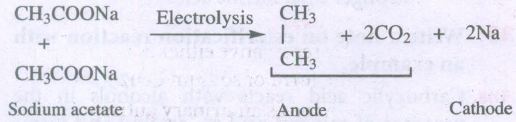
Sodium formate solution on electrolysis gives hydrogen
96.
Adsorption is an exothermic process, i.e.,energy factor favours the process. As ΔG = ΔH - TΔS, in adsorption, though ΔS is -ve but ΔH is also -ve and ΔH > TΔS in magnitude so that ΔG is -ve.
Hence, the process is spontaneous.
97.
(i) A substance which, though itself not a catalyst, promotes the activity of a catalyst is called a promotor.
(ii) Eg: In the Haber's process for the synthesis of ammonia, traces of molybdenum increase the activity of finely divided iron which acts as acatalyst.
\({ N }_{ 2 }+{ 3H }_{ 2 }\overset { Fe }{ \underset { +mo }{ \leftrightharpoons } } { 2NH }_{ 3 }\)
98.
At the anode oxidation occurs
Li(s) ⟶ \({ Li }_{ (aq) }^{ + }\) + e-
At the cathode reduction occurs
Li++ CoO2(s) + e- ⟶ Li CoO2(s)
Overall reactions
Li(s)+ CoO2 ⟶ LiCoO2(s)
99.
The main functions of the salt bridge are
(i) To complete the electrical circuit by the allowing only ions to flow from one solution to other without mixing the two solutions.
(ii) To maintain electrical neutrality of the solution in the two half cells.
100.
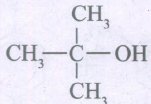 Tertiary butyl alcohol does not give iodoform reaction. All other compounds contains α H atoms and they undergo iodoform reaction.
101.
When ethylene reacts with alkaline KMnO4 solution (Baeyer's reagent), it forms glycol (diol).

102.
Magnesium has to precipitate as Mg(OH)2 when treated with NH4OH, but addition of NH4CI will suppress the ionisation of NH4OH due to common ion effect. So ionic product of Mg2+ and OH- ions will be less than the solubility product (Ksp) of Mg(OH)2. Hence will not precipitate.
103.
(i) Acidic buffer solution: a solution containing a weak acid and its salt.
Example: Solution containing acetic acid and sodium acetate
(ii) Basic buffer solution: a solution containing a weak base and its salt.
Example: Solution containing NH4OH and NH4Cl.
104.
(i) pH = -log10 [H3O+]
(ii) The pH of a solution is defined as the negative logarithm of base 10 of the molar concentration of the hydronium ions present in the solution.
105.
(i) Lewis acid: It is a species that accepts an electron pair. Eg: \(\mathrm{Ag}^{+} ; \mathrm{BF}_{3} ; \mathrm{A} / \mathrm{Cl}_{3}\)
(ii) Lewis base: It is a species that donates an electron pair. Eg: \( \mathrm{Cl}^{-} ; \mathrm{NH}_{3} ; \mathrm{H}_{2} \mathrm{O}\)
106.
(i) Environmental conservation
(ii) Use jute bags or cloth bags in place of polythene bags.
(iii) KMnO4 acts as a strong oxidising agent.
107.
Order of the reaction = \(\frac { 1 }{ 2 } +\frac { 3 }{ 2 } =\frac { 4 }{ 2 } =2\)
The reaction is second order.
108.
Rate of a reaction at any time depends on the concentration of the reactants which keeps on decreasing with time.
109.
(i) Fluorine due to its small size high electronegativity and low F-F bond energy is more reactive than CIF3
(ii) While CI-F bond in CIF3 is weaker than CI-CI bond in Cl2 therefore, CIF3 is more reactive than Cl2.
(iii) So these graphite rods are consumed slowly and need to be replaced from time - to - time
110.
(i) Sulphur has great catenation property and forms large molecule having high weight, which results higher melting point.
(ii) While oxygen exists as diatomic molecule of less molecular weight, hence has very low melting point.
111.
The defects which are caused by missing or misplaced atoms or ions in the crystal.
112.
(i) The intermolecular forces of attraction that are present in solids are very strong.
(ii) The constituent particles of solids have fixed position.
(iii) Hence, solids have a definite volume.
113.
(i) Anhydrous AlCl3 is an electro-deficient compound while hydrated AICl3 is not.
(ii) Therefore, anhydrous AICl3 is more soluble in diethyl either because the oxygen atom of ether donates a pair of electrons to the vacant p-orbital on the Al atom in AlCl3 forming a co-ordinate bond.
(iii) In case of hydrated AlCl3, Al is not electron deficient, since, H2O has already donated a pair of e- to it.
114.
(i) Zeolites have a three dimensional crystalline structure looks like a honeycomb consisting of a network of interconnected tunnels and cages.
(ii) Water molecules moves freely in and out of these pores hence they are highly porous.
115.
CrO < Cr2O3 < CrO3
∴ Higher the oxidation state, more will be the acidic character.
116.
MA2B2
[Pt(NH3)2Cl2]
117.
(i) The stereoisomers of a coordination compound have the same chemical formula and connectivity between the central metal atom and the ligands.
(ii) But they differ in the spatial arrangement of ligands in three dimensional space. They can be further classified as geometrical isomers and optical isomers.
118.
(i) Lighter sulphide ore particles are wetted by pine oil and rise to the surface with the from while gangue particles are wetted by water.
(ii) Therefore, the froth flotation method is selected for the concentration of sulphide ores.
119.
(i) Conversion of ores into oxides.
(ii) Reduction of metal oxides.
120.
Ea = 200 kJ mol-1=200 \(\times\) 103J mol-1
A = 1.6 \(\times\) 1013s-1; T = 600 K; R = 8.314 JK mol-1
\(k=A{ e }^{ -\left( \frac { Ea }{ RT } \right) }\)
\(k=1.6\times { 10 }^{ 13 }{ s }^{ -1 }{ e }^{ -\left( \frac { 200\times 10^3}{ 8.314 \times 600 } \right) }\)
\(k=1.6\times { 10 }^{ 13 }{ s }^{ -1 }{ e }^{ -\left( 40.09 \right) }\)
\(k=1.6\times { 10 }^{ 13 }\times 3.8\times { 10 }^{ -18 }{ s }^{ -1 }\)
\(k=6.08\times { 10 }^{ -5 }{ s }^{ -1 }\)
121.
An interstitial compound or alloy is a compound that is formed when small atoms like hydrogen, boron, carbon or nitrogen are trapped in the interstitial holes in a metal lattice. They are usually non-stoichiometric compounds. Transition metals form a number of interstitial compounds such as TiC, ZrH1.92, Mn4N etc.
Properties of interstitial compound
(i) They are hard and show electrical and thermal conductivity.
(ii) They have high melting points higher than those of pure metals.
(iii) Transition metal hydrides are used as powerful reducing agents
(iv) Metallic carbides are chemically inert.
122.
The oxidation states of 4d metals vary from +3 for Y to +8 for Ru and Os.
The highest oxidation state of 4d elements are found in their compounds with the higher electronegative elements like O, F & Cl.
Example: In RuO4, OsO4 & WCl6
The oxidation state of Ru and Os is +8.
The oxidation state of W is +6.
Generally in going down a group, a stability of higher oxidation state increases while that of lower oxidation state decreases.
4d series (5th period) - Yttrium to Cadmium (10 elements)
| Elements | Oxidation states |
|---|---|
| Y | +3 |
| Zr | +3, +4 |
| Nb | +2, +3, +4, +5 |
| Mo | +2, +3, +4, +5, +6 |
| Tc | +2, +4, +5, +7 |
| Ru | +2, +3, +4, +5, +6, +7 +8 |
| Rh | +2, +3, +4, +6 |
| Pd | +2, +3, +4 |
| Ag | +1, +2, +3 |
| Cd | +2 |
123.
| Ligand | Type of Ligand | Number of donor atoms |
| NH3 | monodentate ligand | 1 |
| en | bidentate ligand | 2 |
| ox2- | bidentate ligand | 2 |
| pyridine | monodentate ligand | 1 |
124.
\({ Ag }^{ + }2N{ H }_{ 3 }\rightleftharpoons { \left[ { Ag\left( { { NH }_{ 3 } } \right) }_{ 2 } \right] }^{ + }\)
\(k=\frac { { \left[ { Ag\left( { { NH }_{ 3 } } \right) }_{ 2 } \right] }^{ + } }{ \left[ { Ag }^{ + } \right] { \left[ { NH }^{ 3+ } \right] }^{ 2 } } \)
\(=\frac { \left[ { Ag }^{ + } \right] }{ { \left[ { Ag\left( { NH }_{ 3 } \right) }_{ 2 } \right] }^{ + } } =\frac { 1 }{ k{ \left( { NH }_{ 3 } \right) }^{ 2 } } \)
\(=\frac { 1 }{ 1.7\times { 10 }^{ 7 }\times { \left( 0.2 \right) }^{ 2 } } =\frac { { 10 }^{ -7 } }{ 1.7\times 4\times { 10 }^{ -2 } } \)
\(=\frac { { 10 }^{ -5 } }{ 6.8 } =1.47\times { 10 }^{ -5 }\)
125.
i) Na2[Ni(EDTA)] - Sodium 2, 2', 2",2'" - (ethane-1,2 diyldinitrilo tetraacetatonickelate)(II)
ii) [Ag(CN)2]- - Dicyanido-kC-argentate (I) ion
iii) [CO(en)3]2(SO4)3 - Tris (ethane 1, 2 diamine)cobalt (III) sulphate
iv) [CO(ONO)(NH3)5]2+ - Pentaamminenitrito - KO cobalt (III) ion
v) [Pt(NH3)2Cl(NO2)] - Diammainechloridonitro - kN - platinum (II)
126.
127.
(i) Fluorine is most electronegative atom.
(ii) It has only one unpaired electron.
128.
(i) In heavier post transition metals, the outers electrons (ns) have a tendency to remain inert and show reluctance to take part in the bonding, which is known as inert pair effect.
(ii) This effect is also observed in groups 14, 15 and 16.
129.
Catenation is an ability of an element to form chain of atoms.
The conditions for catenation.
(a) The valency of element is greater than or equal to two.
(b) Element should have an ability to bond with itself
(c) The self bond must be as strong as Its bond with other elements
(d) Kinetic inertness of catenated compound towards other molecules.
(e) Carbon possesses all the above properties and forms a wide range of compounds with itself and with other elements such as H, O, N, S and halogens.
130.
In p-block elements, the first member of each group differs from the other elements of the corresponding group. The following factors are responsible for this anomalous behaviour
(i) Small size of the first member.
(ii) High ionisation enthalpy and high electronegativity.
(iii) Absence of d-orbitals in their valance shell.
131.
a) if both assertion and reason are true and reason is the correct explanation of assertion.
132.
(a)

12th Standard Syllabus & Materials
12th Standard
TN 12th Computer Applications களப்பெயர் முறைமை (DNS) Sample Question Papers Study Material - QB365 Set A
NEW12th Standard
TN 12th Computer Applications வலையமைப்பு எடுத்துக்காட்டுகள் மற்றும் நெறிமுறைகள் Sample Question Papers Study Material - QB365 Set A
NEW12th Standard
TN 12th Computer Applications கணினி வலையமைப்பு ஓர் அறிமுகம் Sample Question Papers Study Material - QB365 Set A
NEW12th Standard
TN 12th Computer Applications PHP-உடன் MySQL-ஐ இணைத்தல் Sample Question Papers Study Material - QB365 Set A



Tamilnadu Stateboard 12th Standard Subjects

Maths
Chemistry

Physics

Biology

Computer Science

Business Maths and Statistics

Economics

Commerce

Accountancy

History

Computer Applications
Biology
Computer Technology
Computer Applications
Computer Science
Business Maths and Statistics
Commerce
Economics
Maths
Chemistry
Physics
Computer Technology
History
Accountancy

Tamil

English

French
Tamilnadu Stateboard Standards
