
 100% FREE ACCESS
12th Standard Syllabus & Materials
12th Standard
TN 12th Computer Applications மின்னணு தரவு பரிமாற்றம் Sample Question Papers Study Material - QB365 Set A
NEW12th Standard
TN 12th Computer Applications மின் - வணிக பாதுகாப்பு அமைப்புகள் Sample Question Papers Study Material - QB365 Set A
NEW12th Standard
TN 12th Computer Applications மின்னணு செலுத்தல் முறைகள் Sample Question Papers Study Material - QB365 Set A
NEW12th Standard
TN 12th Computer Applications மின் - வணிகம் Sample Question Papers Study Material - QB365 Set A
NEW12th Standard
TN 12th Computer Applications திறந்த மூல கருத்துருக்கள் Sample Question Papers Study Material - QB365 Set A
NEW12th Standard
TN 12th Computer Applications வலையமைப்பு வடமிடல் Sample Question Papers Study Material - QB365 Set A

Published on: 31/08/2020
12th Standard Chemistry English Medium Model 2 Mark Book Back Questions (New Syllabus) 2020
Download Tamil Nadu 12th Standard Chemistry question papers, model tests, one-mark questions, important questions, and public exam papers in PDF format. Free study materials and answer keys for TN State Board students.
Questions + Answers key
Take MCQ Chemistry Test
1.
Draw the major product formed when 1-ethoxyprop-1-ene is heated with one equivalent of HI.
2.
Why is anode in galvanic cell considered to be negative and cathode positive electrode?
3.
How do antiseptics differ from disinfectants?
4.
Give any three difference between DNA and RNA.
5.
Explain the rate determining step with an example.
6.
7.
Give the uses of helium.
8.
Give the characteristics of image formed by a plane mirror.
9.
The resistance of a conductivity cell is measured as 190 Ω using 0.1M KCl solution (specific conductance of 0.1M KCl is 1.3 Sm-1). When the same cell is filled with 0.003 M sodium chloride solution, the measured resistance is 6.3KΩ. Both these measurements are made at a particular temperature. Calculate the specific and molar conductance of NaCl solution.
10.
Calculate the concentration of OH- in a fruit juice which contains \(2\times10^{-3}\) M, H3O+ ion. Identify the nature of the solution.
11.
Which will be adsorbed more readily on the surface of charcoal and why? NH3 or CO2?
12.
There are two isomers with the formula CH3NO2. How will you distinguish between them?
13.
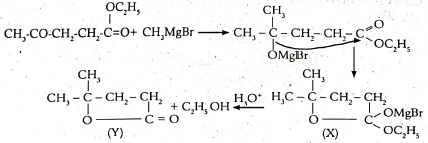
Identify X and Y.
\({ CH }_{ 3 }CO{ CH }_{ 2 }{ CH }_{ 2 }COO{ C }_{ 2 }{ H }_{ 5 }\overset { { CH }_{ 3 }MgBr }{ \longrightarrow } X\overset { { H }_{ 3 }{ O }^{ + } }{ \longrightarrow } Y\)
14.
What are actinides? Give three examples.
15.
[CuCl4]2- exists while [Cul4]2- does not exist why?
16.
Discuss the Lowry – Bronsted concept of acids and bases.
1.

2.
Anodic oxidation:
The electrode at which the oxidation occurs is called the anode. In Daniel cell, the oxidation take place at zinc electrode, i.e., zinc is oxidised to Zn2+ ions and the electrons. The Zn2+ ions enters the solution and the electrons enter the zinc metal, then flow through the external wire and then enter the copper strip. Electrons are liberated at zinc electrode and hence it is negative (-ve).
\({ Zn }_{ (s) }\longrightarrow { Zn }^{ 2+ }{ _{ (aq) } }+ 2{ e }^{ - } \) (loss of electron-oxidation)
Cathodic reduction:
The electrons flow through the circuit from zinc to copper, where the Cu2+ ions in the solution accept the electrons, get reduced to copper and the same get deposited on the electrode. Here, the electrons are consumed and hence it is positive (+ve).
\({ Cu }^{ 2+ }_{ (aq) }+{ 2e }^{ - }\longrightarrow { Cu }_{ (s) } \)(gain of electron-reduction)
3.
| S.No | Antiseptics | Disinfectants |
| 1. | Antiseptics are medicines applied to living tissues (living humans). | Disinfectants are applied to inanimated objects. |
| 2. | All the antiseptics are disinfectants. | All the disinfectants are not antiseptics. |
| 3. | They are not ingested or swallowed. Eg: Povidone - iodine. |
They can be injected or swallowed. Eg :Hydrogen peroxide, Chlorine compounds |
4.
| DNA | RNA |
|---|---|
| DNA is mainly present in nucleus, mitochondria and chloroplast | RNA is mainly present in cytoplasm, nucleolus and ribosomes |
| It contains deoxyribose sugar | It contains ribose sugar |
| Base pair A = T. G≡C | Base pair A = U. C≡G |
| Double stranded molecules | Single stranded molecules |
| It's life time is high | It is short lived |
| It is stable and not hydrolysed easily by alkalis | It is unstable and hydrolyzed easily by alkalis |
| It can replicate itself | It cannot replicate itself It is formed from DNA |
5.
(i) The step which has the lowest rate value among the other steps of the reaction is called as the rate determining step (or) rate limiting step: (or)
(ii) The overall rate of a reaction is controlled by the slowest step in a reaction called the rate determining step.
Example:
\(2 \mathrm{~A}+\mathrm{B} \rightarrow \mathrm{C}+\mathrm{D}\) going by two steps like,
\( \mathrm{A}+\mathrm{B} \stackrel{\mathrm{k}_{1}}{\longrightarrow} \mathrm{C}+\mathrm{Z}-(1) \text { Step }(\text { slow }) \)
\(Z+A \stackrel{k_{2}}{\longrightarrow} D-(2) \text { Step }(\text { fast }) \)
Over all reaction: \(2 \mathrm{~A}+\mathrm{B} \rightarrow \mathrm{C}+\mathrm{D}\)
Here \(A+B \underset{\text { Slow }}{\stackrel{K_{1}}{\longrightarrow}} C+Z\), step is the rate determining step. For the decomposition of hydrogen peroxide catalysed by I-.
2H2O2(aq)\(\rightarrow\) 2H2O(I) + O2(g)
It is experimentally found that the reaction is first order with respect to both H2,O2, and I-, which indicates that I- is also involved in the reaction. The mechanism involves the following steps.
Step: 1
H2O2(aq)+I-1(aq) \(\rightarrow\) H2O(l)+OI-1(aq)
Step: 2
H2O2(aq)+OI-1(aq)\(\rightarrow\) H2O + I-(aq) + O(g)
Overall reaction is
2H2O2(aq) \(\rightarrow\) 2H2O(l) + O2(g)
These two reactions are elementary reactions. Adding equation (1), and (2) gives the overall reaction. Step 1 is the rate determining step, since it involves both H2,O2 and I-, the overall reaction is bimolecular.
6.
7.
(i) Helium is used to provide inert atmosphere in electric-arc welding of metals.
(ii) Helium has lowest boiling point hence used in cryogenics.
(iii) It is much less denser than air and hence used for filling air balloons.
8.
(i) The image formed by a plane mirror is virtual, erect, and laterally inverted.
(ii) The size of the image is equal to the size of the object.
(iii The image distance far behind the mirror is equal to the object distance in front of it.
(iv) If an object is placed between two plane mirrors inclined at an angle e, then the number of images n formed is as,
\(n=\left( \cfrac { 360 }{ \theta } -1 \right) \)
9.
Given that
κ = 1.3 Sm-1 (for 0.1M KCl solution)
R = 190 Ω
\(\kappa = \frac{1}{R}(\frac{l}{A})\)
κ . R =\((\frac{l}{A})\) = (1.3 Sm-1) (190Ω)
= 247 m-1
\(\kappa_{(NaCl)} = \frac{1}{R_{(NaCl)}} (\frac{l}{A})\)
\(= \frac{1}{6.3 K\Omega}(247 m^{-1})\) (6.3KΩ = 6.3 x 10³Ω)
= 39.2 x 10⁻³ Sm-1
\(\Lambda_m = \frac{\kappa \times 10^{-3} mol^{-1} m^3}{M}\)
\(=\frac{39.2 \times 10 ^{-3}(Sm^{-1})10^-3 (mol^{-1} m^3)}{0.003}\)
\(\Lambda_m\) = 13.04 \(\times\) 10-3 Sm2 mol-1
10.
Given that H3O+ = \(2\times10^{-3}M\)
\(K_{w}=[H_{3}O^{+}][OH^{-}]\)
\(\therefore [OH^{-}]=\frac{K_{w}}{[H_{3}O^{+}]}=\frac{1\times10^{-14}}{2\times10^{-3}}=0.5\times10^{-11}M\)
\(2\times10^{-3} >>0.5\times10^{-11}\)
i.e., [H3O+]>>[OH-], hence the juice is acidic in nature
11.
The critical temperature of NH3 is 406 K and that of CO2 is 304 K. So, NH3 has higher critical temperature and greater VanderWaal's forces of attraction than CO2. So NH3 will be more adsorbed than CO2.
12.
a) Primary and secondary nitroalkanes, having α-H, also show an equilibrium mixture of two tautomers namely nitro - and aci - form
.JPG)
b) Difference:
| S.No | Nitro form | Aci - form |
| 1. | Less acidic in nature. | More acidic |
| 2. | Dissolves in NaOH slowly | Dissolves in NaOH instantly |
| 3. | Decolourises FeCl3 solution | With FeCl3 gives reddish brown colour |
| 4. | Electrical conductivity is low | Electrical conductivity is high |
13.
14.
The fourteen elements following actinoids is from thorium to lawrencium are called actinides.
Examples: Uranium, Thorium, Neptunium
15.
In [CuCI4]-2 Cu2+, is reduced to Cu+ by I-. Hence Cupric Iodide in converted to cuprous Iodide so [CuI4]-2 does not exist. In [CuCI4]-2 Cl- cannot effect this change and so exists.
16.
(i) An acid is defined as a substance that has a tendency to donate a proton to another substance and base is a substance that has a tendency to accept a proton form other substance.
(ii) In other words, an acid is a proton donor and a base is a proton acceptor.
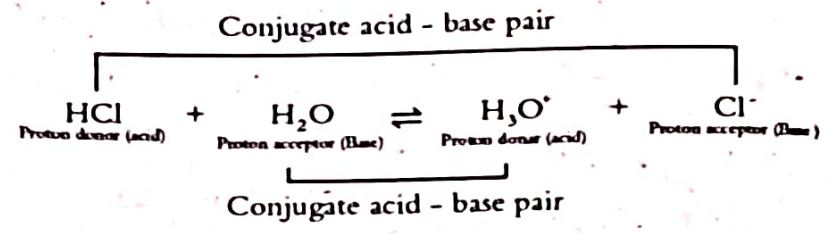
(iii) When hydrogen chloride is dissolved in water, it donates a proton to the later. Thus, HCI behaves as an acid and H2O is base. The proton transfer from the acid to base can be represented as
HCI + H2O ⇌ H3O+ + Cl-
(iv) When ammonia is dissolved in water, it accepts a proton from water. In this case, ammonia (NH3) acts as a base and H2O is acid. The reaction is represented as
H2O + NH3 ⇌ NH4+ + OH-
(v) Let us consider the reverse reaction following equilibrium.
\(\underset { proton\ donar\\ \quad \quad \ (acid) }{ HCl } +\underset { Proton\ acceptor\\ \quad \quad \quad \quad (base) }{ { H }_{ 2 }O } \leftrightharpoons \underset { Proton\ donar\\ \quad \quad \quad \quad \ (acid) }{ { H }_{ 2 }{ O }^{ + } } +\underset { Proton\ acceptor\\ \quad \quad \quad \quad \ (base) }{ { Cl }^{ - } } \)
H3O+ donates a proton to Cl- to form HCI i.e., the products also behave as acid and base.
(vi) In general, Lowry - Bronsted (acid - base) reaction is represented as
Acid1 + Base2 ⇌ Acid2 + Base1
(vii) The species that remains after the donation of a proton is a base (Base1) and is called the conjugate base of the Bronsted acid (Acid1). In other words, chemical species that differ only by a proton are called conjugate acid - base pairs.

12th Standard Syllabus & Materials
12th Standard
TN 12th Computer Applications களப்பெயர் முறைமை (DNS) Sample Question Papers Study Material - QB365 Set A
NEW12th Standard
TN 12th Computer Applications வலையமைப்பு எடுத்துக்காட்டுகள் மற்றும் நெறிமுறைகள் Sample Question Papers Study Material - QB365 Set A
NEW12th Standard
TN 12th Computer Applications கணினி வலையமைப்பு ஓர் அறிமுகம் Sample Question Papers Study Material - QB365 Set A
NEW12th Standard
TN 12th Computer Applications PHP-உடன் MySQL-ஐ இணைத்தல் Sample Question Papers Study Material - QB365 Set A



Tamilnadu Stateboard 12th Standard Subjects

Maths
Chemistry

Physics

Biology

Computer Science

Business Maths and Statistics

Economics

Commerce

Accountancy

History

Computer Applications
Biology
Computer Technology
Computer Applications
Computer Science
Business Maths and Statistics
Commerce
Economics
Maths
Chemistry
Physics
Computer Technology
History
Accountancy

Tamil

English

French
Tamilnadu Stateboard Standards
