
 100% FREE ACCESS
12th Standard Syllabus & Materials
12th Standard
TN 12th Computer Applications மின்னணு தரவு பரிமாற்றம் Sample Question Papers Study Material - QB365 Set A
NEW12th Standard
TN 12th Computer Applications மின் - வணிக பாதுகாப்பு அமைப்புகள் Sample Question Papers Study Material - QB365 Set A
NEW12th Standard
TN 12th Computer Applications மின்னணு செலுத்தல் முறைகள் Sample Question Papers Study Material - QB365 Set A
NEW12th Standard
TN 12th Computer Applications மின் - வணிகம் Sample Question Papers Study Material - QB365 Set A
NEW12th Standard
TN 12th Computer Applications திறந்த மூல கருத்துருக்கள் Sample Question Papers Study Material - QB365 Set A
NEW12th Standard
TN 12th Computer Applications வலையமைப்பு வடமிடல் Sample Question Papers Study Material - QB365 Set A

Published on: 03/09/2020
12th Standard Chemistry English Medium Model 5 Mark Creative Questions (New Syllabus) 2020
Download Tamil Nadu 12th Standard Chemistry question papers, model tests, one-mark questions, important questions, and public exam papers in PDF format. Free study materials and answer keys for TN State Board students.
Questions + Answers key
Take MCQ Chemistry Test
1.
Ail organic compound. (A) C7H6O reduces Tollens reagent. Compound (A) reacts with acetic anhydride in the presence of anhydrous sodium acetate and gives an unsaturated acid (B). Compound (A) reacts with acetone in the presence of alkali and gives (C). What are (A)(B) and (C) Explain the reactions.
2.
An organic compound (A) C2H3OCI on treatment with Pd and BaSO4 gives (B) C2H4O which answers iodoform test. (B) when treated with cone.H2SO4 undergoes polymerisation to give (C) a cyclic compound. Identify (A), (B) and (C) and explain the reactions.
3.
An organic compound (A) of molecular formula C7H6O is not reduced by Fehling's solution but will undergo Cannizzaro reaction. Compound (A) reacts with aniline to give compound (B). Compound (A) also reacts with Cl2 in the presence of catalyst to give compound (C). Identify (A) (B) and (C) and explain the reactions.
4.
Account for reducing nature of formic acid.
5.
Discuss the mechanism of aldol condensation.
6.
Explain the classification of hormones.
7.
Give the uses of carbohydrates.
8.
Explain the classification of polymers based on their structure and mode of synthesis.
9.
An organic compound 'A' is a sodium salt of phenolic acid with molecular formula C7H5O3Na. 'A' on heating with soda lime gives compound 'B' of molecular formula C6H6O. 'B' gives violet colour with neutral ferric chloride. 'B' on treatment with C6H5COCI in the presence of NaOH gives an ester 'C'. Identify 'A', 'B' and 'C'. Explain the reactions.
10.
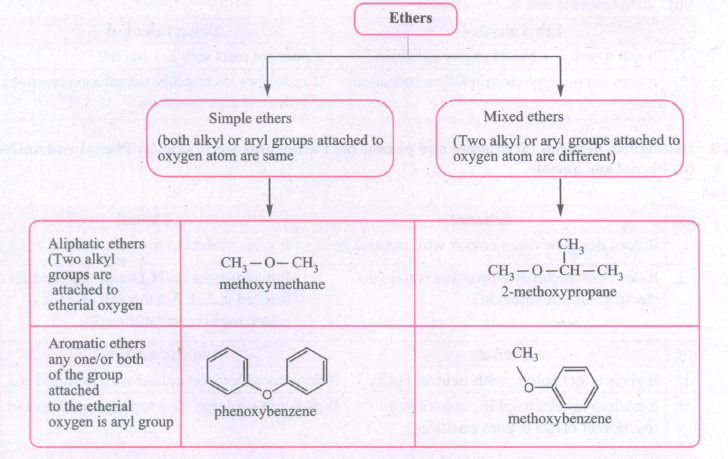
What are ethers? Write note on simple and mixed ethers with examples.
11.
Account for
i) Reduction of CH3CH gives CH3CH2NH2 while CH3NC gives (CH3)2NH.
ii) (CH3)2NH requires two molar proportion of CH3I to give the same crystalline product formed by (CH3)2N with one mole of CH3l.
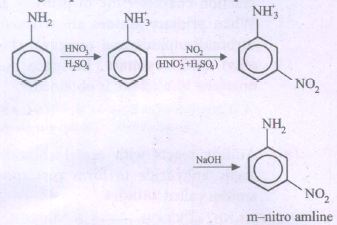
iii) Nitration of aniline with conc.HNO3 may end up with same meta nitro product.
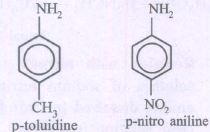
iv) p-toluidine is a stronger base than p-nitroaniline.
12.
An organic compound A (C2H6O2) liberates hydrogen with metallic sodium. Compound A when heated with anhydrous zinc chloride ultimately gives B (C2H4O) whereas) when heated with cone. phosphoric acid gives C (C4H10O3). A on oxidation with acidified K2Cr2O7 gives compound D (CH2O2). Identify A, B, C and D. Explain the reactions involved.
13.
An organic compound A of molecular f formula C6H6O gives violet colouration with neutral FeCl3. Compound A on treatment with metallic Na gives compound B. Compound B on treatment with CO2 at 400 K under pressure gives C. This product on acidification gives compound D (C7H6O3) which is used in medicine. Identify (A) (B) (C) and D and explain the reactions.
14.
Name the method to deduce the charge of the sol particle. Explain it with a neat diagram.
15.
Give the special characteristics of enzyme catalysed reactions.
16.
Write the electrochemical mechanism of corrosion.
17.
If E1 = 0.5 V corresponds to Cr3++ 3e- ➝ Cr(s) and E2 = 0.41V corresponds to Cr3++ e- ➝ Cr2+ reactions, calculate the emf (E3) of the reaction Cr2++ 2 e- ➝ Cr(s)
18.
To 1M solution of AgNO3, 0.75 F quantity of current is passed. What is the concentration of the electrolyte, AgNO3 remaining in the solution?
19.
Calculate the pH of 0.1 M NH4OH if Kb = 1.75 x 10⁻⁵
20.
Calculate the pH of 0.001 M HCI solution.
21.
22.
A first order reaction completes 25% of the reaction in 100 mins. What are the rate constant and half life values of the reaction?
23.
The conversion of molecules x to y follows second order kinetics. Its concentration of x is increased to three times how will it affect the rate of formation of y?
For the reaction x ➝ y as it follows second order kinetics wherefore the rate of formation of y?
24.
Write a short note on the oxidation states of 3d series elements.
25.
An element A occupies group number 15 and period number 3, reacts with chlorine to give compound B. The compound B on hydrolysis gives a dibasic acid C. The compound C on heating undergoes auto oxidation and reduction to give a tribasic acid D. Identify the elements A compounds B, C and D. Write the reactions.
26.
Explain the Deacon's process.
27.
Complete the following equations:
a. 4NaCI + MnO2 + 4H2SO4 \(\longrightarrow \)?
b. 6XeF4 + 12H2O\(\longrightarrow \) ?
28.
Give a detailed account on allotropes of sulphur.
29.
How are crystals classified?
30.
Ionic solids, which have anionic vacancies due to metal excess defect, develop colour. Explain with the help of a suitable example.
31.
Distinguish between diamond and graphite.
32.
What is zone refining? Describe the principle involved in the purification of the metal by this method.
33.
Explain refining of nickel by mond's process
34.
What are the salient feature of crystal field theory?
35.
Give the postulates and limitation of Werner's theory of co-ordination compounds.
1.
(i) An organic compound (A) is identified as C6H5CHO benzaldehyde. Benzaldehyde reduces Tollen'sreagent and also undergoes. Cannizaro reaction.
\(\underset { (A) }{ C_{ 6 }{ H }_{ 5 }CHO } +{ Ag }_{ 2 }O\longrightarrow 2Ag+\underset { (B) }{ { C }_{ 6 }{ H }_{ 5 }COOH } \)
(ii) Benzaldehyde reacts with acetic anhydride in the presence of sodium acetate gives cinnamic acid and it is (B) an unsaturated acid
\(\underset { (A) }{ { C }_{ 6 }{ H }_{ 5 }CHO } +\left( { CH }_{ 3 }CO \right) _{ 2 }O\overset { { CH }_{ 3 }COONa }{ \longrightarrow } \underset { (B) }{ { C }_{ 6 }{ H }_{ 5 }CH } { =CHCOOH }+{ CH }_{ 3 }COOH\)
(iii) Compound A reacts with acetone to form compound (C) benzal acetone.
\(\underset {(A)}{{ C }_{ 6 }{ H }_{ 5 }CHO}+{ CH }_{ 3 }COC{ H }_{ 3 }\overset { NaOH }{ \longrightarrow } { C }_{ 6 }{ H }_{ 5 }CH=\underset { (C) }{ CH } -CO{ CH }_{ 3 }\)
| Compound | Compound Name | Formula |
| A | Benzaldehyde | C6H5CHO |
| B | Cinnamic acid | C6H5CH = CHCOOH |
| C | Benzal acetone | C6H5CH - CH-COCH3 |
2.
(i) Compound (A) must be acetyl chloride which undergoes Rosenmund's reduction giving acetaldehyde.
\(\underset { (A) }{ { CH }_{ 3 }COCl } \overset { Pd/BaS{ O }_{ 4 } }{ \longrightarrow } \underset { (B) }{ { CH }_{ 3 }CHO } \)
(B) undergoes iodoform reaction
\(\underset { (B) }{ { CH }_{ 3 }COH } \overset { { I }_{ 2 }/NaOH }{ \longrightarrow } \underset { Iodoform }{ { CHI }_{ 3 } } +HCOONa\)
(ii) Acetaldehyde (B) undergoes polymerisation giving a cyclic compound.
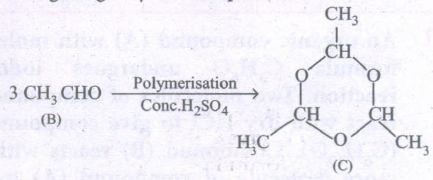
| Compound | Compound name | Formula |
| A | Acetyl chloride | CH3COCI |
| B | Acetaldehyde | CH3CHO |
| C | Paraldehyde | 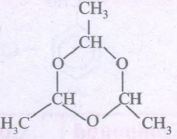 |
3.
(i) Compound A is identified as benzaldehyde C6H5CHO from its molecular formula. C6H5CHO undergoes Cannizzaro reaction and it does not reduce Fehling's solution.
\({ C }_{ 6 }{ H }_{ 5 }CHO+{ C }_{ 6 }{ H }_{ 5 }CHO\overset { NaOH }{ \longrightarrow } { C }_{ 6 }{ H }_{ 5 }{ CH }_{ 2 }OH+{ C }_{ 6 }{ H }_{ 5 }COONa\)
(ii) Benzaldehyde reacts with aniline to form Schiff's base C6H5CH = NC6H5 and it is (B)
\({ C }_{ 6 }{ H }_{ 5 }-\overset { \underset { | }{ H } }{ C } =\underset { Aniline }{ O+{ C }_{ 6 }H_{ 5 }{ NH }_{ 2 } } \longrightarrow \underset { Schiff's \ base(B) }{ { C }_{ 6 }{ H }_{ 5 }CH={ NC }_{ 6 }{ H }_{ 5 }+{ H }_{ 2 }O } \)
(iii) Benzaldehyde reacts with chlorine in the presence of catalyst to give m-chlorobenzaldehyde and it is (C).
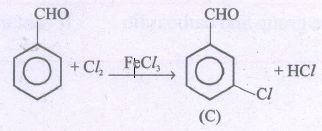
| Compound | Compound Name | Formula |
|---|---|---|
| A | Benzaldehyde | C6H5CHO |
| B | Schiff's base | C6H5CH = NC6H5 |
| C | m-cholorobenzaldehyde |  |
4.
(i) Formic acid (HCOOH) is unique because it contains both an aldehyde group and carboxyl group also.
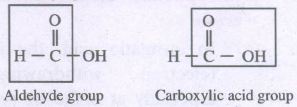
(ii) Hence it can act as a reducing agent. It reduces Fehling's solution Tollen's reagent and decolourises pink coloured KMnO4 solution.
(iii) Whereas in acetic acid, there is no aldehyde group and it cannot act as reducing agent.
(iv) Formic acid reduces ammoniacal silver nitrate solution (Tollen's reagent) to metallic silver.
HCOOH + Ag2O⟶H2O + CO2 + 2Ag↓ (metallic silver)
(v) Formic acid reduces Fehling's solution. It reduces blue coloured cupric ions to red coloured cuprous ions.
\(\mathrm{HCOO}^{-}+2 \mathrm{Cu}^{2+}+5 \mathrm{OH}^{-} \longrightarrow \mathrm{CO}_{3}^{2-}+\mathrm{Cu}_{2} \mathrm{O}+3 \mathrm{H}_{2} \mathrm{O}\\
\quad \quad \quad \quad (blue) \quad \quad \quad \quad \quad \quad \quad \quad \quad \quad \quad (red)\)
5.
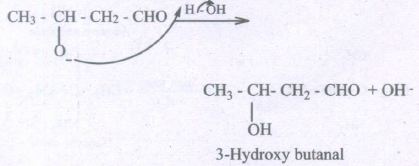
This reaction is catalysed by base. The carbanion generated is nucleophilic in nature. Hence it can bring about nucleophilic attack on carbonyl group
Step 1: The carbanion is formed as the a-hydrogen atom is removed as a proton by the base

Step 2: The carbanion attacks the carbonyl carbon of another unionised aldehyde molecule
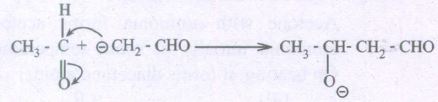
Step 3: The alkoxide ion formed is protonated by water to give 'aldol'.
6.
(i) Hormones are classified according to the distance over which they act as, endocrine, paracrine and autocrine hormones.
(ii) Endocrine hormones act on cells distant from the site of their release. Example: insulin and epinephrine are synthesized and released in the bloodstream by specialized ductless endocrine glands.
(iii) Paracrine hormones (alternatively, local mediators) act only on cells close to the cell that released them. For example, interleukin -1 (IL-1) Autocrine hormones act on the same cell that released them. For example, protein growth factor interleukin-2 (IL-2).
7.
Importance of carbohydrates:
(i) Carbohydrates, widely distributed in plants and animals, acts mainly as energy sources and structural polymers.
(ii) Carbohydrate is stored in the body as glycogen and in plant as starch.
(iii) Carbohydrates such as cellulose which is the primary components of plant cell wall, is used to make paper, furniture (wood) and cloths (cotton)
(iv) Simple sugar glucose serves as an instant source of energy.
(v) Ribose sugars are one of the components of nucleic acids.
(vi) Modified carbohydrates such as hyaluronate (glycosaminoglycans) act as shock absorber and lubricant.
8.
(i) Structure:
(a) Linear polymers (long continuous chain) E.g. HDPE, PVC
(b) Branched polymers (one main chain with small chains as branches) E.g. polypropylene, LDPE.
(c) Cross linked polymers (linking of chain polymers) E.g. bakelite, melamine, formaldehyde
(ii) Mode of synthesis:
(a) Addition polymers. Formed by polymerisation of monomers without the elimination of byproduct. E.g. polyethylene, PVC, teflon.
(b) Condensation Polymer formed by the condensation of two or more monomers with the elimination of simple molecules like H2O, NH3, etc., E.g. Nylon:6-6, polyester.
9.
(i) The organic compound (A) which is sodium salt of phenolic acid is sodium salicylate.
(ii) (A) on heating with soda lime gives Compound (B) phenol. Phenol gives violet colouration with neutral perchloride.
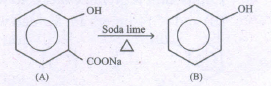
(iii) Phenol on treatment with C6H5COCl in the presence of NaOH gives on ester 'C':
C6H5OH + C6H5COCl \(\overset { NaOH }{ \longrightarrow } \underset { (C) }{ { C }_{ 6 }{ H }_{ 5 }OCO{ C }_{ 6 }{ H }_{ 5 }+HCl } \)
| Compound | Compound Name | Formula |
| A | Sodium benzoate' | 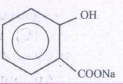 |
| B | Phenol | C6H5OH |
| C | Phenyl benzoate | C6H5OCO C6H5 |
10.
Ethers are a class of organic compound in which an oxygen atom is connected to two alkyl/aryl groups Ethers can be considered as the derivatives of hydrocarbon in which one hydrogen atom is replaced by an alkoxy (-OR) or an aryloxy (-OAr ) group. The general formula of aliphatic ether is CnH2n+2O.
Classification:
11.
(i) CH3CN (Methyl cyanide) on reduction gives CH3CH2NH2 (ethylamine) because addition of hydrogen takes place at ≡ CN
\({ CH }_{ 2 }-C\equiv N\xrightarrow [ 4H ]{ { LiAH }_{ 4 } } { \underset { Ethylamine\\ (Primary\quad amine) }{ { CH }_{ 3 }-{ CH }_{ 2 }{ NH }_{ 2 } } }\)
Whereas CH3NC (Methyl isocyanide) on reduction with LiAlH4 gives secondary amine
\({ CH }_{ 3 }-\underset { \overset { | }{ H } }{ N } -{ CH }_{ 3 }\)
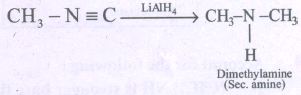
In methyl cyanide, -CN group is attached to alkyl group and by reduction it gives a primary amine wherease in methyl isocyanide -NC group is attached to alkyl group and by reduction it gives a secondary amine.
(ii) (CH3)2 NH (Secondary amine) requires 2 moles of CH3I to give a quaternary salt (crystalline product) whereas (CH3)2N (tertiary amine) require only one mole of CH3I to give the same quaternary salt. It is due to the number of alkyl groups present in amines.
\(\underset { Secondary \ anmine }{ { ( }{ CH }_{ 3 })_{ 2 }-NH+{ 2CH }_{ 3 }I } \rightarrow { { [(CH }_{ 3 })_{ 4 }N] }^{ + }\underset { Tetramethy\\ ammonium \ iodide }{ { I }^{ - } } \)
(iii) Nitration of aniline with cone. HNO3 results in the formation of m-nitro aniline because nitric acid is a strong acid. It protonates aniline forming anilinium ion C6H5NH3+ because of positive charge on nitrogen, it is meta directive and -NO2 group is substituted at meta position.
(iv) p-Toluidine contains a methyl group which has +I effect (electron withdrawing group and due to this, p-toluidine is a stronger base than p-nitro aniline in which the nitro group is less reactive and it deactivate the benzene rin make it a less basic
12.
An organic compound A (C2H6O2) liberates hydrogen with metallic sodium.
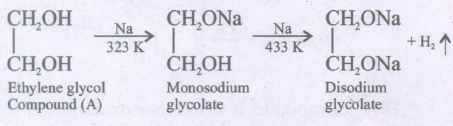
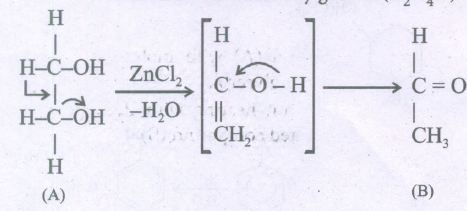
(ii) Compound A when heated with anhydrous zinc chloride ultimately gives B (C2H4O)
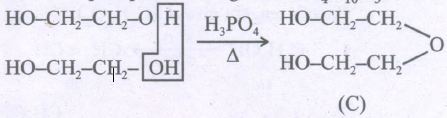
(iii) Compound A when heated with conc. phosphoric acid gives C (C4H10O3).
(iv) Compound A on oxidation with acidified K2Cr2O7 gives compound D (CH2O2).
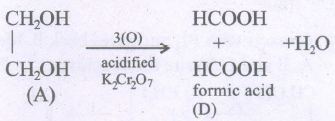
| Compound | Compound Name | Formula |
| A | Ethylene glycol | \(\overset { { CH }_{ 2 }OH }{ \underset { { CH }_{ 2 }OH }{ | } } \) |
| B | Acetaldehyde | CH3-CHO |
| C | Diethylene glycol | \(\overset { HCOOH }{ \underset { HCOOH }{ + } } \) |
| D | Formic acid | 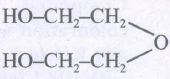 |
13.
(i) Compound A is phenol. (C6H5OH)
Phenols on reaction with metallic Na compound (B) ie., Sodium Phenoxide
\(\underset { (A) }{ { 3C }_{ 6 }{ H }_{ 5 }OH+2Na } \longrightarrow \underset { (B) }{ { 2C }_{ 6 }{ H }_{ 5 }ONa+{ H }_{ 2 } } \)
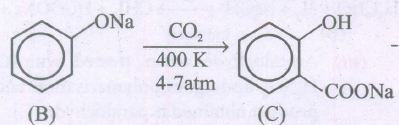
(ii) (B) is heated with CO2 at 400K under pressure, to give (C). This is decomposed by dil.HCl, and (D) is formed
| Compound | Compound Name | Formula |
| A | Phenol | C6H5OH |
| B | Sodium Phenoxide | C6H5ONa |
| C | Sodium Salicylate | 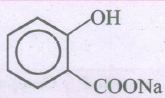 |
| D | Salicylicacid | 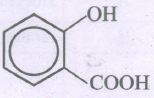 |
14.
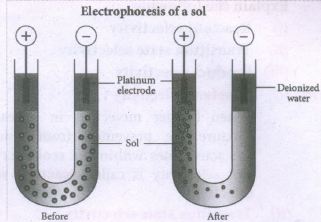
Electrophoresis:
(i) When electric potential is applied across two platinum electrodes dipped in a hydrophilic sol, the dispersed particles move toward one or other electrode.
(ii) This migration of sol particles under the influence of electric field is called electrophoresis or cataphoresis.
(iii) If the sol particles migrate to the cathode, then they posses positive (+) charges, and if the sol particles migrate to the anode then they have negative charges(-).
(iv) Thus from the direction of migration of sol particles we can determine the charge of the sol particles.
(v) Hence electrophoresis is used for detection of presence of charges on the sol particles
15.
(i) Effective and efficient conversion is the special characteristic of enzyme catalysed reactions. An enzyme may transform a million molecules of reactant in a minute
For Eg: \({ 2H }_{ 2 }{ O }_{ 2 }\longrightarrow { 2H }_{ 2 }O+{ O }_{ 2 }\)
For this reaction, the activation energy is 18k cal/mole without a catalyst With colloidal platinum as a, catalyst the activation energy is 11.7kcal /mole. But with the enzyme catalyst the activation energy of this reaction is less than 2kcal/ mole.
(ii) Enzyme catalysis is highly specific in nature.
(iii) Enzyme catalysed reaction has maximum rate at optimum temperature
(iv) The rate of enzyme catalysed reactions varies with the pH of the system. The rate is maximum at a pH called optimum pH.
(v) Enzymes can be inhibited i.e. poisoned activity of an enzyme is decreased and destroyed by a poison. The physiological action of drugs is related to their inhibiting action.
(vi) Catalytic activity of enzymes is increased by coenzymes or activators.
16.
(i) The formation of rust requires both oxygen and water. Since it is an electrochemical redox process, it requires an anode and cathode in different places on the iron.
(ii) The iron surface and a droplet of water on the surface form a tiny galvanic cell.
(iii) The region enclosed by water is exposed to low amount of oxygen and it acts as the anode.
(iv) The remaining area has high amount of oxygen and it act a cathode. So an electro chemical cell is formed. Corrosion occurs at the anode i.e., in the region enclosed by the water.
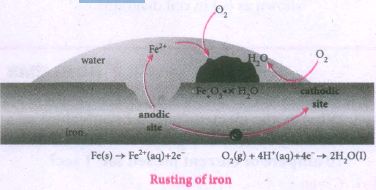
Anode (oxidation)Iron dissolve in the andoe region:
\({ 2Fe }_{ (s) }\rightarrow { 2Fe }_{ (aq) }^{ 2+ }+{ 4e }^{ - }\) Eo = 0.44V
The electrons move through the iron metal from the anode to the cathode area where the oxygen dissolved in water, is reduced to water.
Cathode (reduction):
The reaction of atmospheric carbon dioxide with water gives carbonic acid which furnishes the H+ ions for reduction.
\({ O }_{ 2(g) }+{ 4H }_{ (aq) }^{ + }+{ 4e }^{ - }\rightarrow { 2H }_{ 2 }O(l)\) Eo = 1.23 V
The electrical circuit is completed by the migration of ions through water droplet.
The overall redox reactions is,
\({ 2Fe }_{ (s) }+{ O }_{ 2(g) }+{ 4H }_{ (aq) }^{ + }\rightarrow { 2Fe }_{ (aq) }^{ 2+ }+{ 2H }_{ 2 }O(l)\) Eo = 0.444 + 1.23 = 1.67V
The positive emf value indicates that the reaction is spontaneous
Fe2+ ions are further oxidised to Fe3+ which on further reaction with oxygen to form rust.
\({ 4Fe }_{ (Aq) }^{ 2+ }+{ O }_{ 2(g) }+{ 4H }_{ (aq) }^{ + }\rightarrow { 4Fe }_{ (aq) }^{ 2+ }+{ 2H }_{ 2 }O(l)\)
\({ 3Fe }_{ (Aq) }^{ 3+ }+{ 4{ H }_{ 2 }O }(l)\rightarrow { Fe }_{ 2 }{ O }_{ 3 }.{ H }_{ 2 }{ O }_{ (s) }+{ 6H }_{ (aq) }^{ + }\)
17.
Given:
E1 = 0.5 V
Cr3++ 3e- ➝ Cr(s).......(1)
E2 = 0.41 V
Cr3++ e- ➝ Cr2+ .....(2)
The required reaction is,
Cr2++ 2 e- ➝ Cr(s)
Then,
Formula:
\({ E }_{ 3 }=\frac { 3{ E }_{ 1 }+{ E }_{ 2 } }{ 2 } \)
Solution:
= \(\frac { 3(0.5)+(0.41) }{ 2 } =\frac { 1.5+0.41 }{ 2 } \)
= 0.955 V
E3 = 0.955 V
18.
Initial concentration of
AgNO3 = 1M= IN
Quantity of current 0.75 F
Formula:
1Faraday = 1equivalent mass
Solution:
For IF current In AgNO3 will be liberated.
For 0.75 F current 0.75 N AgNO3 will be liberated
The concentration of AgNO3 remaining
= 1.0 - 0.75 = 0.25 N
ஃ The concentration of AgNO3 remaining
19.
Degree if dissociation \(\alpha =\sqrt { \frac { K_{ a } }{ C } } ,C\alpha =\sqrt { { K }_{ a }.C } \)
∴ \(pOH=\log\frac { 1 }{ \sqrt { { K }_{ b }.C } } =\log\frac { { 10 }^{ 3 } }{ \sqrt { 1.75\times { 10 }^{ -5 }\times .1 } } \)
\(=\log\frac { 1 }{ \sqrt { 1.75\times { 10 }^{ -6 } } } =\log\frac { { 10 }^{ 3 } }{ \sqrt { 1.75 } } \)
\(=3-\frac { 1 }{ 2 } \log1.75\)
\(=3-\frac { 1 }{ 2 } \times 0.2430=2.8785\)
pH = 14 - pOH
∴ pH = 14 - 2.8785 = 11.1215
Alternating,
\(\left[ { H }^{ - } \right] =\sqrt { { K }_{ b }\times C } \)
\(=\sqrt { 1.75\times { 10 }^{ -5 }\times 0.1 } =\sqrt { 1.75\times { { 10 }^{ -6 } } } \)
= 1.322 x 10⁻³
∴ pOH = - log [H+] = - log (1.323 x 10⁻³)
3 - 0.1216 = 2.8784
∴ pH = 14 - pOH = 14 - 2.8784 = 11.1216
20.
HCI ⟶ H+ + Cl-. HCI is a strong acid.
[H+] from HCI is very much greater than [H+] from water which is 1 x 10⁻⁷ M.
∴ [H+] = [HCI] = 0.001 M
∴ pH = -log (0.001) = 3.0
∴ That is acidic solution.
21.
22.
Given data: Time taken for 25% completion of the reaction = 100 mins
a = 100; x = 25 and a - x = 75; t = 100min
Formula: \(k=\frac { 2.303 }{ t } \log { \frac { a }{ a-x } } ;{ t }_{ \frac { 1 }{ 2 } }=\frac { 0.693 }{ k } \)
Solution:
\(k=\frac { 2.303 }{ 100 } \log\frac { 100 }{ 100-25 } \)
\(=\frac { 2.303 }{ 100 } \log\frac { 100 }{ 75 } =\frac { 2.303 }{ 100 } \log\frac { 4 }{ 3 } \)
\(=\frac { 2.303 }{ 100 } \times 0.1249\)
Rate constant(k) = 2.8773 x 10⁻³ min-1
\({ t }_{ \frac { 1 }{ 2 } }=\frac { 0.693 }{ k } =\frac { 0.693 }{ 2.8773\times { 10 }^{ -3 }{ ,min }^{ -1 } } \)
\(=\frac { 693 }{ 2.8773 } =240.85\)
Half-life period (t1/2) = 240.85 minutes
23.
Rate = k [x]2 = ka2
[x] = a mol-1
If the concentration of x is in cross three time, then
(x) = 3a mol L-1
Rate = R(3a)2 = 9 ka2
Hence, the rate of formation will increase by 9 times.
24.
(i) The first transition metal Scandium exhibits only +3 oxidation state, but all other transition elements exhibit variable oxidation states by loosing electrons from (n-1)d orbital and ns orbital as the energy difference between them is very small.
(ii) At the beginning of the series, +3 oxidation state is stable but towards the end +2 oxidation state becomes stable.
(iii) The number of oxidation states increases with the number of electrons available, and it decreases as the number of paired electrons increases.
(iv) Hence, the first and last elements show less number of oxidation states and the middle elements with more number of oxidation states.
(v) For example, the first element Sc has only one oxidation state +3; the middle element Mn has six different oxidation states from +2 to +7. The last element Cu shows +1 and +2 oxidation states only.
(vi) The relative stability of different oxidation - states of 3d metals is correlated with the extra stability of half filled and fully filled electronic configurations. Example: Mn2+(3d5) is more stable than Mn4+(3d3).
25.
(i) As per the position in the periodic table, the element A is phosphorus as below:
(ii) Phosphorus reacts with dry chlorine to form phosphorus trichloride as below
\(\underset { (A) }{ { P }_{ 4 } } +6{ Cl }_{ 2 }\longrightarrow \underset { (B) }{ { 4PCl }_{ 3 } } \)
Hence, compound B is phosphorus trichloride.
(iii) PCl3 on hydrolysis gives phosphorus acid H3PO3, which is dibasic acid,
\(\underset { (B) }{ { PCl }_{ 3 } } +3{ H }_{ 2 }O\longrightarrow { 3HCl }+\underset { (C) }{ { H }_{ 3 }{ PO }_{ 3 } } \)
Hence, compound C is phosphorus acid.
(iv) H3PO3 on heating undergo auto oxidation and reduction producing phosphoric acid md phosphine as below:
\(\underset { (c) }{ { 4H }_{ 3 }{ PO }_{ 3 } } \overset { \Delta }{ \longrightarrow } { PH }_{ 3 }+\underset { (b) }{ { 3H }_{ 3 }{ PO }_{ 4 } } \)
Phosphoric acid is a tribasic acid. Hence, compound D is phosphoric acid.
Thus A = Phosphorus
B = Phosphorus trichloride
C = Phosphorus acid
D = Phosphoric acid
26.
(i) In this process a mixture of air and hydrochloric acid is passed up a chamber containing a number of shelves, pumice stones soaked in cuprous chloride are placed.
(ii) Hot gases at about 723 K are passed through a jacket that surrounds the chamber.
\(4 \mathrm{HCl}+\mathrm{O}_{2} \frac{400^{\circ} \mathrm{C}}{\mathrm{Cu}_{2} \mathrm{Cl}_{2}} 2 \mathrm{H}_{2} \mathrm{O}+\mathrm{Cl}_{2} \uparrow\)
The chlorine obtained by this method is dilute and is employed for the manufacture of bleaching powder. The catalysed reaction is,
\(2 \mathrm{Cu}_{2} \mathrm{Cl}_{2}+\mathrm{O}_{2} \rightarrow 2 \mathrm{Cu}_{2} \mathrm{OCl}_{2}\\ \quad \quad \quad \quad \quad \quad \quad \text { cuprous oxychloride } \)
\(\mathrm{Cu}_{2} \mathrm{OCl}_{2}+2 \mathrm{HCl} \rightarrow 2 \mathrm{CuCl}_{2}+\mathrm{H}_{2} \mathrm{O}\\ \quad \quad \quad \quad \quad \quad \quad \quad \quad\text { Cupric chloride } \)
\(2 \mathrm{CuCl}_{2} \rightarrow \mathrm{Cu}_{2} \mathrm{Cl}_{2}+\mathrm{Cl}_{2}\\ \quad \quad \quad \quad \text { cuprous chloride }\)
27.
(a) NaCl + MnO2 + 4H2SO4 \(\longrightarrow \) MnCl2+ 4NaHSO4 + 2H2O + Cl2
(b) 6XeF4 + 12H2O \(\longrightarrow \) 4Xe + 2XeO3 + 24HF + 3O2
28.
(a) Rhombic Sulphur (α - Sulphur):
(a) It is yellow in colour.
(b) Its melting point is 385.8K and specific gravity is 2.06
(c) It is stable form of sulphur at room temperature.
(d) It is formed on evaporating the solution of sulphur in CS2.
(e) It in insoluble in water, readily soluble in CS2 and dissolves to some extent in benzene, alcohol and ether.
(b) Monoclinic sulphur \(\left( \beta -sulphur \right) \):
(a) Its melting point is 393K and specific gravity is 1.98
(b) It is prepared by melting rhombic sulphur in a dish and cooling, till crust is formed. Two holes are made in crust and remaining liquid is powered out. On removing crust, colourless needle - shaped crystals of β - sulphur is formed.
(c) Monoclinic sulphur is stable above 369K and below 369K α - sulphur is stable.
(d) At 369K both forms are stable and this temperature is called transition temperature.
(e) Both rhombic and monoclinic sulphur have S8 molecules, these are packed to give different crystal structure S8 form is puckered and has crown shape.
Several other modifications containing 6-20 sulphur atoms per ring are synthesised
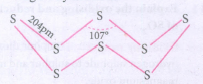
(f) In Cyclo-S6 the ng adopts chair form.
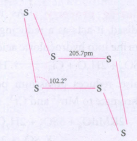
(g) At elevated temperatures (~1000K), S2 is dominant species and is, paramagnetic like O2
29.
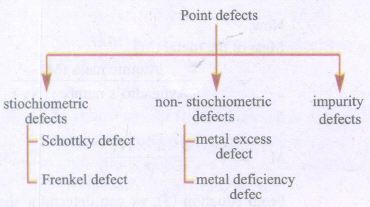
Crystal defects are classified as follows
(i) Point defects
(ii) Line defects
(iii) Interstitial defects
(iv) Volume defects
Point defects are further classified as follows
30.
(i) The colour develops because of the presence of electrons in the 8 anionic sites.
(ii) These electron absorb energy from the visible region of radiation and get excited.
(iii) For example when crystals of NaCl are heated in an atmosphere of sodium vapours, the sodium atoms get deposited on the surface of the crystal and the deposited Na atoms.
(iv) During this process, the Na atoms on the surface lose electrons to form Na+ ions
(v) These electrons get excited by absorbing energy from the visible light and impart yellow colour to the crystals.
31.
| DIAMOND | GRAPHITE |
| C is sp3 hybridised. | C is sp2 hybridised. |
| Three dimensional, tetrahedral structure. | Two dimensional, sheet like structure. |
| Crystalline, transparent with extra brilliance. | Crystalline, opaque and shiny substance. |
| It is hard with high density and high melting point. | It is soft with low density and high melting point. |
| Bad conductor of and electricity. | Good conductor of heat and electricity. |
32.
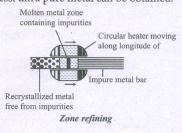
Zone refining:
This method is employed for preparing highly pure metal (such as silicon, tellurium, germanium), which are used as semiconductors. It is based on the principle that melting point of a substance is lowered by the presence of impurities. Consequently, when an impure molten metal is cooled, crystals of the pure metal are solidified, and the impurities remain behind the remaining metal.
The process consists In casting the impure metal in the form of a bar. A circular heater fitted around this bar is slowly moved longitudinally from one end to the other. At the heated zone, the bar melts, and as the heater moves on, pure metal crystallizes, while the impurities pass into the adjacent molten part In this way, the impurities are swept from one end of the bar to the other. By repeating the process, ultra pure metal can be obtained.
33.
(i) The impure nickel is heated in a stream of carbon monoxide at around 350 K.
(ii) The nickel reacts with the CO to form a highly volatile nickel tetracarbonyl.
(iii) The solid impurities are left behind
\({ Ni }_{ (s) }+4{ CO }_{ (g) }\longrightarrow { Ni(CO) }_{ 4(g) }\)
(iv) On heating the nickel tetracarbonyl around 460 K, the complex decomposes to give pure metal.
\({ Ni(CO) }_{ 4(g) }\longrightarrow { Ni }_{ (s) }+{ 4CO }_{ (g) }\)
34.
Valance bond theory helps us to visualize the bonding in complexes. However, it has limitations as mentioned above. Hence Crystal Field Theory to explain some of the properties, like colour, magnetic behavior, etc., This theory I was originally used to explain the nature of bonding in ionic crystals. Later on, it is used to explain the properties of transition metals and their complexes. The salient features of this theory are as follows.
(i) Crystal Field Theory (CFT) assumes that the bond between the ligand and the central metal atom is purely ionic. i.e. the bond is formed due to the electrostatic attraction between the electron rich ligand and the electron deficient metal.
(ii) In the coordination compounds, the central metal atom/ion and the ligands are considered as point charges (in case of I charged metal ions or ligands) or electric dipoles (in case of neutral metal atoms or ligands).
(iii) According to crystal field theory, the complex formation is considered as the following series of hypothetical steps.
Step 1: In an isolated gaseous state, all the five d orbitals of the central metal ion are degenerate. Initially, the ligands form a spherical field of negative charge around the metal. In this filed, the energies of all the five d orbitals will increase due to the repulsion between the electrons of the metal and the ligand.
Step 2: The ligands are approaching the metal atom in actual bond directions. To illustrate this let us consider an octahedral field, in which the I central metal ion is located at the origin and the six ligands are coming from the +x, -x, +y, -y, +z and -z directions as shown below.
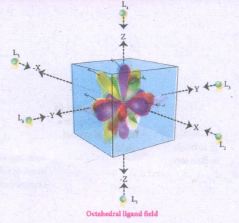
As shown in the figure, the orbitals lying along the axes dx2-y2 and dz2 orbitals will experience strong repulsion and raise in energy to a greater extent than the orbitals with lobes directed between the axes (dxy, dyz, and dzx). Thus the degenerate d orbitals now split into two sets and the process is called crystal field splitting.
Step 3: Up to this point the complex formation would not be favored. However, when the ligands approach further, there will be an attraction between the negatively charged electron and the positively charged metal ion, that results in a net decrease in energy. This decrease in energy is the driving force for the complex formation.
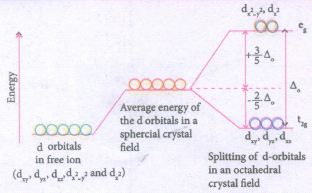
Crystal field splitting in octahedral complexes: During crystal field splitting in octahedral field, in order to maintain the average energy of the orbitals (barycentre) constant, the energy of the orbitals dx2-y2 and d z2 (represented as eg orbitals) will increase by 3/5 \({ \triangle }_{ o }\) while that of the other three orbitals dxy ' dyz and dzx (represented as t2g orbitals) decrease by 2/5 \({ \triangle }_{ o }\) , Here, \({ \triangle }_{ o }\) represents the crystal field splitting energy in the octahedral field.
35.
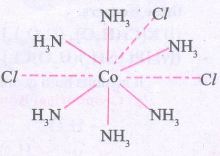
(i) Every metal atom has two types of valencies Primary valency or ionisable valency Secondary valency or non ionisable valency
(ii) The primary valency corresponds to the oxidation state of the metal ion. It is always satisfied by negative ions.
(iii) Secondary valency corresponds to the coordination number of the metal ion or atom. It is satisfied by either negative ions or neutral molecules.
(iv) The molecules or ions that satisfy secondary valencies are called ligands.
(v) The ligands which satisfy secondary valencies must project in definite directions in space. So the secondary valencies are directional in nature whereas the primary valencies are non - directional in nature.
(vi) The ligands have unshared pair of electrons. These unshared pair of electrons are donated to central metal ion or atom in a compound. Such compounds are called coordination compounds.
Werner's representation
Eg: [Co(NH)6]Cl3
Cl: primary valency (dotted lines)
NH3: secondary valency (solid lines).
Defects of Werner's theory
Werner's theory describes the structures of many co-ordination compounds successfully. However, it does not explain the magnetic and spectral properties.

12th Standard Syllabus & Materials
12th Standard
TN 12th Computer Applications களப்பெயர் முறைமை (DNS) Sample Question Papers Study Material - QB365 Set A
NEW12th Standard
TN 12th Computer Applications வலையமைப்பு எடுத்துக்காட்டுகள் மற்றும் நெறிமுறைகள் Sample Question Papers Study Material - QB365 Set A
NEW12th Standard
TN 12th Computer Applications கணினி வலையமைப்பு ஓர் அறிமுகம் Sample Question Papers Study Material - QB365 Set A
NEW12th Standard
TN 12th Computer Applications PHP-உடன் MySQL-ஐ இணைத்தல் Sample Question Papers Study Material - QB365 Set A



Tamilnadu Stateboard 12th Standard Subjects

Maths
Chemistry

Physics

Biology

Computer Science

Business Maths and Statistics

Economics

Commerce

Accountancy

History

Computer Applications
Biology
Computer Technology
Computer Applications
Computer Science
Business Maths and Statistics
Commerce
Economics
Maths
Chemistry
Physics
Computer Technology
History
Accountancy

Tamil

English

French
Tamilnadu Stateboard Standards
