
 100% FREE ACCESS
12th Standard Syllabus & Materials
12th Standard
TN 12th Computer Applications மின்னணு தரவு பரிமாற்றம் Sample Question Papers Study Material - QB365 Set A
NEW12th Standard
TN 12th Computer Applications மின் - வணிக பாதுகாப்பு அமைப்புகள் Sample Question Papers Study Material - QB365 Set A
NEW12th Standard
TN 12th Computer Applications மின்னணு செலுத்தல் முறைகள் Sample Question Papers Study Material - QB365 Set A
NEW12th Standard
TN 12th Computer Applications மின் - வணிகம் Sample Question Papers Study Material - QB365 Set A
NEW12th Standard
TN 12th Computer Applications திறந்த மூல கருத்துருக்கள் Sample Question Papers Study Material - QB365 Set A
NEW12th Standard
TN 12th Computer Applications வலையமைப்பு வடமிடல் Sample Question Papers Study Material - QB365 Set A

Published on: 03/06/2021
QB365 provides detailed and simple solution for every Book back Questions in class 12 Accountancy Subject. It will helps to get more idea about question pattern in every book back questions with solution.
Download Tamil Nadu 12th Standard Accountancy question papers, model tests, one-mark questions, important questions, and public exam papers in PDF format. Free study materials and answer keys for TN State Board students.
Questions + Answers key
Take MCQ Accountancy Test
1.
From the given information calculate the inventory turnover ratio and inventory conversion period (in months) of Sania Ltd.
| Particulars | Rs. |
|---|---|
| Revenue from operations | 1,90,000 |
| Inventory at the beginning of the year | 40,000 |
| Inventory at the end of the year | 20,000 |
| Purchases made during the year | 90,000 |
| Carriage inwards | 10,000 |
2.
Justina, Navi and Rithika are partners sharing profits and losses equally. On 31.3.2019, Rithika retired from the partnership firm. Profits of the preceding years is as follows:
2016: Rs. 5,000; 2017: Rs. 10,000 and 2018: Rs. 30,000
Find out the share of profit of Ritika for the year 2019 till the date of retirement if
(a) Profit is to be distributed on the basis of the previous year’s profit
(b) Profit is to be distributed on the basis of the average profit of the past 3 years
Also pass necessary journal entries by assuming that partners’ capitals are fluctuating. Accountancy
3.
Anu Company forfeited 200 equity shares of Rs.10 each issued at par held by Thiyagu for nonpayment of the final call of Rs.3 per share. The shares were reissued to Laxman at Rs.6 per share. Show the journal entries for forfeiture and reissue.
4.
What is inventory conversion period? How is it calculated?
5.
6.
From the following information relating to Sridevi enterprises, calculate the value of goodwill on the basis of 4 years purchase of the average profits of 3 years.
(a) Profits for the years ending 31st December 2016, 2017 and 2018 were Rs. 1,75,000, Rs. 1,50,000 and Rs. 2,00,000 respectively.
(b) A non-recurring income of Rs. 45,000 is included in the profits of the year 2016.
(c) The closing stock of the year 2017 was overvalued by Rs. 30,000.
7.
A and B contribute Rs. 4,00,000 and Rs. 2,00,000 respectively as capital. Their respective share of profit is 3:2 and the profit before interest on capital for the year is Rs. 27,000. Compute the amount of interest on capital in each of the following situations:
(i) if the partnership deed is silent as to the interest on capital
(ii) if interest on capital @ 3% is allowed as per the partnership deed
(iii) if the partnership deed allows interest on capital @ 5% p.a.
8.
How annual subscription is dealt with in the final accounts of not–for–profit organisation?
9.
What are the features of incomplete records?
10.
Anjali and Nithya are partners of a firm sharing profits and losses in the ratio of 5:3. They admit Pramila on 1.1.2018. On that date, their balance sheet showed accumulated loss of Rs. 40,000 on the asset side of the balance sheet. Give the journal entry to transfer the accumulated loss on admission.
1.
Inventory turnover ratio = \(\frac{Cost\ of\ revenue\ from\ operations}{Average\ inventory}\) = \(\frac{1,20,000}{30,000}\) = 4 times
Cost of revenue from operations
= Opening inventory + Net Purchases + Direct expenses (carriage inwards) – Closing inventory
= 40,000 + 90,000 + 10,000 – 20,000
= Rs.1,20,000
Average inventory = \(\frac{Opening\ inventory + Closing\ inventory}{2}\)
= \(\frac{40,000 + 20,000}{2}\) = Rs.30,000
Inventory conversion period (in months) = \(\frac{Number\ of\ months\ in\ a\ year}{Inventory\ turnover\ ratio}\) = \(\frac{12}{4}\) = 3 months
2.
(a) If profit is to be distributed on the basis of the previous year’s profit:
Ritika’s share of profit for 3 months \(=30000\times\frac{3}{12}\times\frac{1}{3}=Rs.2,500\)
| Date | Particulars | L.F | Debit Rs. |
Credit Rs. |
|
|---|---|---|---|---|---|
| 2019 March 31 |
Profit and loss Suspense A/c | Dr. | 2,500 | ||
| To Rithika’s capital A/c | 2,500 | ||||
| (Rithika’s current year share of profit credited to her capital account) |
(b) If profit is to be distributed on the basis of the average profit of the past 3 years:
Average profit \(=\frac{5,000+10,000+30,000}{3}\)
= 15,000
Ritika’s share of profit for 3 months \(=15000\times\frac{3}{12}\times\frac{1}{3}=Rs.1,250\)
| Date | Particulars | L.F | Debit Rs. |
Credit Rs. |
|
|---|---|---|---|---|---|
| 2019 March 31 |
Profit and loss Suspense A/c | Dr. | 1,250 | ||
| To Rithika’s capital A/c | 1,250 | ||||
| (Rithika’s current year share of profit credited to her capital account) |
3.
| Date | Particulars | L.F. | Debit Rs. |
Credit Rs. |
|
|---|---|---|---|---|---|
| Equity share capital A/c (200 × 10) | Dr. | 2,000 | |||
| To Equity share final call A/c (200 × 3) | 600 | ||||
| To Forfeited shares A/c (200 × 7) | 1,400 | ||||
| (200 shares forfeited) | |||||
| Bank A/c (200 × 6) | Dr | 1,200 | |||
| Forfeited shares A/c (200 × 4) | Dr | 800 | |||
| To Share capital A/c (200 × 10) | 2,000 | ||||
| (Forfeited shares reissued) | |||||
| Forfeited shares A/c (1,400-800) | Dr. | 600 | |||
| To Capital reserve A/c | 600 | ||||
| (Gain on reissue of forfeited shares transferred to capital reserve account) |
4.
(i) Inventory conversion period is the time taken to sell the inventory.
(ii) A shorter inventory conversion period indicates more efficiency in the management of inventory.
(iii) It is computed as follows:
Inventory conversion period (in days)
= \(\frac { Number\ of\ days\ in\ a\ year }{ Inventory\ turnover\ ratio } \)
Inventory conversion period (in months)
= \(\frac { Number\ of\ month\ in\ a\ year }{ Inventory\ turnover\ ratio } \).
5.
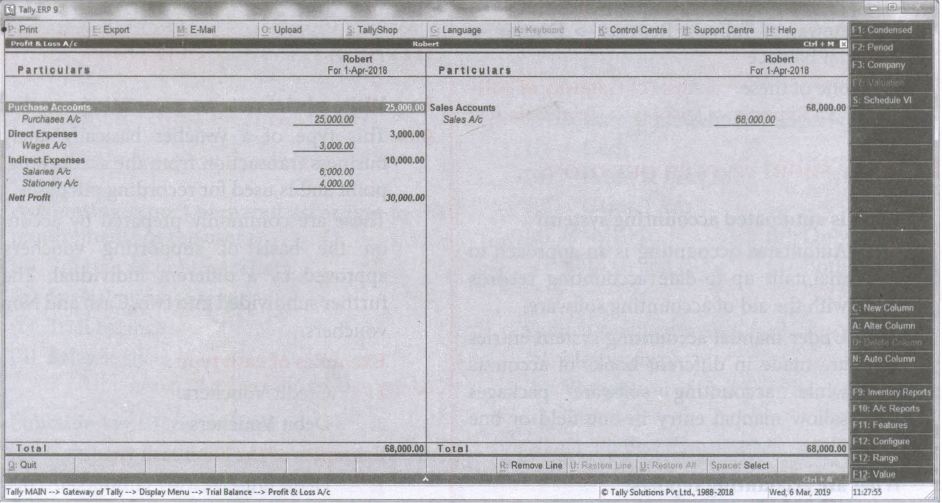
6.
| Particulars | 2016 Rs. | 2017 Rs. | 2018 Rs. |
|---|---|---|---|
| Profit | 1,75,000 | 1,50,000 | 2,00,000 |
| Less: Non - recurring-income | 45,000 | - | - |
| 1,30,000 | 1,50,000 | 2,00,000 | |
| Less: Over valuation of closing stock | - | 30,000 | - |
| 1,30,000 | 1,20,000 | 2,00,000 | |
| Add: Over valuation of Opening stock | - | - | 30,000 |
| Profit after adjustments | 1,30,000 | 1,20,000 | 2,30,000 |
Average profit \(=\frac{Total\ profit}{Number\ of\ years}\)
\(=\frac{1,30,000+1,20,000+2,30,000}{3}\)
\(=\frac{4,80,000}{3}\) = Rs. 1,60,000
Goodwill = Average profit \(\times\) Number of years of purchase
= 1,60,000 \(\times\) 4
= Rs. 6,40,000
7.
(i) Interest on capital will not be allowed as the partnership deed is silent as to the interest on capital.
(ii) Profit before interest on capital is Rs. 27,000.
Computation of interest on capital:
A: 4,00,000 \(\times\) \(\frac{3}{100}\) = Rs. 12,000
B: 2,00,000 \(\times\) \(\frac{3}{100}\) = Rs. 6,000
Since there is sufficient profit, interest on capital will be provided.
(iii) Profit before interest on capital is Rs. 27,000.
Computation of interest on capital:
A: 4,00,000 \(\times\) \(\frac{5}{100}\) = Rs. 20,000
B: 2,00,000 \(\times\) \(\frac{5}{100}\) = Rs. 10,000
Since the profit is insufficient, interest on capital will not be provided. Profit of Rs. 27,000 will be distributed to the partners in their capital ratio of 2:1.
8.
(A) Treatment in income and Expenditure account:
When subscription received for the current year, previous years and subsequent period are given separately, subscription received for the current year will be shown on the credit side of Income and Expenditure
Account after making the adjustments given below:
(i) Subscription outstanding for the current year is to be added.
(ii) Subscription received in advance in the previous year which is meant for the current year, is to be added.When 'total subscription received during the current year is given, that total subscriptions received during the current year will be shown on the credit side of Income and Expenditure Account after making the following-adjustments: (i) Subscription outstanding in the previous year which is received in the current year will be subtracted. Subscription outstanding for the current year is added.
(iii) Subscriptions received in advance in the previous year which is meant for the current year, is added and subscriptions received in advance in the current year which is meant for the subsequent year must be subtracted.
(B) Treatment in Balance Sheet
(i) Subscriptions outstanding for the current year and still outstanding for the previous year will be shown on the assets side of the balance sheet.
(ii) Subscriptions received in advance in the current year will be shown on the liabilities side of the balance sheet.
9.
1) Nature:
It is an inscientific and insystematic way of recording transaction. Accounting principle and accounting standards are not followed properly.
2) Types of account maintained:
In general only cash and personal account maintained fully. Real account and nominal account are not maintained properly some transaction are correctly omitted.
3) Lack of uniformity:
There is no uniformity in recording the transaction among different Organisation. Different Organisation record their transaction according to their needs and conveniences.
4) Financial Statement may not represents true and fair view:
Due to the incomplete information and inaccurate record of account profit or loss calculated from these records cannot be realised upon. It may not represent true predictability. Assets and liabilities may not represent a true and fair view of financial position.
5) Suitability:
Only the business concerns which have no legal obligation to maintain books of account under double entry System may maintain incomplete record. Hence it may be maintained by small fixed sole traders and partnership items.
6) Mixing up of personal and business transactions:
Generally personal transactions of the owners, are mixed up with the business transaction. For example purchases of goods for own use may be mixed up along with business purchases.
10.
| Date | Particulars | L.F | Debit Rs. |
Credit Rs. |
|---|---|---|---|---|
| 2018 January 1 | Anjali's capital A/c (40,000\(\times\)5/8) Dr | 25,000 | ||
| Nithya's capital A/c (40,000 \(\times\) 3/8) Dr | 15,000 | |||
| To Profit and loss A/c | 40,000 | |||
| (Accumulated loss transferred to old partner's capital account in the old profit sharing ratio) |

12th Standard Syllabus & Materials
12th Standard
TN 12th Computer Applications களப்பெயர் முறைமை (DNS) Sample Question Papers Study Material - QB365 Set A
NEW12th Standard
TN 12th Computer Applications வலையமைப்பு எடுத்துக்காட்டுகள் மற்றும் நெறிமுறைகள் Sample Question Papers Study Material - QB365 Set A
NEW12th Standard
TN 12th Computer Applications கணினி வலையமைப்பு ஓர் அறிமுகம் Sample Question Papers Study Material - QB365 Set A
NEW12th Standard
TN 12th Computer Applications PHP-உடன் MySQL-ஐ இணைத்தல் Sample Question Papers Study Material - QB365 Set A



Tamilnadu Stateboard 12th Standard Subjects

Maths

Chemistry

Physics

Biology

Computer Science

Business Maths and Statistics

Economics

Commerce
Accountancy

History

Computer Applications
Biology
Computer Technology
Computer Applications
Computer Science
Business Maths and Statistics
Commerce
Economics
Maths
Chemistry
Physics
Computer Technology
History
Accountancy

Tamil

English

French
Tamilnadu Stateboard Standards


