
 100% FREE ACCESS
12th Standard Syllabus & Materials
12th Standard
TN 12th Maths Applications of Matrices and Determinants Sample Question Papers Study Material - QB365 Set A
NEW12th Standard
TN 12th Computer Applications மின்னணு தரவு பரிமாற்றம் Sample Question Papers Study Material - QB365 Set A
NEW12th Standard
TN 12th Computer Applications மின் - வணிக பாதுகாப்பு அமைப்புகள் Sample Question Papers Study Material - QB365 Set A
NEW12th Standard
TN 12th Computer Applications மின்னணு செலுத்தல் முறைகள் Sample Question Papers Study Material - QB365 Set A
NEW12th Standard
TN 12th Computer Applications மின் - வணிகம் Sample Question Papers Study Material - QB365 Set A
NEW12th Standard
TN 12th Computer Applications திறந்த மூல கருத்துருக்கள் Sample Question Papers Study Material - QB365 Set A

Published on: 04/06/2021
QB365 provides detailed and simple solution for every Book back Questions in class 12 Business Maths Subject. It will helps to get more idea about question pattern in every book back questions with solution.
Download Tamil Nadu 12th Standard Business Maths and Statistics question papers, model tests, one-mark questions, important questions, and public exam papers in PDF format. Free study materials and answer keys for TN State Board students.
Questions + Answers key
Take MCQ Business Maths and Statistics Test
1.
The subscription department of a magazine sends out a letter to a large mailing list inviting subscriptions for the magazine. Some of the people receiving this letter already subscribe to the magazine while others do not. From this mailing list, 45% of those who already subscribe will subscribe again while 30% of those who do not now subscribe will subscribe. On the last letter, it was found that 40% of those receiving it ordered a subscription. What percent of those receiving the current letter can be expected to order a subscription?
2.
Solve the following equation by using Cramer’s rule
x + 4y + 3z = 2, 2x−6y + 6z = −3, 5x− 2y + 3z = −5
3.
Solve the following equation by using Cramer’s rule
2x + y −z = 3, x + y + z =1, x− 2y− 3z = 4
4.
The cost of 2kg of wheat and 1kg of sugar is Rs. 100. The cost of 1kg of wheat and 1kg of rice is Rs. 80. The cost of 3kg of wheat, 2kg of sugar and 1kg of rice is Rs. 220. Find the cost of each per kg using Cramer’s rule.
5.
Find k if the equations x + y + z = 1, 3x − y − z = 4, x+ 5y + 5z = k are inconsistent.
1.
Transition probability matrix
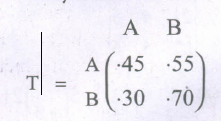
Where A represents the percentage of subscribers and B represents the percentage of non - subscribers.
A 40% = ·40
By the given data, 40% received the order of subscription = 60% are non-subscribers.
A 40% = ·40
and B 60% = ·60
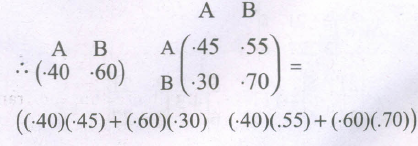
((-40)(-45) + (·60)(-30) (-40)(.55) + (-60)(.70))
(-18+·18 ·22+42)
(·36 ·64)
\(\Rightarrow\) 36% of those receiving the current letter can be expected to order a subscription
2.
\(\Delta =\left| \begin{matrix} 1 & 4 & 3 \\ 2 & -6 & 6 \\ 5 & -2 & 3 \end{matrix} \right| \)
= \(1\left| \begin{matrix} -6 & 6 \\ -2 & 3 \end{matrix} \right| -4\left| \begin{matrix} 2 & 6 \\ 5 & 3 \end{matrix} \right| +3\left| \begin{matrix} 2 & -6 \\ 5 & -2 \end{matrix} \right| \)
= 1(-18 + 12) - 4(6 - 30) +3 (- 4 +30)
= 1(- 6) - 4(- 24) + 3(26)
= - 6 + 96 + 78 = 168 \(\neq \) 0
Since \(\Delta \neq 0\) the system is consistent with unique solution and Cramer's rule can be applied
\(\Delta x=\left| \begin{matrix} 2 & 4 & 3 \\ -3 & -6 & 6 \\ -5 & -2 & 3 \end{matrix} \right| \)
= \(2\left| \begin{matrix} -6 & 6 \\ -2 & 3 \end{matrix} \right| -4\left| \begin{matrix} -3 & 6 \\ -5 & 3 \end{matrix} \right| +3\left| \begin{matrix} -3 & -6 \\ -5 & -2 \end{matrix} \right| \)
= 2 (- 18 + 12) - 4(- 9 +30) + 3(6 -30)
= 2(- 6) - 4(21) + 3(- 24)
= -12-84-72 =-168
\(\Delta y=\left| \begin{matrix} 1 & 2 & 3 \\ 2 & - & 6 \\ 5 & -5 & 3 \end{matrix} \right| =1\left| \begin{matrix} -3 & 6 \\ -5 & 3 \end{matrix} \right| -2\left| \begin{matrix} 2 & 6 \\ 5 & 3 \end{matrix} \right| +3\left| \begin{matrix} 2 & -3 \\ 5 & -5 \end{matrix} \right| \)
= 1 (-9+30)-2(6-30)+3(- 10+ 15)
= 1(21) - 2(- 24) + 3(5)
= 21 + 48 + 15 = 84
\(\Delta z=\left| \begin{matrix} 1 & 4 & 2 \\ 2 & -6 & -3 \\ 5 & -2 & -5 \end{matrix} \right| \)
= \(1\left| \begin{matrix} -6 & -3 \\ -2 & -5 \end{matrix} \right| -4\left| \begin{matrix} 2 & -3 \\ 5 & -5 \end{matrix} \right| +2\left| \begin{matrix} 2 & -6 \\ 5 & -2 \end{matrix} \right| \)
= 1(30-6)-4(-10+ 15)+2(-4+30)
= 24 - 4(5) + 2(26)
= 24 - 20 + 52 = 56
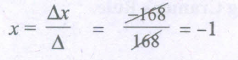
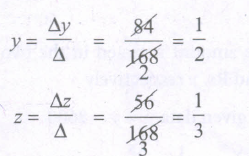
Solution set is \(\left\{ -1,\frac { 1 }{ 2 } ,\frac { 1, }{ 3 } \right\} \)
3.
\(\Delta =\left| \begin{matrix} 2 & 1 & -1 \\ 1 & 1 & 1 \\ 1 & -2 & 3 \end{matrix} \right| =2\)
\(\left| \begin{matrix} 1 & 1 \\ -2 & -3 \end{matrix} \right| -1\left| \begin{matrix} 1 & 1 \\ 1 & -3 \end{matrix} \right| -1\left| \begin{matrix} 1 & 1 \\ 1 & -2 \end{matrix} \right| \)
= 2 (-3+2) - 1 (-3 -1) -1 (-2-1)
= 2(-1) -1 (-4) -1 (-3)
= -2 + 4 + 3 = 5.
Since\(\Delta \neq 0\),
we can apply Cramer's rule and the system is consistent with unique solution.
\(x=\left| \begin{matrix} 3 & 1 & -1 \\ 1 & 1 & 1 \\ 4 & -2 & 3 \end{matrix} \right| =3\left| \begin{matrix} 1 & 1 \\ -2 & -3 \end{matrix} \right| -1\left| \begin{matrix} 1 & 1 \\ 4 & -3 \end{matrix} \right| -1\left| \begin{matrix} 1 & 1 \\ 4 & -2 \end{matrix} \right| \)
= 3(-3 + 2) -1(-3 -4) -1(-2 -4)
= 3 (-1) -1 (-7) -1 (-6)
= -3 + 7 + 6 = 10.
\(\Delta y=\left| \begin{matrix} 2 & 3 & -1 \\ 1 & 1 & 1 \\ 1 & 4 & -3 \end{matrix} \right| =2\left| \begin{matrix} 1 & 1 \\ 4 & -3 \end{matrix} \right| -3\left| \begin{matrix} 1 & 1 \\ 1 & -3 \end{matrix} \right| -1\left| \begin{matrix} 1 & 1 \\ 1 & 4 \end{matrix} \right| \)
= 2(-3 -4) -3 (-3 -1) -1 (4-1)
= 2 (-7) -3 (-4) -1(3)
= 14 + 12 - 3 = -5
\(\Delta z=\left| \begin{matrix} 2 & 1 & 3 \\ 1 & 1 & 1 \\ 1 & -2 & 4 \end{matrix} \right| \)
= \(2\left| \begin{matrix} 1 & 1 \\ -2 & 4 \end{matrix} \right| -1\left| \begin{matrix} 1 & 1 \\ 1 & 4 \end{matrix} \right| +3\left| \begin{matrix} 1 & 1 \\ 1 & -2 \end{matrix} \right| \)
= 2(4 + 2) -1(4 -1) + 3(-2 -1)
= 2(6) -1(3) + 3(-3)
= 12 - 3 - 9
= 0
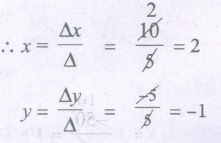
\(z=\cfrac { \Delta z }{ \Delta } =\cfrac { 0 }{ 5 } =0\)
\(\therefore\)Solution set is (2, -1, 0)
4.
Let the cost of lkg of wheat be Rs. x, 1kg of sugar be Rs. y and lkg of rice be Rs. z.
By the given data,
2x + y = 100
x + z = 80
3x + 2y + z = 220
\(\Delta =\left| \begin{matrix} 2 & 1 & 0 \\ 1 & 0 & 1 \\ 3 & 2 & 1 \end{matrix} \right| =2\left| \begin{matrix} 0 & 1 \\ 2 & 1 \end{matrix} \right| -1\left| \begin{matrix} 1 & 1 \\ 3 & 1 \end{matrix} \right| +0\)
= 2 (0 - 2) -1 (1 - 3) + 0
= 2(-2) - 1(- 2)
= - 4 + 2 = -2
\(\Delta x=\left| \begin{matrix} 100 & 1 & 0 \\ 80 & 0 & 1 \\ 220 & 2 & 1 \end{matrix} \right| =100\left| \begin{matrix} 0 & 1 \\ 2 & 1 \end{matrix} \right| -1\left| \begin{matrix} 80 & 1 \\ 220 & 1 \end{matrix} \right| +0\)
= 100(0 - 2) - 1 (80 - 220)
= 100(- 2) - 1(- 140)
= - 200 + 140 = - 60.
\(\Delta y=\left| \begin{matrix} 2 & 100 & 0 \\ 1 & 80 & 1 \\ 3 & 220 & 1 \end{matrix} \right| =2\left| \begin{matrix} 80 & 1 \\ 220 & 1 \end{matrix} \right| -100\left| \begin{matrix} 1 & 1 \\ 3 & 1 \end{matrix} \right| +0\)
= 2 (80 - 220) - 100 (1 - 3)
= 2 (- 140) - 100 (-2)
= - 280 + 200 = - 80.
\(\Delta z=\left| \begin{matrix} 2 & 1 & 100 \\ 1 & 0 & 80 \\ 3 & 2 & 220 \end{matrix} \right| \)
\(2\left| \begin{matrix} 0 & 80 \\ 2 & 220 \end{matrix} \right| -1\left| \begin{matrix} 1 & 80 \\ 3 & 220 \end{matrix} \right| +100\left| \begin{matrix} 1 & 0 \\ 3 & 2 \end{matrix} \right| \)
= 2(0 - 160) - 1(220 - 240) + 100(2 - 0)
= 2(- 160) - 1(- 20) + 100(2)
= - 320 + 20 + 200
= -100
\(x=\cfrac { \Delta x }{ \Delta } =\cfrac { -60 }{ -2 } =30\)
\(y=\cfrac { \Delta y }{ \Delta } =\cfrac { -80 }{ -2 } =40\)
\(z=\cfrac { \Delta z }{ \Delta } =\cfrac { -100 }{ -2 } =50\)
\(\therefore\) The cost of 1 kg of wheat is Rs. 30
The cost of 1 kg sugar is Rs. 40 and The cost of 1 kg of rice is Rs. 50
5.
x +y + z = 1, 3x - y - z = 4, x + 5y + 5z = k
| Augmented matrix [A,B] |
Elementary Transformation |
|---|---|
| \(\left( \begin{matrix} 1 & 1 & 1 \\ 3 & -1 & -1 \\ 1 & 5 & 5 \end{matrix}\begin{matrix} 1 \\ 4 \\ k \end{matrix} \right) \) | |
| \(\sim \left( \begin{matrix} 1 & 1 & 1 \\ 0 & -4 & -4 \\ 0 & 4 & 4 \end{matrix}\begin{matrix} 1 \\ 1 \\ k-1 \end{matrix} \right) \) | \({ R }_{ 2 }\rightarrow { R }_{ 3 }-3{ R }_{ 1 }\) \({ R }_{ 3 }\rightarrow { R }_{ 3 }-{ R }_{ 1 }\) |
| \(\sim \left( \begin{matrix} 1 & 1 & 1 \\ 0 & -4 & -4 \\ 0 & 0 & 0 \end{matrix}\begin{matrix} 1 \\ 1 \\ k \end{matrix} \right) \) | \({ R }_{ 3 }\rightarrow { R }_{ 3 }+{ R }_{ 2 }\) |
Here clearly \(\rho (A)=2\)
Since the given system is inconsistent \(\rho (A)\neq \rho (A,B)\)
This can take any value other than zero.
\(\therefore\) k can take any value other than zero.

12th Standard Syllabus & Materials
12th Standard
TN 12th Computer Applications வலையமைப்பு வடமிடல் Sample Question Papers Study Material - QB365 Set A
NEW12th Standard
TN 12th Computer Applications களப்பெயர் முறைமை (DNS) Sample Question Papers Study Material - QB365 Set A
NEW12th Standard
TN 12th Computer Applications வலையமைப்பு எடுத்துக்காட்டுகள் மற்றும் நெறிமுறைகள் Sample Question Papers Study Material - QB365 Set A
NEW12th Standard
TN 12th Computer Applications கணினி வலையமைப்பு ஓர் அறிமுகம் Sample Question Papers Study Material - QB365 Set A



Tamilnadu Stateboard 12th Standard Subjects

Maths

Chemistry

Physics

Biology

Computer Science
Business Maths and Statistics

Economics

Commerce

Accountancy

History

Computer Applications
Biology
Computer Technology
Computer Applications
Computer Science
Business Maths and Statistics
Commerce
Economics
Maths
Chemistry
Physics
Computer Technology
History
Accountancy

Tamil

English

French
Tamilnadu Stateboard Standards


