
 100% FREE ACCESS
12th Standard Syllabus & Materials
12th Standard
TN 12th Computer Applications மின்னணு தரவு பரிமாற்றம் Sample Question Papers Study Material - QB365 Set A
NEW12th Standard
TN 12th Computer Applications மின் - வணிக பாதுகாப்பு அமைப்புகள் Sample Question Papers Study Material - QB365 Set A
NEW12th Standard
TN 12th Computer Applications மின்னணு செலுத்தல் முறைகள் Sample Question Papers Study Material - QB365 Set A
NEW12th Standard
TN 12th Computer Applications மின் - வணிகம் Sample Question Papers Study Material - QB365 Set A
NEW12th Standard
TN 12th Computer Applications திறந்த மூல கருத்துருக்கள் Sample Question Papers Study Material - QB365 Set A
NEW12th Standard
TN 12th Computer Applications வலையமைப்பு வடமிடல் Sample Question Papers Study Material - QB365 Set A

Published on: 23/06/2021
QB365 provides detailed and simple solution for every
Creative Questions in class 12 Business Maths Subject.It will helps to get more idea about question pattern in
every Creative questions with solution.
Download Tamil Nadu 12th Standard Business Maths and Statistics question papers, model tests, one-mark questions, important questions, and public exam papers in PDF format. Free study materials and answer keys for TN State Board students.
Questions + Answers key
Take MCQ Business Maths and Statistics Test
1.
Calculate the 3-yearlymoving averages of the production figures (in tonnes) for the following data.
| Year | 1973 | 1974 | 1975 | 1976 | 1977 | 1978 | 1979 | 1980 | 1981 | 1982 | 1983 | 1984 | 1985 | 1986 | 1987 |
| Production | 15 | 21 | 30 | 36 | 42 | 46 | 50 | 56 | 63 | 70 | 74 | 82 | 90 | 95 | 102 |
2.
Out of 1000 T.V. viewers, 320 watched a particular programme. Calculate the standard error.
3.
If the mean of the binomial distribution is 20 and standard deviation is 4, then find the number of events.
4.
Determine whether the following is a probability distribution of a random variable X.
| X | 0 | 1 | 2 |
| P(X) | 0.6 | 0.1 | 0.2 |
5.
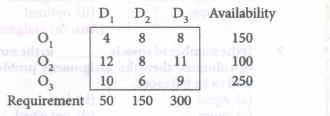
Determine an initial basic feasible solution to the following transportation problem using feast cost method.
6.
Evaluate \(\int { \frac { 2{ cos }^{ 2 }x-cos2x }{ { sin }^{ 2 }x } } \)
7.
Write down the order and degree of the following differential equations.
\(\left( \frac { dy }{ dx } \right) ^{ 2 }-7\frac { d^{ 3 }y }{ { dx }^{ 3 } } +y\frac { { d }^{ 2 }y }{ dx^{ 2 } } +4\frac { dy }{ dx } \)- log x = 0
8.
Find the missing term from the following data.
| x | 20 | 30 | 40 |
| y | 51 | - | 34 |
9.
Find the area under the curve y = 4x2 - 8x + 6 bounded by the Y-axis, X-axis and the ordinate at x = 2.
10.
Solve: x + 2y = 3 and 2x + 4y = 6 using rank method.
1.
| Year | Production | 3-yearly moving total | 3-yearly moving average |
| 1973 | 15 | - | - |
| 1974 | 21 | 22.00 | |
| 1975 | 30 | 66 | 29.00 |
| 1976 | 36 | 87 | 36.00 |
| 1977 | 42 | 108 | 41.33 |
| 1978 | 46 | 124 | 46.00 |
| 1979 | 50 | 138 | 50.67 |
| 1980 | 56 | 152 | 56.33 |
| 1981 | 63 | 169 | 63.00 |
| 1982 | 70 | 189 | 69.00 |
| 1983 | 74 | 207 | 75.33 |
| 1984 | 82 | 226 | 82.00 |
| 1985 | 90 | 246 | 89.00 |
| 1986 | 95 | 267 | 95.67 |
| 1987 | 102 | 287 | - |
2.
Sample size n = 1000
Sample proportion of T.V. viewers
p=\(\frac { 320 }{ 1000 } \)=0.32
∴ q = 1 - P = 1 - 0.32 =0.68
Standard error = \(\sqrt { \frac { pq }{ n } } =\sqrt { \frac { (.32)(.68) }{ 1000 } } \)
S.E = 0.0147
3.
Given mean 20 ⇒ np = 20
S.D = 4 ⇒ \(\sqrt { npq } \) = 4
∴ \(\frac { npq }{ np } =\frac { 16 }{ 20 } \Rightarrow q=\frac { 4 }{ 5 } \)
P = 1-q =\(1-\frac { 4 }{ 5 } =\frac { 1 }{ 5 } \)
Substitutingp and q in npq = 16, we get
\(n\times \frac { 1 }{ 5 } \times \frac { 4 }{ 5 } \) =16
n = \(\frac { 16\times 5\times 5 }{ 4 } \) = 100
∴ Number of events = 100
4.
P(X = 0) + P(X = 1) + P(X = 2)
= 0.6 + 0.1 + 0.2 = 0.9 ≠ 1
Hence the given distribution of probabilities is not a probability distribution.
5.
Here total availability = 150 + 100 + 250 = 500
total requirement = 50 + 150 + 300 = 500
∴ Total availability = total requirement
∴ The given problem is a balanced transportation problem
Hence, there exists a feasible solution to the given problem
I - allocation:
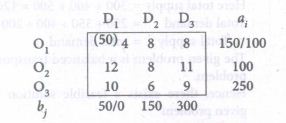
[∵ least cost is 4 & min (50,150) = 50]
II - allocation:
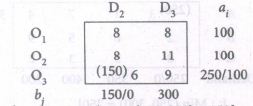
[∵ least cost is 6 & min (150, 250) = 150]
III - allocation:
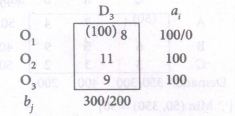
[∵ least cost is 8 & min (300, 100) = 100]
IV - allocation:
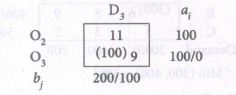
[∵ least cost is 9 & min (200,100) = 100]
V - allocation:
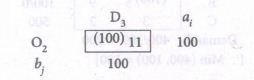
[∵ min (100, 100) = 100]
Thus, the allocations are
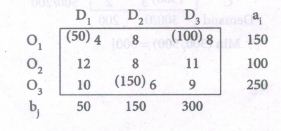
∴ The transportation schedule is
O1 → D1, O1 → D3, O2 → D3, O3 → D2, O3 → D3
Hence, the total transportation cost is
= 50(4) + 100(8) + 100(11) + 150(6) + 100(9)
= 200 + 800 + 1100 + 900 + 900
= Rs. 3900
6.
∴ \(\int { \frac { 2{ cos }^{ 2 }x-cos2x }{ { sin }^{ 2 }x } } \)
= \(\int { \frac { 2{ cos }^{ 2 }x-\left( 2{ cos }^{ 2 }x-1 \right) }{ { sin }^{ 2 }x } } \)
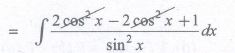
= \(\int { \frac { 1 }{ { sin }^{ 2 }x } } dx\)
= ∫ cosec2 x dx
= -cot x + c
7.
The highest derivative if of order 3 and its power is 1
∴ order is 3 and degree is 1.
8.
Since only two values of yare given, the polynomial which fits the data is of degree 1.
Hence 2nd differences are zeros
∴ Δ2(y0) = 0
⇒ (E-1)2yo=0
⇒(E2 - 2E + 1) yo = 0
⇒y2 - 2y1 +yo = 0
⇒34 - 2y1 + 51 = 0
⇒85 - 2y1 =0
⇒2y1 + 85 ⇒ y1 = \(\frac{85}{2}\)
⇒y1 = 42.5
9.
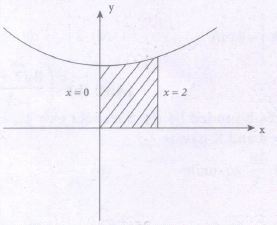
The Y-axis is the ordinate at x = 0.
The area bounded by the ordinates at x = 0, x = 2 and the given curve is
\(A=\int _{ a }^{ b }{ y } dx\)
\(=\int _{ 0 }^{ 2 }{ ({ 4x }^{ 2 }-8x+6)dx } \)
\(={ \left[ \frac { { 4x }^{ 3 } }{ 3 } -\frac { 8{ x }^{ 2 } }{ 2 } +6x \right] }_{ 0 }^{ 2 }\)
\(=4\left( \frac { 8 }{ 3 } \right) -4(4)+6(2)\)
\(\frac { 32 }{ 3 } -6+12=\frac { 32 }{ 3 } -4\)
\(=\frac { 32-12 }{ 3 } =\frac { 20 }{ 3 } \)
∴ Area \(=\frac { 20 }{ 3 } \)sq.units
10.
The non-homogeneous equations are
x + 2y = 3, 2x + 4y = 6
| Augmented matrix [A, b] | Elementary Transformation |
| \(\left( \begin{matrix} 1 & 2 & 3 \\ 2 & 4 & 6 \end{matrix} \right) \) | |
| \(-\left( \begin{matrix} 1 & 2 & 3 \\ 0 & 0 & 0 \end{matrix} \right) \) | \({ R }_{ 2 }\rightarrow { R }_{ 2 }-2{ R }_{ 1 }\) |
Here \(\rho (A)=1\) and \(\rho \left( \left[ A,B \right] \right) =1\)
Since \(\rho (A)=\rho \left[ \left( A,B \right) \right] =1<\) Number of unknowns, the given system is consistent with infinitely many solutions.
To find the solution, let us rewrite the above echelon form into the matrix form, we get
\(\left( \begin{matrix} 1 & 2 \\ 0 & 0 \end{matrix} \right) \left( \begin{matrix} x \\ y \end{matrix} \right) =\left( \begin{matrix} 3 \\ 0 \end{matrix} \right) \)
\(\Rightarrow x+2y=3\)
let \(y=k,k\varepsilon R\)
\((1)\Rightarrow x+2k=3\Rightarrow x=3-2k\)
\(\therefore\) Solution set is \(\left\{ 3-2k,k \right\} ,k\epsilon R\)
For different values of k; we get infinite number of solutions

12th Standard Syllabus & Materials
12th Standard
TN 12th Computer Applications களப்பெயர் முறைமை (DNS) Sample Question Papers Study Material - QB365 Set A
NEW12th Standard
TN 12th Computer Applications வலையமைப்பு எடுத்துக்காட்டுகள் மற்றும் நெறிமுறைகள் Sample Question Papers Study Material - QB365 Set A
NEW12th Standard
TN 12th Computer Applications கணினி வலையமைப்பு ஓர் அறிமுகம் Sample Question Papers Study Material - QB365 Set A
NEW12th Standard
TN 12th Computer Applications PHP-உடன் MySQL-ஐ இணைத்தல் Sample Question Papers Study Material - QB365 Set A



Tamilnadu Stateboard 12th Standard Subjects

Maths

Chemistry

Physics

Biology

Computer Science
Business Maths and Statistics

Economics

Commerce

Accountancy

History

Computer Applications
Biology
Computer Technology
Computer Applications
Computer Science
Business Maths and Statistics
Commerce
Economics
Maths
Chemistry
Physics
Computer Technology
History
Accountancy

Tamil

English

French
Tamilnadu Stateboard Standards


