
 100% FREE ACCESS
12th Standard Syllabus & Materials
12th Standard
TN 12th Maths Applications of Matrices and Determinants Sample Question Papers Study Material - QB365 Set A
NEW12th Standard
TN 12th Computer Applications மின்னணு தரவு பரிமாற்றம் Sample Question Papers Study Material - QB365 Set A
NEW12th Standard
TN 12th Computer Applications மின் - வணிக பாதுகாப்பு அமைப்புகள் Sample Question Papers Study Material - QB365 Set A
NEW12th Standard
TN 12th Computer Applications மின்னணு செலுத்தல் முறைகள் Sample Question Papers Study Material - QB365 Set A
NEW12th Standard
TN 12th Computer Applications மின் - வணிகம் Sample Question Papers Study Material - QB365 Set A
NEW12th Standard
TN 12th Computer Applications திறந்த மூல கருத்துருக்கள் Sample Question Papers Study Material - QB365 Set A

Published on: 13/05/2022
QB365 provides detailed and simple solution for every
Creative Questions in class 12 Business Maths Subject.It will helps to get more idea about question pattern in
every Creative questions with solution.
Download Tamil Nadu 12th Standard Business Maths and Statistics question papers, model tests, one-mark questions, important questions, and public exam papers in PDF format. Free study materials and answer keys for TN State Board students.
Questions + Answers key
Take MCQ Business Maths and Statistics Test
1.
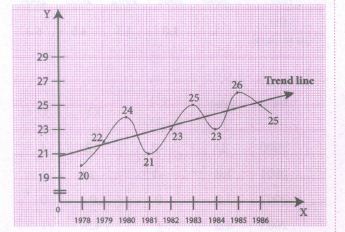
Fit a trend line to the following data by graphic method.
| Year | 1978 | 1979 | 1980 | 1981 | 1982 | 1983 | 1984 | 1985 | 1986 |
| Production of steel | 20 | 22 | 24 | 21 | 23 | 25 | 23 | 26 | 25 |
2.
A sample of five measurements of the diameter of a sphere were recorded by a scientist as 6.33, 6.37,6.36,6.32 and 6.37 mm. Determine the point estimate of
(a) mean
(b) variance.
3.
If a random variable X follows Poisson distribution such that P(X = 2) = 9. P(X = 4) + 90 P(X = 6) then find the mean and variance.
4.
A random variable. X has following distribution
| X | -1 | 0 | 1 | 2 |
| P(X=x) | \(\frac{1}{3}\) | \(\frac{1}{6}\) | \(\frac{1}{6}\) | \(\frac{1}{3}\) |
Find E(2X+3)2
5.
For the given pay-off matrix, choose the best alternative for the given states of nature under
(i) Maximin (ii) Minimax princple
| Alternative | States of Nature | ||
| Good | Fair | Bad | |
| A | 100 | 60 | +50 |
| B | 80 | 50 | +10 |
| C | 40 | 20 | +5 |
6.
Evaluate \(\int { \frac { cos2x-cos2\alpha }{ cosx-cos\alpha } } dx\)
7.
Form the differential equation for y = (A + Bx)e3x where A and B are constants.
8.
Using graphic method, find the value of y when x=27.
| x | 10 | 15 | 20 | 25 | 30 |
| y | 35 | 32 | 29 | 26 | 23 |
9.
Find the area under the demand curve xy = 1 bounded by the ordinates x = 3, x = 9 and x-axis
10.
Find the rank of the matrix \(A=\left( \begin{matrix} 1 & 2 & -4 \\ 2 & -1 & 3 \\ 8 & 1 & 9 \end{matrix}\begin{matrix} 5 \\ 6 \\ 7 \end{matrix} \right) \)
1.
2.
Sample mean \(\bar { x } =\frac { \Sigma x }{ n } \)
= \(\frac { 6.35+6.37+6.36+6.32+6.37 }{ 5 } \)
= \(\frac { 31.75 }{ 5 } \) = 6.35 mm
| X | X-\(\bar { x } \) | (X-\(\bar { x } \))2 |
| 6.33 | 0.02 | 0.0004 |
| 6.33 | 0.02 | 0.0004 |
| 6.36 | 0.01 | 0.0001 |
| 6.32 | -6.32 | 0.0009 |
| 6.37 | 0.02 | 0.0004 |
| 0.0023 |
Sample variance = \(\frac { 1 }{ n-1 } \Sigma (x-\bar { x } )^{ 2 }=\frac { 0.0023 }{ 4 } \)
= 0.00055
n = 0.0055 mm2
3.
Given P(X = 2) = 9 P(X = 4) + 90 P(X = 6)
Since X follows Poisson distribution with
P(X,λ) = \(\frac { { e }^{ -\lambda }.{ \lambda }^{ 0 } }{ x! } \)
\(\frac { { e }^{ -\lambda }.{ \lambda }^{ 2 } }{ 2! } =\frac { { e }^{ -\lambda }.{ \lambda }^{ 4 } }{ 4! } +\frac { { 90e }^{ -\lambda }.{ \lambda }^{ 6 } }{ 6! } \)
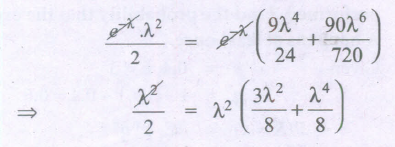
⇒ \(\frac { 1 }{ 2 } =\frac { 3{ \lambda }^{ 2 }+\lambda ^{ 4 } }{ 8 } \)
⇒ λ4+3λ2 = 4
⇒ λ4+ 3λ2-4 = 0
Put λ2 = t
⇒ t2 + 3t-4 = 0 ⇒ (t-1)(t + 4) = 0
⇒ t = 1 or t = -4
∴ t = 1 [t = -4 is not possible]
∴ λ2 = 1 ⇒ λ = 1
∴ Mean = 1
For Poisson distribution, mean = variance = 1
4.
\(E(X)=\sum { xp(x)=-1(\frac { 1 }{ 3 } )+0(\frac { 1 }{ 6 } )+1(\frac { 1 }{ 6 } )+2\left( \frac { 1 }{ 3 } \right) } \)
\(=\frac { -1 }{ 3 } +\frac { 1 }{ 6 } +\frac { 2 }{ 3 } =\frac { -2+1+4 }{ 6 } \)
\(=\frac { 3 }{ 6 } =\frac { 1 }{ 2 } \)
\(E({ X }^{ 3 })={ \sum { x } }^{ 2 }p(x)\)
\(=1(\frac { 1 }{ 3 } )+0(\frac { 1 }{ 6 } )+1(\frac { 1 }{ 6 } )+4(\frac { 1 }{ 3 } )\)
\(=\frac { 1 }{ 3 } +\frac { 1 }{ 6 } +\frac { 4 }{ 3 } =\frac { 2+1+8 }{ 6 } =\frac { 11 }{ 6 } \)
\(\therefore E{ (2X+3) }^{ 2 }=E(4{ X }^{ 2 }+12X+9)\)
\(=4\left( \frac { 11 }{ 6 } \right) +12\left( \frac { 1 }{ 2 } \right) +9\)
\(=\frac { 22 }{ 3 } +6+9=\frac { 22 }{ 3 } +15\)
\(=\frac { 22+45 }{ 3 } =\frac { 67 }{ 3 } \)
\(\therefore E(2X+3{ ) }^{ 2 }=\frac { 67 }{ 3 } \)
5.
| Alternative | States of Nature | Minimum | Maximum | ||
| Good | Fair | Bad | |||
| A | 100 | 60 | +50 | +50 | 100 |
| B | 80 | 50 | +10 | 10 | 80 |
| C | 40 | 20 | +5 | 5 | 40 |
(i) Max (50, 10, 5) = 50
∴ A is the best alternative under maximin principle
(ii) Min (100, 80,40) = 40
∴ C is the best alternative under minimax principle
6.
\(\int { \frac { cos2x-cos2\alpha }{ cosx-cos\alpha } } dx\)
= \(\frac { ({ 2cos }^{ 2 }x-1)-({ 2cos }^{ 2 }\alpha -1) }{ cos\quad x-cos\alpha } dx\)
= \(\frac { { 2cos }^{ 2 }x-cos^{ 2 }\alpha }{ cos\quad x-cos\alpha } \)
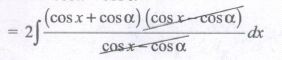
= \(2\int { (cos\quad x+cos\alpha )dx } \)
= \(2[sinx+cos\alpha .x]+c\)
= \(2sinx+2xcos\alpha +c\)
7.
Given y = (A + Bx)e3x ....(1)
Differentiating w.r.t 'x' we get,
\(\frac { dy }{ dx } \)= (A+Bx)e3x(3)+e3x(B)
⇒ \(\frac { dy }{ dx } \) = 3y + Be3x [Using (1)]
⇒ Be3x = \(\frac { dy }{ dx } \)-3y
Differentiating again w.r.t 'x' we get,
\(\frac { d^{ 2 }y }{ { dx }^{ 2 } } =3\left( \frac { dy }{ dx } \right) \)+ Be3x(3)
⇒ \(\frac { d^{ 2 }y }{ { dx }^{ 2 } } =3\left( \frac { dy }{ dx } \right) +3\left[ \frac { dy }{ dx } -3y \right] \) [Using (2)]
⇒ \(\frac { d^{ 2 }y }{ { dx }^{ 2 } } =3\left( \frac { dy }{ dx } \right) +3\left( \frac { dy }{ dx } \right) \)-9y
⇒ \(\frac { d^{ 2 }y }{ { dx }^{ 2 } } =6\left( \frac { dy }{ dx } \right) \)-9y which is the required differential equation.
8.
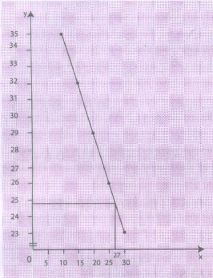
From the graph, it is clear that when x = 27, the value of y is 24.8
9.
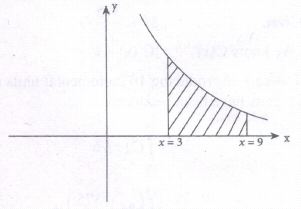
Area \(=\int _{ a }^{ b }{ ydx } \)
\(=\int _{ 3 }^{ 9 }{ \frac { 1 }{ x } dx } \)
\(={ [log\quad x] }_{ 3 }^{ 9 }\)
= log9-log3
\(=log\left( \frac { 9 }{ 3 } \right) \)
A = log 3 sq.units.
10.
The order of A is 3 x 4
\(\therefore \rho (A)\le min\left( 3,4 \right) \)
\(\rho (A)\le 3\)
Consider the third order minor
\(\left| \begin{matrix} 1 & 2 & -4 \\ 2 & -1 & 3 \\ 8 & 1 & 9 \end{matrix} \right| =1\left| \begin{matrix} -1 & 3 \\ 1 & 9 \end{matrix} \right| -2\left| \begin{matrix} 2 & 3 \\ 8 & 9 \end{matrix} \right| -4\left| \begin{matrix} 2 & -1 \\ 8 & 1 \end{matrix} \right| \)
= 1(- 9 - 3) - 2(18 - 24) - 4(2 + 8)
= 1 (-12) - 2 (- 6) - 4 (10)
= - 12 + 12 - 40
= - 40::\(\neq \) 0.
There is a minor of order 3, which is not zero
\(\therefore \rho (A)=3\)

12th Standard Syllabus & Materials
12th Standard
TN 12th Computer Applications வலையமைப்பு வடமிடல் Sample Question Papers Study Material - QB365 Set A
NEW12th Standard
TN 12th Computer Applications களப்பெயர் முறைமை (DNS) Sample Question Papers Study Material - QB365 Set A
NEW12th Standard
TN 12th Computer Applications வலையமைப்பு எடுத்துக்காட்டுகள் மற்றும் நெறிமுறைகள் Sample Question Papers Study Material - QB365 Set A
NEW12th Standard
TN 12th Computer Applications கணினி வலையமைப்பு ஓர் அறிமுகம் Sample Question Papers Study Material - QB365 Set A



Tamilnadu Stateboard 12th Standard Subjects

Maths

Chemistry

Physics

Biology

Computer Science
Business Maths and Statistics

Economics

Commerce

Accountancy

History

Computer Applications
Biology
Computer Technology
Computer Applications
Computer Science
Business Maths and Statistics
Commerce
Economics
Maths
Chemistry
Physics
Computer Technology
History
Accountancy

Tamil

English

French
Tamilnadu Stateboard Standards


