
 100% FREE ACCESS
12th Standard Syllabus & Materials
12th Standard
TN 12th Computer Applications மின்னணு தரவு பரிமாற்றம் Sample Question Papers Study Material - QB365 Set A
NEW12th Standard
TN 12th Computer Applications மின் - வணிக பாதுகாப்பு அமைப்புகள் Sample Question Papers Study Material - QB365 Set A
NEW12th Standard
TN 12th Computer Applications மின்னணு செலுத்தல் முறைகள் Sample Question Papers Study Material - QB365 Set A
NEW12th Standard
TN 12th Computer Applications மின் - வணிகம் Sample Question Papers Study Material - QB365 Set A
NEW12th Standard
TN 12th Computer Applications திறந்த மூல கருத்துருக்கள் Sample Question Papers Study Material - QB365 Set A
NEW12th Standard
TN 12th Computer Applications வலையமைப்பு வடமிடல் Sample Question Papers Study Material - QB365 Set A

Published on: 23/06/2021
QB365 provides detailed and simple solution for every
Creative Questions in class 12 Business Maths Subject.It will helps to get more idea about question pattern in
every Creative questions with solution.
Download Tamil Nadu 12th Standard Business Maths and Statistics question papers, model tests, one-mark questions, important questions, and public exam papers in PDF format. Free study materials and answer keys for TN State Board students.
Questions + Answers key
Take MCQ Business Maths and Statistics Test
1.
The followingdata relateto the life(inhours) of 10 samples of 6 electricbulbs each drawn at an intervalof one hour from a production process.Draw the controlchart for \(\overline { X } \) and \(\overline { R } \) and comment.
| Sample No | Lifetime (inhour) | |||||
| 1 | 2 | 3 | 4 | 5 | 6 | |
| 1 | 620 | 687 | 666 | 689 | 738 | 686 |
| 2 | 501 | 585 | 524 | 585 | 653 | 668 |
| 3 | 673 | 701 | 686 | 567 | 619 | 660 |
| 4 | 646 | 626 | 572 | 628 | 631 | 743 |
| 5 | 494 | 984 | 659 | 643 | 660 | 640 |
| 6 | 634 | 755 | 625 | 582 | 683 | 555 |
| 7 | 619 | 710 | 664 | 693 | 770 | 534 |
| 8 | 630 | 723 | 614 | 535 | 550 | 570 |
| 9 | 482 | 791 | 533 | 612 | 497 | 499 |
| 10 | 706 | 524 | 626 | 503 | 661 | 754 |
(For n = 6,A2= 0.483,D3 = 0,D4 = 2.004)
2.
A sample poll of 100 voters chosen at random from all voters in a given district indicated that 55% of them were in favour of a particular candidate. Find
(a) 95% confidence limits
(b) 99% confidence limits for the proportion to all voters in favour of this candidate.
3.
If the height of 300 students are normally distributed with mean 64.5 inches and standard deviation 3.3 inches find the height below which 99% of the student lie?
4.
Consider the problem of assigning five jobs to five persons. The assignment costs are given as follows. Determine the optimum assignment.
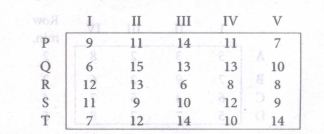
5.
The random variable X tan take only the values 0,1,2. Given that P(X = 0) = P(X = 1) = P and E(X2) = E(X), find the value of p.
6.
Evaluate \(\int _{ 0 }^{ \frac { \pi }{ 4 } }{ sin } 3xsin\ 2x\ dx\)
7.
The total cost of production y and the level of output x are related to the marginal cost of production by the equation (6x2+2y2)dx-(x2+4xy)dy = 0. What is the relation between total cost and output if y = 2 when x = 1?
8.
Using Lagrange's formula find the value of y when x = 4 from the following table.
| x | 0 | 3 | 5 | 6 | 8 |
| y | 276 | 460 | 414 | 343 | 110 |
9.
The marginal revenue function (in thousands of rupees) of a commodity is 7+e-0.05x where x is the number of units sold. Find the total revenue from the sale of 100 units (e-5 = 0.0067)
10.
A new transit system has just gone into operation in a city. Of those who use the transit system this year, 10% will switch over to using their own car next year and 90% will continue to use the transit system. Of those who use their cars this year, 80% will continue to use their cars next year and 20% will switch over to the transit system. Suppose the population of the city remains constant and that 50% of the commuters use the transit system and 50% of the commuters use their own car this year,
(i) What percent of commuters will be using the transit system after one year?
(ii) What percent of commuters will be using the transit system in the long run?
1.
| Sample No | Total | \(\overline { X } \) | R = Xmax - Xmin |
| 1 | 4086 | 681 | 118 |
| 2 | 3516 | 586 | 167 |
| 3 | 3906 | 651 | 134 |
| 4 | 3846 | 641 | 171 |
| 5 | 4080 | 680 | 490 |
| 6 | 3834 | 639 | 200 |
| 7 | 3990 | 665 | 236 |
| 8 | 3622 | 604 | 188 |
| 9 | 3414 | 569 | 309 |
| 10 | 3774 | 629 | 251 |
| 6345 | 2264 |
\(\bar{\bar{X}}\) = 634.5, \(\bar{R}\) = 226.4
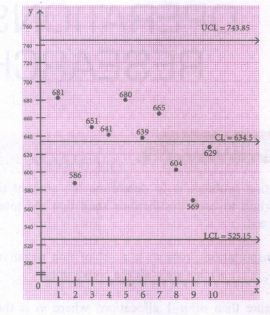
Control limits for \(\overline { X } \) - chart are
UCL = \(\bar{\bar{X}}\) + A2\(\bar{R}\)
= 634.5+ 0.483x 226.4
= 743.85
CL = 634.5
LCL = \(\bar{\bar{X}}\)- A2\(\bar{R}\) = 525.15
Control limits of R-chart are
UCL = D4\(\bar{R}\) = 2.004 x226.4
= 453.7056
CL = 226.4
LCL = D3\(\bar{R}\) = 0
\(\overline { X } \)-chart
R - chart
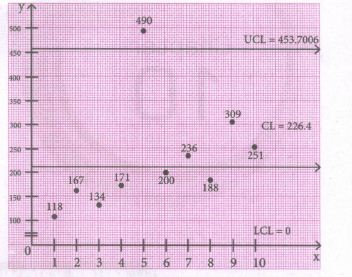
Conclusion: Since one point in R-chart lie outside the control limits, the given system is not in control
2.
Given p = \(\frac { 55 }{ 100 } \)
∴ q = \(\frac { 45 }{ 100 } \) and n = 100
Standard error = \(\sqrt { \frac { pq }{ n } } =\sqrt { \frac { \frac { 55 }{ 100 } \times \frac { 45 }{ 100 } }{ 100 } } \)
= 0.0497
(a) As the level of significance α = 0.05 \(Z_{ \frac { \alpha }{ 2 } }\) = 1.96
∴ 95% confidence limits for proportion is given by \(p-Z_{ \frac { \alpha }{ 2 } }(S.E)\le p\ge p+Z_{ \frac { \alpha }{ 2 } }(S.E)\)
⇒ 0.55 - (1.96) (0.0497) ≤ p ≤ 0.55 + (1.96) (0.0497)
⇒ 0.453 ≤ p ≤ 0.647
∴ 95% confidence interval for proportion is (0.45, 0.65)
(b) As the level of significance is α = 0.01, \(Z_{ \frac { \alpha }{ 2 } }\) = 2.58
∴ 99% confidence limits for proportion is given by \(p-Z_{ \frac { \alpha }{ 2 } }(S.E)\le p\ge p+Z_{ \frac { \alpha }{ 2 } }(S.E)\)
⇒ 0.55 - (2.58) (0.0497) ≤ p ≤ 0.55 + (2.58) (0.0497)
⇒ 0.422 ≤ p ≤ 0.678
Hence, 99% confidence interval for proportion is (0.42, 0.68).
3.
Let X denote the height of the student
Given μ = 64.5 inches and σ = 3.3 inches
Given that P(-∞ < Z < C) = 0.99
⇒ P( -∞ < Z < 0) + P (0 < Z < C) = 0.99
⇒ 0.5 + P (0 < Z < C) = 0.99
⇒ P(0 < Z < C) = 0.99 - 0.5 = 0.49...(1)
From the standard normal distribution table
P(0 < Z < 2.33) = 0.49...(2)
From (1) & (2), C = 2.33
we know that Z = \(\frac { X-\mu }{ \sigma } \)
⇒ 2.33 = \(\frac { X-64.5 }{ 3.3 } \)
⇒ X = (2.33) (3.3) + 64.5
⇒ X = 72.19 inches
Hence, the height below which 99% of the student lie is 72.19 inches.
4.
Here the number of rows and columns are equal.
∴ The given assignment problem is balanced.
Step 1 :
Select a smallest element in each row and subtract this from all the elements in its row.
∴ The cost matrix of the given assignment problem is
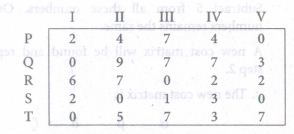
Here column IV has no zero. Go to step 2.
Step 2:
Select the smallest element in each column and subtract this from all the elements in its column.
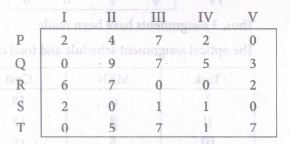
Since each row and column contains atleast one zero, assignments can be made.
Step 3:
Examine the row with exactly one zero. Mark the zero by \(\Box \) and draw a vertical line. After examining all the rows examine the column with one zero. mark the zero by \(\Box\) and draw a horizontal line.
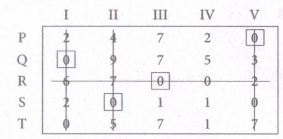
Here only 4 assignments have been made.
The numbers not lying on the line are
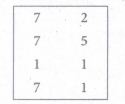
and min. of these numbers is 1.
Now subtract 1 from all these numbers and add 1 to the numbers on the intersecting line (ie. 6, 7, 2). Other numbers remains the same.
∴ The new cost matrix is
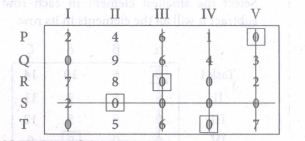
Now, repeat Step 3.
Thus, all the 5 assignments have been made.
The optimal assignment schedule and total cost is
| Person | Job | Cost |
| P | V | 7 |
| Q | I | 6 |
| R | III | 6 |
| S | II | 9 |
| T | IV | 10 |
| Total Cost | Rs. 38 | |
5.
Clearly P(X = 0) + P(X = 1) + P(X = 2)= 1
p + P + P(X = 2) =1
2p + P(X = 2) = 1
P(X = 2) = 1 - 2p
so, probability distribution of X is
| X | 0 | 1 | 2 |
| P(X) | p | p | 1-2p |
∴ E(X) = 0xp+1xp+2(1-2p)
= p+2-4p = 2-3p
and E(X2) = 0xp+1(p)+4(1-2p)
= p+4-8p = 4-7p
Since E(X2) = E(X)we get,
4-7p = 2-3p ⇒ 4-2 = -3p+7p
⇒2 = 4p ⇒ p =\(\frac{2}{4}=\frac{1}{2}\)
∴ p = \(\frac{1}{2}\)
6.
Let I = \(\int _{ 0 }^{ \frac { \pi }{ 4 } }{ sin } 3x\ sin\ 2x\ dx\)
= \(\frac { 1 }{ 2 } \int _{ 0 }^{ \frac { \pi }{ 4 } }{ 2sin } 3xsin2x\quad dx\)
= \(\frac { 1 }{ 2 } \int _{ 0 }^{ \frac { \pi }{ 4 } }{ \left[ cos(3x-2x)-cos(3x+2x) \right] } dx\)
\(\left[ \because 2sin(sinD=cos(C-D))-cos(C+D) \right] \)
= \(\frac { 1 }{ 2 } \int _{ 0 }^{ \frac { \pi }{ 4 } }{ (cosx-cos5x)dx } \)
= \(\frac { 1 }{ 2 } { \left[ sinx-\frac { sin5x }{ 5 } \right] }_{ 0 }^{ \frac { \pi }{ 4 } }\)
= \(\frac { 1 }{ 2 } \left[ \left( sin\frac { \pi }{ 4 } -\frac { 1 }{ 5 } sin5\frac { \pi }{ 4 } \right) -\left( sin0-\frac { 1 }{ 5 } sin5(0) \right) \right] \)
= \(\frac { 1 }{ 2 } \left[ \frac { 1 }{ \sqrt { 2 } } -\frac { 1 }{ 5 } \left( \frac { -1 }{ \sqrt { 2 } } \right) \right] \quad \quad \left[ \because sin0=0 \right] \)
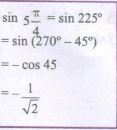
= \(\frac { 1 }{ 2 } \left[ \frac { 1 }{ \sqrt { 2 } } +\frac { 1 }{ 5\sqrt { 2 } } \right] \)
= \(\frac { 1 }{ 2 } \left( \frac { 5+1 }{ 5\sqrt { 2 } } \right) =\frac { 1 }{ 2 } \times \frac { 6 }{ 5\sqrt { 2 } } =\frac { 3 }{ 5\sqrt { 2 } } \times \frac { \sqrt { 2 } }{ \sqrt { 2 } } \)
= \(\frac { 3\sqrt { 2 } }{ 10 } \)
7.
Given (6x2+2y2)dx-(x2+4xy)dy = 0
⇒ (6x2+2y2)dx = (x2+4xy)dy
⇒ \(\frac { dy }{ dx } =\frac { 6{ x }^{ 2 }+2{ y }^{ 2 } }{ { x }^{ 2 }+4xy } \)
This is a homogeneous function of degree 2.
∴ Put y = vx and \(\frac { dy }{ dx } =v+x\frac { dv }{ dx } \)
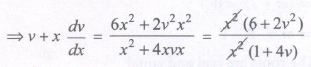
⇒ v+x\(\frac { dv }{ dx } =\frac { 6+2{ v }^{ 2 } }{ 1+4v } \)
⇒ x\(\frac { dv }{ dx } =\frac { 6+2v^{ 2 } }{ 1+4v } -v=\frac { 6+2v^{ 2 }-v(1+4v) }{ 1+4v } \)
=\(\frac { 6+2{ v }^{ 2 }-v-4{ v }^{ 2 } }{ 1+4v } \) ....(1)
⇒ x\(\frac { dv }{ dx } =\frac { 6-v-2v^{ 2 } }{ 1+4v } \)
Separating the variables we get,
\(\frac { (1+4v)dv }{ 6-v-2{ v }^{ 2 } } =\frac { dx }{ x } \)
[∵ t = 6-v-2v2 ⇒ dt = (-1-4v)dv, \(\int { \frac { dt }{ t } } \) = log t]
∴ -\(\int { \frac { (-1-4v)dv }{ 6-v-2v^{ 2 } } } =\int { \frac { dx }{ x } } \)
⇒ -log(6-v-2v2) = log x + log k
⇒ \(\frac { 1 }{ 6-v-2{ v }^{ 2 } } \) = kx
Replacing v by \(\frac{y}{x}\) we get, \(\frac { 1 }{ 6-\frac { y }{ x } -\frac { 2y^{ 2 } }{ { x }^{ 2 } } } \) = kx
⇒ \(\frac { { x }^{ 2 } }{ 6x^{ 2 }-xy-2y^{ 2 } } \) = kx
⇒ x = k(6x2-xy-2y2)
When x = 1, y = 2 ⇒
1 = k(6-2-8) ⇒ 1 = k(-4) ⇒ k = -\(\frac{1}{4}\)
⇒ x = \(\frac{1}{4}\)(6x2-xy-2y2)
⇒ 4x = 2y2+xy-6x2
8.
Given xo = 0, x1 = 3, x2 = 5, x3 = 6, x4 = 8
yo = 276, y1 = 460, y2 = 414, y3 = 343, y4 = 110
Lagrange's formula is
y = \(\frac { (x-{ x }_{ 1 })(x-{ x }_{ 2 })(x-{ x }_{ 3 })(x-{ x }_{ 4 }) }{ ({ x }_{ 0 }-{ x }_{ 1 })({ x }_{ 0 }-{ x }_{ 2 })({ x }_{ 0 }-{ x }_{ 3 })({ x }_{ 0 }-{ x }_{ 4 }) } { y }_{ 0 }+\frac { (x-{ x }_{ 0 })(x-{ x }_{ 2 })(x-{ x }_{ 3 })(x-{ x }_{ 4 }) }{ ({ x }_{ 1 }-{ x }_{ 0 })({ x }_{ 1 }-{ x }_{ 2 })({ x }_{ 1 }-{ x }_{ 3 })({ x }_{ 1 }-{ x }_{ 4 }) } { y }_{ 1 }+\frac { (x-{ x }_{ 0 })(x-{ x }_{ 1 })(x-{ x }_{ 3 })(x-{ x }_{ 4 }) }{ ({ x }_{ 2 }-{ x }_{ 0 })({ x }_{ 2 }-{ x }_{ 1 })({ x }_{ 2 }-{ x }_{ 3 })({ x }_{ 2 }-{ x }_{ 4 }) } { y }_{ 2 }+\frac { (x-{ x }_{ 0 })(x-{ x }_{ 1 })(x-{ x }_{ 3 })(x-{ x }_{ 4 }) }{ ({ x }_{ 3 }-{ x }_{ 0 })({ x }_{ 3 }-{ x }_{ 1 })({ x }_{ 3 }-{ x }_{ 2 })({ x }_{ 3 }-{ x }_{ 4 }) } { y }_{ 3 }+\frac { (x-{ x }_{ 0 })(x-{ x }_{ 2 })(x-{ x }_{ 3 })(x-{ x }_{ 4 }) }{ ({ x }_{ 4 }-{ x }_{ 0 })({ x }_{ 4 }-{ x }_{ 2 })({ x }_{ 4 }-{ x }_{ 3 })({ x }_{ 4 }-{ x }_{ 4 }) } { y }_{ 4 }\)
⇒ 276 \(\frac { (1)(-1)(-2)(-4) }{ (-3)(-5)(-6)(-8) } +460\frac { (4)(-1)(-2)(-4) }{ (3)(-2)(-3)(-5) } +414\frac { (4)(1)(-1)(-4) }{ (5)(2)(-1)(-3) } +343\frac { (4)(1)(-1)(-2) }{ (6)(3)(1)(-2) } +110\frac { (4)(1)(-1)(-2) }{ (8)(5)(3)(2) } \)
⇒ y = -3.066 + 163.555 + 441.6 - 152.44 + 3.666
⇒ y = 453.311.
9.
Given' R'(x) = 7 + e-0.05x
Total revenue from sale of 100 units is
\(R=\int _{ 0 }^{ 100 }{ (7+{ e }^{ -0.05x })dx } \)
\(={ \left[ 7x+\frac { { e }^{ -0.05x } }{ -0.05 } \right] }_{ 0 }^{ 100 }\)
\(=700-\frac { 100 }{ 5 } ({ e }^{ -5 }-{ e }^{ 0 })\left[ 0.05=\frac { 5 }{ 100 } \right] \)
= 700-20(0.0067-1)[∵e0=1]
= 700-0.134
= 719.866
Since the revenue is given in thousands,
Total revenue = 719.866 x 1000
= Rs. 7,19,866
10.
Let A represents the percent of commuters who use the transit system and B represents the percent of commuters who use their own car. Transition probability matrix
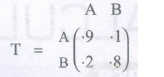
Given 50% of commuters use the transit system and 50% of the commuters use their own car this year.
(i) Percentage of commuters after one year
\(\left( \cdot 5\cdot 5 \right) \left( \begin{matrix} \cdot 9 & \cdot 1 \\ \cdot 2 & \cdot 8 \end{matrix} \right) \)
= (-5\(\times\)·9+·5\(\times\).2 ·5\(\times\)·1+·5\(\times\)·8)
= (-45 + ·10 ·05 +.40)
= (-55 - 45)
A = 55% and B = 45%
(ii) Equilibrium will be reached in the long run at equilibrium, we must have
(A B)T = (A B) wher A+B = 1
\(\Rightarrow \left( \begin{matrix} A & B \end{matrix} \right) \left( \begin{matrix} \cdot 9 & \cdot 1 \\ \cdot 2 & \cdot 8 \end{matrix} \right) =\left( \begin{matrix} A & B \end{matrix} \right) \)
\(\left( \begin{matrix} \cdot 9A+\cdot 2B & \cdot 1A+8B \end{matrix} \right) =\left( \begin{matrix} A & B \end{matrix} \right) \)
Equating the corresponding entries on both sides we get,
\(\cdot 9A+\cdot 2B=A\Rightarrow \cdot 9A+\cdot 2(1-A)=A\)
[Since A + B = 1, B = 1 -A]
\(\Rightarrow \cdot 9A+\cdot 2-\cdot 2A=A\)
\(\Rightarrow \cdot 2=A-\cdot 9A+\cdot 2A\)
\(\Rightarrow \cdot 2=A(1-\cdot 9+\cdot 2)\)
\(\Rightarrow \cdot 2=A=(\cdot 3)\)
\(\therefore\) 67% of the commuters will be using the transit system in the long run.

12th Standard Syllabus & Materials
12th Standard
TN 12th Computer Applications களப்பெயர் முறைமை (DNS) Sample Question Papers Study Material - QB365 Set A
NEW12th Standard
TN 12th Computer Applications வலையமைப்பு எடுத்துக்காட்டுகள் மற்றும் நெறிமுறைகள் Sample Question Papers Study Material - QB365 Set A
NEW12th Standard
TN 12th Computer Applications கணினி வலையமைப்பு ஓர் அறிமுகம் Sample Question Papers Study Material - QB365 Set A
NEW12th Standard
TN 12th Computer Applications PHP-உடன் MySQL-ஐ இணைத்தல் Sample Question Papers Study Material - QB365 Set A



Tamilnadu Stateboard 12th Standard Subjects

Maths

Chemistry

Physics

Biology

Computer Science
Business Maths and Statistics

Economics

Commerce

Accountancy

History

Computer Applications
Biology
Computer Technology
Computer Applications
Computer Science
Business Maths and Statistics
Commerce
Economics
Maths
Chemistry
Physics
Computer Technology
History
Accountancy

Tamil

English

French
Tamilnadu Stateboard Standards


