
 100% FREE ACCESS
12th Standard Syllabus & Materials
12th Standard
TN 12th Computer Applications மின்னணு தரவு பரிமாற்றம் Sample Question Papers Study Material - QB365 Set A
NEW12th Standard
TN 12th Computer Applications மின் - வணிக பாதுகாப்பு அமைப்புகள் Sample Question Papers Study Material - QB365 Set A
NEW12th Standard
TN 12th Computer Applications மின்னணு செலுத்தல் முறைகள் Sample Question Papers Study Material - QB365 Set A
NEW12th Standard
TN 12th Computer Applications மின் - வணிகம் Sample Question Papers Study Material - QB365 Set A
NEW12th Standard
TN 12th Computer Applications திறந்த மூல கருத்துருக்கள் Sample Question Papers Study Material - QB365 Set A
NEW12th Standard
TN 12th Computer Applications வலையமைப்பு வடமிடல் Sample Question Papers Study Material - QB365 Set A

Published on: 01/06/2021
QB365 provides detailed and simple solution for every Book back Questions in class 12 Chemistry Subject. It will helps to get more idea about question pattern in every book back questions with solution.
Download Tamil Nadu 12th Standard Chemistry question papers, model tests, one-mark questions, important questions, and public exam papers in PDF format. Free study materials and answer keys for TN State Board students.
Questions + Answers key
Take MCQ Chemistry Test1.
Consider the following statements:
(i) increase in concentration of the reactant increases the rate of a zero order reaction.
(ii) rate constant k is equal to collision frequency A if Ea = 0
(iii) rate constant k is equal to collision frequency A if Ea = ∞
(iv) a plot of ln (k) vs T is a straight line.
(v) a plot of ln (k) vs \(\left( \frac { 1 }{ T } \right) \) is a straight line with a positive slope.
Correct statements are
(ii) only
(ii) and (iv)
(ii) and (v)
(i), (ii) and (v)
2.
For a reaction Rate = k[acetone]3/2 then unit of rate constant and rate of reaction respectively is _______.
(mol L-1 S-1),(mol1/2 L1/2 S-1)
(mol-1/2 L1/2 s-1),(mol L-1 s-1)
(mol1/2 L1/2 s-1),(mol L-1 s-1)
(mol L s-1),(mol1/2 L1/2 s)
3.
For the reaction, 2NH3 ⟶ N2 + 3H2, if \(\frac { -d[NH_{ 3 }] }{ dt } \) = k1[NH3], \(\frac { d[N_{ 2 }] }{ dt } =k_{ 2 }[NH_{ 3 }],\frac { d[{ H }_{ 2 }] }{ dt } \)= k3[NH3] then the relation between k1, k2 and k3 is _________.
k1 = k2 = k3
k1 = 3k2 = 2k3
1.5k1 = 3k2 = k3
2k1 = k2 = 3k3
4.
Among the following graphs showing variation of rate constant with temperature (T) for a reaction, the one that exhibits Arrhenius behavior over the entire temperature range is _______.

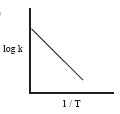
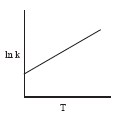
both (b) and (c)
5.
For a first order reaction A ⟶ B the rate constant is x min−1. If the initial concentration of A is 0.01M, the concentration of A after one hour is given by the expression.
001. e−x
1 x 10⁻²(1-e-60x)
(1 x 10⁻²)e-60x
none of these
1.
(rate constant K is equal to collision frequency A if Ea = 0)
In zero order reactions, increase in the concentration of reactant does not alter the rate.
So statement (i) is wrong.
\(k=A{ e }^{ -\left( \frac { { E }_{ a } }{ RT } \right) }\)
if Ea = 0 so, statement (ii) is correct, and statement (iii) is wrong
k = Ae0
k = A
In k = In A - \({ \left( \frac { { E }_{ a } }{ R } \right) }\) \(\left( \frac { 1 }{ T } \right) \)
This equation is of the form of a straight line y = mx+c
A plot of In k Vs \(\left( \frac { 1 }{ T } \right) \) gives a straight line with a negative slope
So statement (iv) and (v) are wrong.
2.
Rate = k[A]n
Rate = \(\frac{-\mathrm{d}[\mathrm{A}]}{\mathrm{dt}}\)
unit of rate = \(\frac{mol L^{-1}}{s}\)=mol L-1/s-1
unit of rate constant
\(=\frac{ (mol{ L }^{ -1 }{ S }^{ -1 }) }{ ({ mol }{ L }^{ -1 })^n } \)
= mol1-nLn-1s-1
in the case
rate = k [Acetone]3/2
n = 3/2
= mol1-(3/2)L(3/2)-1s-1
(mol-(1/2) L(1/2) s-1).
3.
\(Rate=\frac { -1 }{ 2 } \frac { d[NH_3] }{ dt } \)
\(\frac { -d\left[ { N }_{ 2 } \right] }{ dt } =\frac { 1 }{ 3 } \frac { d\left[ { H}_{ 2 } \right] }{ dt } \)
\(=\frac { 1 }{ 2 } { k_1\left[ { NH}_{ 3 } \right] } = { k_2 \left[ { NH}_{ 3 } \right] }=\frac { 1 }{ 3 } { k_3\left[ { NH}_{ 3 } \right] } \)
[3/2] k1 = 3k2 = k3
1.5k1 = 3k2 = k3
4.
\(k=A{ e }^{ -\left( \frac { { E }_{ a } }{ RT } \right) }\)
In k = In A - \({ \left( \frac { { E }_{ a } }{ R } \right) }\) \(\left( \frac { 1 }{ T } \right) \)
This equation is of the form of a straight line y = mx+c
A plot of In k Vs \(\left( \frac { 1 }{ T } \right) \) gives a straight line with a negative slope.
5.
\(k=\frac { 2.303 }{ t } log\frac { \left[ { A }_{ 0 } \right] }{ \left[ A \right] } \)
\(k=\frac { 1 }{ t } ln \frac { \left[ { A }_{ 0 } \right] }{ \left[ A \right] } \)
\(e^{kt}=\frac { \left[ { A }_{ 0 } \right] }{ \left[ A \right] }\)
[A] = [A0] ekt
In this case
k = x min-1 and [A0] = 0.01 M = 1 x 10⁻²M
t = 1 hour = 60 min
[A] = (1 x 10⁻²)e-60x

12th Standard Syllabus & Materials
12th Standard
TN 12th Computer Applications களப்பெயர் முறைமை (DNS) Sample Question Papers Study Material - QB365 Set A
NEW12th Standard
TN 12th Computer Applications வலையமைப்பு எடுத்துக்காட்டுகள் மற்றும் நெறிமுறைகள் Sample Question Papers Study Material - QB365 Set A
NEW12th Standard
TN 12th Computer Applications கணினி வலையமைப்பு ஓர் அறிமுகம் Sample Question Papers Study Material - QB365 Set A
NEW12th Standard
TN 12th Computer Applications PHP-உடன் MySQL-ஐ இணைத்தல் Sample Question Papers Study Material - QB365 Set A



Tamilnadu Stateboard 12th Standard Subjects

Maths
Chemistry

Physics

Biology

Computer Science

Business Maths and Statistics

Economics

Commerce

Accountancy

History

Computer Applications
Biology
Computer Technology
Computer Applications
Computer Science
Business Maths and Statistics
Commerce
Economics
Maths
Chemistry
Physics
Computer Technology
History
Accountancy

Tamil

English

French
Tamilnadu Stateboard Standards



