
 100% FREE ACCESS
12th Standard Syllabus & Materials
12th Standard
TN 12th Maths Applications of Matrices and Determinants Sample Question Papers Study Material - QB365 Set A
NEW12th Standard
TN 12th Computer Applications மின்னணு தரவு பரிமாற்றம் Sample Question Papers Study Material - QB365 Set A
NEW12th Standard
TN 12th Computer Applications மின் - வணிக பாதுகாப்பு அமைப்புகள் Sample Question Papers Study Material - QB365 Set A
NEW12th Standard
TN 12th Computer Applications மின்னணு செலுத்தல் முறைகள் Sample Question Papers Study Material - QB365 Set A
NEW12th Standard
TN 12th Computer Applications மின் - வணிகம் Sample Question Papers Study Material - QB365 Set A
NEW12th Standard
TN 12th Computer Applications திறந்த மூல கருத்துருக்கள் Sample Question Papers Study Material - QB365 Set A

Published on: 27/02/2021
12th Standard English medium Maths Reduced Syllabus Two Mark Important Questions - 2021(Public Exam )
Download Tamil Nadu 12th Standard Maths question papers, model tests, one-mark questions, important questions, and public exam papers in PDF format. Free study materials and answer keys for TN State Board students.
Questions + Answers key
Take MCQ Maths Test1.
Construct the truth table for the following statements.
(¬p ⟶ r) ∧ ( p ↔️ q)
2.
Evaluate the following definite integrals:
\(\int _{ -1 }^{ 1 }{ \frac { dx }{ { x }^{ 2 }+2x+5 } } \)
3.
Evaluate the following limit, if necessary use l ’Hôpital Rule
\(\underset { x\rightarrow \infty }{ lim } \frac { x }{ logx } \)
4.
Using the Rolle’s theorem, determine the values of x at which the tangent is parallel to the x -axis for the following functions:
f(x) = x2 − x, x ∈ [0, 1]
5.
Simplify \({ sec }^{ -1 }\left( sec\left( \frac { 5\pi }{ 3 } \right) \right) \)
6.
Which one of the points i, −2 + i, and 3 is farthest from the origin?
7.
Show that if p, q, r are rational the roots of the equation x2 − 2px + p2 − q2 + 2qr − r2 = 0 are rational.
8.
Find the value of
\(2{ cos }^{ -1 }\left( \frac { 1 }{ 2 } \right) +{ sin }^{ -1 }\left( \frac { 1 }{ 2 } \right) \)
9.
If z1 = 1 - 3i, z2 = - 4i, and z3 = 5 , show that (z1 + z2) + z3 = z1+ (z2 + z3)
10.
solve: x dy + y dx = xy dx
11.
Evaluate \(\int _{ 1 }^{ 2 }{ \frac { { e }^{ x } }{ 1+{ e }^{ 2x } } dx } \)
12.
Determine the domain of convexity of the function y=ex
13.
Prove that the function f(x)=e-x is strictky increasing on [0,1]
14.
Verify Lagrange’s Mean Value theorem for \(f(x)=\sqrt { x-2 } \) in the interva [2,6]
15.
Let p: Jupiter is a planet and q: India is an island be any two simple statements. Give verbal sentence describing each of the following statements.
(i) ¬p
(ii) p ∧ ¬q
(iii) ¬p ∨ q
(iv) p➝ ¬q
(v) p↔q
16.
Evaluate the following \(\int _{ 0 }^{ \pi /2 }{ { cos}^{ 7}x\quad dx } \)
17.
Determine the order and degree (if exists) of the following differential equations:
dy + (xy − cos x)dx = 0
18.
Show that y = e−x + mx + n is a solution of the differential equation ex \(\left( \frac { { d }^{ 2 }y }{ { dx }^{ 2 } } \right) \) -1 = 0
19.
For each of the following differential equations, determine its order, degree (if exists)
\(\sqrt { \frac { dy }{ dx } } -4\frac { dy }{ dx } -7x=0\)
20.
If (cosθ + i sinθ)2 = x + iy, then show that x2+y2 =1
21.
Evaluate \(sin\left( { cos }^{ -1 }\left( \frac { 1 }{ 2 } \right) \right) \)
22.
Solve 6x - 7y = 16, 9x - 5y = 35 using (Cramer's rule).
23.
Show that the equations 3x + y + 9z = 0, 3x + 2y + 12z = 0 and 2x + y + 7z = 0 have nontrivial solutions also.
24.
Find the equation of the plane containing the line of intersection of the planes x + y + Z - 6 = 0 and 2x + 3y + 4z + 5 = 0 and passing through the point (1, 1, 1)
25.
Find centre and radius of the following circles.
x2+y2−x+2y−3 = 0
26.
Find the modulus and principal argument of the following complex numbers.
\(\sqrt { 3 } \)-i
27.
Find the value of tan(tan-1(-0.2021)).
28.
Find the modulus of the following complex numbers
2i(3−4i)(4−3i).
29.
Find the modulus of the following complex numbers
(1-i)10
30.
Evaluate the following if z = 5−2i and w = −1+3i
z w
31.
Find the angle between the straight line \(\vec { r } =(2\hat { i } +\hat { j } +\hat { k } )+t(\hat { i } -\hat { j } +\hat { k } )\) and the plane 2x-y+z = 5
32.
Show that the lines \(\frac { x-1 }{ 4 } =\frac { 2-y }{ 6 } =\frac { z-4 }{ 12 } \) and \(\frac { x-3 }{ -2 } =\frac { y-3 }{ 3 } =\frac { 5-z }{ 6 } \) are parallel.
33.
Find the principal argument Arg z, when z = \(\frac { -2 }{ 1+i\sqrt { 3 } } \)
34.
Identify the type of the conic for the following equations :
11x2−25y2−44x+50y−256 = 0
35.
Find the rank of the following matrices by minor method:
\(\left[ \begin{matrix} 2 & -4 \\ -1 & 2 \end{matrix} \right] \)
36.
Find the inverse (if it exists) of the following:
\(\left[ \begin{matrix} -2 & 4 \\ 1 & -3 \end{matrix} \right] \)
37.
If U(x, y, z) = \(\frac { { x }^{ 2 }+{ y }^{ 2 } }{ xy } +3{ z }^{ 2 }y\), find \(\frac { \partial U }{ \partial x } ;\frac { \partial U }{ \partial y } \) and \(\frac { \partial U }{ \partial z } \)
38.
The cumulative distribution function of a discrete random variable is given by
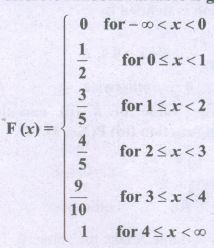
Find
(i) the probability mass function
(ii) P(X < 3) and
(iii) P(X \(\ge \)2).
39.
Discuss the nature of the roots of the following polynomials:
x5-19x4+ 2x3+ 5x2+11
40.
If tan-1 x + tan-1y + tan-1 z = \(\pi\), show that x + y + z = xyz
1.
Truth Table for (~p ⟶ r) ∧ ( p ↔️ q)
| p | q | r | ~ p | ~ p ⟶ r | p ↔️ q | (~p ⟶ r) ∧ ( p ↔️ q) |
| T | T | T | F | T | T | T |
| T | T | F | F | T | T | T |
| T | F | T | F | T | F | F |
| T | F | F | F | T | F | F |
| F | T | T | T | T | F | F |
| F | T | F | T | F | F | F |
| F | F | T | T | T | T | T |
| F | F | F | T | F | F | F |
2.
\(\int _{ -1 }^{ 1 }{ \frac { dx }{ { x }^{ 2 }+2x+5 } } \)
\(=\int _{ -1 }^{ 1 }{ \frac { dx }{ { x }^{ 2 }+2x+1+4 } } =\int _{ -1 }^{ 1 }{ \frac { dx }{ { (x+1) }^{ 2 }{ 2 }^{ 2 } } } \)
\(\left[ \because \int { \frac { dx }{ { x }^{ 2 }-{ a }^{ 2 } } } =\frac { 1 }{ 2a } log\left| \frac { x-a }{ x+a } \right| \right] \)
\(={ \left[ \frac { 1 }{ 2 } { tan }^{ -1 }\left( \frac { x+1 }{ 2 } \right) \right] }_{ -1 }^{ 1 }\)
\(=\frac { 1 }{ 2 } \left[ { tan }^{ -1 }(1)-{ tan }^{ -1 }(0) \right] \)
\(\\ =\frac { 1 }{ 2 } \left[ \frac { \pi }{ 4 } \right] =\frac { \pi }{ 8 } \)
3.
\(\underset { x\rightarrow \infty }{ lim } \frac { x }{ logx } =\frac { \infty }{ \infty } \)
Which is in indeterminate form
∴ By L' Hopital rule we get,
\(\underset { x\rightarrow \infty }{ lim } \frac { \frac { 1 }{ 1 } }{ x } =\underset { x\rightarrow \infty }{ lim } x=\infty \)
4.
Given f(x) = x2 − x, x ∈ [0, 1]
(i) f(x) is continuous in [0, 1]
(ii) f(x) is differentiable in (0, 1)
(iii) f(0) = 02 - 0 = 0
f(1) = 12-1 = 1-1 = 0
∴ f(0) = f(1)
By Rolle's theorem, there exists C ∈ [0, 1] such that
f'(c) = 0
⇒ 2c - 1 = 0
⇒ 2c = 1
⇒ c = \(\frac12\) ∈ [0, 1]
5.
\({ sec }^{ -1 }\left( sec\left( \frac { 5\pi }{ 3 } \right) \right) \)
Note that \(\frac{5\pi}{3}\) is not in [0, \(\pi\)]\{\(\frac{\pi}{2}\)}, the principal range of sec-1 x.
we write \(\frac { 5\pi }{ 3 } =2\pi -\frac { \pi }{ 3 } \).
Now, sec\(\left( \frac { 5\pi }{ 3 } \right) =sec\left( 2\pi -\frac { \pi }{ 3 } \right) =sec\left( \frac { \pi }{ 3 } \right) and\frac { \pi }{ 3 } \in [0,\pi ]\)\{\(\frac{\pi}{2}\)}
Hence, sec-1\(\left( sec\left( \frac { 5\pi }{ 3 } \right) \right) ={ sec }^{ -1 }\left( sec\left( \frac { \pi }{ 3 } \right) \right) =\frac { \pi }{ 3 } \)
6.
The distance between origin to z = i, −2 + i, and 3 are
|z| = |i| = 1
|z| = |−2+i| = \(\sqrt { \left( -2 \right) ^{ 2 }+{ 1 }^{ 2 } } =\sqrt { 5 }\)
|z| = |3| = 3
Since \(1<\sqrt { 5 } <3\), the farthest point from the origin is 3 .
7.
The roots are rational if Δ = b2−4ac = (−2p)2−4(p2−q2+2qr−r2).
But this expression reduces to 4(q2−2qr+r2) or 4(q−r)2 which is a perfect square.
Hence the roots are rational.
8.
\(2{ cos }^{ -1 }\left( \frac { 1 }{ 2 } \right) +{ sin }^{ -1 }\left( \frac { 1 }{ 2 } \right) \)
Let \({ cos }^{ -1 }\left( \frac { 1 }{ 2 } \right) =x\) and\({ sin }^{ -1 }\left( \frac { 1 }{ 2 } \right) \)
\(\Rightarrow cosx=\frac { 1 }{ 2 } \)
\(\Rightarrow cosx=cos\frac { \pi }{ 3 } \) \(\left[ \therefore \frac { \pi }{ 3 } \varepsilon \left[ 0,\pi \right] \right] \)
\(\Rightarrow x=\frac { \pi }{ 3 } \)
[\(\therefore\) Principal domain of sin is \(\therefore \left[ \frac { -\pi }{ 2 } ,\frac { \pi }{ 2 } \right] \) and principal domain of cos is\(\left[ 0,\pi \right] \)
\(siny=\frac { 1 }{ 2 } \)
\(siny=sin\frac { \pi }{ 6 } \) \(\left[ \because \frac { \pi }{ 6 } \varepsilon \left[ \frac { -\pi }{ 2 } ,\frac { \pi }{ 2 } \right] \right] \)
\(\Rightarrow x=\frac { \pi }{ 3 } \) and \(y=\frac { \pi }{ 6 } \)
\(\therefore \quad 2{ cos }^{ -1 }\left( \frac { 1 }{ 2 } \right) +{ sin }^{ -1 }\left( \frac { 1 }{ 2 } \right) \)
= \(2\left( \frac { \pi }{ 3 } \right) +\frac { \pi }{ 6 } =\frac { 2\pi }{ 3 } +\frac { \pi }{ 6 } \)
= \(\frac { 4\pi +\pi }{ 6 } =\frac { 5\pi }{ 6 } \)
9.
(z1 + z2) + z3 = z1 + (z2 + z3)
Given z1= 1-3i, z2 - 4i and z3 = 5
LHS = (z1+ z2) + z3
= [1- 3i + (- 4i)] + 5
[1-7i] + 5
= 6 -7i
RHS = z1+ (z2 + z3)
= 1- 3i + (-4i + 5)
= 6 - 7i
LHS = RHS
∴ (z1+ z2)+ z3 = z1+(z2+ z3)
10.
|xy| = cex
11.
\(\frac { 1 }{ 6 } \left[ log\left( \frac { 35 }{ 8 } \right) \right] \)
12.
concave upward everywhere
13.
f(x) is strictly decreasing on [0, 1]
14.
c = 3
15.
Given p : Jupiter is a planet and
q : India is an island.
(i) ¬p : Jupiter is not a planet.
(ii) p ∧ ¬q : Jupiter is a planet and India is not an island.
(iii) ¬p ∨ q : Jupiter is not a planet or India is an island.
(iv) p➝ ¬q : If Jupiter is a planet then India is not an island.
(v) p↔q : Jupiter is a planet if and only if India is an island.
16.
\({ I }_{ n }=\int _{ 0 }^{ \pi /2 }{ { cos }^{ 7 }xdx=\frac { n-1 }{ n } { I }_{ n-2 },n\ge 2 } \)
\(\therefore { I }_{ 7 }=\int _{ 0 }^{ \pi /2 }{ { cos }^{ 7 }xdx=\frac { 6 }{ 7 } \times \frac { 4 }{ 5 } \times \frac { 2 }{ 3 } \times 1 } =\frac { 16 }{ 35 } \)
17.
dy + (xy − cos x)dx = 0 is a first order differential equation with degree 1
since the equation can be rewritten as
\(\frac{dy}{dx}\) + xy - cos x = 0
18.
Given y = e−x + mx + n .... (1)
Derentiating cquation (1) wr.t 'x', we get
\(\frac { dx }{ dx } =-e^{ -x }(-1)+m\)
\(\frac { d^{ 2 }y }{ d{ x }^{ 2 } } =-e^{ -x }+m\)
Again differentiating, we get
\(\Rightarrow \frac { d^{ 2 }y }{ d{ x }^{ 2 } } ={ e^{ x } }+0\)
\(\Rightarrow \left( \frac { d^{ 2 }y }{ d{ x }^{ 2 } } \right) =e^x\)
Substituting the value of \(\frac{d^2y}{dx^2}\) in the given differential equation, we get
\(\Rightarrow e^{ x }\left( \frac { d^{ 2 }y }{ d{ x }^{ 2 } } \right) -1=e^x(e^x)-1\\= e^{x-x}-1\\
e^0-1= 1-1=0\)
Thus the solution of the given differential equation ex \(\left( \frac { { d }^{ 2 }y }{ { dx }^{ 2 } } \right) \) -1 = 0
19.
\(\sqrt { \frac { dy }{ dx } } -4\frac { dy }{ dx } -7x=0\)
The given differential equation is
\(\sqrt { \frac { dy }{ dx } } =4\frac { dy }{ dx } +7x\)
Squaring both sides,
\(\frac { dy }{ dx } =\quad { \left( 4\frac { dy }{ dx } +7x \right) }^{ 2 }\)
\(16{ \left( \frac { dy }{ dx } \right) }^{ 2 }+{ 49 }x^{ 2 }+56x{ \left( \frac { dy }{ dx } \right) }\)
The highest derivative is 1 and its maximum power is 2.
∴ Order 1, degree 2.
20.
(cos θ + i sin θ )2 = cos 2θ + isin 2θ
[By De moivre's theorem]
⇒ cos 2θ + isin 2θ = x + iy
Equating the real and imaginary parts we get,
x = cos 2θ, y = sin 2θ
∴ x2 + y2 = cos22θ + sin22θ = 1
Hence proved
21.
Let \({ cos }^{ -1 }\left( \frac { 1 }{ 2 } \right) =\theta \Rightarrow cos\theta =\frac { 1 }{ 2 } \)
\(\Rightarrow sin\theta =\sqrt { 1-{ cos }^{ 2 }\theta } =\sqrt { 1-\frac { 1 }{ 4 } } =\sqrt { \frac { 3 }{ 4 } } =\frac { \sqrt { 3 } }{ 2 } \)
\(\therefore sin\left( { cos }^{ -1 }\left( \frac { 1 }{ 2 } \right) \right) =\frac { \sqrt { 3 } }{ 2 } \)
22.
Δ = \(\left| \begin{matrix} 6 & -7 \\ 9 & -5 \end{matrix} \right| \) = -30 + 63 = 33
Δ1 = \(\left| \begin{matrix} 16 & -7 \\ 35 & -5 \end{matrix} \right| \) = -80 + 245 = 165
Δ2 = \(\left| \begin{matrix} 6 & 16 \\ 9 & 35 \end{matrix} \right| \) = 210 - 144 = 66
∴ x = \(\frac { { \triangle }_{ 1 } }{ \triangle } =\frac { 165 }{ 33 } \) = 5
y = \(\frac { { \triangle }_{ 2 } }{ \triangle } =\frac { 66 }{ 33 } \) = 2
∴ Solution set is { 5, 2}
23.
The matrix form of the system is
\(\left[ \begin{matrix} 3 & 1 & 9 \\ 3 & 2 & 12 \\ 2 & 1 & 7 \end{matrix} \right] \left[ \begin{matrix} x \\ y \\ z \end{matrix} \right] =\left[ \begin{matrix} 0 \\ 0 \\ 0 \end{matrix} \right] \)
AX = B where
A=\(\left[ \begin{matrix} 3 & 1 & 9 \\ 3 & 2 & 12 \\ 2 & 1 & 7 \end{matrix} \right] ,X=\left[ \begin{matrix} x \\ y \\ z \end{matrix} \right] ,B=\left[ \begin{matrix} 0 \\ 0 \\ 0 \end{matrix} \right] \)
|A| =\(\left| \begin{matrix} 3 & 1 & 9 \\ 3 & 2 & 12 \\ 2 & 1 & 7 \end{matrix} \right| =3\left| \begin{matrix} 2 & 12 \\ 1 & 7 \end{matrix} \right| -1\left| \begin{matrix} 3 & 12 \\ 2 & 7 \end{matrix} \right| +9\left| \begin{matrix} 3 & 2 \\ 2 & 1 \end{matrix} \right| \)
= 3 (14 - 12) - 1 (21 -24) + 9 (3 -4)
= 3 (2) -1 (-3) + 9 (-1)
= 6 + 3 - 9 = 9 - 9 = 0
Since |A| = 0, the homogeneous system of equations have non-trivial solutions also.
24.
The equation of the required plane through the intersection of the given planes is
( x + y + z - 6 ) + λ (2x + 3y + 4z + 5) = 0 ......(1)
This passes through (1, 1, 1)
∴ ( 1+ 1 + z - 6) + λ (2 + 3+ 4 + 5) = 0
⇒ -3 +14λ = 0 \(\Rightarrow \lambda =\frac { 3 }{ 14 } \)
Substituting \(\lambda =\frac { 3 }{ 14 } \) in (1) we get
( x + y + z - 6 )+\(\frac { 3 }{ 14 } \) (2x + 3y + 4z + 5) = 0
⇒ 14( x + y + z - 6 ) +3 (2 + 3+ 4 + 5) = 0
⇒ 20x + 23y + 26z - 69 = 0
25.
Equation of the circle is x2 + y2 - x + 2y - 3 = 0
Here 2g = -1 ⇒ g = \(\frac { -1 }{ 2 } \)
2f = 2 ⇒ f = 1 and c = -3
Centre is (-g, -f) = \(\left( \frac { 1 }{ 2 } ,-1 \right) \)
and r = \(\sqrt { { g }^{ 2 }+{ f }^{ 2 }-c } \)
= \(\sqrt { \frac { 1 }{ 4 } +1+3 } \)
= \(\sqrt { \frac { 1 }{ 4 } +4 } =\sqrt { \frac { 1+16 }{ 2 } } \)
r = \(\sqrt { \frac { 17 }{ 2 } } \) units.
26.
\(\sqrt { 3 } -i\)
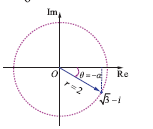
r = 2 and \(-\alpha =\frac { \pi }{ 6 } \)
Since the complex number lies in the fourth quadrant, has the principal value
\(\theta =-\alpha =-\frac { \pi }{ 6 } \)
Therefore, the modulus and principal argument of
\(-\sqrt { 3 } -i\) are 2 and \(\frac { \pi }{ 6 } \)
27.
tan(tan-1(0.2021))
= -0.2021[\(\because \) tan (tan-1x) = x for any real number]
28.
2i(3−4i)(4−3i)
Let z = 2i(3−4i)(4−3i).
∴ |z| = |2i(3-4i)(4-3i)|
= |2i| |3-4i| |4-3i|
= \(\sqrt { { 2 }^{ 2 } } \sqrt { { 3 }^{ 2 }+(-4)^{ 2 } } \sqrt { { 4 }^{ 2 }+(-3)^{ 2 } } \)
= \(\\ 2.\sqrt { 9+16 } \sqrt { 16+9 } =2.\sqrt { 25 } .\sqrt { 25 } \)
= 2(5)(5) = 50
29.
(1-i)10
Let z = (1- i)10
|z| = |1- i|10 = \(\left[ \sqrt { { 1 }^{ 2 }+(-1)^{ 2 } } \right] ^{ 10 }\)
= \(\left[ \sqrt { 2 } \right] ^{ 10 }\) = 21/2 x 10 = 25 = 32
30.
z w
= (5-2i)(-1+3i)
= -5+15i+2i-6i2
= -5+17i-6(-1)
= -5+17i+6
= 1+17i
31.
The angle between a line \(\vec { r } =\vec { a } +t\vec { b } \) and a plane \(\vec { r } .\vec { n } \) = p with normal \(\vec { n } \) is θ = \(sin^{ -1 }\left( \frac { |\vec { b } .\vec { n } | }{ |\vec { b }| .|\vec { n } | } \right) \quad \)
Here, \(\vec { b } =\hat { i } -\hat { j } +\hat { k } \) and \(\vec { n } =2\hat { i } \hat { j } +\hat { k } \)
So, we get θ = \(sin^{ -1 }\left( \frac { |\vec { b } .\vec { n } | }{ |\vec { b }| .|\vec { n } | } \right) \quad =sin^{ -1 }\left( \frac { |(\hat { i } -\hat { j } +\hat { k } ).(2\hat { i } -\hat { j } +\hat { k } )| }{ |\hat { i } -\hat { j } +\hat { k } ||2\hat { i } -\hat { j } +\hat { k } | } \right) =sin^{ -1 }\left( \frac { 2\sqrt { 3 } }{ 3 } \right) \).
32.
We observe that the straight line \(\frac { x-1 }{ 4 } =\frac { 2-y }{ 6 } =\frac { z-4 }{ 12 } \) is parallel to the vector \(4\hat { i } -6\hat { j } +12\hat { k } \) and the straight line \(\frac { x-3 }{ -2 } =\frac { y-3 }{ 3 } =\frac { 5-z }{ 6 } \) is parallel to the vector \(2\hat { i } +3\hat { j } -6\hat { k } \)
Since \(4\hat { i } -6\hat { j } +12\hat { k } =-2(-2\hat { i } +3\hat { j } -6\hat { k } )\), two vectors are parallel, and hence the two straight lines are parallel.
33.
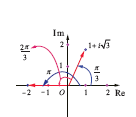
ang \(z=\frac { -2 }{ 1+i\sqrt { 3 } } \)
= arg(-2)-arg \(\left( 1+i\sqrt { 3 } \right) \) \(\left( \because arg\left( \frac { { z }_{ 1 } }{ { z }_{ 2 } } \right) =arg{ z }_{ 1 }=g_{ 2 } \right) \)
= \(\left( \pi -{ tan }^{ -1 }\left( \frac { 0 }{ 2 } \right) \right) -tan^{ -1 }\left( \frac { \sqrt { 3 } }{ 1 } \right) \)
= \(\pi -\frac { \pi }{ 3 } =\frac { 2\pi }{ 3 } \)
This implies that one of the values of arg z is \(\frac { 2\pi }{ 3 } \)
Since \(\frac { 2\pi }{ 3 } \) lies between \(-\pi \), the principal argument Argz is \(\frac { 2\pi }{ 3 } \)
34.
A = 11, C = -25, D = -44, E = - 50, and F = -256
Here A ≠ C and A and C are of opposite signs. Hence, the given equation represents a hyperbola.
35.
\(\left[ \begin{matrix} 2 & -4 \\ -1 & 2 \end{matrix} \right] \)
Let A =\(\left[ \begin{matrix} 2 & -4 \\ -1 & 2 \end{matrix} \right] \)
A is a matrix of order 2 \(\times\) 2
∴ \(\rho \)(A) ≤ min(2,2) = 2
The highest order of minor of A is 2
it is \(\left| \begin{matrix} 2 & -1 \\ -1 & 2 \end{matrix} \right| \)= 4 - 4 = 0
So, \(\rho \)(A)<2
Next consider the minor of order 1 |2| = 2 ≠ 0
∴ \(\rho \)(A) = 1
36.
\(\left[ \begin{matrix} -2 & 4 \\ 1 & -3 \end{matrix} \right] \)
Let A = \(\left[ \begin{matrix} -2 & 4 \\ 1 & -3 \end{matrix} \right] \)
|A| = \(\left| \begin{matrix} -2 & 4 \\ 1 & -3 \end{matrix} \right| \)= 6 - 4 = 2 ≠ 0
Since A is nonsingular, A-1 exists
A-1 = \(\frac { 1 }{ |A| } \)
Now, adj A = \(\left[ \begin{matrix} -3 & -4 \\ -1 & -2 \end{matrix} \right] \)
[Interchange the entries in leading diagonal and change the sign of elements in the off diagonal]
∴ A-1 = \(\frac{1}{2}\)\(\left[ \begin{matrix} -3 & -4 \\ -1 & -2 \end{matrix} \right] \).
37.
Given U(x, y, z) = \(\frac { { x }^{ 2 }+{ y }^{ 2 } }{ xy } +3{ z }^{ 2 }y\)
\(\frac { \partial U }{ \partial x } =\frac { xy(2x)-({ x }^{ 2 }+{ y }^{ 2 })(y) }{ { x }^{ 2 }{ y }^{ 2 } } +0\)
\(=\frac { 2{ x }^{ 2 }y-{ x }^{ 2 }y-{ y }^{ 3 } }{ { x }^{ 2 }{ y }^{ 2 } } =\frac { { x }^{ 2 }y-{ y }^{ 3 } }{ { x }^{ 2 }{ y }^{ 2 } } \)
\(=\frac { y({ x }^{ 2 }-{ y }^{ 2 }) }{ { x }^{ 2 }{ y }^{ 2 } } =\frac { { x }^{ 2 }-{ y }^{ 2 } }{ { x }^{ 2 }y } \)
\(\frac { \partial U }{ \partial y } =\frac { xy(2y)-({ x }^{ 2 }+{ y }^{ 2 })(x) }{ { x }^{ 2 }{ y }^{ 2 } } +3{ z }^{ 2 }\)
= \(\frac { { 2xy }^{ 2 }-{ x }^{ 3 }-{ xy }^{ 2 } }{ { x }^{ 2 }{ y }^{ 2 } } +3{ z }^{ 2 }\)
\(=\frac { { xy }^{ 2 }-{ x }^{ 3} }{ { x }^{ 2 }{ y }^{ 2 } } +3{ z }^{ 2 }\)
\(=\frac { { y }^{ 2 }-{ x }^{ 2 } }{ x{ y }^{ 2 } } +3{ z }^{ 2 }\)
\(\frac { \partial U }{ \partial z } =0+3y(2z)=6yz\)
38.
(i) Probability mass function
For a discrete random variable we have
f(x) = p(X = x)
\(\therefore f(0)=F(0)=\frac { 1 }{ 2 } \)
f(1) = F(1) - F(0)
= \(\frac { 3 }{ 5 } -\frac { 1 }{ 2 } =\frac { 6-5 }{ 10 } =\frac { 1 }{ 10 } \)
f(2) = F(2)-F(1)
= \(\frac { 4 }{ 5 } -\frac { 3 }{ 5 } =\frac { 1 }{ 5 } \)
f(3) = F(3) - F(2)
\(\frac { 9 }{ 10 } -\frac { 4 }{ 5 } =\frac { 9-8 }{ 10 } =\frac { 1 }{ 10 } \)
f(4) = F(4)-F(3)
= \(1-\frac { 9 }{ 10 } =\frac { 1 }{ 10 } \)
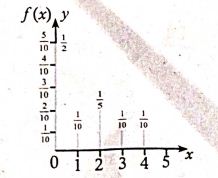
ஃThe probability mass function is
| X | 0 | 1 | 2 | 3 | 4 |
| f(x) | \(\cfrac { 1 }{ 2 } \) | \(\cfrac { 1 }{ 10 } \) | \(\cfrac { 1 }{ 5 } \) | \(\cfrac { 1 }{ 10 } \) | \(\cfrac { 1 }{ 10 } \) |
(ii) p(x < 3) = p(x = 0) + p(x = 1) + p(x = 2)
= \(\frac { 1 }{ 2 } +\frac { 1 }{ 10 } +\frac { 1 }{ 5 } =\frac { 5+1+2 }{ 10 } =\frac { 8 }{ 10 } \)
= \(\frac { 4 }{ 5 } \)
(iii) p(x≥2) = p(x = 2) + p(x = 3) + p(x = 4)
= \(\frac { 1 }{ 5 } +\frac { 1 }{ 10 } +\frac { 1 }{ 10 } =\frac { 2+1+1 }{ 10 } =\frac { 4 }{ 10 } \)
= \(\frac { 2 }{ 5 } \)
39.
Let P(x) be the polynomial under consideration.
The number of sign changes for P(x) and P(−x) are 2 and 1 respectively. Hence it has at most two positive roots and at most one negative root. Since the difference between number of sign changes in coefficients of P(−x) and the number of negative roots is even, we cannot have zero negative roots. So the number of negative roots is 1. Since the difference between number of sign changes in coefficient of P(x) and the number of positive roots must be even, we must have either zero or two positive roots. But as the sum of the coefficients is zero, 1 is a root. Thus we must have two and only two positive roots Obviously the other two roots are imaginary numbers.
40.
\({ tan }^{ -1 }x+{ tan }^{ -1 }y+{ tan }^{ -1 }z={ tan }^{ -1 }\left( \frac { x+y+z-xyz }{ 1-xy-yz-zx } \right) \)
Given \({ tan }^{ -1 }x+{ tan }^{ -1 }x+{ tan }^{ -o }y+{ tan }^{ -1 }z=\pi \)
\(\Rightarrow \pi ={ tan }^{ -1 }\left( \frac { x+y+zxyz }{ 1-xy-yz-zx } \right) \)
\(\Rightarrow tan\pi =\frac { x+y+z-xyz }{ 1-xy-yz-zx } \)
\(\Rightarrow 0=\frac { x+y+z-xyz }{ 1-xy-yz-zx } \quad [\therefore tan\pi =0]\)
\(\Rightarrow x+y+z-xyz=0\)
\(\Rightarrow x+y+z=xyz\)

12th Standard Syllabus & Materials
12th Standard
TN 12th Computer Applications வலையமைப்பு வடமிடல் Sample Question Papers Study Material - QB365 Set A
NEW12th Standard
TN 12th Computer Applications களப்பெயர் முறைமை (DNS) Sample Question Papers Study Material - QB365 Set A
NEW12th Standard
TN 12th Computer Applications வலையமைப்பு எடுத்துக்காட்டுகள் மற்றும் நெறிமுறைகள் Sample Question Papers Study Material - QB365 Set A
NEW12th Standard
TN 12th Computer Applications கணினி வலையமைப்பு ஓர் அறிமுகம் Sample Question Papers Study Material - QB365 Set A



Tamilnadu Stateboard 12th Standard Subjects
Maths

Chemistry

Physics

Biology

Computer Science

Business Maths and Statistics

Economics

Commerce

Accountancy

History

Computer Applications
Biology
Computer Technology
Computer Applications
Computer Science
Business Maths and Statistics
Commerce
Economics
Maths
Chemistry
Physics
Computer Technology
History
Accountancy

Tamil

English

French
Tamilnadu Stateboard Standards

