
 100% FREE ACCESS
12th Standard Syllabus & Materials
12th Standard
TN 12th Computer Applications மின்னணு தரவு பரிமாற்றம் Sample Question Papers Study Material - QB365 Set A
NEW12th Standard
TN 12th Computer Applications மின் - வணிக பாதுகாப்பு அமைப்புகள் Sample Question Papers Study Material - QB365 Set A
NEW12th Standard
TN 12th Computer Applications மின்னணு செலுத்தல் முறைகள் Sample Question Papers Study Material - QB365 Set A
NEW12th Standard
TN 12th Computer Applications மின் - வணிகம் Sample Question Papers Study Material - QB365 Set A
NEW12th Standard
TN 12th Computer Applications திறந்த மூல கருத்துருக்கள் Sample Question Papers Study Material - QB365 Set A
NEW12th Standard
TN 12th Computer Applications வலையமைப்பு வடமிடல் Sample Question Papers Study Material - QB365 Set A

Published on: 01/06/2021
QB365 provides detailed and simple solution for every book back questions in class 12 Maths subject.It will helps to get more idea about question pattern in every book back questions with solution.
Download Tamil Nadu 12th Standard Maths question papers, model tests, one-mark questions, important questions, and public exam papers in PDF format. Free study materials and answer keys for TN State Board students.
Questions + Answers key
Take MCQ Maths Test1.
Evaluate the following:
\(\int _{ 0 }^{ 1 }{ { x }^{ 3 }{ e }^{ -2x }dx } \)
2.
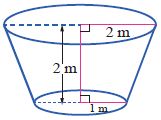
Find, by integration, the volume of the container which is in the shape of a right circular conical frustum.
3.
Father of a family wishes to divide his square field bounded by x = 0, x = 4, y = 4 and y = 0 along the curve y2 = 4x and x2 = 4y into three equal parts for his wife, daughter and son. Is it possible to divide? If so, find the area to be divided among them.
4.
Find, by integration, the area of the region bounded by the lines 5x − 2y = 15, x + y + 4 = 0 and the x-axis
5.
The region enclosed by the circle x2 + y2 = a2 is divided into two segments by the line x = h. Find the area of the smaller segment.
1.
Let \(u={ x }^{ 3 }\quad dv={ e }^{ -2x }\)
\(u_1=3{ x }^{ 2 }{ v }_{ 1 }=\frac { { e }^{ -2x } }{ -2 } \)
\(u_2=6x\quad { v }_{ 2 }=\frac { { e }^{ -2x } }{ 4 } \)
\(u_3=6\quad { v }_{ 3 }=\frac { { e }^{ -2x } }{ -8 } \)
\(u_4 = 0 \quad \ { v }_{ 4 }=\frac { { e }^{ -2x } }{ 16 } \)
Bernoulli's' formula:
\(\int { uvdx } ={ uv }_{ 1 }-u'{ v }_{ 2 }+u"{ v }_{ 3 }-u"'{ v }_{ 4 }+...\)
\(\therefore \int _{ 0 }^{ 1 }{ { x }^{ 3 }{ e }^{ -2x }dx={ \left[ { x }^{ 3 }\left( \frac { { e }^{ -2x } }{ -2 } \right) -3{ x }^{ 2 }\left( \frac { { e }^{ -2x } }{ 4 } \right) +6x\left( \frac { { e }^{ -2x } }{ -8 } \right) -6\left( \frac { { e }^{ -2x } }{ 16 } \right) \right] }_{ 0 }^{ 1 } } \)
\(={ \left[ { e }^{ -2x }\left( \frac { -{ x }^{ 3 } }{ 2 } -\frac { -3{ x }^{ 2 } }{ 4 } -\frac { 3x }{ 4 } -\frac { 3 }{ 8 } \right) \right] }_{ 0 }^{ 1 }\)
\(=\left[ { e }^{ -2 }\left( -\frac { 1 }{ 2 } -\frac { 3 }{ 4 } -\frac { 3 }{ 4 } -\frac { 3 }{ 8 } \right) -{ e }^{ -0 }\left( \frac { -3 }{ 8 } \right) \right] \)
\(={ e }^{ -2 }\left( \frac { -4-12-3 }{ 8 } \right) +\frac { 3 }{ 8 } \)
\(={ e }^{ -2 }\left( \frac { -19 }{ 8 } \right) +\frac { 3 }{ 8 } =\frac { 3 }{ 8 } -\frac { 19 }{ 8 } { e }^{ -2 }\)
2.
Volume of the right circular conical frustum is obtained by revolving the line y = x between x = a and x = b around the x - axis
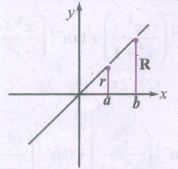
\(\therefore\) Height of the frustum h = b - a
\(\therefore\)Volume \(=\pi \int _{ a }^{ b }{ { x }^{ 2 }dx } =\pi { \left[ \frac { { x }^{ 3 } }{ 3 } \right] }_{ a }^{ b }\)
\(=\frac { \pi }{ 3 } [{ b }^{ 3 }-{ a }^{ 3 }]\)
\(=\frac { \pi }{ 3 } (b-a)({ b }^{ 2 }+ab+{ a }^{ 2 })\)
Now, substitute h = b - a, r = a and R = b we get Volume of the conical frustum
\(\frac { \pi }{ 3 } [h({ R }^{ 2 }+rR+{ r }^{ 2 })]\)
Given h = 2 m, r = 1 m, R = 2 m we get
Required volume \(=\frac { \pi }{ 3 } [2(4+2+1)]\)
\(=\frac { \pi }{ 3 } (14)\)
\(=\frac { 14\pi }{ 3 } \)
3.
Equation of the given curves are y2 = 4x and x2 = 4y
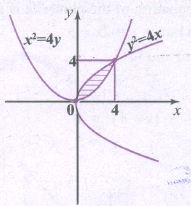
\(\therefore \) Required area \(=\int _{ 0 }^{ 4 }{ \left( \sqrt { 4x } -\frac { { x }^{ 2 } }{ 4 } \right) dx } \)
\(=\int _{ 0 }^{ 4 }{ \left( 2\sqrt { x } -\frac { { x }^{ 2 } }{ 4 } \right) dx } \)
\(={ \left[ \frac { { 2x }^{ \frac { 3 }{ 2 } } }{ \frac { 3 }{ 2 } } \right] }_{ 0 }^{ 4 }{ \left[ \frac { 4 }{ 3 } x\sqrt { x } -\frac { { x }^{ 3 } }{ 12 } \right] }_{ 0 }^{ 4 }\)
\(=\frac { 4 }{ 3 } (4)(2)-\frac { 64 }{ 12 } \)
\(=\frac { 32 }{ 3 } -\frac { 32 }{ 6 } =\frac { 64-32 }{ 6 } =\frac { 32 }{ 6 } \)
\(=\frac { 16 }{ 3 } \) sq.units
Yes the area can be divided into 3 equal parts and the area to the divided among his, wife daughter and son is \(=\frac { 16 }{ 3 } \)sq.units
4.
The lines 5x − 2y = 15, x + y + 4 = 0 intersect at (1, −5). The line 5x − 2y =15 meets the x-axis at (3, 0). The line x + y + 4 = 0 meets the x-axis at (−4, 0). The required area is shaded. It lies below the x-axis. It can be computed either by considering vertical strips or horizontal strips.
When we do by vertical strips, the region has to be divided into two sub-regions by the line x = 1. Then, we get
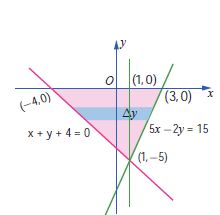
\(A=\left| \int _{ -4 }^{ 1 }{ ydx } \right| +\left| \int _{ 1 }^{ 3 }{ ydx } \right| \)
\(=\left| \int _{ -4 }^{ 1 }{ (-4-x)dx } \right| +\left| \int _{ 1 }^{ 3 }{ \left( \frac { 5x-15 }{ 2 } \right) dx } \right| \)
\(=\left| { \left( -4x-\frac { { x }^{ 2 } }{ 2 } \right) }_{ -4 }^{ 1 } \right| +\left| { \left( \frac { { 5x }^{ 2 } }{ 4 } -\frac { 15x }{ 2 } \right) }_{ 1 }^{ 3 } \right| \)
\(=\left| \left( -\frac { 9 }{ 2 } \right) -\left( 8 \right) \right| +\left| \left( -\frac { 45 }{ 4 } \right) -\left( -\frac { 25 }{ 4 } \right) \right| \)
\(=\frac { 25 }{ 2 } +5\)
\(=\frac { 35 }{ 2 } \)
When we do by horizontal strips, there is no need to subdivide the region. In this case, the area is bounded on the right by the line 5x − 2y = 15 and on the left by x + y + 4 = 0. So, we get
\(A=\int _{ -5 }^{ 0 }{ [{ x }_{ R }-{ x }_{ L }]dy } =\int _{ -5 }^{ 0 }{ \left[ \frac { 15+2y }{ 5 } -(-4-y) \right] dy } \)
\(=\int _{ -5 }^{ 0 }{ \left[ 7+\frac { 7y }{ 5 } \right] dy={ \left[ 7y+\frac { { 7y }^{ 2 } }{ 10 } \right] }_{ -5 }^{ 0 } } \)
\(\\ =0-\left[ -35+\frac { 35 }{ 2 } \right] =\frac { 35 }{ 2 } \)
5.
The smaller segment is sketched. Here 0
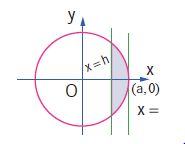
\(A=2\int _{ h }^{ a }{ \sqrt { { a }^{ 2 }-{ x }^{ 2 } } } dx=2{ \left[ \frac { x\sqrt { { a }^{ 2 }-{ x }^{ 2 } } }{ 2 } +\frac { { a }^{ 2 } }{ 2 } { sin }^{ -1 }\left( \frac { x }{ a } \right) \right] }_{ h }^{ a }\)
\(=2\left[ 0+\frac { { a }^{ 2 } }{ 2 } { sin }^{ -1 }(1) \right] -2\left[ \frac { h\sqrt { { a }^{ 2 }-{ h }^{ 2 } } }{ 2 } +\frac { { a }^{ 2 } }{ 2 } { sin }^{ -1 }\left( \frac { h }{ a } \right) \right] \)
\(={ a }^{ 2 }\left( \frac { \pi }{ 2 } \right) -h\sqrt { { a }^{ 2 }-{ h }^{ 2 } } -{ a }^{ 2 }{ sin }^{ -1 }\left( \frac { h }{ a } \right) \)
\(=a^{2}\left[\frac{\pi}{2}-\sin ^{-1}\left(\frac{h}{a}\right)\right]-h \sqrt{a^{2}-h^{2}}\)
\(={ a }^{ 2 }{ cos }^{ -1 }\left( \frac { h }{ a } \right) -h\sqrt { { a }^{ 2 }-{ h }^{ 2 } } \)

12th Standard Syllabus & Materials
12th Standard
TN 12th Computer Applications களப்பெயர் முறைமை (DNS) Sample Question Papers Study Material - QB365 Set A
NEW12th Standard
TN 12th Computer Applications வலையமைப்பு எடுத்துக்காட்டுகள் மற்றும் நெறிமுறைகள் Sample Question Papers Study Material - QB365 Set A
NEW12th Standard
TN 12th Computer Applications கணினி வலையமைப்பு ஓர் அறிமுகம் Sample Question Papers Study Material - QB365 Set A
NEW12th Standard
TN 12th Computer Applications PHP-உடன் MySQL-ஐ இணைத்தல் Sample Question Papers Study Material - QB365 Set A



Tamilnadu Stateboard 12th Standard Subjects
Maths

Chemistry

Physics

Biology

Computer Science

Business Maths and Statistics

Economics

Commerce

Accountancy

History

Computer Applications
Biology
Computer Technology
Computer Applications
Computer Science
Business Maths and Statistics
Commerce
Economics
Maths
Chemistry
Physics
Computer Technology
History
Accountancy

Tamil

English

French
Tamilnadu Stateboard Standards



