
 100% FREE ACCESS
12th Standard Syllabus & Materials
12th Standard
TN 12th Computer Applications மின்னணு தரவு பரிமாற்றம் Sample Question Papers Study Material - QB365 Set A
NEW12th Standard
TN 12th Computer Applications மின் - வணிக பாதுகாப்பு அமைப்புகள் Sample Question Papers Study Material - QB365 Set A
NEW12th Standard
TN 12th Computer Applications மின்னணு செலுத்தல் முறைகள் Sample Question Papers Study Material - QB365 Set A
NEW12th Standard
TN 12th Computer Applications மின் - வணிகம் Sample Question Papers Study Material - QB365 Set A
NEW12th Standard
TN 12th Computer Applications திறந்த மூல கருத்துருக்கள் Sample Question Papers Study Material - QB365 Set A
NEW12th Standard
TN 12th Computer Applications வலையமைப்பு வடமிடல் Sample Question Papers Study Material - QB365 Set A

Published on: 13/05/2022
QB365 provides detailed and simple solution for every Creative Questions in class 12 Maths Subject. It will helps to get more idea about question pattern in every Creative questions with solution.
latest Creative QuestionsDownload Tamil Nadu 12th Standard Maths question papers, model tests, one-mark questions, important questions, and public exam papers in PDF format. Free study materials and answer keys for TN State Board students.
Questions + Answers key
Take MCQ Maths Test1.
Find a linear approximation to f(x)=3xe2x-10 at x=5
2.
If w=xyexy find \(\frac { { \partial }^{ 2 }u }{ \partial x\partial y } \)
3.
Determine the domain of concavity of the curve y=2-x2
4.
Obtain Maclaurin’s Series expansion for e2x.
5.
Using Rolle’s theorem find the value of c for f(x) = sin x in[0,2π]
6.
Find x if the rate of decrease of \(\frac { { x }^{ 2 } }{ 2 } -2x+5\) is twice the decrease of x.
7.
Evaluate \(\int _{ 1 }^{ 2 }{ \frac { 3x }{ { 9x }^{ 2 }-1 } dx } \)
8.
Prove that \(\int _{ 0 }^{ \frac { \pi }{ 2 } }{ log(tan \ x)dx } \)
9.
IF u(x, y) = x2 + 3xy + y2, x, y, ∈ R, find tha linear appraoximation for u at (2, 1)
10.
If f (x, y) = 2x3 - 11x2y + 3y3, prove that \(x\frac { \partial f }{ \partial x } +y\frac { \partial f }{ \partial y } =3f\)
11.
A circular metal plate expands under heating so that its radius increases by 2%. Find the approximate increase in the area of the plate if the radius of the plate before heating is 10cm.
12.
Find the maximum and minimum values of f(x) = |x+3| ∀ \(x\in R\).
13.
If z =\(\left( \frac { \sqrt { 3 } }{ 2 } +\frac { i }{ 2 } \right) ^{ 107 }+\left( \frac { \sqrt { 3 } }{ 2 } -\frac { i }{ 2 } \right) ^{ 107 }\), then show that Im (z) = 0
14.
If (cosθ + i sinθ)2 = x + iy, then show that x2+y2 =1
15.
If z1 and z2 are two complex numbers, such that |z1| = Iz2|, then is it necessary that z1 = z2?
16.
Find the locus of a point which divides so that the sum of its distances from (-4, 0) and (4, 0) is 10 units.
17.
If a parabolic reflector is 24 cm in diameter and 6 cm deep, find its locus.
18.
Evaluate \(sin\left( \frac { 1 }{ 2 } { cos }^{ -1 }\frac { 4 }{ 5 } \right) \)
19.
Prove that \({ tan }^{ -1 }\left( \frac { 1 }{ 7 } \right) +{ tan }^{ -1 }\left( \frac { 1 }{ 13 } \right) ={ tan }^{ -1 }\left( \frac { 2 }{ 9 } \right) \)
20.
If \({ cot }^{ -1 }\left( \frac { 1 }{ 7 } \right) =\theta \) find the value of cos \(\theta \)
21.
If the planes \({ \overset { \rightarrow }{ r } }.\left( \overset { \wedge }{ i } +2\overset { \wedge }{ j } +3\overset { \wedge }{ k } \right) =7\) and \({ \overset { \rightarrow }{ r } }.\left( \lambda \overset { \wedge }{ i } +2\overset { \wedge }{ j } -7\overset { \wedge }{ k } \right) =26\) are perpendicular. Find the value of λ.
22.
Find the parametric form of vector equation of a line passing through a point (2, -1, 3) and parallel to line \({ \overset { \rightarrow }{ r } }=\left( \overset { \wedge }{ i } +\overset { \wedge }{ j } \right) +t\left( 2\overset { \wedge }{ i } +\overset { \wedge }{ j } -2\overset { \wedge }{ k } \right) \)
23.
A force of magnitude 6 units acting parallel to \(\overset { \wedge }{ 2i } -\overset { \wedge }{ 2j } +\overset { \wedge }{ k } \) displaces the point of application from (1, 2, 3) to (5, 3, 7). Find the work done.
24.
If sin ∝, cos ∝ are the roots of the equation ax2 + bx + c-0 (c ≠ 0), then prove that (n + c)2 - b2 + c2
1.
33x – 150
2.
\(\frac { { \vartheta }^{ 2 }u }{ \vartheta x\vartheta y } ={ e }^{ xy }\left[ 3xy+1+{ x }^{ 2 }{ y }^{ 2 } \right] \)
3.
concave downward everywhere
4.
\({ e }^{ 2x }=1+\frac { 2x }{ 1! } +\frac { \left( 2x \right) ^{ 2 } }{ 2! } +\frac { \left( 3x \right) ^{ 3 } }{ 3! } +...\)
5.
\(\theta =\frac { \pi }{ 2 } ,\frac { 2\pi }{ 2 } \varepsilon \left( 0,2\pi \right) \)
6.
x = 4
7.
Let I = \(\int _{ 1 }^{ 2 }{ \frac { 3x }{ { 9x }^{ 2 }-1 } dx } \) ⇒ IA3| = \(\left| I \right| \)
Put t = 9x2 - 1 ⇒ dt = 18x dx
\(\frac{d t}{6}=3 x d x\)
| x | 1 | 2 |
| t | 9 | 35 |
∴ \(\int _{ 8 }^{ 35 }{ \frac { dt }{ 6t } } \)
= \(\frac { 1 }{ 6 } { \left[ log \ t \right] }_{ 8 }^{ 35 }\)
= \(\frac { 1 }{ 6 } [log35-log8]\)
= \(\frac { 1 }{ 6 } \left[ log\left( \frac { 35 }{ 8 } \right) \right] \)
8.
Let \(\int _{ 0 }^{ \frac { \pi }{ 2 } }{ log(tan \ x)dx } \) ....(1)
Applying the property \(\int _{ 0 }^{ a }{ f(x) } dx=\int _{ 0 }^{ a }{ f(a-x)dx } \)
we get
I = \(\int _{ 0 }^{ \pi /2 }{ log(tan(\frac { \pi }{ 2 } -x))dx } \)
= \(\int _{ 0 }^{ \pi /2 }{ log(cot \ x) } dx\) ......(2)
\((1)+(2)\longrightarrow 2I\int _{ 0 }^{ \pi /2 }{ log(tan \ x)+log(cot \ x)dx } \)
\(
=\int_{0}^{\pi / 2} \log \tan x \cdot \cot x d x
\)
\(\int _{ 0 }^{ \pi /2 }{ log1dx } =0\)
⇒ I = 0 Hence proved
9.
Given u(x, y) = x2 + 3xy + y2
u(xo, yo) = u(2,1)
= 22 + 3(2)(1) + 12
= 4 + 6 + 1 = 11
\(\frac { \partial u }{ \partial x } \) = 2x+ 3y
\({ \left( \frac { \partial u }{ \partial x } \right) }_{ (2,1) }\)= 2 + 3 = 5
\(\frac { \partial u }{ \partial y } \) = 3x+ 2y
\({ \left( \frac { \partial u }{ \partial y } \right) }_{ (2,1) }\) = 6 + 2 = 8
Linear approximation
L(x,y) = U(xo, yo) + \({ \left( \frac { \partial u }{ \partial x } \right) }_{ ({ x }_{ 0 },{ y }_{ 0 }) }\) (x - xo) + \({ \left( \frac { \partial u }{ \partial y} \right) }_{ ({ x }_{ 0 }{ ,y }_{ 0 }) }\)(y - yo)
L (x,y) = 11 + 5 (x - 2) + 8 (y - 1)
= 11 + 5x - 10 + 8y - 8
L(x,y) = 5x + 8y - 7
10.
Given f(x, y) = 2x3 - 11x2y + 3y3
f(tx, ty) = 2t3 x3 - 11 t2 x2ty + 3t3y3
= t3(2x3 - 11x2y + 3y3)
= t3. f(x,y)
∴ f (x, y) is a homogeneous function of degree 3.
∴ By Euler's theorem,
\(x\frac { \partial f }{ \partial x } +y\frac { \partial f }{ \partial y } =3f\)
11.
Let r be the radius and A be the area of the plate
Given \(\frac { \triangle r }{ r } \times 100=2\)
when r = 10
\(\frac { \triangle r }{ r } \times 100=2\)
⇒ \(\triangle r=\frac { 2r }{ 100 } =\frac { 2\times 10 }{ 100 } =\frac { 2 }{ 10 } \)
\(\therefore dr=\frac { 2 }{ 10 } \)
A= ㅠr2
dA = 2πr(dr) = 2π(10)\(\left( \frac { 2 }{ 10 } \right) \)
= 4πcm2
12.
f(x) -|x+3| = ∀ \(x\in R\).
Now, |x+3| ≥ 0 ∀ \(x\in R\).
⇒ f(x) ≥ 0 ∀ \(x\in R\).
So, the minimum value of f(x) is 0
Also, f(x) = |x + 3| does not have the maximum value.
13.
Z = \(\left( \frac { \sqrt { 3 } }{ 2 } +\frac { i }{ 2 } \right) ^{ 107 }+\left( \frac { \sqrt { 3 } }{ 2 } -\frac { i }{ 2 } \right) ^{ 107 }\)
\(\bar { z } =\left( \overline { \frac { \sqrt { 3 } }{ 2 } +\frac { i }{ 2 } } \right) ^{ 107 }+\left( \overline { \frac { \sqrt { 3 } }{ 2 } -\frac { i }{ 2 } } \right) ^{ 107 }\)
= \(\left( \frac { \sqrt { 3 } }{ 2 } -\frac { i }{ 2 } \right) ^{ 107 }+\left( \frac { \sqrt { 3 } }{ 2 } +\frac { i }{ 2 } \right) ^{ 107 }\) = z
Since z = \(\bar { z } \), Im(z) = 0
14.
(cos θ + i sin θ )2 = cos 2θ + isin 2θ
[By De moivre's theorem]
⇒ cos 2θ + isin 2θ = x + iy
Equating the real and imaginary parts we get,
x = cos 2θ, y = sin 2θ
∴ x2 + y2 = cos22θ + sin22θ = 1
Hence proved
15.
Let z1 = a+ib and z2 = c+id
Given |z1| = Iz2|
⇒ \(\sqrt { { a }^{ 2 }+{ b }^{ 2 } } =\sqrt { { c }^{ 2 }+{ d }^{ 2 } } \)
Squaring both sides we get, a2 + b2 = c2 + d2
This cannot imply that a = c and b = d
∴ z1 and z2 need not be equal
16.
Let P(x, y) be the movable point.
By focal property of ellipse, PA + PB = 2a
∴ 2a = 10 ⇒ a = 5
Since focus is (4, 0), ae = 4 ⇒ 5e = 4 ⇒ e = \(\frac45\)
Also b2 = a2(1 - e2) = 25\(\left( 1-\frac { 16 }{ 25 } \right) =25\left( \frac { 9 }{ 25 } \right) \) = 9
Equation of ellipse is \(\frac { { x }^{ 2 } }{ { a }^{ 2 } } +\frac { { y }^{ 2 } }{ { b }^{ 2 } } =1\)
\(\frac { { x }^{ 2 } }{ 25 } +\frac { { y }^{ 2 } }{ 9 } =1\)
17.
Let AOB be the vertical section of the reflector and m is the mid-point of AB. Let the equation of the parabola be y2 = 4ax A(6, 12) lies on (1)
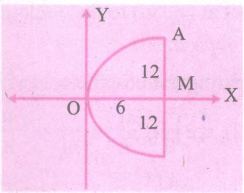
∴ 122 = 4a(6) ⇒ a = 6
∴ Focus is (a, 0) = (b, 0)
Hence focus coincides with m, the mid-point of AB.
18.
Let \({ cos }^{ -1 }\left( \frac { 4 }{ 5 } \right) =\theta \Rightarrow cos\theta =\frac { 4 }{ 5 } \)
\(\therefore sin\left( \frac { 1 }{ 2 } { cos }^{ -1 }\left( \frac { 4 }{ 5 } \right) \right) =sin\left( \frac { 1 }{ 2 } \theta \right) \)
= \(sin\frac { \theta }{ 2 } =\sqrt { \frac { 1-cos\theta }{ 2 } } \)
= \(\sqrt { \frac { 1-\frac { 4 }{ 5 } }{ 2 } } =\sqrt { \frac { 5-4 }{ 5(2) } } =\sqrt { \frac { 1 }{ 10 } } \)
19.
L.H.S = \({ tan }^{ -1 }\left( \frac { 1 }{ 7 } \right) +{ tan }^{ -1 }\left( \frac { 1 }{ 13 } \right) \)
= \({ tan }^{ -1 }\left( \cfrac { \frac { 1 }{ 7 } +\frac { 1 }{ 3 } }{ 1-\left( \frac { 1 }{ 7 } \right) \left( \frac { 1 }{ 13 } \right) } \right) ={ tan }^{ -1 }\left( \cfrac { \frac { 13+7 }{ 91 } }{ \frac { 91-1 }{ 91 } } \right) \)
\(=\tan ^{-1}\left(\frac{\frac{20}{91}}{\frac {90}{91}}\right)=\tan ^{-1}\left(\frac{20}{\not 91} \times \frac{\not 91}{90}\right) \)
\(=\tan ^{-1}\left(\frac{\not 20^{2}}{\not 90^{9}}\right)=\tan ^{-1}\left(\frac{2}{9}\right)=\mathrm{RHS}
\)
Hence proved.
20.
Given
\({ cot }^{ -1 }\left( \frac { 1 }{ 7 } \right) =0\Rightarrow \theta =\frac { 1 }{ 7 } \)
\(\Rightarrow tan\theta =7\)
\(\Rightarrow sec\theta =\sqrt { 1+{ tan }^{ 2 }\theta } =\sqrt { 1+{ 7 }^{ 2 } } =\sqrt { 50 } =5\sqrt { 2 } \)
\(\Rightarrow cos\theta ={ \frac { 1 }{ 5\sqrt { 2 } } }\)
21.
The planes \(\overset { \rightarrow }{ r } .\overset { \rightarrow }{ { n }_{ 1 } } ={ d }_{ 1 }\) and \(\overset { \rightarrow }{ r } .\overset { \rightarrow }{ { n }_{ 2 } } ={ d }_{ 2 }\) are perpendicular if \(\overset { \rightarrow }{ { n }_{ 1 } } .\overset { \rightarrow }{ { n }_{ 2 } } =0\)
Here \(\overset { \rightarrow }{ { n }_{ 1 } } =\overset { \wedge }{ i } +2\overset { \wedge }{ j } +3\overset { \wedge }{ k } \) and \(\overset { \rightarrow }{ { n }_{ 2 } } =\lambda \overset { \wedge }{ i } +2\overset { \wedge }{ j } -7\overset { \wedge }{ k } \)
\(\therefore \overset { \rightarrow }{ { n }_{ 1 } } .\overset { \rightarrow }{ { n }_{ 2 } } =\left( \overset { \wedge }{ i } +2\overset { \wedge }{ j } +3\overset { \wedge }{ k } \right) .\left( \lambda \overset { \wedge }{ i } +2\overset { \wedge }{ j } -7\overset { \wedge }{ k } \right) =0\)
⇒ λ + 4 - 21 = 0
⇒ λ - 17 = 0
⇒ λ = 17
22.
The parametric form of vector equation of a line passing through a point \(\left( \overset { \rightarrow }{ a } \right) \) and parallel to \(\overset { \rightarrow }{ b } \) is
\({ \overset { \rightarrow }{ r } }=\overset { \rightarrow }{ a } +t\overset { \rightarrow }{ b } \), t ∈ R
⇒ Here \(\overset { \rightarrow }{ a } =2\overset { \wedge }{ i } -\overset { \wedge }{ j } +3\overset { \wedge }{ k } \) and \(\overset { \rightarrow }{ b } =2\overset { \wedge }{ i } +\overset { \wedge }{ j } -2\overset { \wedge }{ k } \)
\(\therefore { \overset { \rightarrow }{ r } }=\left( 2\overset { \wedge }{ i } -\overset { \wedge }{ j } +3\overset { \wedge }{ k } \right) +t\left( 2\overset { \wedge }{ i } +\overset { \wedge }{ j } -2\overset { \wedge }{ k } \right) \), t ∈ R which is the required equation of a line.
23.
\(\overset { \rightarrow }{ F } =\frac { 6\left( \overset { \wedge }{ 2i } -2\overset { \wedge }{ j } +\overset { \wedge }{ k } \right) }{ \sqrt { 4+4+1 } } =\frac { 6 }{ 3 } \left( \overset { \wedge }{ 2i } -2\overset { \wedge }{ j } +\overset { \wedge }{ k } \right) =\overset { \wedge }{ 4i } -4\overset { \wedge }{ j } +2\overset { \wedge }{ k } \)
\(\overset { \rightarrow }{ d } \) = (5, 3, 7) - (1, 2, 3) = (4, 1, 4) =\(\overset { \wedge }{ 4i } +\overset { \wedge }{ j } +4\overset { \wedge }{ k } \)
∴ Work done (w)
= \(\overset { \rightarrow }{ F } .\overset { \rightarrow }{ d } =\left( \overset { \wedge }{ 4i } -4\overset { \wedge }{ j } +2\overset { \wedge }{ k } \right) .\left( \overset { \wedge }{ 4i } +\overset { \wedge }{ j } +4\overset { \wedge }{ k } \right) \)
= 16 - 4 + 8 = 20 units
24.
Sum of the roots = sin ∝ + cos ∝ = \(\frac{-b}{a}\)
Product of the roots = sin ∝ cos ∝ = \(\frac{c}{a}\)
Now 1 = cos2∝ + sin2 ∝
= (sin ∝ +cos ∝)2 - 2 sin ∝ cos ∝
\(1=\frac { { b }^{ 2 } }{ { a }^{ 2 } } -\frac { 2c }{ a } \Rightarrow 1=\frac { { b }^{ 2 }-2ac }{ { a }^{ 2 } } \)
⇒ a2 = b2 - 2ac ⇒ a2 + 2ac = b2
Adding c2 both sides, a2 +2ac+c2 = b2+c2
⇒ (a+c)2 = b2 + c2

12th Standard Syllabus & Materials
12th Standard
TN 12th Computer Applications களப்பெயர் முறைமை (DNS) Sample Question Papers Study Material - QB365 Set A
NEW12th Standard
TN 12th Computer Applications வலையமைப்பு எடுத்துக்காட்டுகள் மற்றும் நெறிமுறைகள் Sample Question Papers Study Material - QB365 Set A
NEW12th Standard
TN 12th Computer Applications கணினி வலையமைப்பு ஓர் அறிமுகம் Sample Question Papers Study Material - QB365 Set A
NEW12th Standard
TN 12th Computer Applications PHP-உடன் MySQL-ஐ இணைத்தல் Sample Question Papers Study Material - QB365 Set A



Tamilnadu Stateboard 12th Standard Subjects
Maths

Chemistry

Physics

Biology

Computer Science

Business Maths and Statistics

Economics

Commerce

Accountancy

History

Computer Applications
Biology
Computer Technology
Computer Applications
Computer Science
Business Maths and Statistics
Commerce
Economics
Maths
Chemistry
Physics
Computer Technology
History
Accountancy

Tamil

English

French
Tamilnadu Stateboard Standards



