
 100% FREE ACCESS
12th Standard Syllabus & Materials
12th Standard
TN 12th Computer Applications மின்னணு தரவு பரிமாற்றம் Sample Question Papers Study Material - QB365 Set A
NEW12th Standard
TN 12th Computer Applications மின் - வணிக பாதுகாப்பு அமைப்புகள் Sample Question Papers Study Material - QB365 Set A
NEW12th Standard
TN 12th Computer Applications மின்னணு செலுத்தல் முறைகள் Sample Question Papers Study Material - QB365 Set A
NEW12th Standard
TN 12th Computer Applications மின் - வணிகம் Sample Question Papers Study Material - QB365 Set A
NEW12th Standard
TN 12th Computer Applications திறந்த மூல கருத்துருக்கள் Sample Question Papers Study Material - QB365 Set A
NEW12th Standard
TN 12th Computer Applications வலையமைப்பு வடமிடல் Sample Question Papers Study Material - QB365 Set A

Published on: 27/02/2021
12th Standard English Medium Physics Reduced syllabus Annual Exam Model Question Paper - 2021
Download Tamil Nadu 12th Standard Physics question papers, model tests, one-mark questions, important questions, and public exam papers in PDF format. Free study materials and answer keys for TN State Board students.
Questions + Answers key
Take MCQ Physics Test1.
The coil of a moving coil galvanometer has 5 turns and each turn has an effective area of 2 x 10⁻² m2. It is suspended in a magnetic field whose strength is 4 x 10⁻² Wb m–2. If the torsional constant K of the suspension fibre is 4 x 10⁻⁹ N m deg–1.
(a) Find its current sensitivity in division per microampere.
(b) Calculate the voltage sensitivity of the galvanometer for it to have full scale deflection of 50 divisions for 25 mV.
(c) Compute the resistance of the galvanometer
2.
An electron moving perpendicular to a uniform magnetic field 0.500 T undergoes circular motion of radius 2.50 mm. What is the speed of electron?
3.
4.
Two resistors when connected in series and parallel, their equivalent resistances are 15 Ω and \(\frac{56}{15}\)Ω respectively. Find the individual resistances.
5.
(a) Calculate the electric potential at points P and Q as shown in the figure below.
(b) Suppose the charge + 9μC is replaced by - 9 μC find the electrostatic potentials at points P and Q.
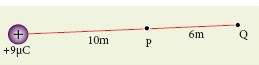
(c) Calculate the work done to bring a test charge +2 μC from infinity to the point Q. Assume the charge +9 μC is held fixed at origin and +2 μC is brought from infinity to P.
6.
Consider a rectangular block of metal of height A, width B and length C as shown in the figure.
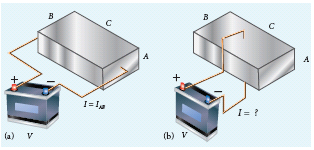
If a potential difference of V is applied between the two faces A and B of the block (figure (a)), the current IAB is observed. Find the current that flows if the same potential difference V is applied between the two faces B and C of the block (figure (b)). Give your answers in terms of IAB.
7.
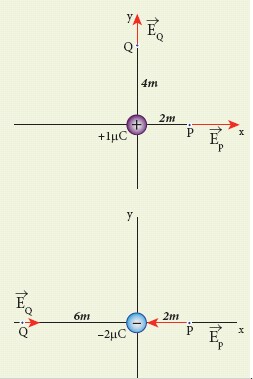
Calculate the electric field at points P, Q for the following two cases, as shown in the figure.
(a) A positive point charge +1 μC is placed at the origin.
(b) A negative point charge -2 μC is placed at the origin.
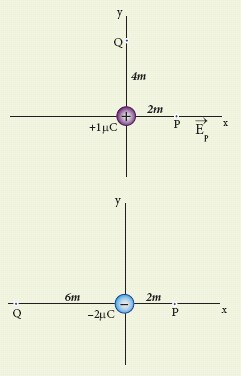
8.
Two small-sized identical equally charged spheres, each having mass 1 g are hanging in equilibrium as shown in the figure. The length of each string is 10 cm and the angle θ is 30° with the vertical. Calculate the magnitude of the charge in each sphere. (Take g = 10 ms−2)
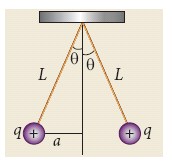
9.
What will be the effect on interference fringes if red light is replaced by blue light?
10.
What is the use of industrial robots?
11.
Define photo diode.
12.
What is a reactor core?
13.
A fusion reaction is more energetic than a fission reaction. Why?
14.
What is nuclear chain reaction?
15.
A conductor of linear mass density 0.2 g m–1 suspended by two flexible wire as shown in figure. Suppose the tension in the supporting wires is zero when it is kept inside the magnetic field of 1 T whose direction is into the page. Compute the current inside the conductor and also the direction of the current. Assume g = 10 m s–2
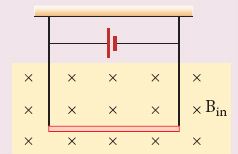
16.
Let E be the electric field of magnitude 6.0 x 10⁶ N C–1 and B be the magnetic field magnitude 0.83 T. Suppose an electron is accelerated with a potential of 200 V, will it show zero deflection?. If not, at what potential will it show zero deflection.
17.
Capacitors P and Q have identical cross sectional areas A and separation d. The space between the capacitors is filled with a dielectric of dielectric constant εr as shown in the figure. Calculate the capacitance of capacitors P and Q.
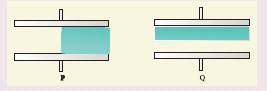
18.
A point charge of +10 μC is placed at a distance of 20 cm from another identical point charge of +10 μC. A point charge of -2 μC is moved from point a to b as shown in the figure. Calculate the change in potential energy of the system? Interpret your result.
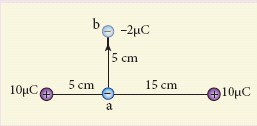
19.
Draw the free body diagram for the following charges as shown in the figure (a), (b) and (c).
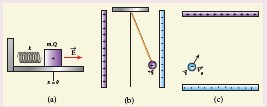
20.
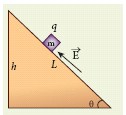
A block of mass m carrying a positive charge q is placed on an insulated frictionless inclined plane as shown in the figure. A uniform electric field E is applied parallel to the inclined surface such that the block is at rest. Calculate the magnitude of the electric field E.
21.
Let I1 and I2 be the steady currents passing through a long horizontal wire XY and PQ respectively. The wire PQ is fixed in horizontal plane and the wire XY be is allowed to move freely in a vertical plane. Let the wire XY is in equilibrium at a height d over the parallel wire PQ as shown in figure.
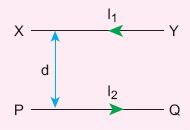
Show that if the wire XY is slightly displaced and released, it executes Simple Harmonic Motion (SHM). Also, compute the time period of oscillations.
22.
Consider a point charge +q placed at the origin and another point charge -2q placed at a distance of 9 m from the charge +q. Determine the point between the two charges at which electric potential is zero.
23.
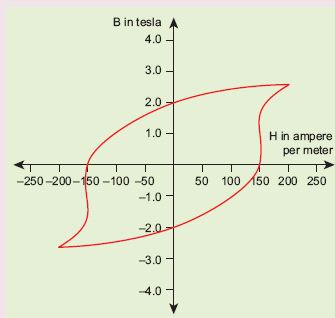
The BH curve for a ferromagnetic material is shown in the figure. The material is placed inside a long solenoid which contains 1000 turns/cm. The current that should be passed in the solenoid to demagnetize the ferromagnet completely is _____.
1.00 m A
1.25 mA
1.50 mA
1.75 mA
24.
A non-conducting charged ring carrying a charge of q, mass m and radius r is rotated about its axis with constant angular speed ω. Find the ratio of its magnetic moment with angular momentum is _____.
\(\\ \frac { q }{ m } \)
\(\\ \frac { 2q }{ m } \)
\(\\ \frac { q }{ 2m } \)
\(\\ \frac { q }{ 4m } \)
25.
A particle having mass m and charge q accelerated through a potential difference V. Find the force experienced when it is kept under perpendicular magnetic field \(\vec { B } \).
\(\sqrt { \frac { 2{ q }^{ 3 }BV }{ m } } \)
\(\sqrt { \frac { { q }^{ 3 }{ B }^{ 2 }V }{ 2m } } \)
\(\sqrt { \frac { 2{ q }^{ 3 }{ B }^{ 2 }V }{ m } } \)
\(\sqrt { \frac { { 2q }^{ 3 }BV }{ { m }^{ 3 } } } \)
26.
An inductor 20 mH, a capacitor 50 μF and a resistor 40Ω are connected in series across a source of emf V = 10 sin 340 t. The power loss in AC circuit is
0.76 W
0.89 W
0.46 W
0.67 W
27.
In a series resonant RLC circuit, the voltage across 100 Ω resistor is 40 V. The resonant frequency ω is 250 rad/s. If the value of C is 4 µF, then the voltage across L is
600 V
4000 V
400 V
1 V
28.
In a series RL circuit, the resistance and inductive reactance are the same. Then the phase difference between the voltage and current in the circuit is
\(\frac{\pi}{4}\)
\(\frac{\pi}{2}\)
\(\frac{\pi}{6}\)
zero
29.
A thin semi-circular conducting ring (PQR) of radius r is falling with its plane vertical in a horizontal magnetic field B, as shown in the figure.
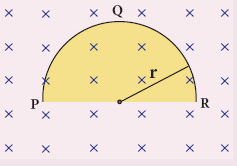
The potential difference developed across the ring when its speed v, is
Zero
\(\frac { { Bv\pi { r }^{ 2 } } }{ 2 } \) and P is at higher potential
πrBv and R is at higher potential
2rBv and R is at higher potential
30.
Which one of them is used to produce a propagating electromagnetic wave?
an accelerating charge
a charge moving at constant velocity
a stationary charge
an uncharged particle
31.
An electric field \(\vec { E } =10x\hat { i } \) exists in a certain region of space. Then the potential difference V = Vo – VA, where Vo is the potential at the origin and VA is the potential at x = 2 m is _____.
10 V
-20 V
+20 V
-10 V
32.
Rank the electrostatic potential energies for the given system of charges in increasing order
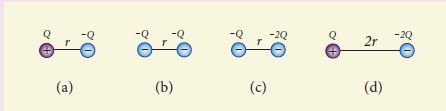
1 = 4 < 2 < 3
2 = 4 < 3 < 1
2 = 3 < 1 < 4
3 < 1 < 2 < 4
33.
Two identical point charges of magnitude –q are fixed as shown in the figure below. A third charge +q is placed midway between the two charges at the point P. Suppose this charge +q is displaced a small distance from the point P in the directions indicated by the arrows, in which direction(s) will +q be stable with respect to the displacement?
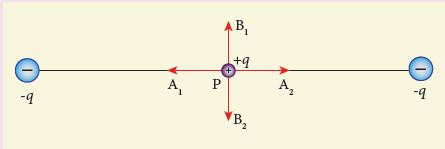
A1 and A2
B1 and B2
both directions
No stable
34.
The internal resistance of a 2.1 V cell which gives a current of 0.2 A through a resistance of 10 Ω is ______.
0.2 Ω
0.5 Ω
0.8 Ω
1.0 Ω
35.
What is the value of resistance of the following resistor?
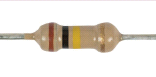
100 k Ω
10 k Ω
1 k Ω
1000 k Ω
36.
A carbon resistor of (47 ± 4.7 ) k Ω to be marked with rings of different colours for its identification. The colour code sequence will be ______.
Yellow – Green – Violet – Gold
Yellow – Violet – Orange – Silver
Violet – Yellow – Orange – Silver
Green – Orange – Violet - Gold
37.
The following graph shows current versus voltage values of some unknown conductor. What is the resistance of this conductor?
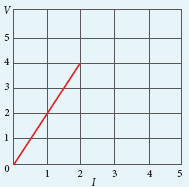
2 ohm
4 ohm
8 ohm
1 ohm
1.
N = 5 turns
A = 2 x 10⁻² m2
B = 4 x 10⁻² Wb m-2
K = 4 x 10⁻⁹ N m deg-1
(a) Current sensitivity
\({ I }_{ s }=\frac { NAB }{ K } =\frac { 5\times 2\times { 10 }^{ -2 }\times 4\times { 10 }^{ -2 } }{ 4\times 10^{ -9 } } \)
= 106 divisions per ampere
\(I\mu A=\) 1microambire =10-6ampere
Therefore,
\({ I }_{ s }={ 10 }^{ 6 }\frac { div }{ A } =1\frac { div }{ { 10 }^{ -6 }A } =1\frac { div }{ \mu A } \)
\({ I }_{ s }=1div{ \left( \mu A \right) }^{ -1 }\)
(b) Voltage sensitivity
\({ V }_{ s }=\frac { \theta }{ V } =\frac { 50div }{ 25mv } =2\times { 10 }^{ 3 }{ div \ V }^{ -1 }\)
(c) The resistance of the galvanometer is
\({ R }_{ g }=\frac { { I }_{ s } }{ { v }_{ s } } =\frac { { 10 }^{ 6 }\frac { div }{ A } }{ { 2\times }10^{ 6 }\frac { div }{ V } } =0.5\times { 10 }^{ 3 }\frac { V }{ A } =0.5k\Omega \)
2.
Charge of an electron q = –1.60 × 10⁻¹⁹ C ⇒ |q| = 1 60 x 10-19 C
Magnitude of magnetic field B = 0.500 T
Mass of the electron, m = 9.11 × 10⁻³¹ kg
Radius of the orbit, r = 2.50 mm = 2.50 × 10⁻³ m
Speed of the electron, V = \(q \frac{\mathrm{rB}}{\mathrm{m}}\)
\( v = 1.60 \times 10^{-19} \times\frac{ 2.50 \times 10^{-3} \times 0.500}{9.11 \times 10^{-31}}\)
\(v=2.195 \times 10^8 \mathrm{~m} \mathrm{s} ^{-1}\)
3.
4.
Rs = R1 + R2 = 15 Ω (1)
\({ R }_{ p }=\frac { { R }_{ 1 }{ R }_{ 2 } }{ { R }_{ 1 }{ +R }_{ 2 } } =\frac { 56 }{ 15 } \Omega \quad \) (2)
From equation (1) substituting for R1 + R2 in equation (2)
\(\frac { { R }_{ 1 }{ R }_{ 2 } }{ 15 } =\frac { 56 }{ 15 } \Omega \)
∴ R1R2 = 56
\({ R }_{ 2 }=\frac { 56 }{ 15 } \Omega \) (3)
Substituting for R2 in equation (1) from equation (3)
\({ R }_{ 1 }+\frac { 56 }{ { R }_{ 1 } } =15\)
Then, \(\frac { { R }_{ 1 }^{ 2 }+56 }{ { R }_{ 1 } } =15\)
R12 + 56 = 15 R1
R12 - 15 R1 + 56 = 0
The above equation can be solved using factorisation.
R1 = 8 Ω (or) R1 = 7 Ω
If (R1 = 8 Ω)
Substituting in equation (1)
8 + R2 = 15
R2 = 15 – 8 = 7 Ω ,
R2 = 7 Ω i.e , (when R1 = 8 Ω ; R2 = 7 Ω)
If R1= 7 Ω
Substituting in equation (1)
7 + R2 = 15
R2 = 8 Ω , i.e , (when R1 = 7 Ω ; R2 = 8 Ω )
5.
(a) Electric potential at point P is given by
Vp=\(\frac { 1 }{ 4\pi { \varepsilon }_{ 0 } } \frac { q }{ { r }_{ p } } =\frac { 9\times 10^{ 9 }\times 9\times { 10 }^{ -6 } }{ 10 } \) = 8.1 x 10³ V
Electric potential at point Q is given by
VQ = \(\frac { 1 }{ 4\pi { \varepsilon }_{ 0 } } \frac { q }{ { r }_{ Q } } =\frac { 9\times 10^{ 9 }\times 9\times { 10 }^{ -6 } }{ 16 } \) = 5.06 x 10³ V
Note that the electric potential at point Q is less than the electric potential at point P. If we put a positive charge at P, it moves from P to Q. However if we place a negative charge at P it will move towards the charge +9μC.
The potential difference between the points P and Q is given by
ΔV = Vp-VQ = +3.04 x 10³ V
b) Suppose we replace the charge +9 μC by -9 μC, then the corresponding potentials at the points P and Q are,
Vp = -8.1 x 10³ V, VQ = -5.06 x 10³ V
Note that in this case electric potential at the point Q is higher than at point P.
The potential difference or voltage between the points P and Q is given by
ΔV = Vp-VQ= -3.04 x 10³V
(c) The electric potential V at a point P due to some charge is defined as the work done by an external force to bring a unit positive charge from infinity to P. So to bring the q amount of charge from infinity to the point P, work done is given as follows.
W = qV
WQ = 2 x 10-6 x 5.06 x 103J = 10.12 x 10⁻³ J.
6.
In the first case, the resistance of the block
\({ R }_{ AB }=\rho \frac { length }{ Area } =\rho \frac { C }{ AB } \)
The current \({ I }_{ AB }=\frac { V }{ { R }_{ AB } } =\frac { V }{ \rho } .\frac { AB }{ C } \quad (1)\)
In the second case, the resistance of the block \({ R }_{ BC }=\rho \frac { A }{ BC } \)
The current \({ I }_{ BC }=\frac { V }{ { R }_{ BC } } =\frac { V }{ \rho } .\frac { BC }{ C } \quad (2)\)
To express IBC interms of IAB, we multiply and divide equation (2) by AC, we get
\({ I }_{ BC }=\frac { V }{ \rho } .\frac { BC }{ A } \frac { AC }{ AC } =\left( \frac { V }{ \rho } .\frac { AB }{ C } \right) .\frac { { C }^{ 2 } }{ { A }^{ 2 } } =\frac { { C }^{ 2 } }{ { A }^{ 2 } }.{ I }_{ AB }\)
Since C > A, the current IBC > IAB
7.
Case (a)
The magnitude of the electric field at point P is
Ep = \(\frac { 1 }{ 4\pi \varepsilon _{ 0 } } \frac { q }{ { r }^{ 2 } } =\frac { 9\times { 10 }^{ 9 }\times 1\times 10^{ -6 } }{ 4 } \)
= 2.25 x 10³ NC-1
Since the source charge is positive, the electric field points away from the charge. So the electric field at the point P is given by
\(\bar { { E }_{ p } } \) = 2.25 x 10³ NC-1
For the point Q
\(|\vec { { E }_{ Q } } |=\frac { 9\times 10^{ 9 }\times 1\times { 10 }^{ -6 } }{ 16 } \) = 0.56 x 10³ NC-1
Hence \(\vec { { E }_{ Q } } \) = 0.56 x 10³\(\hat { j } \) NC-1
Case (b)
The magnitude of the electric field at point P
\(\bar { { E }_{ p } } =\frac { kq }{ r^{ 2 } } =\frac { 1 }{ 4\pi { \varepsilon }_{ 0 } } \frac { q }{ { r }^{ 2 } } =\frac { 9\times 10^{ 9 }\times 2\times 10^{ -6 } }{ 4 } \)
= 4.5 x 10³ NC-1
Since the source charge is negative, the electric field points towards the charge. So the electric field at the point P is given by
\(\vec { E_{ p } } \) = -4.5 x 10³\(\hat { i } \)NC-1
For the point Q, \(|\vec { { E }_{ Q } } |\frac { 9\times 10^{ 9 }\times 2\times { 10 }^{ -6 } }{ 36 } \)
= 0.5 x 10³ NC-1
\(\vec { E_{ Q } } \) = 0.5 x 10³\(\hat { i } \)NC-1
At the point Q the electric field is directed along the positive x-axis.
8.
If the two spheres are neutral, the angle between them will be 0o when hanged vertically. Since they are positively charged spheres, there will be a repulsive force between them and they will be at equilibrium with each other at an angle of 30° with the vertical. At equilibrium, each charge experiences zero net force in each direction. We can draw a free-body diagram for one of the charged spheres and apply Newton’s second law for both vertical and horizontal directions.
The free-body diagram is shown below
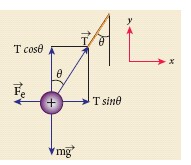
In the x-direction, the acceleration of the charged sphere is zero.
Using Newton’s second law \((\vec { { F }_{ tot }= } m\vec { a } )\), we have
T sinθ\(\hat { i } \) - Fe\(\hat { i } \) =0
T sinθ = Fe ......(1)
Here T is the tension acting on the charge due to the string and Fe is the electrostatic force between the two charges.
In the y-direction also, the net acceleration experienced by the charge is zero
Tcosθ\(\hat { j } \) - mg\(\hat { j } \) = 0
Tcosθ = mg ..(2)
By dividing equation (1) by equation (2),
tanθ = \(\frac { { F }_{ e } }{ mg } \) .....(3)
Since they are equally charged, the magnitude of the electrostatic force is
\({ F }_{ e }=k\frac { { q }^{ 2 } }{ { r }^{ 2 } } \) where k=\(\frac { 1 }{ 4\pi { \varepsilon }_{ 0 } } \)
Here r = 2a = 2Lsinθ. By substituting these values in equation (3),
tanθ = k\(\frac { { q }^{ 2 } }{ mg(2Lsin\theta )^{ 2 } } \) ..........(4)
Rearranging the equation (4) to get q
q = 2 Lsinθ\(\\ \sqrt { \frac { mgtan\theta }{ k } } \)
= 2 x 0.1 x sin 30o x \(\sqrt { \frac { 10^{ -3 }\times 10\times { tan30 }^{ 0 } }{ 9\times 10^{ 9 } } } \)
q = 8.01 x 10⁻⁸C = 80.1 nC
9.
\(\beta =\cfrac { D\lambda }{ d } ,i.e\beta \propto \lambda \) the wavelength of blue light is less than that of red light, hence if red light is replaced by blue light, the fringe width decreases, i.e., fringes come closer.
10.
Industrial robots are used for welding, cutting, robotic water jet cutting, robotic laser cutting, lifting, sorting, bending, manufacturing, assembling, packing, transport, handling hazardous materials like nuclear waste, weaponry, laboratory research, mass production of consumer and industrial goods.
11.
A P-N junction diode which converts an optical signal into electric current is known as photo diode.
12.
The fuel bundles which consist of tiny pellets of uranium oxide are placed in calandria reactor vessel. The part of the reactor vessel which contains the fuel rod is known as reactor core.
13.
In nuclear fusion reaction, the energy liberated per unit mass of the nuclei taking part in the reaction is many times larger than the energy liberated in a fission reaction.
14.
A nuclear reaction in which the neutron used to carry out the nuclear fission reaction gets multiplied as more and more such fission reaction take place is called a nuclear chain reaction.
15.
Linear mass density of the conductor is = 0.2 g/m
Mass per unit length \(\frac{M}{l}=0.2 \times 10^{-3} \mathrm{~kg} / \mathrm{m}\)
Magnetic field B = 1T.
Acceleration due to gravity, g = 10 ms-2
Force \(=\frac{m}{l} \times g\)
= 0.2 x 10-3 x 10 = 0.2 x 10⁻²
F = 2 x 10⁻³ N ....(1)
If the coil is placed in the magnetic field then the force acting on the coil is
F= BIl ....(2)
From the equation (1) and (2) we get
BIl = 2 x 10⁻³
∴ 1 x L x I = 2 x 10⁻³
∴ I = 2 x 10⁻³ A [∴ l = 1m]
∴ I = 2mA
16.
Electric field, E = 6.0 x 10⁶ N C-1 and magnetic field, B = 0.83 T.
Then.
\(v=\frac { E }{ B } =\frac { { 6.0\times 10 }^{ 6 } }{ 0.83 } =7.23\times { 10 }^{ 6 }{ ms }^{ -1 }\)
When an electron goes with this velocity, it shows null deflection. Since the accelerating potential is 200 V, the electron acquires kinetic energy because of this accelerating potential. Hence,
\(\frac { 1 }{ 2 } mv^{ 2 }=eV \)
\(v=\sqrt { \frac { 2eV }{ m } }\)
Since the mass of the electron, m = 9.1 x 10⁻³¹kg and charge of an electron, \(\left| q \right| =e=1.6\times { 10 }^{ -19 }C.\) The velocity acquired by the electron due to accelerating potential 200 V is
\({ v }_{ 200 }=\sqrt { \frac { 2\left( 1.6\times { 10 }^{ -19 } \right) \left( 200 \right) }{ \left( 9.1\times { 10 }^{ -31 } \right) } } =8.39\times { 10 }^{ 6 }m{ s }^{ -1 }\)
Since the speed v200 > v, the electron is deflected towards direction of Lorentz force. So, in order to have null deflection, the potential, we have to supply is
\(v=\frac { { 1mv }^{ 2 } }{ 2\quad e } =\frac { \left( 9.1\times { 10 }^{ -31 } \right) \times \left( 7.23\times { 10 }^{ 6 } \right) ^{ 2 } }{ 2\times \left( 1.6\times { 10 }^{ -19 } \right) } \)
V = 148.65 V
17.
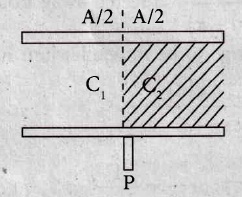
(a) \(C_{1}=\frac{\varepsilon_{0} A}{2d} (\because area=\frac{A}{2})\)
\(C_{2}=\frac{\varepsilon_{r} \varepsilon_{0} A}{d} \)
C1 and C2 are in parellel,
\(C_{P}=\left(C_{1}+C_{2}\right) \)
\(C_{P}=\frac{1}{2}\left(\frac{\varepsilon_{r} \varepsilon_{0} A}{d}+\frac{\varepsilon_{0} A}{d}\right) \)
\(=\frac{1}{2} \frac{\varepsilon_{0} A}{d}\left(\varepsilon_{r}+1\right) \)
\(C_{P}=\frac{\varepsilon_{0} A}{2 d}\left(\varepsilon_{r}+1\right) \)
.jpg)
(b) \(C_1=\frac{\varepsilon_0 \varepsilon_r A}{d / 2}=\frac{2 \varepsilon_0 \varepsilon_r A}{d}(\because \text { Separation }=d / 2)\)
\(C_2=\frac{2 \varepsilon_0 A}{d}\)
C1 and C2 are in series,
\(\frac{1}{C_1} =\frac{1}{C_1}+\frac{1}{C_2} \)
\(=\frac{d}{2 \varepsilon_0 \varepsilon_r A}+\frac{d}{2 \varepsilon_0 A} \)
\(=\frac{d}{2 \varepsilon_0 A}\left(\frac{1}{\varepsilon_r}+1\right) \)
\(\frac{1}{C_1} =\frac{d}{2 \varepsilon_0 A}\left(\frac{1+\varepsilon_r}{\varepsilon_r}\right) \)
\(\therefore C_s =\frac{2 e_0 A}{d}\left(\frac{e_r}{1+e_r}\right)\)
18.
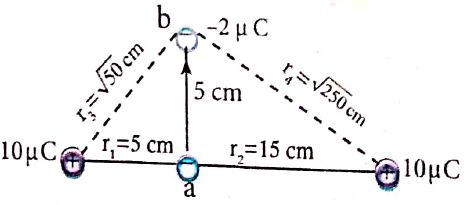
\(W =\left(V_{b}-V_{a}\right) q\left[where\ V=\frac{K Q}{r}\right] \)
To find Vb :
\(V_b=\frac{kQ}{r_3}+\frac{kQ}{r_4}\)
\(V_{b} =\frac{K \times 10 \times 10^{-6}}{\sqrt{50 \times 10^{-4}}}+\frac{K \times 10 \times 10^{-6}}{\sqrt{250 \times 10^{-4}}} \)
\(V_{b} =\frac{K \times 10^{-5}}{\sqrt{50} \times 10^{-2}}+\frac{K \times 10^{-5}}{\sqrt{250} \times 10^{-2}} \)
\(=K \times 10^{-3}\left[\frac{1}{\sqrt{50}}+\frac{1}{\sqrt{250}}\right] \)
\(=9 \times 10^{9} \times 10^{-3}\left[\frac{1}{\sqrt{50}}+\frac{1}{\sqrt{250}}\right] \)
Vb = 1842002 V
To find Va :
\(V_a=\frac{kQ}{r_1}+\frac{kQ}{r_2}\)
\(V_{a} =\frac{K \times 10 \times 10^{-6}}{\sqrt{5 \times 10^{-2}}}+\frac{K \times 10 \times 10^{-6}}{\sqrt{15 \times 10^{-2}}} \)
Va = 2400000 V
\(\therefore W_{D} =\left(V_{b}-V_{a}\right) q=(1842002-2400000)( -2 \times 10^{-6} )\)
W = +1.12J
Positive sign implies that to move the charge - 2 μC external work is required.
19.
(a) In the figure
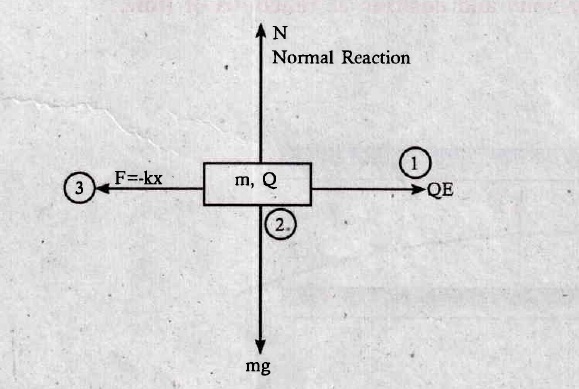
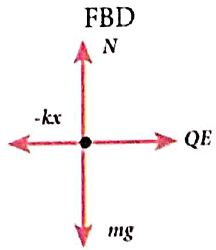
1 - Electrostatic force Fe = QE
2 - Weight W = mg
3 - Elastic force F = -kx
4 - Upward force = Normal reaction = N
b) In this figure
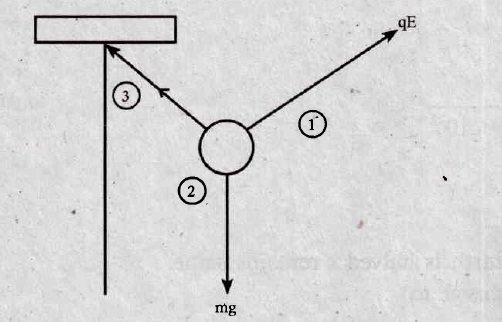
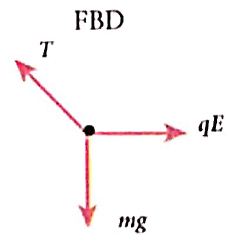
1- Electrostatic force F = qE
2 - Weight W = mg
3 - Tension acting along the string is T
(c) The charge is attracted towards the positively charged plate because it is a negative charge.
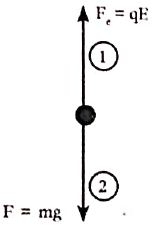
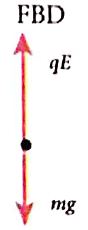
1 - Force = qE
2 - Downward force F = mg
20.
Note: A similar problem is solved in XIth Physics volume I, unit 3 section 3.3.2. There are three forces that acts on the mass m:
(i) The downward gravitational force exerted by the Earth (mg)
(ii) The normal force exerted by the inclined surface (N)
(iii) The Coulomb force given by uniform electric field (qE) The free body diagram for the mass m is drawn below.
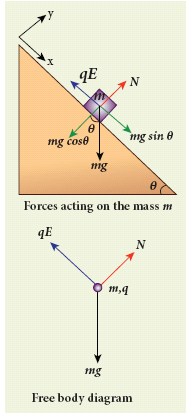
A convenient inertial coordinate system is located in the inclined surface as shown in the figure. The mass m has zero net acceleration both in x and y-direction.
Along x-direction, applying Newton’s second law, we have
mg sinθ\(\hat { i } \) - qE\(\hat { i } \) = 0
mg sinθ - q E = 0
or, E = \(\\ \frac { mgsin\theta }{ q } \)
Note that the magnitude of the electric field is directly proportional to the mass m and inversely proportional to the charge q. It implies that, if the mass is increased by keeping the charge constant, then a strong electric field is required to stop the object from sliding. If the charge is increased by keeping the mass constant, then a weak electric field is sufficient to stop the mass from sliding down the plane.
The electric field also can be expressed in terms of height and the length of the inclined surface of the plane.
E = \(\frac { mgh }{ qL } \).
21.
Let the currents flowing through wires XY and PQ be I1 and I2
Magnetic field along PQ is \(\mathrm{B}_{1}=\frac{\mu_{o} I_{2}}{2 \pi r}\)
Force per unit length on PQ is \(\frac{F_{2}}{l}=\frac{\mu_{0} I_{1} I_{2}}{2 \pi r}\)
If the wire XY is slightly displaced and released, it executes simple harmonic motion with the condition that acceleration is directly proportional to the displacement y
\(\therefore a=-\omega^{2} y\) .....(1)
The distance between two wires = d
Time period
\(T=\frac{2 \pi}{\omega} \)
\(a=\frac{g}{d} y \) .....(2)
By comparing the equations (1) and (2) we get
\(\omega^{2} =-\frac{g}{d} \ \therefore \omega=\sqrt{\frac{g}{d}} \)
\(\text { Time period } =\frac{2 \pi}{\omega}=2 \pi \sqrt{\frac{d}{g}} \)
\(\therefore T =2 \pi \sqrt{\frac{d}{g}} \)
22.
According to the superposition principle, the total electric potential at a point is equal to the sum of the potentials due to each charge at that point.
Consider the point at which the total potential zero is located at a distance x from the charge +q as shown in the figure.
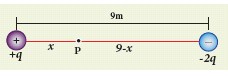
The total electric potential at P is zero.
Vtot = \(\frac { 1 }{ 4\pi { \varepsilon }_{ 0 } } \left( \frac { q }{ x } -\frac { 2q }{ (9-x) } \right) \)=0
Which gives \(\frac { q }{ x } -\frac { 2q }{ (9-x) } \)
or \(\frac { 1 }{ x } =\frac { 2 }{ (9-x) } \)
Hence, x = 3m
23.
(c)
1.50 mA
24.
Magnetic moment,
μ = IA
Angular momentum,
L = Iω
Ratio \(\frac{p_m}{L}=\frac{(q/T)\pi r^2}{mr^2\omega}=\frac{q}{2m}\)
25.
Lorentz force F = Bqv
Energy w = qV
Energy is equal to kinetic energy,
\(qV=\frac{1}{2}mv^2\)
\(v=\sqrt { \frac {2qV }{ m } } \)
\(\therefore Lorentz \ force \ F= Bq\times \sqrt \frac{2qV}{m}=\sqrt { \frac { 2{ B }^{ 2 }{ q }^{ 3 }V }{ m } } \)
26.
L = 20 x 10-3H. C = 50 x 10-6 F, R= 40Ω
enf V = 10 sin 340 t
\(\therefore V_0=10 \mathrm{~V}, \omega=340 \)
\(X_1=1 \omega^{\prime}=20 \times 10^3 \times 340 \)
\(=6800 \times 10^{-1}=6.8 \Omega \)
\(X_C=\frac{1}{C .} \)
\(=\frac{1}{50 \times 10^{-\alpha} \times 340}=\frac{10^{\circ}}{17000}=\frac{10^{\prime}}{17}=58.823 \Omega \)
\(Z=\sqrt{R^2+\left(X_6-X_1\right)^2} \)
\(=\sqrt{(40)^2+(58.82-6.8)^2} \)
\(=\sqrt{(40)^2+(52.02)^2} \)
\(=65.62 \Omega\)
The peak current in the circuit is,
\(I_0=\frac{V_0}{Z}=\frac{10}{65.62} \)
\(\cos 0=\frac{R}{Z}=\frac{40}{65.62} \)
\(\text{Power loss in A.C. circuit }=V_{r m} 1_{r \rightarrow \infty} \cos \phi \)
\(=\frac{1}{2} V_{\mathrm{o}} I_{\mathrm{c}} \cos \phi \)
\(=\frac{1}{2} \times 10 \times \frac{10}{65.62} \times \frac{40}{65.62}\)
\(\frac{2000}{4305.98}\)
= 0.46 W
27.
\(\omega=250 \mathrm{rad} / \mathrm{s}, C=4 \times 10^{-} \mathrm{F} \)
\(R=100 \Omega, \quad \mathrm{V}_{\mathrm{R}}=40 \mathrm{~V} \)
\(\therefore I_{\mathrm{R}}=\frac{V_R}{100}=\frac{40}{100}=0.4 \mathrm{~A} \)
\(\omega=\frac{1}{\sqrt{L C}} \)
\(\omega^2=\frac{1}{L C} \)
\((250)^2=\frac{1}{L \times 4 \times 10^{-6}} \)
\(L=\frac{1}{4 \times(250)^2 \times 10^{-6}} \)
\(=\frac{1}{4 \times 250 \times 250 \times 10^{-6}} \)
\(=\frac{1}{1000 \times 10^{-6} \times 250} \)
\(=\frac{10^3}{250}=\frac{1000}{250}=4 \mathrm{H}\)
Voltage acnoss L, Vt = IXL
VL = l x L x ω
= 0.4 x 4 x 250
0.4 x 1000 = 400 V
28.
In RL circuit, tanΦ = \(\frac{X_l}{R}\)
If R = X1, then tanΦ = \(\frac{X_l}{X_l}=1\)
∴ Φ = tan-1(1)=\(\frac{\pi}{4}\)
∴ Phase difference \(=\frac{\pi}{4}\)
29.
(d)
2rBv and R is at higher potential
30.
(a)
an accelerating charge
31.
\(\vec {E}\) = 10x\(\hat{i},\) when x = 2 m
\(\vec {E}\) = 10 x 2 x \(\hat{i}\) = 20\(\hat{i}\)
Since, \(E=\frac{-dV}{dx}\therefore V=+20 V\)
32.
\(U=\frac{1}{4\piε_0}\frac{q_1q_2}{r_{12}}\)
\(i) U=\frac{1}{4\piε_0}\frac{Q(-Q)}{r}=\frac{1}{4\piε_0}[\frac{-Q^2}{r}]\)
\(ii) U=\frac{1}{4\piε_0}\frac{(-Q)(-Q)}{r}=\frac{1}{4\piε_0}[\frac{Q^2}{r}]\)
\(iii) U=\frac{1}{4\piε_0}\frac{Q(2Q)}{r}=\frac{1}{4\piε_0}[\frac{2Q^2}{r}]\)
\(iv) U=\frac{1}{4\piε_0}\frac{Q(-2Q)}{2r}=\frac{1}{4\piε_0}[\frac{-Q^2}{r}]\)
From the values, 1 = 4 < 2 < 3
33.
The charge + q will be stable between B1 and B2 with respect to the displacement.
34.
I = 0.2 A, R = 10 Ω, E = 2.1 V
\(I=\frac{ɛ}{R+r}\)
\(0.2=\frac{2.1}{10+r}\)
0.2 x (10 + r) = 2.1
2 + 0.2 r = 2.1
0.2 r = 2.1 - 2 = 0.1
Internal resistance, \(r=\frac{0.1}{0.2}=\frac{1}{2}\)
r = 0.5 Ω
35.
Brown - 1
Black - 0
Yellow - 104
(∴ R = 10 x 104 Ω = 100 kΩ)
36.
Yellow - 4
Violet - 7
Orange - 103
Silver - Tolerance - 10%
37.
Resistance, \(R=\frac{V}{I}=\frac{4}{2}=2 \ ohm\)

12th Standard Syllabus & Materials
12th Standard
TN 12th Computer Applications களப்பெயர் முறைமை (DNS) Sample Question Papers Study Material - QB365 Set A
NEW12th Standard
TN 12th Computer Applications வலையமைப்பு எடுத்துக்காட்டுகள் மற்றும் நெறிமுறைகள் Sample Question Papers Study Material - QB365 Set A
NEW12th Standard
TN 12th Computer Applications கணினி வலையமைப்பு ஓர் அறிமுகம் Sample Question Papers Study Material - QB365 Set A
NEW12th Standard
TN 12th Computer Applications PHP-உடன் MySQL-ஐ இணைத்தல் Sample Question Papers Study Material - QB365 Set A



Tamilnadu Stateboard 12th Standard Subjects

Maths

Chemistry
Physics

Biology

Computer Science

Business Maths and Statistics

Economics

Commerce

Accountancy

History

Computer Applications
Biology
Computer Technology
Computer Applications
Computer Science
Business Maths and Statistics
Commerce
Economics
Maths
Chemistry
Physics
Computer Technology
History
Accountancy

Tamil

English

French
Tamilnadu Stateboard Standards

