
 100% FREE ACCESS
12th Standard Syllabus & Materials
12th Standard
TN 12th Maths Applications of Matrices and Determinants Sample Question Papers Study Material - QB365 Set A
NEW12th Standard
TN 12th Computer Applications மின்னணு தரவு பரிமாற்றம் Sample Question Papers Study Material - QB365 Set A
NEW12th Standard
TN 12th Computer Applications மின் - வணிக பாதுகாப்பு அமைப்புகள் Sample Question Papers Study Material - QB365 Set A
NEW12th Standard
TN 12th Computer Applications மின்னணு செலுத்தல் முறைகள் Sample Question Papers Study Material - QB365 Set A
NEW12th Standard
TN 12th Computer Applications மின் - வணிகம் Sample Question Papers Study Material - QB365 Set A
NEW12th Standard
TN 12th Computer Applications திறந்த மூல கருத்துருக்கள் Sample Question Papers Study Material - QB365 Set A

Published on: 27/02/2021
12th Standard English Medium Physics Reduced syllabus Public Exam Model Question Paper with Answer key - 2021
Download Tamil Nadu 12th Standard Physics question papers, model tests, one-mark questions, important questions, and public exam papers in PDF format. Free study materials and answer keys for TN State Board students.
Questions + Answers key
Take MCQ Physics Test1.
An electron moving perpendicular to a uniform magnetic field 0.500 T undergoes circular motion of radius 2.50 mm. What is the speed of electron?
2.
Compute the work done and power delivered by the Lorentz force on the particle of charge q moving with velocity \(\vec { v } \). Calculate the angle between Lorentz force and velocity of the charged particle and also interpret the result.
3.
Show the time period of oscillation when a bar magnet is kept in a uniform magnetic field is \(T=2\pi \sqrt { \frac { 1 }{ { p }_{ m }B } } \) in second, where I represents a moment of inertia of the bar magnet, pm is the magnetic moment and B is the magnetic field.
4.
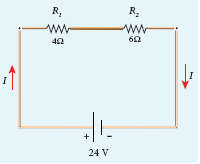
Calculate the equivalent resistance for the circuit which is connected to 24 V battery and also find the potential difference across each resistors in the circuit.
5.
The image of an object formed by a lens on the screen is not in sharp focus. Suggest a method to get a dear focussing of the image on the screen without disturbing the positions of the object, the lens or the screen.
6.
How does the power of a convex lens vary, if the incident red light is replaced by violet light?
7.
Write the expression for angular resolution.
8.
If the intensity of radiation in a photocell is increased how does the stopping potential vary?
9.
What is the role of nanostructure in the morpho butterfly wings?
10.
What is nuclear chain reaction?
11.
Let E be the electric field of magnitude 6.0 x 10⁶ N C–1 and B be the magnetic field magnitude 0.83 T. Suppose an electron is accelerated with a potential of 200 V, will it show zero deflection?. If not, at what potential will it show zero deflection.
12.
A particle of charge q moves with velocity\(\vec { v } \) along positive y-direction in a magnetic field \(\vec { B } \) .Compute the Lorentz force experienced by the particle
(a) when magnetic field is along positive y - direction
(b) when magnetic field points in positive z - direction
(c) when magnetic field is in zy - plane and making an angle θ with velocity of the particle. Mark the direction of magnetic force in each case
13.
A circular antenna of area 3 m2 is installed at a place in Madurai. The plane of the area of antenna is inclined at 47o with the direction of Earth’s magnetic field. If the magnitude of Earth’s field at that place is 4.1 x 10⁻⁵ T find the magnetic flux linked with the antenna.
14.
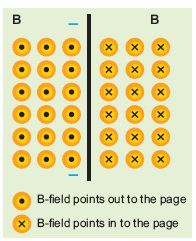
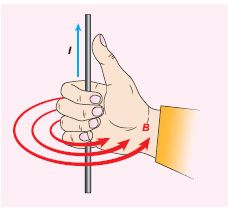
The magnetic field shown in the figure is due to the current carrying wire. In which direction does the current flow in the wire?
15.
If the resistance of coil is 3 Ω at 20oC and α = 0.004/oC then determine its resistance at 100oC.
16.
If a positive half-wave rectified voltage is fed to a load resistor, for which part of a cycle there will be current flow through the load?
00–900
900–1800
00–1800
00–3600
17.
Mp denotes the mass of the proton and Mn denotes mass of a neutron. A given nucleus of binding energy B, contains Z protons and N neutrons. The mass M(N, Z) of the nucleus is given by _____.(where c is the speed of light)
M (N,Z) = NMn + ZMp - Bc2
M (N,Z) = NMn + ZMp + Bc2
M (N,Z) = NMn + ZMp - B/c2
M (N,Z) = NMn + ZMp + B/c2
18.
The work functions for metals A, B and C are 1.92 eV, 2.0 eV and 5.0 eV respectively. The metal/metals which will emit photoelectrons for a radiation of wavelength 4100 Å is/are _____.
A only
both A and B
all these metals
none
19.
In an electron microscope, the electrons are accelerated by a voltage of 14 kV. If the voltage is changed to 224 kV, then the de Broglie wavelength associated with the electrons would _____.
increase by 2 times
decrease by 2 times
decrease by 4 times
increase by 4 times
20.
In a Young’s double-slit experiment, the slit separation is doubled. To maintain the same fringe spacing on the screen, the screen-to-slit distance D must be changed to, _____.
2D
\(\frac{D}{2}\)
\(\sqrt{2}\)D
\(\frac{D}{\sqrt2}\)
21.
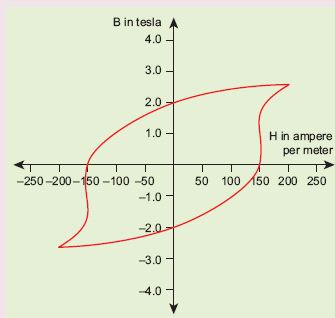
The BH curve for a ferromagnetic material is shown in the figure. The material is placed inside a long solenoid which contains 1000 turns/cm. The current that should be passed in the solenoid to demagnetize the ferromagnet completely is _____.
1.00 m A
1.25 mA
1.50 mA
1.75 mA
22.
A non-conducting charged ring carrying a charge of q, mass m and radius r is rotated about its axis with constant angular speed ω. Find the ratio of its magnetic moment with angular momentum is _____.
\(\\ \frac { q }{ m } \)
\(\\ \frac { 2q }{ m } \)
\(\\ \frac { q }{ 2m } \)
\(\\ \frac { q }{ 4m } \)
23.
\(\frac{20}{\pi^2}H\) inductor is connected to a capacitor of capacitance C. The value of C in order to impart maximum power at 50 Hz is
50 μF
0.5 μF
500 μF
5 μF
24.
The flux linked with a coil at any instant t is given by \(\Phi\)B = 10t2 − 50t + 250. The induced emf at t = 3s is
−190 V
−10 V
10 V
190 V
25.
If E = Eo sin[106 x -ωt] be the electric field of a plane electromagnetic wave, the value of ω is_____.
0.3 x 10⁻¹⁴ rad s−1
3 x 10⁻¹⁴ rad s−1
0.3 x 10¹⁴ rad s−1
3 x 10¹⁴ rad s-1
26.
Two metallic spheres of radii 1 cm and 3 cm are given charges of -1 \(\times\) 10-2 C and 5 \(\times\) 10-2 C respectively. If these are connected by a conducting wire, the final charge on the bigger sphere is
3 \(\times\) 10-2 C
4 \(\times\) 10-2 C
1 \(\times\) 10-2 C
2 \(\times\) 10-2 C
27.
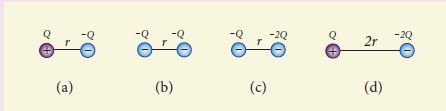
Rank the electrostatic potential energies for the given system of charges in increasing order
1 = 4 < 2 < 3
2 = 4 < 3 < 1
2 = 3 < 1 < 4
3 < 1 < 2 < 4
28.
Two identical conducting balls having positive charges q1 and q2 are separated by a centre to centre distance r. If they are made to touch each other and then separated to the same distance, the force between them will be _____.
less than before
same as before
more than before
zero
29.
A piece of copper and another of germanium are cooled from room temperature to 80 K. The resistance of ______.
each of them increases
each of them decreases
copper increases and germanium decreases
copper decreases and germanium increases
30.
There is a current of 1.0 A in the circuit shown below. What is the resistance of P ?
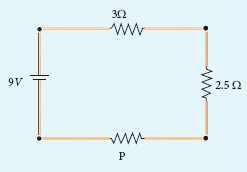
1.5 Ω
2.5 Ω
3.5 Ω
4.5 Ω
31.
The eyepiece and objective of a microscope having focal lengths of 0.03 m and 0.04 m respectively are separated by a distance 0.2 m. Now the eyepiece and the objective are to be interchanged such that the angular magnification of the instrument remains the same. What is the separation between the lenses?
32.
In Young's experiment, the upper slit is covered by a thin glass plate of refractive index 1.4 while the lower slit is covered by another glass plate having the same thickness as the first one but having refractive index 1.7. Interference pattern is observed using light of wavelength 5400 Å. It is observed that the point P on the screen where the central maximum (n = 0) fell before the glass were inserted now has \(\cfrac { 3 }{ 4 } \) th original intensity. It is further observed that what used to be the fifth maximum earlier, lies below the point P while the sixth minimum lies above P. Calculate the thickness of the glass plate.
33.
You are given two converging lenses of focal lengths 1.25 cm and 5 cm to design a compound microscope. If it is desired to have a magnification of 30, find out the separation between the objective and the eyepiece.
34.
For a BJT, the common - base current gain α = 0.98 and the collector base junction reverse bias saturation ICU = 0.6μA. This BJT is connected in the common emitter mode and operated in the active region with a base drive current ID= 20 μA. The collector current IC for this mode of operating is
35.
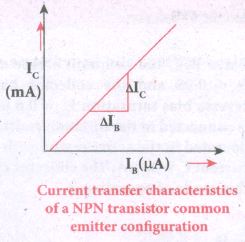
Explain current transfer characteristics.
36.
Explain the principle and working of a moving coil galvanometer.
37.
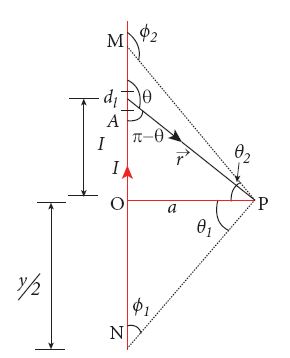
Show that for a straight conductor, the magnetic field
\(\overset { \rightarrow }{ B } =\frac { { \mu }_{ ° }I }{ 4\pi a } (cos\varphi _{ 1 }-cos\varphi _{ 2 })\hat { n } \)
\(=\frac { { \mu }_{ ° }I }{ 4\pi a } (sin{ \theta }_{ 1 }+sin{ \theta }_{ 2 })\hat { n } \)
1.
Charge of an electron q = –1.60 × 10⁻¹⁹ C ⇒ |q| = 1 60 x 10-19 C
Magnitude of magnetic field B = 0.500 T
Mass of the electron, m = 9.11 × 10⁻³¹ kg
Radius of the orbit, r = 2.50 mm = 2.50 × 10⁻³ m
Speed of the electron, V = \(q \frac{\mathrm{rB}}{\mathrm{m}}\)
\( v = 1.60 \times 10^{-19} \times\frac{ 2.50 \times 10^{-3} \times 0.500}{9.11 \times 10^{-31}}\)
\(v=2.195 \times 10^8 \mathrm{~m} \mathrm{s} ^{-1}\)
2.
For a charged particle moving on a magnetic field, \(\vec { F } \)= q(\(\vec { v } \)x\(\vec { B } \))
The work done by the magnetic field is
\(W=\int { \overset { \rightarrow }{ F } .{ d \vec r } =\int { \overset { \rightarrow }{ F } .\overset { \rightarrow }{ v } dt } } \)
\(W=q\int { \left( \overset { \rightarrow }{ v } \times \overset { \rightarrow }{ B } \right) } .\overset { \rightarrow }{ v } dt=0\)
Since \(\overset { \rightarrow }{ v } \times \overset { \rightarrow }{ B } \) is perpendicular to \(\vec { v } \) and hence \(\left( \overset { \rightarrow }{ v } \times \overset { \rightarrow }{ B } \right) .\overset { \rightarrow }{ v } =\overset { \rightarrow }{ 0 } \)
This means that Lorentz force does no work on the particle. From work-kinetic energy theorem, (Refer section 4.2.6, XI th standard Volume I)
\(\frac { dw }{ dt } =p=0\)
Since \(\overset { \rightarrow }{ F } .\overset { \rightarrow }{ v } =0\Rightarrow \overset { \rightarrow }{ F } \ and \ \overset { \rightarrow }{ v } \) are perpendicular to each other. The angle between Lorentz force and velocity of the charged particle is 90o. Thus Lorentz force changes the direction of the velocity but not the magnitude of the velocity. Hence Lorentz force does no work and also does not alter kinetic energy of the particle.
3.
The magnitude of deflecting torque (the torque which makes the object rotate) acting on the bar magnet will tend to align the bar magnet parallel to the direction of the uniform magnetic field \(\overset { \rightarrow }{ B } \)
\(\left| \overset { \rightarrow }{ r } \right| ={ p }_{ m }Bsin\theta \)
The magnitude of restoring torque acting on the bar magnet can be written as
\(\left| \overset { \rightarrow }{ r } \right| =I\frac { { d }^{ 2 }\theta }{ { dt }^{ 2 } } \)
Under equilibrium conditions, both magnitudes of deflecting torque and restoring torque will be equal but act in the opposite directions, which means
\(\frac { { d }^{ 2 }\theta }{ { dt }^{ 2 } } =-{ p }_{ m }Bsin\theta \)
4.
Since the resistors are connected in series, the effective resistance in the circuit
= 4 Ω + 6 Ω = 10 Ω
The Current I in the circuit =\(\frac { V }{ { R }_{ eq } } =\frac { 24 }{ 10 } =2.4A\)
Voltage across 4Ω resistor
V1= IR1 = 2.4A x 4Ω = 9.6V
Voltage across 6 Ω resistor
V2 = IR2 = 2.4A x 6Ω = 14.4V
5.
For getting a sharp image, we have to use light of suitable wavelength. This is because focal length of a lens depends upon wavelength.
6.
Power of a lens increases if red light is replaced by violet light because \(\\ \\ P=\cfrac { 1 }{ f } \left( _{ a }{ n }_{ g }-1 \right) \left( \cfrac { 1 }{ { R }_{ 1 } } -\cfrac { 1 }{ { R }_{ 2 } } \right) \) and refractive index is maximum for violet light in visible region of spectrum.
7.
The angular resolution has a unit in radian (rad) and it is given by the equation,
\(\theta =\cfrac { 1.22\lambda }{ \alpha } \)
8.
The stopping potential does not depend on the intensity of incident radiation; so stopping potential will remain unchanged.
9.
The scales on the wings of a morpho butterfly contain nanostructures that change the way light waves interact with each other, giving the wings brilliant metallic blue and green hues.
10.
A nuclear reaction in which the neutron used to carry out the nuclear fission reaction gets multiplied as more and more such fission reaction take place is called a nuclear chain reaction.
11.
Electric field, E = 6.0 x 10⁶ N C-1 and magnetic field, B = 0.83 T.
Then.
\(v=\frac { E }{ B } =\frac { { 6.0\times 10 }^{ 6 } }{ 0.83 } =7.23\times { 10 }^{ 6 }{ ms }^{ -1 }\)
When an electron goes with this velocity, it shows null deflection. Since the accelerating potential is 200 V, the electron acquires kinetic energy because of this accelerating potential. Hence,
\(\frac { 1 }{ 2 } mv^{ 2 }=eV \)
\(v=\sqrt { \frac { 2eV }{ m } }\)
Since the mass of the electron, m = 9.1 x 10⁻³¹kg and charge of an electron, \(\left| q \right| =e=1.6\times { 10 }^{ -19 }C.\) The velocity acquired by the electron due to accelerating potential 200 V is
\({ v }_{ 200 }=\sqrt { \frac { 2\left( 1.6\times { 10 }^{ -19 } \right) \left( 200 \right) }{ \left( 9.1\times { 10 }^{ -31 } \right) } } =8.39\times { 10 }^{ 6 }m{ s }^{ -1 }\)
Since the speed v200 > v, the electron is deflected towards direction of Lorentz force. So, in order to have null deflection, the potential, we have to supply is
\(v=\frac { { 1mv }^{ 2 } }{ 2\quad e } =\frac { \left( 9.1\times { 10 }^{ -31 } \right) \times \left( 7.23\times { 10 }^{ 6 } \right) ^{ 2 } }{ 2\times \left( 1.6\times { 10 }^{ -19 } \right) } \)
V = 148.65 V
12.
Velocity of the particle is \(\vec { v } =v\hat { j } \)
(a) Magnetic field is along positive y-direction, this implies \(\vec B=B\hat { j } \)
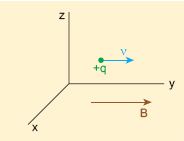
From Lorentz force, \( {\vec F } _{ m }=q(v\hat { j } \times B\hat { j } )=\vec 0\)
So, no force acts on the particle when it moves along the direction of magnetic field.
(b) Since the magnetic field points in positive z - direction, this implies, \(\vec { B } =B\hat { k } \)
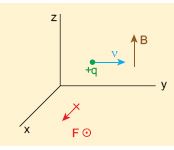
From Lorentz force, \( {\vec F } _{ m }=q(v\hat { j } \times B\hat { k } )=qvB\vec i \)
Therefore, the magnitude of the Lorentz force is qvB and direction is along positive x - direction.
(c) Magnetic field is in zy - plane and making an angle θ with the velocity of the particle, which implies \( {\vec B } =Bcos\theta \hat { j } +Bsin\theta \hat { k } \)
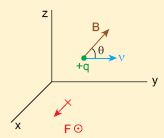
From Lorentz force,
\({ \vec F }_{ m }=q(v\hat { j } )\times (Bcos\theta \hat { j } +Bsin\theta \hat k)\)
\(=qvBsin\theta \hat { i } \)
13.
B = 4.1 x 10⁻⁵ T; θ = 90o – 47o = 43° ;
A = 3m2
We know that \(\Phi_{B}=B A \cos \theta\)
\(\Phi_{\mathrm{B}}\) = 4.1 x 10–5 x 3 x cos 43o
= 4.1 x 10–5 x 3 x 0.7314
= 89.96 \(\mu \mathrm{Wb}\).
14.
Using right hand rule, current flows upwards.
15.
R0 = 3 Ω, T = 100oC, T0 = 20oC
α = 0.004/oC, RT = ?
RT = R0(1 + α(T - T0))
R100 = 3(1 + 0.004 x 80)
R100 = 3.96 Ω
16.
(c)
00–1800
17.
B = ∆m x c2
∆m = \(\frac{B}{c^2}\)
N Mn + Z Mp - M(N,Z) = \(\frac{B}{c^2}\)
N (N,Z) = N Mn + ZMp - \(\frac{B}{c^2}\)
18.
\(E=\frac{12400 \stackrel{o}A}{4100 \stackrel{o}A}=3.02 eV\)
19.
\(\lambda\propto \frac{1}{\sqrt{V}}\)
\(\frac{\lambda_1}{\lambda_2}=\frac{\sqrt{224\times10^3}}{\sqrt{14\times 10^3}}\)
\(=\sqrt{16}=4\)
\(\lambda_{\mathrm{2}}= \frac{\lambda_1}{4}\)
20.
d' = 2d, β' = β, D' = ?
W.K.T, Fringe width
\(\beta = \frac{D\lambda}{d} \Rightarrow D' = \frac{Dd'}{d}\)
\(D' = \frac{D2d}{d}=2D\)
21.
(c)
1.50 mA
22.
Magnetic moment,
μ = IA
Angular momentum,
L = Iω
Ratio \(\frac{p_m}{L}=\frac{(q/T)\pi r^2}{mr^2\omega}=\frac{q}{2m}\)
23.
\(L=\frac{20}{\pi^2} \mathrm{H}, \mathrm{f}=50 \mathrm{~Hz} \)
\(f=\frac{1}{2 \pi \sqrt{L C}} \)
\(50=\frac{1}{2 \pi \sqrt{\frac{20}{\pi^2} \times C}} \)
\(50=\frac{1}{2 \times \sqrt{20 C}} \)
\(\therefore(50)^2=\frac{1}{4 \times 20 C} \)
\(\therefore C=\frac{1}{2500 \times 4 \times 20}=5 \times 10^{-6}=5 \mu \mathrm{F}\)
24.
\(\phi_B =10 t^2-50 t+250 \)
\(e =\frac{-d \phi_B}{d t} \)
\(=\frac{-d}{d t}\left(10 t^2-50 t+250\right) \)
=-(20 t - 50)
=-20 t + 50
When, t = 3 s, e =-20(3) + 50 = -60 + 50
e = -10V
25.
E = Eo sin(kx – ωt)
ω = ck
ω = 3 x 108 x 106
ω = 3 x 10¹⁴ rad s-1
26.
Q = q1 + q2 = 4 x 10⁻²C
\(q_{2f}=Q[\frac{r_2}{r_1+r_2}]\)
= 4 x 10⁻² \([\frac{3}{4}]\)
q2f = 3 x 10⁻² C
27.
\(U=\frac{1}{4\piε_0}\frac{q_1q_2}{r_{12}}\)
\(i) U=\frac{1}{4\piε_0}\frac{Q(-Q)}{r}=\frac{1}{4\piε_0}[\frac{-Q^2}{r}]\)
\(ii) U=\frac{1}{4\piε_0}\frac{(-Q)(-Q)}{r}=\frac{1}{4\piε_0}[\frac{Q^2}{r}]\)
\(iii) U=\frac{1}{4\piε_0}\frac{Q(2Q)}{r}=\frac{1}{4\piε_0}[\frac{2Q^2}{r}]\)
\(iv) U=\frac{1}{4\piε_0}\frac{Q(-2Q)}{2r}=\frac{1}{4\piε_0}[\frac{-Q^2}{r}]\)
From the values, 1 = 4 < 2 < 3
28.
Force ∝ charge
After the separation, the magnitude of charge will be increased. So the force will be more than before.
29.
Resistivity ∝ temperature for conductor. so, copper → decreases
Resistivity ∝\(\frac{1}{\text {temperature for semiconductor}}\)
so, germanium → increases.
30.
Rs = 3 + 2.5 + P = 5.5 + P
V = 9 V, I = 1.0 A
Rs = \(\frac{V}{I}=\frac{9}{1}= 9 \Omega\)
∴ 9 = 5.5 + P
∴ P = 9 - 5.5 = 3.5 Ω
31.
Given data:
In first case, fe.= 0.03 m
f0= 0.04 m , L = 0.2 m
\(m=\cfrac { L }{ { f }_{ o } } \left( 1+\cfrac { 0.25 }{ { f }_{ o } } \right) \)
For m to be the same in both cases,
= \(\cfrac { L }{ 0.03 } \left( 1+\cfrac { 0.25 }{ 0.04 } \right) \)
= \(\cfrac { 0.2 }{ 0.04 } \left( 1+\cfrac { 0.25 }{ 0.04 } \right) \)
= \(\cfrac { L }{ 0.03 } \times \cfrac { 29 }{ 4 } =\cfrac { 0.2 }{ 0.04 } \times \cfrac { 28 }{ 3 } \)
\(L=\cfrac { 5.6 }{ 29 } =0.193m\)
32.
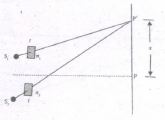
Path difference = \(\cfrac { xd }{ D } +\left( { n }_{ 2 }-{ n }_{ 1 } \right) t\)
For P, = 0; x path difference
= (n2 - n1) t = 0.3 t
\(I={ I }_{ o }{ cos }^{ 2 }\cfrac { \phi }{ 2 } \)
\(\cfrac { I }{ { I }_{ o } } ={ cos }^{ 2 }\cfrac { \phi }{ 2 } ,cos\cfrac { \phi }{ 2 } =\cfrac { \sqrt { 3 } }{ 2 } \)
\(\cfrac { \phi }{ 2 } =\cfrac { \pi }{ 6 } ,\phi =\cfrac { \pi }{ 3 } \)
Path difference = \(\cfrac { \lambda }{ 2\pi } \phi =\cfrac { 2\lambda }{ 2\pi } \cfrac { \pi }{ 3 } =\cfrac { \pi }{ 6 } \)
\(0.3t=5\lambda +\cfrac { \pi }{ 6 } \)
33.
The magnification due to the objective lens
\({ m }_{ o }=\cfrac { { v }_{ o } }{ \left( -{ \mu }_{ o} \right) } \)
If the object is close to the focus of the objective lens then
uo = fo and v = L
(L = distance between two lenses)
\({ m }_{ o }=\cfrac { L }{ { f }_{ o } } \)
If the final image is at the near point, then magnification due to the eye lens is
\({ m }_{ e }=\left( 1+\cfrac { D }{ { f }_{ e } } \right) \)
\(M={ m }_{ o }\times { m }_{ e }=\cfrac { L }{ { f }_{ o } } \left( 1+\cfrac { D }{ { f }_{ e } } \right) \)
The separation between the two lenses is 6.25 cm.
34.
α = 0.98
ICu = 0.6 μA
\(\alpha =\frac { \beta }{ 1+\beta } \)
(or)
\(0.98=\frac { 1 }{ \frac { 1 }{ \beta } +1 } \)
β = 49
ICEO = (1 + β)ICBO
= (1 + 49) x 0.6μA
ICEO = 30 μA
= (1 + 49) x 0.6 μA
ICEO = 30 μA
IC = βIB+ ICEO
= 49 x 20 μA + 30 μA
IC = 1.01 mA
35.
(i) This gives the variation of collector current (IC) with changes in base current (IB) at constant collector-emitter voltage (VCE).
(ii) It is seen that a small Ie flows even when IB is zero. This current is called the common emitter leakage current (ICEQ) which is due to the flow of minority charge carriers.
Forward current gain:
(i) The ratio of the change in collector current (ΔIC) to the change in base current (ΔIB) at constant collector-emitter voltage (VCE) is called forward current gain(β)
\(\beta ={ \left( \frac { \triangle { I }_{ C } }{ \triangle { I }_{ B } } \right) }_{ { V }_{ CE } }\)
(ii) It is value is very high and it generally ranges from 50 to 200. It depends on the construction of the transistors and will be provided by the manufacturer.
36.
Principle : When a current carrying loop is placed in a uniform magnetic field it experiences a torque.
Construction : A moving coil galvanometer consists of a rectangular coil PQRS of insulated thin copper wire. The coil contains a large number of turns wound over a light metallic frame. A cylindrical soft-iron core is placed symmetrically inside the coil as shown in Figure. The rectangular coil is suspended freely between two pole pieces of a horse-shoe magnet.
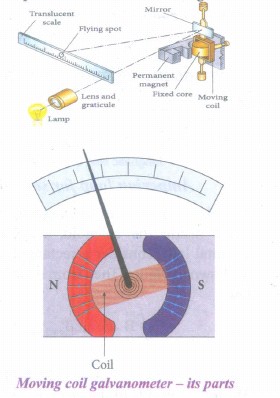
The upper end of the rectangular coil is attached to one end of fine strip of phosphor bronze and the lower end of the coil is connected to a hair spring which is also made up of phosphor bronze. In a fine suspension strip, a small plane mirror is attached in order to measure the deflection of the coil with the help of lamp and scale arrangement. The other end of the mirror is connected to a torsion head. In order to pass electric current through the galvanometer, the suspension strip and the spring S are connected to terminals.
Working : Consider a single turn of the rectangular coil PQRS whose length be l and breadth b. PQ = RS = l and QR = SP = b.
Let I be the electric current flowing through the rectangular coil PQRS as shown in Figure. The horse-shoe magnet has hemi - spherical magnetic poles which produces a radial magnetic field. Due to this radial field, the sides QR and SP are always parallel to the magnetic field B and experience no force. The sides PQ and RS are always parallel to the magnetic field and experience force in opposite directions. Due to this, torque is produced.
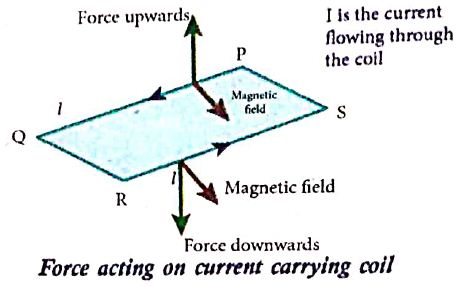
For single turn, the deflection torque is,
て = bF = bBIl = (lb)BI
て = ABI
since, area of the coil A = lb
For coil with N turns, we get
て = NABI ........(1)
Due to this deflecting torque, the coil gets twisted and restoring torque (also known as restoring couple) is developed. Hence the moment of restoring couple is proportional to the amount of twist θ. Thus
て = Kθ ............(2)
where K is the restoring couple per unit twist or torsional constant of the spring.
At equilibrium, the deflection couple is equal to the restoring couple. Therefore by comparing equations (1) and (2), we get,
NABI = Kθ
⇒ I =\(\frac { K }{ NAB } \) θ ...........(3)
(or) I = Gθ
where G = \(\frac { K }{ NAB } \) is called galvanometer constant or current reduction factor of the galvanometer.
Since, suspended moving coil galvanometer is very sensitive, we have to handle with high care while doing experiments. Most of the galvanometer we use are pointer type moving coil galvanometer.
37.
In a right angle triangle OPN let the angle \(\angle\)OPN = \(\theta \)1 which implies, \({ \varphi }_{ 1 }=\frac { \pi }{ 2 } -{ \theta }_{ 1 }\) and also in a right angle triangle OPM,
\(\angle\)OPN = \(\theta \)2 which implies, \({ \varphi }_{ 2 }=\frac { \pi }{ 2 } +{ \theta }_{ 2 }\)
Hence,
\(\overset { \rightarrow }{ B } =\frac { { \mu }_{ ° }I }{ 4\pi a } \left( cos\left( \frac { \pi }{ 2 } -{ \theta }_{ 1 } \right) -cos\left( \frac { \pi }{ 2 } +{ \theta }_{ 2 } \right) \right) \hat { n } \)
\(=\frac { { \mu }_{ ° }I }{ 4\pi a } (si{ n }_{ 1 }+{ sin }_{ 2 })\hat { n } \)

12th Standard Syllabus & Materials
12th Standard
TN 12th Computer Applications வலையமைப்பு வடமிடல் Sample Question Papers Study Material - QB365 Set A
NEW12th Standard
TN 12th Computer Applications களப்பெயர் முறைமை (DNS) Sample Question Papers Study Material - QB365 Set A
NEW12th Standard
TN 12th Computer Applications வலையமைப்பு எடுத்துக்காட்டுகள் மற்றும் நெறிமுறைகள் Sample Question Papers Study Material - QB365 Set A
NEW12th Standard
TN 12th Computer Applications கணினி வலையமைப்பு ஓர் அறிமுகம் Sample Question Papers Study Material - QB365 Set A



Tamilnadu Stateboard 12th Standard Subjects

Maths

Chemistry
Physics

Biology

Computer Science

Business Maths and Statistics

Economics

Commerce

Accountancy

History

Computer Applications
Biology
Computer Technology
Computer Applications
Computer Science
Business Maths and Statistics
Commerce
Economics
Maths
Chemistry
Physics
Computer Technology
History
Accountancy

Tamil

English

French
Tamilnadu Stateboard Standards

