
 100% FREE ACCESS
12th Standard Syllabus & Materials
12th Standard
TN 12th Computer Applications மின்னணு தரவு பரிமாற்றம் Sample Question Papers Study Material - QB365 Set A
NEW12th Standard
TN 12th Computer Applications மின் - வணிக பாதுகாப்பு அமைப்புகள் Sample Question Papers Study Material - QB365 Set A
NEW12th Standard
TN 12th Computer Applications மின்னணு செலுத்தல் முறைகள் Sample Question Papers Study Material - QB365 Set A
NEW12th Standard
TN 12th Computer Applications மின் - வணிகம் Sample Question Papers Study Material - QB365 Set A
NEW12th Standard
TN 12th Computer Applications திறந்த மூல கருத்துருக்கள் Sample Question Papers Study Material - QB365 Set A
NEW12th Standard
TN 12th Computer Applications வலையமைப்பு வடமிடல் Sample Question Papers Study Material - QB365 Set A

Published on: 13/05/2022
QB365 provides detailed and simple solution for every Book back Questions in class 12 Physics Subject. It will helps to get more idea about question pattern in every book back questions with solution.
latest Book back QuestionsDownload Tamil Nadu 12th Standard Physics question papers, model tests, one-mark questions, important questions, and public exam papers in PDF format. Free study materials and answer keys for TN State Board students.
Questions + Answers key
Take MCQ Physics Test1.
Assuming that energy released by the fission of a single \(_{ 92 }^{ 235 }{ U }\) nucleus is 200MeV, calculate the number of fissions per second required to produce 1-watt power.
2.
Consider two hydrogen atoms HA and HB in ground state. Assume that hydrogen atom HA is at rest and hydrogen atom HB is moving with a speed and make head-on collision with the stationary hydrogen atom HA. After the collision, both of them move together. What is minimum value of the kinetic energy of the moving hydrogen atom HB, such that any one of the hydrogen atoms reaches first excitation state.
3.
On your birthday, you measure the activity of the sample 210Bi which has a half-life of 5.01 days. The initial activity that you measure is 1µCi.
(a) What is the approximate activity of the sample on your next birthday? Calculate
(b) the decay constant
(c) the mean life
(d) initial number of atoms.
4.
Calculate the mass defect and the binding energy per nucleon of the \(_{ 47 }^{ 108 }{ Ag }\) nucleus. [atomic mass of Ag = 107.905949]
5.
(a) A hydrogen atom is excited by radiation of wavelength 97.5 nm. Find the principal quantum number of the excited state
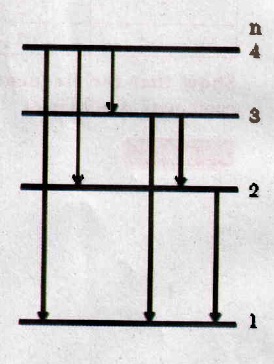
(b) Show that the total number of lines in emission spectrum is \(\frac { n(n-1) }{ 2 } \) Compute the total number of possible lines in emission spectrum as given in(a).
1.
Energy produced per second in reactor = 1 W = 1 J/s
Energy produced per fission = 200 MeV = 200 x 106 x 1.6 x 10-19 J
= 3.2 x 10¹¹ J
Number of fissions per second required \(=\frac{\text { Energy produced per second in reactor }}{\text { Energy produced per fission }} \)
\(=\frac{1}{3.2 \times 10^{11}}=\frac{10 \times 10^{10}}{3.2}=3.125 \times 10^{10} \)
Number of fissions per second = 3.125 x 10¹⁰
2.
Kinetic energies,
KEAi = 0
KEAf = KEBt
It should obey law of conservation of energy
Total Initial KE = Total final KE
\(\mathrm{KE}_{\mathrm{A}_{i}}+\mathrm{KE}_{\mathrm{B}_{i}}=\mathrm{KE}_{\mathrm{A}_{\mathrm{t}}}+\mathrm{KE}_{\mathrm{B}_{\mathrm{t}}} \)
\(0+\mathrm{KE}_{\mathrm{B}_{i}}=\mathrm{KE}_{\mathrm{A}_{\mathrm{f}}}+\mathrm{KE}_{\mathrm{A}_{t}} \)
\(\mathrm{KE}_{\mathrm{B}_{\mathrm{i}}}=2 \mathrm{KE}_{\mathrm{A}_{\mathrm{f}}} \)
Minimum energy required for excite the hydrogen atom is 10.2eV
Hence minimum Kinetic energy of HB is
\(\mathrm{KE}_{\mathrm{B}_{1}}=2 \times 10.2 \mathrm{eV}=20.4 \mathrm{eV}\)
3.
\(\mathrm{T}_{\frac{1}{2}}=5.01 \text { days} \), \(\mathrm{R}_{o}=1 μ \mathrm{Ci}=3.7 \times 10^{10} \times 10^{-6} \) decays per second
\(if\ \mathrm{t}=1\ year\ \mathrm{R}= ? \), \(\tau=? \), \(\lambda=? \), \(\mathrm{~N}_{o}=? \)
a) \(\mathrm{R}=\mathrm{R}_{o} \mathrm{e}^{-\lambda t} \)
\(\mathrm{R}=\mathrm{R}_{o} \mathrm{e}^{-\frac{0.6931}{\mathrm{~T}_{1 / 2} }t} \)
\(\mathrm{R}=\mathrm{R}_{o} \mathrm{e}^{-\frac{0.6931}{5.01} \times 365} \)
\(\mathrm{R}=\mathrm{R}_{o} \mathrm{e}^{-50.5}=\mathrm{R}_{o} \times 1.17 \times 10^{-22} \)
\(\mathrm{R}=1 \mu \mathrm{Ci} \times 1.17 \times 10^{-22}=1.17 \times 10^{-22} \mu \mathrm{Ci} \)
\(\mathrm{R}=1.17 \times 10^{-22} \mu \mathrm{Ci} \)
b) \(\lambda=\frac{0.6931}{T_{\frac{1}{2}}}=\frac{0.6931}{5.01}=0.1383 \text { day }^{-1} \)
\(\lambda=\frac{0.6931}{T_{\frac{1}{2}}}=\frac{0.6931}{5.01 \times 24 \times 60 \times 60}=1.6 \times 10^{-6} \mathrm{~s}^{-1} \)
\(\lambda=1.6 \times 10^{-6} \mathrm{~s}^{-1} \)
c) \(\tau=\frac{1}{\lambda}=\frac{1}{0.1383}=7.23 \text { days } \)
\(\tau=7.23 \text { days } \)
\(R_{o}=\lambda N_{o} \)
\(N_{o}=\frac{R_{o}}{\lambda}=\frac{3.7 \times 10^{10} \times 10^{-6}}{1.6 \times 10^{-6}}=2.3 \times 10^{10} \)
\(N_{o}=2.3 \times 10^{10} \)
4.
A = 108, Z =47, N = 108 - 47 = 61
mp = 1.007825 u, mn = 1.008665 u, M = 107.905949 u
(a) \(\Delta \mathrm{m}=Z \mathrm{~m}_{\mathrm{P}}+\mathrm{Nm}_{\mathrm{n}}-\mathrm{M} \)
\(\Delta \mathrm{m}\) = (47 x 1 .007825 + 61 x 1 .008665 - 107 .905949)
\(\Delta \mathrm{m}\) = 47.367775 + 61.528565 -107.905949
\(\Delta \mathrm{m}\) = 108.89634 - 107.905949
\(\Delta \mathrm{m}\) = 0.990391 u
\(\mathrm{BE}=\Delta \mathrm{m} \times 931 \mathrm{MeV} \)
BE = 0.990391 x 931 MeV = 922.054 MeV
(c) \(\overline{\mathbf{B E}}=\frac{\mathbf{B E}}{\mathbf{A}} \)
\(\overline{\mathrm{BE}}=\frac{922.054}{108}=8.537 \mathrm{MeV}=8.5 MeV\)
5.
Wavelength of incident radiation = 97.5 nm = 97.5 x 10⁻⁹ m
Energy of hydrogen atom in its ground state = -13.6 eV
(a) Principal quantum number n = ?
(b) (i) Number of possible transitions = ?
(ii) Total number possible lines = ?
(a) Energy absorbed by Hydrogen atom
\(E=\frac{h c}{\lambda}=\frac{6.6 \times 10^{-34} \times 3 \times 10^{8}}{97.5 \times 10^{-9}} \mathrm{~J} \)
\(E=\frac{h c}{\lambda}=\frac{6.6 \times 10^{-34} \times 3 \times 10^{8}}{97.5 \times 10^{-9} \times 1.6 \times 10^{-19}} \mathrm{eV} \)
E = 12.74 eV
Energy of the electron in first orbit of Hydrogen is -13.6 ev
En = -13.6 + 12.74 = -0.86 eV
We know that
\(\mathrm{E}_{\mathrm{n}} =-\frac{13.6}{\mathrm{n}^{2}} \)
\(-0.86 =-\frac{13.6}{\mathrm{n}^{2}} \)
\(\mathrm{n}^{2} =15.88 \)
\(\mathrm{n} \cong 4 \)
(b) (i) By using arithmetic progression, For the principle quantum number "n",
Total number of possible transition form level n is \(\frac{\mathrm{n}(\mathrm{n}-1)}{2}\)
(ii) Total number of possible transitions form level 4 is 3
Total number of possible transitions form level 3 is 2
Total number of possible transition form level 2 is 1
Hence total number of possible transitions is 3 + 2 + 1 = 6

12th Standard Syllabus & Materials
12th Standard
TN 12th Computer Applications களப்பெயர் முறைமை (DNS) Sample Question Papers Study Material - QB365 Set A
NEW12th Standard
TN 12th Computer Applications வலையமைப்பு எடுத்துக்காட்டுகள் மற்றும் நெறிமுறைகள் Sample Question Papers Study Material - QB365 Set A
NEW12th Standard
TN 12th Computer Applications கணினி வலையமைப்பு ஓர் அறிமுகம் Sample Question Papers Study Material - QB365 Set A
NEW12th Standard
TN 12th Computer Applications PHP-உடன் MySQL-ஐ இணைத்தல் Sample Question Papers Study Material - QB365 Set A



Tamilnadu Stateboard 12th Standard Subjects

Maths

Chemistry
Physics

Biology

Computer Science

Business Maths and Statistics

Economics

Commerce

Accountancy

History

Computer Applications
Biology
Computer Technology
Computer Applications
Computer Science
Business Maths and Statistics
Commerce
Economics
Maths
Chemistry
Physics
Computer Technology
History
Accountancy

Tamil

English

French
Tamilnadu Stateboard Standards



