
 100% FREE ACCESS
12th Standard Syllabus & Materials
12th Standard
TN 12th Computer Applications மின்னணு தரவு பரிமாற்றம் Sample Question Papers Study Material - QB365 Set A
NEW12th Standard
TN 12th Computer Applications மின் - வணிக பாதுகாப்பு அமைப்புகள் Sample Question Papers Study Material - QB365 Set A
NEW12th Standard
TN 12th Computer Applications மின்னணு செலுத்தல் முறைகள் Sample Question Papers Study Material - QB365 Set A
NEW12th Standard
TN 12th Computer Applications மின் - வணிகம் Sample Question Papers Study Material - QB365 Set A
NEW12th Standard
TN 12th Computer Applications திறந்த மூல கருத்துருக்கள் Sample Question Papers Study Material - QB365 Set A
NEW12th Standard
TN 12th Computer Applications வலையமைப்பு வடமிடல் Sample Question Papers Study Material - QB365 Set A

Published on: 07/03/2020
12th Standard Mathematics English Medium All Chapter Three Marks Book Back and Creative Questions 2020
Download Tamil Nadu 12th Standard Maths question papers, model tests, one-mark questions, important questions, and public exam papers in PDF format. Free study materials and answer keys for TN State Board students.
Questions + Answers key
Take MCQ Maths Test1.
Establish the equivalence property p ➝ q ≡ ㄱp ν q
2.
For the random variable X with the given probability mass function as below, find the mean and variance.
\(f(x)=\begin{cases} \begin{matrix} \cfrac { 1 }{ 2 } e^{ -\frac { x }{ 2 } } & for\quad x>0 \end{matrix} \\ \begin{matrix} 0 & otherwise \end{matrix} \end{cases}\)
3.
If α and β are the roots of the quadratic equation 2x2−7x+13 = 0 , construct a quadratic equation whose roots are α2 and β2.
4.
Solve :(1+e2x)dy+(1+y2)exdx=0
5.
Verify that y=-x-1 is a solution of the D.E (y-x)dy-(y2-x2)dx=0
6.
Evaluate \(\int _{ 0 }^{ 1 }{ x(1-x) } ^{ n }dx\)
7.
If \(f(x)=\left| \begin{matrix} x+1 & 2x+1 & 3x+1 \\ 2x+1 & 3x+1 & x+1 \\ 3x+1 & x+1 & 2x+1 \end{matrix} \right| \) ,then find \(\int _{ 0 }^{ 1 }{ f(x)dx } \)
[Hint:R2➝R2➝R1;R2➝R3➝R1]
8.
Find the approximate value of \(\left( \frac { 17 }{ 81 } \right) ^{ \frac { 1 }{ 4 } }\) using linear approximation.
9.
Evaluate the following limits, if necessary use L’Hopitals rule
(i) \(\underset { x\rightarrow { 0 }^{ + } }{ lim } { x }^{ sinx }\)
(ii) \(\underset { x\rightarrow 0 }{ lim } \cfrac { cotx }{ cot2x } \)
(iii) \(\underset { x\rightarrow \frac { { \pi }^{ - } }{ 2 } }{ lim } \left( tanx \right) ^{ cosx }\)
10.
The side of a square is equal to the diameter of a circle. If the side and radius change at the same rate then find the ratio of the change of their areas.
11.
Let G = {1, i, -1, -i} under the binary operation multiplication. Find the inverse of all the elements.
12.
If f = \(\frac { x }{ { x }^{ 2 }+{ y }^{ 2 } } \) then show that = \(x\frac { \partial f }{ \partial x } +y\frac { \partial f }{ \partial y } \) = -f
13.
If w(x, y) = x3 − 3xy + 2y2, x, y ∊ R, find the linear approximation for w at (1,−1)
14.
Evaluate \(\\ \int _{ 0 }^{ 1 }{ { e }^{ -2x }(1+x-{ 2x }^{ 3 })dx } \)
15.
Two balls are chosen randomly from an urn containing 6 red and 8 black balls. Suppose that we win Rs. 15 for each red ball selected and we lose Rs. 10 for each black ball selected. X denotes the winning amount, then find the values of X and number of points in its inverse images.
16.
Solve \({ y }^{ 2 }+{ x }^{ 2 }\frac { dy }{ dx } =xy\frac { dy }{ dx } \)
17.
Find the equations of tangent and normal to the curve y = x2 + 3x − 2 at the point (1, 2)
18.
Show that y = ae-3x + b, where a and b are arbitary constants, is a solution of the differential equation\(\frac { { d }^{ 2 }y }{ { dx }^{ 2 } } +3\frac { dy }{ dx } =0\)
19.
Find the locus of z if Re\(\\ \left( \frac { \bar { z } +1 }{ \bar { z } -i } \right) \) = 0.
20.
Explain the falacy:
21.
For the hyperbola 3x2 - 6y2 = -18, find the length of transverse and conjugate axes and eccentricity.
22.
Find the circumference and area of the circle x2 +y2 - 2x + 5y + 7 = 0
23.
Solve \({ tan }^{ -1 }\left( \frac { 2x }{ 1-{ x }^{ 2 } } \right) +{ cot }^{ -1 }\left( \frac { 1-{ x }^{ 2 } }{ 2x } \right) =\frac { \pi }{ 3 } ,x>0\)
24.
Evaluate \(cos\left[ { sin }^{ -1 }\frac { 3 }{ 5 } +{ sin }^{ -1 }\frac { 5 }{ 13 } \right] \)
25.
Show that the four points whose position vectors are \(6\overset { \wedge }{ i } -7\overset { \wedge }{ j } ,16\overset { \wedge }{ i } -29\overset { \wedge }{ j } -4\overset { \wedge }{ k } ,3\overset { \wedge }{ i } -6\overset { \wedge }{ j } \) are co-planar
26.
Find the Cartesian form of the equation of the plane \(\overset { \rightarrow }{ r } =\left( s-2t \right) \overset { \wedge }{ i } +\left( 3-t \right) \overset { \wedge }{ j } +\left( 2s+t \right) \overset { \wedge }{ k } \)
27.
Verify that (A-1)T = (AT)-1 for A =\(\left[ \begin{matrix} -2 & -3 \\ 5 & -6 \end{matrix} \right] \).
28.
Solve: 2x + 3y = 10, x + 6y = 4 using Cramer's rule.
29.
Solve: (x-1)4+(x-5)4 = 82
30.
Find the number of real solutions of sin (ex) -5x + 5-x
31.
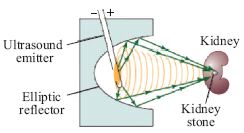
The equation of the ellipse is \(\frac { { \left( x-11 \right) }^{ 2 } }{ 484 } +\frac { { y }^{ 2 } }{ 64 } =1\). ( x and y are measured in centimeters) where to the nearest centimeter, should the patient’s kidney stone be placed so that the reflected sound hits the kidney stone?
32.
Find the altitude of a parallelepiped determined by the vectors \(\vec { a } =-2\hat { i } +5\hat { j } +3\hat { k } \), \(\hat { b } =\hat { i } +3\hat { j } -2\hat { k } \) and \(\vec { c } =-3\vec { i } +\vec { j } +4\vec { k } \) if the base is taken as the parallelogram determined by \(\vec { b } \) and \(\vec { c } \)
33.
Solve the following system of linear equations by matrix inversion method:
2x + 5y = −2, x + 2y = −3
34.
The complex numbers u, v, and w are related by \(\frac { 1 }{ u } =\frac { 1 }{ v } +\frac { 1 }{ w } \) If v = 3−4i and w = 4+3i, find u in rectangular form.
35.
Find the domain of the following
\(f\left( x \right) { =sin }^{ -1 }\left( \frac { { x }^{ 2 }+1 }{ 2x } \right) \)
36.
If z1 = 3, z2 = -7i, and z3 = 5 + 4i, show that z1(z2 + z3) = z1 z2 + z1 z3
37.
Verify whether the following compound propositions are tautologies or contradictions or contingency
(p ∧ q) ∧ ¬ (p ∨ q)
38.
Let g( x, y) = x2 - yx + sin(x+y), x(t) = e3t, y(t) = t2, t ∈ R. Find \(\frac { dg }{ dt } \)
39.
Evaluate \(\int _{ 0 }^{ 2a }{ { x }^{ 2 }\sqrt { 2ax-{ x }^{ 2 } } } dx\)
40.
Using mean value theorem prove that for, a > 0, b > 0, le-a - e-bl < la - bl.
41.
Solve \({ cot }^{ -1 }x-{ cot }^{ -1 }\left( x+2 \right) =\frac { \pi }{ 12 } ,x>0\)
42.
Find the equation of the plane passing through the intersection of the planes 2x + 3y −z + 7 = 0 and and x +y −2z + 5 = 0 and is perpendicular to the plane x +y −3z −5 = 0.
43.
Identify the type of conic and find centre, foci, vertices, and directrices of each of the following :
\(\frac { { \left( x-3 \right) }^{ 2 } }{ 225 } +\frac { { \left( y-4 \right) }^{ 2 } }{ 289 } =1\)
44.
Find the inverse of the non-singular matrix A = \(\left[ \begin{matrix} 0 & 5 \\ -1 & 6 \end{matrix} \right] \), by Gauss-Jordan method.
45.
Solve the equation x3-3x2- 33x + 35 = 0.
1.
| p | q | ㄱp | p ➝ q | ㄱp ν q |
| T | T | F | T | T |
| T | F | F | F | F |
| F | T | T | T | T |
| F | F | T | T | T |
The entries in the columns corresponding to p → q and ㄱp ν q are identical and hence they are equivalent.
2.
\(f(x)=\begin{cases} \begin{matrix} \frac { 1 }{ 2 } e^{ -\frac { x }{ 2 } } & for\quad x>0 \end{matrix} \\ \begin{matrix} 0 & otherwise \end{matrix} \end{cases}\)
\(\int _{ 0 }^{ \infty }{ x.f(x)dx } =\frac { 1 }{ 2 } \int _{ 0 }^{ \infty }{ x.{ e }^{ \frac { -x }{ 2 } } } dx\)
\(\left[ \int _{ 0 }^{ \infty }{ { e }^{ -ax }.{ x }^{ n }dx=\cfrac { n! }{ { a }^{ n+1 } } } \right] \)
= \(\frac { 1 }{ 2 } \times \frac { 1! }{ \left( \frac { 1 }{ 2 } \right) ^{ 2 } } =\frac { 1 }{ 2 } \times \frac { 1 }{ \frac { 1 }{ 4 } } \)
= \(\frac { 1 }{ 2 } \times \frac { 4 }{ 1 } =2\)
\(E({ X }^{ 2 })=\int _{ 0 }^{ \infty }{ { x }^{ 2 }.f(x) } dx\)
= \(\int _{ 0 }^{ \infty }{ { x }^{ 2 }.\frac { 1 }{ 2 } { e }^{ -\frac { x }{ 2 } } } dx\)
= \(\frac { 1 }{ 2 } \int { { x }^{ 2 }.{ e }^{ -\frac { x }{ 2 } }dx } \)
= \(\frac { 1 }{ 2 } \times \frac { 2! }{ \left( \frac { 1 }{ 3 } \right) ^{ 3 } } =\frac { 1 }{ 2 } \times \frac { 2 }{ \frac { 1 }{ 8 } } \)
= \(\frac { 1 }{ 2 } \times 2\times 8=8\)
ஃVar(X)=E(X2) - [E(x)]2
= 8-22
= 8 - 4 = 4
3.
Since α and β are the roots of the quadratic equation, we have α + β =\(\frac { 7 }{ 2 } \) and αβ = \(\frac { 13 }{ 2 } \).
Thus, to construct a new quadratic equation,
Sum of the roots = α2+β2 = (α+β)2-2αβ =\(\frac { -3 }{ 4 } \)
Product of the roots = α2β2 = (αβ)2 = \(\frac { 169 }{ 4 }\)
Thus a required quadratic equation is x2+\(\frac { 3 }{ 4 } x+\frac { 169 }{ 4 } \)= 0.
From this we see that 4x2+3x+169 = 0 is a quadratic equation with roots α2 and β2.
4.
tan-1y+tan-1(ex)=c
5.
prove
6.
\(\frac { 1 }{ (n+1)(n+2) } \)
7.
\(-\frac { 15 }{ 2 } \)
8.
0.677
9.
(i) 1
(ii) 2
(iii) 1
10.
2:π
11.
Clearly 1 is the identity element of (G1)
Inverse of 1 is 1 [∴ (1)(1) = 1]
Inverse of i is -i [∴ (i) (-i) = -i2 = 1]
Inverse of -1 is -1 [∴ (-1)(-1) = 1]
Inverse of is i [∴ (-i)(i) = -i2 = 1]
12.
Given f(x, y) = \(\frac { x }{ { x }^{ 2 }+{ y }^{ 2 } } \)
f(tx, ty) = \(\frac { tx }{ { t }^{ 2 }{ x }^{ 2 }+{ t }^{ 2 }{ y }^{ 2 } } =\frac { tx }{ { t }^{ 2 }(x^{ 2 }+{ y }^{ 2 }) } \)
= \(\frac { x }{ t({ x }^{ 2 }+{ y }^{ 2 }) } ={ t }^{ -1 }.f(x,y)\)
∴ f(x,y) is a homogeneous function of degree - 1
∴ By Euler's theorem,
\(x\frac { \partial f }{ \partial x } +y\frac { \partial f }{ \partial y } \) = nf = -1.f
∴ \(x\frac { \partial f }{ \partial x } +y\frac { \partial f }{ \partial y } \) = -f
Hence proved
13.
Given w (x, y) = x3 - 3xy+ 2.0, x, y ∊ R
wx = \(\frac { \partial w }{ \partial x } \) = 3x2 - 3y + 0 = 3x2 - 3y
wx = at (1, -1)= 3 (1p - 3- (-1) = 3 + 3 = 6
wy = \(\frac { \partial w }{ \partial y } \) = 0 -3x+4y = -3x+4y
wy (1, -1) = -3 (1)+4(-1)= -3 - 4 = -7.
w (xo, yo) = w (1, -1)
= 13- 3(1) (-1) + 2 (-1)2
= 1+3+2 = 6
Linear approximation is given by
L(x,y) = w(xo,yo) + \((\frac { \partial w }{ \partial x })_{(x_o,y_o) }\)(x-x0) + \((\frac { \partial w }{ \partial xy})_{(x_o,y_o) }\) (y-yo)
= 6 + 6 (x - 1) + -7 (y + 1)
= 6 + 6x - 6 - 7y - 7
= 6x - 7y - 7
14.
Taking u = 1 + x − 2x3 and v = e-2x, and applying the Bernoulli’s formula, we get
I = \(\\ \int _{ 0 }^{ 1 }{ { e }^{ -2x }(1+x-{ 2x }^{ 3 })dx } \)
\(={ \left[ (1+x-{ 2x }^{ 3 })\left( \frac { { e }^{ -2x } }{ -2 } \right) -(1-6{ x }^{ 2 })\left( \frac { { e }^{ -2x } }{ -4 } \right) +(-12x)\left( \frac { { e }^{ -2x } }{ -8 } \right) -(-12)\left( \frac { { e }^{ -2x } }{ 16 } \right) \right] }_{ 0 }^{ 1 }\)
\(={ \left[ \frac { { e }^{ -2x } }{ 16 } (16{ x }^{ 3 }+24{ x }^{ 2 }+16x) \right] }_{ 0 }^{ 1 }\)
\(\\ =\frac { 7 }{ 2{ e }^{ 2 } } \)
15.
Let X be the random variable denotes the Winning amount.
X (Both are black balls) = Rs. 2 (-10) = Rs. -20
X (one red and oneblack ball) = Rs.15-Rs. 10 = Rs. 5
X (both are red ball) = Rs. 2 (15) = Rs. 30
= {-20, 5, 30}
The sample space consists of 14C2 = 91
X = -20, Both are black balls= 8C1 = 28
X = 5, One black, one redball = 8C1 x 6C1 = 8 x 6 = 48
X = 30, Both are white balls = 6C1 = 15
| Values of random variable | 30 | 5 | -20 | Total |
| Number of points in inverse image | 15 | 48 | 28 | 91 |
16.
The given equation is rewritten as \(\frac { dy }{ dx } =\frac { { y }^{ 2 } }{ xy-{ x }^{ 2 } } \)
This is a homogeneous differential equation
Put y = vx . Then, we have \(x\frac { dv }{ dx } =\frac { v }{ v-1 } \)
By separating the variables, \(\frac { v-1 }{ v } dv=\frac { dx }{ x } .\)
Integrating, we obtain v − log |v| = log |x| + log |C| or v = log |vxC|.
Replacing v by \(\frac{y}{x}\), we get, \(\frac{y}{x}\) = log |Cy| = ey/x or y = key/x (how!) which is the required solution.
17.
We have, \(\frac{dy}{dx}=2x+3\). Hence at (1, 2), \((\frac{dy}{dx})=5\)
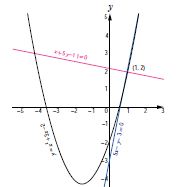
Therefore, the required equation of tangent is.
\((y-2)=5(x-1)\Rightarrow 5x-y-3=0\)
The slope of the normal at the point (1, 2) is -\(\frac{1}{5}\).
therefore, the required equation of normal is
\((y-2)=-\frac{1}{5}(x-1)\Rightarrow x+5y-11=0\)
18.
Given y = ae-3x+ b ........(1)
Differentiating cquation (1) w.r.t 'x', we get
\(\frac { d y }{ d x } =ae^{ -3x }(-3)+0\)
\(\frac { d y }{ d{ x } } =ae^{ -3x }(-3) \)
Again differentiating, we get
\(\Rightarrow \frac { d^{ 2 }y }{ d{ x }^{ 2 } } ={ ae^{-3 x } }(+9)\)
\(\Rightarrow \frac { d^{ 2 }y }{ d{ x }^{ 2 } } =-\frac{1}{3}\frac{dy}{dx}\times 9\)
\(\Rightarrow \frac { d^{ 2 }y }{ d{ x }^{ 2 } } = {-3}\frac{dy}{dx} \)
\(\Rightarrow \frac { d^{ 2 }y }{ d{ x }^{ 2 } } +3\frac{dy}{dx} \) = 0
Therefore, y = ae-3x + b is a solution of the given differential equation.
19.
Let z = x+iy ⇒ \(\bar { z } \) = x+iy
∴ \(\\ \frac { \bar { z } +1 }{ z-1 } =\frac { z-iy+1 }{ x-iy-i } =\frac { (x+1)iy }{ x-i(y+1) }\)
= \(\frac { (x+1)-iy }{ x-i(y+1) } \times \frac { x+i(y+1) }{ x+i(y+1) } \)
Choosing the real part alone we get,
\(\frac { x(x+1)+y(y+1) }{ { x }^{ 2 }+(y+1)^{ 2 } } \) = 0
⇒ x(x+1) + y(y+1) = 0
⇒ x2+x+y2+y = 0 which is the locus of z.
20.
-1 = i2 = i \(\times\) i =\(\sqrt { -1 } \times \sqrt { -1 } =\sqrt { (-1) } \times \sqrt { (-1) } \)
= \(\sqrt { 1 } \)
⇒ -1 = i
In the above proof we have used \(\sqrt { -1 } \times \sqrt { -1 } \)
= \(\sqrt { (-1)(-1) } \) which is wrong
Since \(\sqrt { ab } =\sqrt { a } .\sqrt { b } \) is true only at least one of a and b is non-negative.
21.
Given equation of the hyperbola is
3x2 - 6y2 = -18; \(\div \)by (-18) we get \(\frac{y^2}{3}- \frac{x^2}{6}\) = 1
The transverse axis is long y-axis.
Here a2 = 3, b2 = 6
Length of transverse axis is 2a = 2\(\sqrt { 3 } \)
Length of conjugate axis is 2b = 2\(\sqrt { 3 } \)
\(e=\sqrt { 1+\frac { { b }^{ 2 } }{ { a }^{ 2 } } } =\sqrt { 1+\frac { 6 }{ 3 } } =\sqrt { 1+2 } =\sqrt { 3 } \)
22.
Given equation is x2 + y2 - 2x + 5y + 7 = 0
Here 2g = -2 ⇒ g = -1 ⇒ 2f = 5 ⇒ f = \(\frac { 5 }{ 2 } \)
c = 7
Centre is (-g, -f) = \(\left( 1,\frac { -5 }{ 2 } \right) \)
r = \(\sqrt { { g }^{ 2 }+{ f }^{ 2 }-c } =\sqrt { { 1 }^{ 2 }+{ \left( \frac { -5 }{ 2 } \right) }^{ 2 }-7 } \)
= \(\sqrt { 1+\frac { 25 }{ 4 } -7 } =\sqrt { \frac { 25 }{ 4 } -6 } =\sqrt { \frac { 1 }{ 4 } } =\frac { 1 }{ 2 } \)
∴ Cireumferenee of elrele = 2πr = 2π\(\left( \frac { 1 }{ 2 } \right) \) = π units
Area of the circle = πr2 = π\({ \left( \frac { 1 }{ 2 } \right) }^{ 2 }\) = \(\frac { \pi }{ 4 } \) sq.units
23.
\({ tan }^{ -1 }\left( \frac { 2x }{ 1-{ x }^{ 2 } } \right) +{ tan }^{ -1 }\left( \frac { 2x }{ 1-{ x }^{ 2 } } \right) =\frac { \pi }{ 3 } \)
\(\left[ \because { co }^{ -1 }\left( \frac { 1 }{ x } \right) ={ tan }^{ -1 }\left( x \right) \right] \)
\(\Rightarrow 2{ tan }^{ -1 }\left( \frac { 2x }{ 1-{ x }^{ 2 } } \right) =\frac { \pi }{ 3 } \)
\(\Rightarrow { tan }^{ -1 }\left( \frac { 2x }{ 1-{ x }^{ 2 } } \right) =\frac { \pi }{ 6 } \)
\(\Rightarrow \cfrac { 2x }{ 1-{ x }^{ 2 } } =tan\left( \cfrac { \pi }{ 6 } \right) =\cfrac { 1 }{ \sqrt { 3 } } \)
\(\Rightarrow 2\sqrt { 3x } =1-{ x }^{ 2 }\)
\(\Rightarrow { x }^{ 2 }+2\sqrt { 3x } -1=0\)
\(\Rightarrow x=\frac { -2\sqrt { 3 } \pm \sqrt { 12-4(1)(-1) } }{ 2 } \) \(\left[\because x=\frac{-b \pm \sqrt{b^{2}-4 a c}}{2 a}\right]\)
\(\Rightarrow x=\cfrac { -2\sqrt { 3 } \pm \sqrt { 16 } }{ 2 } \Rightarrow x=\cfrac { -2\sqrt { 3 } \pm 4 }{ 2 } \)
\(\Rightarrow x=2\left( \frac { -\sqrt { 3 } \pm 2 }{ 2 } \right) \)
\(\Rightarrow x=-\sqrt { 3 } \pm 2\)
\(\Rightarrow x=-2-\sqrt { 3 } \text { or} -2-\sqrt { 3 } \)
Since \(x>0,x=-2-\sqrt { 3 } \) is not possible
\(\therefore x=2-\sqrt { 3 } \)
24.
Let \({ sin }^{ -1 }\left( \frac { 3 }{ 5 } \right) =A\Rightarrow \frac { 3 }{ 5 } =sinA\)

\(cosA=\frac { adj }{ hyp } =\frac { 4 }{ 5 } \)
Let \({ sin }^{ -1 }\left( \frac { 5 }{ 13 } \right) =B\Rightarrow sinB=\frac { 5 }{ 13 } \)

\(\Rightarrow cosB=\frac { 12 }{ 13 } \)
\(\therefore cos\left[ { sin }^{ -1 }\frac { 3 }{ 5 } +{ sin }^{ -1 }\frac { 5 }{ 13 } \right] =cos(A+B)\)
= cos A cos B-sin A sin B
= \(\frac { 4 }{ 5 } .\frac { 12 }{ 13 } -\frac { 3 }{ 5 } .\frac { 5 }{ 13 } =\frac { 48 }{ 65 } -\frac { 15 }{ 65 } \)
= \(\frac { 33 }{ 65 } \)
25.
Given \(\overset { \rightarrow }{ OA } =6\overset { \wedge }{ i } -7\overset { \wedge }{ j } ,\overset { \rightarrow }{ OB } =16\overset { \wedge }{ i } -29\overset { \wedge }{ j } -4\overset { \wedge }{ k } ,\overset { \rightarrow }{ OC } =3\overset { \wedge }{ i } -6\overset { \wedge }{ j } \) and \(\overset { \rightarrow }{ OD } =2\overset { \wedge }{ i } +5\overset { \wedge }{ j } +10\overset { \wedge }{ k } \)
\(\overset { \rightarrow }{ AB } =\overset { \rightarrow }{ OB } -\overset { \rightarrow }{ OA } =10\overset { \wedge }{ i } -22\overset { \wedge }{ j } -4\overset { \wedge }{ k } \)
\(\overset { \rightarrow }{ AC } =\overset { \rightarrow }{ OC } -\overset { \rightarrow }{ OA } =-6\overset { \wedge }{ i } +10\overset { \wedge }{ j } -6\overset { \wedge }{ k } \)
\(\overset { \rightarrow }{ AD } =\overset { \rightarrow }{ OD } -\overset { \rightarrow }{ OA } =-4\overset { \wedge }{ i } +12\overset { \wedge }{ j } +10\overset { \wedge }{ k } \)
\(\therefore \left[ \overset { \rightarrow }{ AB } \overset { \rightarrow }{ AC } \overset { \rightarrow }{ AD } \right] =\left| \begin{matrix} 10 \\ -6 \\ -4 \end{matrix}\begin{matrix} -22 \\ -10 \\ 12 \end{matrix}\begin{matrix} -4 \\ -6 \\ 10 \end{matrix} \right| \)
= 10 (100 + 75) + 22(-60 -24) -4(-72 +40)
= 1720 - 1848 + 128 = 0
Hence , the given points are coplanar.
26.
Let \(\overset { \rightarrow }{ r } =x\overset { \wedge }{ i } +y\overset { \wedge }{ j } +z\overset { \wedge }{ k } \)
\(\therefore x\overset { \wedge }{ i } +y\overset { \wedge }{ j } +z\overset { \wedge }{ k } =\left( s-2t \right) \overset { \wedge }{ i } +\left( 3-t \right) \overset { \wedge }{ j } +\left( 2s+t \right) \overset { \wedge }{ k } \)
Equating the co-efficients of like components both sides,
We get, x = s - 2t
y = 3 - t
z = 2s + t
Eliminating x and t using determinates we get
\(\left| \begin{matrix} x \\ y-3 \\ z \end{matrix}\begin{matrix} 1 \\ 0 \\ 2 \end{matrix}\begin{matrix} -2 \\ -1 \\ 1 \end{matrix} \right| =0\)
⇒ x (0+2) -1(y - 3 + z) -2 (2y - 6 - 0) = 0
⇒ 2x - y + 3 - z- 4y + 12 = 0
⇒ 2x - 5y - z + 15 = 0
27.
|A| =\(\left[ \begin{matrix} -2 & -3 \\ 5 & -6 \end{matrix} \right] \) = 12+15 = 27
∴ A-1 = \(\frac { 1 }{ |A| } adjA=\frac { 1 }{ 27 } \left[ \begin{matrix} -6 & 3 \\ -5 & 2 \end{matrix} \right] \)
(A-1)T = \(\frac { 1 }{ 27 } \left[ \begin{matrix} -6 & -5 \\ 3 & 2 \end{matrix} \right] \)...(1)
AT =\(\left[ \begin{matrix} -2 & 5 \\ -3 & -6 \end{matrix} \right] \)
|AT| =\(\left[ \begin{matrix} -2 & 5 \\ -3 & -6 \end{matrix} \right] \) = 12+15 = 27
∴ (AT)-1 = \(\frac { 1 }{ |A^{ T }| } adj(A^{ T })=\frac { 1 }{ 27 } \left[ \begin{matrix} -6 & -5 \\ 3 & -2 \end{matrix} \right] \)...(2)
From (1) and (2), (A-1)T = (AT)-1
28.
Δ = \(\left| \begin{matrix} 2 & 3 \\ 1 & 6 \end{matrix} \right| \) = 12 - 3 = 9 ≠ 0
Δ1 = \(\left| \begin{matrix} 10 & 3 \\ 4 & 6 \end{matrix} \right| \) = 60 - 12 = 48
Δ2 = \(\left| \begin{matrix} 2 & 10 \\ 1 & 4 \end{matrix} \right| \) = 8 - 10 = -2
∴ x = \(\frac { { \triangle }_{ 1 } }{ \triangle } =\frac { 48 }{ 9 } =\frac { 16 }{ 3 } \)
y = \(\frac { { \triangle }_{ 2 } }{ \triangle } =\frac { -2 }{ 9 } \)
∴ Solution set is \(\left\{ \frac { 16 }{ 3 } ,\frac { -2 }{ 9 } \right\} \).
29.
Put y = \(\frac { x-1+x-5 }{ 2 } =-3\)
⇒ x = y + 3
∴ (x-1)4+(x-5)4 = 82
⇒ (y+3-1)4+(y+3-5)4 = 82
⇒ (y+2)4+(y-2)4 = 82
⇒ 2(y4+24y2+16) = 82
⇒ y4+24y2+16 = 41
⇒ y4+24y2-25 = 0
⇒ (y2+25)(y2-1) = 0
⇒ y = 土5i, y = 士1
∴ x = 3土5i, 4, 2.
30.
Given sin (ex) -5x + 5-x
We have \({ 5 }^{ x }+{ 5 }^{ -x }={ ({ 5 }^{ \frac { x }{ 2 } }-{ 5 }^{ \frac { -x }{ 2 } }) }^{ 2 }+2\ge 2\)
If sin (ex) -5x + 5-x has a solution
We get sin (ex) ≥ 2 which i not possible for any
real x as |sin 0|≤ 1 for all θ∈ R.
∴ Sin (ex) = 5X + 5-x has no solution.
31.
The equation of the ellipse is \(\frac { { \left( x-11 \right) }^{ 2 } }{ 484 } +\frac { { y }^{ 2 } }{ 64 } =1\). The origin of the sound wave and the kidney stone of patient should be at the foci in order to crush the stones.
a2 = 484 and b2 = 64
c2 = a2 -b2
= 484-64
= 420
c \(\simeq \) 20.5
Therefore the patient’s kidney stone should be placed 20.5 cm from the centre of the ellipse.
32.
Given \(\vec { a } =-2\hat { i } +5\hat { j } +3\hat { k } \), \(\hat { b } =\hat { i } +3\hat { j } -2\hat { k } \) and \(\vec { c } =-3\vec { i } +\vec { j } +4\vec { k } \)
Volume of the parallelepiped = \(\vec { a } .(\vec { b } \times \vec { c } )\)
= \(\left| \begin{matrix} -2 & 5 & 3 \\ 1 & 3 & -2 \\ -3 & 1 & 4 \end{matrix} \right| \)
= \(-2\left| \begin{matrix} 3 & -2 \\ 1 & 4 \end{matrix} \right| -5\left| \begin{matrix} 1 & -2 \\ - & 4 \end{matrix} \right| +3\left| \begin{matrix} 1 & 3 \\ -3 & 1 \end{matrix} \right| \)
= -2(12+2)-5(4-6)+3(1+9)
= -2(14)-5(-2)+3(10) = -28+10+30
= 12
Vector Area of the base parallelogram = \(\vec { b } \times \vec { c } \)
=\(\left| \begin{matrix} \hat { i } & \hat { j } & \hat { k } \\ 1 & 3 & -2 \\ -3 & 1 & 4 \end{matrix} \right| =\hat { i } \left| \begin{matrix} 3 & -2 \\ 1 & 4 \end{matrix} \right| \hat { j } \left| \begin{matrix} 1 & -2 \\ -3 & 4 \end{matrix} \right| +\hat { k } \left| \begin{matrix} 1 & 3 \\ -3 & 1 \end{matrix} \right| \)
= \(\hat { i } \)(12+2)-\(\hat { j } \)(4-6)+\(\hat { k } \)(1+9)
= \(\hat { i } \)(14)-\(\hat { j } \)(-2)+\(\hat { k } \)(10)
= 14\(\hat { k } \)+2\(\hat { j } \)+10\(\hat { k } \)
Area of the parallelogram =\(\sqrt { { 14 }^{ 2 }+{ 2 }^{ 2 }+{ 10 }^{ 2 } } \)
= \(\sqrt { 196+4+100 } \)
= \(\\ \sqrt { 300 } =10\sqrt { 3 } \)..............(2)
Volume of the parallelepiped = Base area x attitude
∴ Altitude = \(\frac { Volume }{ Base\quad area } =\frac { 12 }{ 10\sqrt { 3 } } =\frac { 6 }{ 5\sqrt { 3 } } \times \frac { \sqrt { 3 } }{ \sqrt { 3 } } \)

= \(\frac { 2\sqrt { 3 } }{ 5 } \) units.
33.
2x+5y = -2, x+2y = -3
The matrix form of the system is
\(\left( \begin{matrix} 2 & 5 \\ 1 & 2 \end{matrix} \right) \left( \begin{matrix} x \\ y \end{matrix} \right) =\left( \begin{matrix} -2 \\ -3 \end{matrix} \right) \)
⇒ AX = B where
A =\(\left( \begin{matrix} 2 & 5 \\ 1 & 2 \end{matrix} \right) ,B=\left( \begin{matrix} -2 \\ -3 \end{matrix} \right) \)
X =\(\left( \begin{matrix} x \\ y \end{matrix} \right) \)
⇒ = A-1B
|A| = \(\left| \begin{matrix} 2 & 5 \\ 1 & 2 \end{matrix} \right| \)= 4 - 5 = -1 ≠ 0
∴ A-1 =\(\frac { 1 }{ |A| } adjA=\frac { 1 }{ -1 } \left[ \begin{matrix} 2 & -5 \\ -1 & 2 \end{matrix} \right] \)
=\(\left[ \begin{matrix} -2 & 5 \\ 1 & -2 \end{matrix} \right] \)
∴ X = A-1B =\(\left[ \begin{matrix} -2 & 5 \\ 1 & -2 \end{matrix} \right] \left[ \begin{matrix} -2 \\ -3 \end{matrix} \right] \)
= \(\left[ \begin{matrix} 4-15 \\ -2+6 \end{matrix} \right] =\left[ \begin{matrix} -11 \\ 4 \end{matrix} \right] \)
∴ Solution set is x = -11, y = 4
34.
Given v = 3-4i, w = 4+3i and \(\frac { 1 }{ u } =\frac { 1 }{ v } +\frac { 1 }{ w } \)
∴ \(\frac { 1 }{ u } =\frac { 1 }{ 3-4i } +\frac { 1 }{ 4+3i } \)
= \(\frac { 3+4i }{ (3-4i)(3+4i) } +\frac { 4-3i }{ (4+3i)(4-3i) } \)
= \(\\ \frac { 3+4i }{ 9-(4i)^{ 2 } } +\frac { 4-3i }{ 16-(3i)^{ 2 } } =\frac { 3+4i }{ 9+16 } +\frac { 4-3i }{ 16+9 } \)
= \(\frac { 3+4i }{ 25 } +\frac { 4-3i }{ 25 } =\frac { 3+4i+4-3i }{ 25 } \)
\(\frac { 1 }{ u } =\frac { 7+i }{ 25 } \)
∴ u = \(\frac { 25 }{ 7+i } \times \frac { 7-i }{ 7-i } =\frac { 25(7-i }{ 7^{ 2 }-({ i }^{ 2 }) } \)
= \(\frac { 25(7-i) }{ 49+1 } =\frac { 25(7-i) }{ 50 } =\frac { 1 }{ 2 } \)(7-i)
∴ u = \(\frac { 1 }{ 2 } \)(7-i) or \(\frac { 7 }{ 2 } \) - \(\frac { i }{ 2 } \)
35.
Given \(f(x)=sin^{ -1 }\left( \frac { x^{ 2 }+1 }{ 2x } \right) \le 1\)
We know that the domain of sin-1(x) is [-1, 1]
\(\Rightarrow -1\le \frac { { x }^{ 2 }+1 }{ 2x } \le 1\)
Consider \(\Rightarrow -1\le \frac { { x }^{ 2 }+1 }{ 2x } \)
\(\Rightarrow 0\le \frac { { x }^{ 2 }+1 }{ 2x } +1\)
\(\Rightarrow \frac { { x }^{ 2 }+1+2x }{ 2x } \ge 0\)
\(\Rightarrow \frac { \left( x+1 \right) ^{ 2 } }{ 2x } \ge 0\)
\(\Rightarrow \) x = -1 and x < 0
Consider \(\cfrac { { x }^{ 2 }+1 }{ 2x } \le 1\)
\(\Rightarrow \frac { { x }^{ 2 }+1 }{ 2x } -1\le 0\)
\(\Rightarrow \frac { { x }^{ 2 }-2x+1 }{ 2x } \le 0\)
\(\Rightarrow \frac { \left( x-1 \right) ^{ 2 } }{ 2x } \le 0\)
From (1) and (2) Domain {-1, 1}
36.
z1(z2 + z3) = z1z2 + z1z3
Given z1= 3, z2 = -7i, z3 = 5+4i
LHS = z1(z2 + z3)
= 3 [-7i + 5 + 4i]
= 3[5-3i]
= 15-9i
RHS = z1z2 + z1z3
= 3(-7i) + 3(5 + 4i)
= -21i +15 +12i
= -9i +15
= 15-9i
LHS = RHS
∴ z1(z1 + z3) = z1z2 + z1z3
Hence proved
37.
| p | q | p ∧ q | p ∨ q | ~p ∨ q | (p ∧ q) ∧ ~(p ∨ q) |
| T | T | T | T | F | F |
| T | F | F | T | F | F |
| F | T | F | T | F | F |
| F | F | F | F | T | F |
The statement (p ∧ q) ∧ ~(p ∨ q)
38.
We shall follow the tree diagram to calculate
So first we need to find \(\frac { \partial g }{ \partial x } ,\frac { \partial g }{ \partial y } ,\frac { dx }{ dt } \) and \(\frac { dx }{ dt } \).
Now, \(\frac { \partial g }{ \partial x } \) = 2x-y + cos(x + y), \(\frac { \partial g }{ \partial x } \) = -x+cos(x + y), \(\frac { dx }{ dt } \) = 3e3t and \(\frac { dx }{ dt } \) = 2t.
Thus, \(\frac { dg }{ dt } =\frac { \partial g }{ \partial x } \frac { dx }{ dt } +\frac { \partial g }{ \partial y } \frac { dy }{ dt } \)
= (2x − y + cos(x + y)) 3e3t + (−x + cos(x + y))( 2t)
= (2e3t - t2 + cos(e3t - t2))3e3t +( -e3t + cos(e3t - t2))(2t )
= 6e6t - 3t2 e3t +3e3t cos(e3t - t2) -2te3t +2t cos(e3t - t2)
Also, some times our W(x, y) will be such that x = x(s, t) , and y = y(s, t) where s, t ∈ R. Then W can be considered as a function that depends on s and t. If x, y both have partial derivatives with respect to s, t and W has partial derivatives with respect to x and y, then we can calculate the partial derivatives of W with respect to s and t using the following theorem.
39.
Put x = 2a cos2\(\theta\).
Then, dx = -4a cos \(\theta\) sin \(\theta\)d\(\theta\)
when x = 0, 2a cos2\(\theta\) = 0 and so \(\theta\) = \(\frac{\pi}{2}\)
When x = 2a, 2a cos2\(\theta\) = 2a and so \(\theta\) = 0
Hence, we get
\(I=\int _{ 0 }^{ 2a }{ { x }^{ 2 }\sqrt { 2ax-{ x }^{ 2 } } dx } \)
\(\int _{ \frac { \pi }{ 2 } }^{ 0 }{ { 4a }^{ 2 }{ cos }^{ 2 }\theta \sqrt { { 4a }^{ 2 }{ cos }^{ 2 }\theta -4{ a }^{ 2 }{ cos }^{ 4 }\theta } } (-4a\ cos\theta sin\ \theta )d\theta \)
\(=\int _{ 0 }^{ \frac { \pi }{ 2 } }{ { 4a }^{ 2 }{ cos }^{ 2 }\theta\ 2a\ cos\ \theta sin\ \theta (4a\ cos\ \theta sin\theta )d\theta } \)
\(=32{ a }^{ 4 }\int _{ 0 }^{ \frac { \pi }{ 2 } }{ { cos }^{ 4 }\theta { sin }^{ 2 }\theta d\theta } \)
\(=32{ a }^{ 4 }\times \frac { 1 }{ 6 } \times \frac { 3 }{ 4 } \times \frac { 1 }{ 2 } \times \frac { \pi }{ 2 } =\pi { a }^{ 4 }\)
40.
Let f(x) = e-x, x ∈ [a, b]
a) e-x is continuous in [a, b]
b) e-x is differentiable in (a, b)
c) f(b) = e-b, f(a) = e-a
By Lagrange's mean value I theorem, there exerise c ∈ [a, b] such that f'(c) = \(\frac { f(b)-f(a) }{ b-a } \)
⇒ -e-c =\(\frac { { e }^{ -b }-{ e }^{ -a } }{ b-a } \)
⇒ -e-c = \(\frac { { e }^{ -a }-{ e }^{ -b} }{ b-a } \)
⇒ |e-c| = \(\left| \frac { { e }^{ -b }-{ e }^{ -a } }{ b-a } \right| \)
⇒ \(\frac { \left| { e }^{ -a }-{ e }^{ -b } \right| }{ \left| a-b \right| } \) < 1
[∵ |-a-c| < 1 for c ∊ [a, b] a > 0, b > 0]
⇒ |e-a - e-b| < |a -b|
Hence proved.
41.
\({ cot }^{ -1 }x-{ xot }^{ -1 }\left( x+2 \right) =\frac { \pi }{ 12 } ,x>0\)
\({ tan }^{ -1 }\left( \frac { 1 }{ x } \right) -{ tan }^{ -1 }\left( \frac { 1 }{ x+2 } \right) =\frac { \pi }{ 2 } \)
\(\left[ \because { cot }^{ 1 }\left( x \right) ={ tan }^{ -1 }\left( \frac { 1 }{ x } \right) ifx>0 \right] \)
\(\Rightarrow { tan }^{ -1 }\left( \frac { \frac { 1 }{ x } +\frac { 1 }{ x+2 } }{ 1+\frac { 1 }{ x } .\frac { 1 }{ x+2 } } \right) =\frac { \pi }{ 2 } \)
\(\Rightarrow \left( \frac { \frac { x+2-x }{ x(x+2) } }{ \frac { x(x+2)+1 }{ x(x+2) } } \right) ={ tan15 }^{ 0 }\)
\(\left[ \because { tan15 }^{ 0 }=tan\left( { 45 }^{ 0 }-30^{ 0 } \right) \right] \)
\(\frac { { tan45 }^{ 0 }-{ tan30 }^{ 0 } }{ 1+tan{ 45 }^{ 0 }tan{ 30 }^{ 0 } } \)
\(\frac { 1-\frac { 1 }{ \sqrt { 3 } } }{ 1+\frac { 1 }{ \sqrt { 3 } } } =\frac { \sqrt { 3 } -1 }{ \sqrt { 3 } +1 } \times \frac { \sqrt { 3 } -1 }{ \sqrt { 3 } -1 } \)
\(\frac { \left( \sqrt { 3 } -1 \right) ^{ 2 } }{ 3-1 } =\frac { \left( \sqrt { 3 } -1 \right) ^{ 2 } }{ 2 } \)
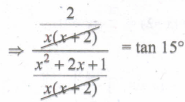
\(\Rightarrow \frac { 2 }{ { x }^{ 2 }+2x+1 } =\frac { \left( \sqrt { 3 } -1 \right) ^{ 2 } }{ 2 } \)
\(\Rightarrow \frac { 7 }{ (x+1)^{ 2 } } =\frac { \left( \sqrt { 3 } -1 \right) ^{ 2 } }{ 2 } \)
\(\Rightarrow 4=(x+1)^{ 2 }\left( \sqrt { 3 } -1 \right) ^{ 2 }\)
Taking square root both sides
\(2=(x+1)(\sqrt { 3 } -1)\)
\(\Rightarrow x+1=\frac { 2 }{ \sqrt { 3- } 1 } \times \frac { \sqrt { 3 } +1 }{ \sqrt { 3 } +1 } =\frac { 2\left( \sqrt { 3 } +1 \right) }{ 3-1 } =\sqrt { 3 } +1\)
\(x+1=\sqrt { 3 }+ 1\)
\(x=\sqrt { 3 } \)
42.
The equation of the plane passing through the intersection of the planes 2x + 3y−z + 7 = 0 and x + y− 2z + 5 = 0 is (2x + 3y −z + 7) +λ (x + y −2z + 5) = 0 or (2 + λ )x+ (3 + λ )y+ (−1 − 2λ ) z+ (7 + 5λ) = 0
since this plane is perpendicular to the given plane x+y−3z−5 = 0, the normals of these two planes are perpendicular to each other.
Therefore, we have (1)(2 + λ) + (1)(3 + λ) + (−3)(−1 − 2λ)z = 0
which implies that λ = −1.
Thus the required equation of the plane is
(2x + 3y − z + 7)−(x + y −2z + 5) = 0
⇒ x + 2y + z + 2 = 0
43.
\(\frac { { (x-3) }^{ 2 } }{ 225 } +\frac { ({ y-4) }^{ 2 } }{ 289 } =1\)
Given equation is \(\frac { { (x-3) }^{ 2 } }{ 225 } +\frac { ({ y-4) }^{ 2 } }{ 289 } =1\)
This is an equation of the ellipse a2 = 289
b2 = 225 and
c2 = a2 - b2 ⇒ 289 - 225 = 64 ⇒ c = 8.
\(e=\sqrt { \frac { { b }^{ 2 } }{ { a }^{ 2 } } } =\sqrt { 1-\frac { 225 }{ 289 } } =\sqrt { \frac { 289-225 }{ 289 } } \)
\(=\sqrt { \frac { 64 }{ 289 } } =\frac { 8 }{ 17 } \)
(a) Center is (3, 4) ⇒ h = 3, k = 4
(b) foci are (h, k+c), (h, k-c)
⇒ (3, 4 + 8), (3, 4 - 8) ⇒ (3, 12), (3,-4)
(c) Vertices are (h, k - a), (h, k + a)
⇒ (3, 4 -17), (3, 4 + 17) ⇒ (3, -13), (3, 21)
(d) Equations of directrices are y - 4 = \(\pm \frac { a }{ e } \)
\(\Rightarrow y-4=\pm \frac { 17 }{ \frac { 8 }{ 17 } } +4\Rightarrow y-4=\pm \frac { -289 }{ 8 } +4\)
\(\Rightarrow y=\frac { 289 }{ 8 } +4\) and \(y=\frac { -289 }{ 8 } +4\)
\(\Rightarrow y=\frac { 289+32 }{ 2 } \) and \(y=\frac { -289+32 }{ 8 } \)
\(\Rightarrow y=\frac { 321 }{ 8 } \) and \(y=\frac { -257 }{ 8 } \)
44.
Applying Gauss-Jordan method, we get
[A | I2] = \(\left[ \begin{matrix} 0 & 5 \\ -1 & 6 \end{matrix}|\begin{matrix} 1 & 0 \\ 0 & 1 \end{matrix} \right] \overset { { R }_{ 1 }\leftrightarrow { R }_{ 2 } }{ \longrightarrow } \left[ \begin{matrix} -1 & 6 \\ 0 & 5 \end{matrix}|\begin{matrix} 0 & 1 \\ 1 & 0 \end{matrix} \right] \overset { { R }_{ 1 }\longrightarrow \left( -1 \right) { R }_{ 1 } }{ \longrightarrow } \left[ \begin{matrix} 1 & -6 \\ 0 & 5 \end{matrix}|\begin{matrix} 0 & -1 \\ 1 & 0 \end{matrix} \right] \)\(\overset { { R }_{ 1 }\longrightarrow \left( -1 \right) { R }_{ 1 } }{ \longrightarrow } \left[ \begin{matrix} 1 & -6 \\ 0 & 5 \end{matrix}|\begin{matrix} 0 & -1 \\ 1 & 0 \end{matrix} \right] \overset { { R }_{ 2 }\longrightarrow \frac { 1 }{ 5 } { R }_{ 2 } }{ \longrightarrow } \left[ \begin{matrix} 1 & -6 \\ 0 & 1 \end{matrix}|\begin{matrix} 0 & -1 \\ \left( 1/5 \right) & 0 \end{matrix} \right] \)\(\overset { { R }_{ 1 }\longrightarrow { R }_{ 1 }+6{ R }_{ 2 } }{ \longrightarrow } \left[ \begin{matrix} 1 & 0 \\ 0 & 1 \end{matrix}|\begin{matrix} \left( 6/5 \right) & -1 \\ \left( 1/5 \right) & 0 \end{matrix} \right] \).
So, we get A-1 = \(\left[ \begin{matrix} \left( 6/5 \right) & -1 \\ \left( 1/5 \right) & 0 \end{matrix} \right] =\frac { 1 }{ 5 } \left[ \begin{matrix} 6 & -5 \\ 1 & 0 \end{matrix} \right] \).
45.
The sum of the coefficients of the polynomial is 0. Hence 1 is a root of the polynomial. To find other roots, we divide x3- 3x2- 33x + 35 by x-1 and get x2-2x-35 as the quotient. Solving this we get 7 and −5 as roots. Thus 1, 7, −5 form the solution set of the given equation.

12th Standard Syllabus & Materials
12th Standard
TN 12th Computer Applications களப்பெயர் முறைமை (DNS) Sample Question Papers Study Material - QB365 Set A
NEW12th Standard
TN 12th Computer Applications வலையமைப்பு எடுத்துக்காட்டுகள் மற்றும் நெறிமுறைகள் Sample Question Papers Study Material - QB365 Set A
NEW12th Standard
TN 12th Computer Applications கணினி வலையமைப்பு ஓர் அறிமுகம் Sample Question Papers Study Material - QB365 Set A
NEW12th Standard
TN 12th Computer Applications PHP-உடன் MySQL-ஐ இணைத்தல் Sample Question Papers Study Material - QB365 Set A



Tamilnadu Stateboard 12th Standard Subjects
Maths

Chemistry

Physics

Biology

Computer Science

Business Maths and Statistics

Economics

Commerce

Accountancy

History

Computer Applications
Biology
Computer Technology
Computer Applications
Computer Science
Business Maths and Statistics
Commerce
Economics
Maths
Chemistry
Physics
Computer Technology
History
Accountancy

Tamil

English

French
Tamilnadu Stateboard Standards

