
 100% FREE ACCESS
12th Standard Syllabus & Materials
12th Standard
TN 12th Computer Applications மின்னணு தரவு பரிமாற்றம் Sample Question Papers Study Material - QB365 Set A
NEW12th Standard
TN 12th Computer Applications மின் - வணிக பாதுகாப்பு அமைப்புகள் Sample Question Papers Study Material - QB365 Set A
NEW12th Standard
TN 12th Computer Applications மின்னணு செலுத்தல் முறைகள் Sample Question Papers Study Material - QB365 Set A
NEW12th Standard
TN 12th Computer Applications மின் - வணிகம் Sample Question Papers Study Material - QB365 Set A
NEW12th Standard
TN 12th Computer Applications திறந்த மூல கருத்துருக்கள் Sample Question Papers Study Material - QB365 Set A
NEW12th Standard
TN 12th Computer Applications வலையமைப்பு வடமிடல் Sample Question Papers Study Material - QB365 Set A

Published on: 01/09/2022
QB365 provides a detailed and simple solution for every Possible Creative Questions in Class 12 Physics Subject - Electrostatics, English Medium. It will help Students to get more practice questions, Students can Practice these question papers in addition to score best marks.
Download Tamil Nadu 12th Standard Physics question papers, model tests, one-mark questions, important questions, and public exam papers in PDF format. Free study materials and answer keys for TN State Board students.
Questions + Answers key
Take MCQ Physics Test1.
The dielectric constant of water is 80. What is its permittivity?
2.
The radius of gold nucleus (Z = 79) is about 7 x 10-15 m. Assume that the positive charge is distributed uniformly throughout the nuclear volume. Find the volume charge density.
3.
What charge would be required to electrify a sphere of radius 25 cm. So as to get a surface charge density of \(\frac{3}{\pi}\) cm-1?
4.
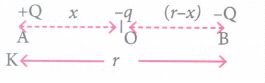
Two charges each of +q coulomb are placed along a line. A third charge -q is placed between them. At what position will the system be in equilibrium?
5.
A metal sphere has a charge of -6μC. When 5 x 10¹² electrons are removed from the sphere. What would be net charge on it?
6.
How many electrons are there in one coulomb of negative charge?
7.
A copper slab of mass 2g contains 2 x 10²² atoms. The charge on the nucleus of each atom is 29 e. What fraction of the electrons must be removed from the sphere to give it a charge of +2μC?
8.
A polythene piece rubbed with wool is found to have a negative charge of 3 x 10⁻⁷ C. Estimate the number of electrons transferred from which to which?
9.
Three points A, B & C lie in a uniform electric field (E) of 5 x 10³ NC-1 Find the potential difference between A & C.
10.
A thin metallic spherical shell of radius R carries a charge Q on its surface. A point charge \(\frac{Q}{2}\) is placed at the centre C and another is placed at the centre C and another a distance x from the centre as shown in the figure.
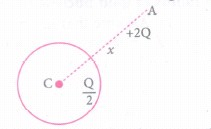
(i) Find the electric flux through the shell.
(ii) Find the force on the charges at C and A.
11.
An electron is released from the bottom plate (E = 104 Nc-1) Find the velocity of the electron when it reaches plate B. (e/m = 1.76 x 10¹¹ Ckg-1).
12.
Devise an arrangement of three point charges separated by finite distance that has zero electric potential energy.
13.
It requires 50 μJ of work to carry a 2C charge from point R to S. What is the potential difference between these points?
14.
Explain in detail the Electrostatic Potential difference between the charges.
15.
How do we determine the electric field due to a continuous charge distribution? Explain.
1.
\({ \varepsilon }_{ r }=\frac { \varepsilon }{ { \varepsilon }_{ 0 } } =80\)
ε = 80 x ε0
= 80 x 8.854 x 10-12
= 708 x 10-12
ε0 = 7.08 x 10⁻¹⁰ C2N-1m-2.
2.
The total positive charge in the nucleus is,
q = +ze = 79 x 1.6 x 10-19C.
Volume charge density, \(\sigma =\frac { q }{ \frac { 4 }{ 3 } \times \pi { R }^{ 3 } } \)
\(s=\frac { q }{ \frac { 4 }{ 3 } \times 3.14\times (7.5\times { 10 }^{ -15 }{ ) }^{ 3 } } \)
= 0.088 x 1026
= 8.8 x 1024 Cm-3
3.
r = 25cm = 25 x 10-2m
\(\sigma =\frac { 3 }{ \pi } { cm }^{ -2 }\)
\(AS,\quad \sigma =\frac { q }{ A } =\frac { q }{ 4\pi { r }^{ 2 } } \) [A - surface Area of the sphere]
\(q=(4\pi { r }^{ 2 })\sigma \)
\(=4\pi (0.25{ ) }^{ 2 }\times \frac { 3 }{ \pi } \)
= 0.75C.
4.
For charge -q to be in equilibrium, for an -q due to +Q at point A should be equal and opposite to that due to +Q at point B.
i.e \(\frac { 1 }{ 4\pi { \varepsilon }_{ 0 } } \frac { Qq }{ { x }^{ 2 } } =\frac { 1 }{ 4\pi { \varepsilon }_{ 0 } } \frac { Q.q }{ { (r-x) }^{ 2 } } \)
r (r - x)2
x r - x
x = \(\frac{r}{2}\)
∴ for equilibrium, -q must be kept at the middle of the line joining the A and B.
5.
q1= 6μC
q2 = ne = 5 x 1012 x (1.6 x 10-19)
q2 = 8.0 x 10⁻⁷ C
= 0.8 x 10⁻⁶ C = 0.8 μC
Since electrons are removed from the sphere, q2 is positive.
∴ Net charge on the sphere,
q = q1 + q2
q = (-6.0 + 0.8) x 10-6C
q = -5.2 x 10⁻⁶C
6.
Charge of an electron, e = 1.6 x 10⁻¹⁹C
q = 1C
∴ No of electrons, n = \(\frac{q}{e}\)
\(n=\frac { 1 }{ 1.6\times { 10 }^{ -19 } } \)
= 6.25 x 10¹⁸
n = 6.25 x 10¹⁸ electrons
7.
Given:
Total number of electrons in the slab,
N = 29 x e = 29 x 2 x 1022
Number g electrons remvoed, n \(=\frac{q}{e}\)
\(n=\frac { 2\times { 10 }^{ -6 } }{ 1.6\times { 10 }^{ -19 } } \)
n 1.25 x 10¹³
∴ fraction of electrons removed
\(=\frac{No.of\ electrons\ removed\ (n)}{Total\ No.of \ electrons(N)}\)
\(\\ =\frac { 29\times 2\times { 10 }^{ 22 } }{ 1.25\times { 10 }^{ 13 } } =2.16\times { 10 }^{ -11 }\)
8.
Here, q = -3 x 10⁻⁷ C
Charge of one electron, e = -1.6 x 10⁻¹⁹ C
Number of electrons transferred from wool to
polythenepiece, n = \(\frac{q}{e}\)\(=\frac { -3\times { 10 }^{ -7 }C }{ -1.6\times { 10 }^{ -19 }C } \)
= 1.875 x 10¹²
9.
The line joining B to C is perpendicular to electric field
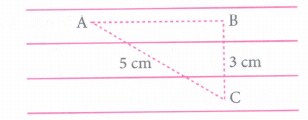
So potential of B = potential of C
i.e. VB = Vc
Distance AB = 4 cm
Potential difference
between A & C = E x AB
= 5 x 103 x (4 x 10-2)
= 200 volt.
AC2 = AB2 + B2
AB2 = AC2 - BC2
= 25 - 9 = 16
AB = 4cm
10.
(i) Electric flux \(\phi =\frac { Total\ enclosed\ charge }{ { \varepsilon }_{ 0 } } \)
Net charge enclosed inside the shell q = 0
∴ electric flux through the shell \(\frac { q }{ { \varepsilon }_{ 0 } } =0\)
(ii) The electric field or net charge inside the spherical conducting shell is zero.
Hence the force on charge \(\frac{Q}{2}\)is zero.
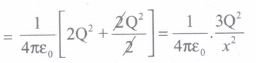
Force on charge at \(A,{ F }_{ A }=\frac { 1 }{ 4\pi { \varepsilon }_{ 0 } } .\frac { 2Q\left( Q+\frac { Q }{ 2 } \right) }{ { x }^{ 2 } } \)
11.
Given: Electric field strength E = 104 NC-1 between the plates
Distance of separation between the plates = 2 cm
= 2 x 10⁻² m.
Velocity of the electron when it reaches B = V = ?
To find:
According to equation of motion V = u2 + 2as
u - initial velocity = 0; a \(=\frac { F }{ m } =\frac { Ee }{ m } =E\left( \frac { e }{ m } \right) \)
Formula: V2 = 2as
Solution:
\(V=\sqrt { 2\times { 10 }^{ 4 }\times 1.76\times { 10 }^{ 11 }\times 2\times { 10 }^{ -2 } } \)
\(V=7.04\times { 10 }^{ 13 }=\sqrt { 0.704\times { 10 }^{ 14 } } \)
\(V=0.84{ 10 }^{ 7 }{ ms }^{ -1 }\)
12.
The system of charges has zero electric potential energy.
The system of charges shown in figure has zero electric potential energy.
\(U=\frac { { q }^{ 2 } }{ a } -K.\frac { { q }^{ 2 } }{ 2a } -K.\frac { { q }^{ 2 } }{ 2a } =0\)
U = 0
13.
\({ V }_{ S }-{ V }_{ R }=\frac { W }{ q } \)
Work W = 50μJ = 50 x 10-6 J
Charge q = 2μC = 2 x 10⁻⁶ C
V = VS - VR \(=\frac { W }{ q } =\frac { 50\times { 10 }^{ -6 } }{ 2\times { 10 }^{ -6 } } =25V\)
V = 25V
14.
(i) Consider a positive charge q kept fixed at the origin which produces an electric field \(\overset { \rightarrow }{ E } \) around it.
(ii) A positive test charge q' is brought from point R to point P against the repulsive force between q and q' as shown in Figure. Work must be done to overcome this repulsion. This work done is stored as potential energy.
(iii) The test charge q' is brought from R to P with constant velocity which means that external force used to bring the test charge q' from R to P must be equal and opposite to the coulomb force \(\left( { \overset { \rightarrow }{ E } }_{ ext }=-{ \overset { \rightarrow }{ F } }_{ coloumb } \right) \)
The work done is
\(W=\int _{ R }^{ P }{ { \overset { \rightarrow }{ F } }_{ ext } } .d\overset { \rightarrow }{ r } \quad \quad \quad ...(1)\)
(iii) Since coulomb force is conservative, work done is independent of the path and it depends only on the initial and final positions of the test charge. If potential energy associated with q' at P is Up and that at R is UR' then difference in potential energy is defined as the work done to bring a test charge q' from point P to R and is given as Up - U R = W.
\(\Delta U=\int _{ R }^{ P }{ { \overset { \rightarrow }{ F } }_{ ext } } .d\overset { \rightarrow }{ r } \)
\(Since{ \overset { \rightarrow }{ F } }_{ ext }=-{ \overset { \rightarrow }{ F } }_{ coloumb }=-q'\overset { \rightarrow }{ E } \)
\(\Delta U=\int _{ R }^{ P }{ \left( -q'\overset { \rightarrow }{ E } \right) } .d\overset { \rightarrow }{ r } =q'\int _{ R }^{ P }{ \left( -\overset { \rightarrow }{ E } \right) } .d\overset { \rightarrow }{ r } \)
15.
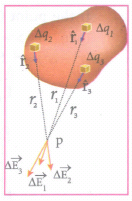
(i) Consider the following charged object of irregular shape as shown in Figure. The entire charged object is divided into a large number of charge elements \(\Delta { q }_{ 1 },\Delta { q }_{ 2 },\Delta { q }_{ 3 },.....\Delta { q }_{ n },\). and each charge element \(\Delta { q }\) is taken as a point charge.
(ii) The electric field at a point P due to a charged object is approximately given by the sum of the fields at P due to all such charge elements.
\(\vec { E } =\frac { 1 }{ 4\pi { \varepsilon }_{ 0 } } \left( \frac { { \Delta q }_{ 1 } }{ { r }_{ 1p }^{ 2 } } { \hat { r } }_{ 1p }+\frac { \Delta { q }_{ 2 } }{ { r }_{ 2p }^{ 2 } } { \hat { r } }_{ 2p }+.....+\frac { \Delta { q }_{ n } }{ { r }_{ np }^{ 2 } } { \hat { r } }_{ np } \right) \)
\(\approx \frac { 1 }{ 4\pi { \varepsilon }_{ 0 } } \sum _{ t=1 }^{ n }{ \frac { { \Delta q }_{ 1 } }{ { r }_{ 1P }^{ 2 } } { \hat { r } }_{ iP } } (1)\)
(iii) Here \(\Delta { q }_{ i }\) is the ith charge element, rip is the unit vector from the ith charge element to the point P. However the equation (1) is only an approximation. To incorporate the continuous distribution of charge, we take the limit \(\Delta q\rightarrow 0(=dq).\) In this limit, the summation in the equation (1) becomes an integration and takes the following form \(\vec { E } =\frac { 1 }{ 4\pi { \varepsilon }_{ 0 } } \int { \frac { dq }{ { r }^{ 2 } } \hat { r } } \) ...(2)
(iv) Here r is the distance of the point P from the infinitesimal charge dq and \(\hat { r } \) is the unit vector from dq to point P. Even though the electric field for a continuous charge distribution can be difficult to evaluate, the force experienced by some test charge q in this electric field is still given by \(\vec { F } =q\vec { E } \)
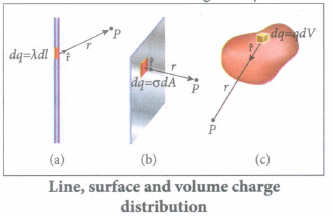
(a) If the charge Q is uniformly distributed along the line of length L, then linear charge density (charge per unit length) \(\lambda \) is \(\lambda =\frac { Q }{ L } \) unit is coulomb per meter (Cm-1). The charge present in the infinitesimal length dl is dq =\(\lambda \)dl. This is shown in Figure 1(a).
The electric field due to the line of total charge Q is given by
\(\vec { E } =\frac { 1 }{ 4\pi { \varepsilon }_{ 0 } } \int { \frac { \lambda dl }{ { r }^{ 2 } } } \hat { r } =\frac { \lambda }{ 4\pi { \varepsilon }_{ 0 } } \int { \frac { dl }{ { r }^{ 2 } } } \hat { r } \)
(b) If the charge Q is uniformly distributed on a surface of area A, then surface charge density (charge per unit area) \(\sigma \) is \(\sigma \) =\(\frac{Q}{A}\). Its unit is coulomb per square meter (C m-2). The charge present in the infinitesimal area dA is dq=\(\sigma dA\). This is shown in the figure 1(b). The electric field due to a total charge Q is given by \(\vec { E } =\frac { 1 }{ 4\pi { \varepsilon }_{ 0 } } \int { \frac { \sigma da }{ { r }^{ 2 } } \hat { r } =\frac { 1 }{ 4\pi { \varepsilon }_{ 0 } } \sigma \int { \frac { da }{ { r }^{ 2 } } } \hat { r } } \) This is shown in Figure 1(b).
(c) If the charge Q is uniformly distributed in a volume V, then volume charge density (charge per unit volume) p is given by \(\rho =\frac { Q }{ V } .\) Its unit is coulomb per cubic meter (Cm-3).
The charge present in the infinitesimal volume element dV is dq = pdV. This is shown in Figure 1(c). The electric field due to a volume of total charge Q is given by,\(\vec { E } =\frac { 1 }{ 4\pi { \varepsilon }_{ 0 } } \int { \frac { \rho dV }{ { r }^{ 2 } } =\hat { r } =\frac { 1 }{ 4\pi { \varepsilon }_{ 0 } } \rho \int { \frac { dV }{ { r }^{ 2 } } \hat { r } } } \).

12th Standard Syllabus & Materials
12th Standard
TN 12th Computer Applications களப்பெயர் முறைமை (DNS) Sample Question Papers Study Material - QB365 Set A
NEW12th Standard
TN 12th Computer Applications வலையமைப்பு எடுத்துக்காட்டுகள் மற்றும் நெறிமுறைகள் Sample Question Papers Study Material - QB365 Set A
NEW12th Standard
TN 12th Computer Applications கணினி வலையமைப்பு ஓர் அறிமுகம் Sample Question Papers Study Material - QB365 Set A
NEW12th Standard
TN 12th Computer Applications PHP-உடன் MySQL-ஐ இணைத்தல் Sample Question Papers Study Material - QB365 Set A



Tamilnadu Stateboard 12th Standard Subjects

Maths

Chemistry
Physics

Biology

Computer Science

Business Maths and Statistics

Economics

Commerce

Accountancy

History

Computer Applications
Biology
Computer Technology
Computer Applications
Computer Science
Business Maths and Statistics
Commerce
Economics
Maths
Chemistry
Physics
Computer Technology
History
Accountancy

Tamil

English

French
Tamilnadu Stateboard Standards

