
 100% FREE ACCESS
6th Standard Syllabus & Materials
6th Standard
TN 6th Tamil பருவம் 1 - இயல் 1 - மொழி -தமிழ்த்தேன் - இன்பத்தமிழ் Sample Question Papers Study Material - QB365 Set A
NEW6th Standard
TN 6th English T1 - Supplementary - The Apple Tree and The Farmer Sample Question Papers Study Material - QB365 Set A
NEW6th Standard
TN 6th English T1 - Prose - When The Trees Walked Sample Question Papers Study Material - QB365 Set A
NEW6th Standard
TN 6th Social Science T3 - CIV - Road Safety Sample Question Papers Study Material - QB365 Set A
NEW6th Standard
TN 6th Social Science T3 - CIV - Local Bodies - Rural and Urban Sample Question Papers Study Material - QB365 Set A
NEW6th Standard
TN 6th Social Science T3 - CIV - Democracy Sample Question Papers Study Material - QB365 Set A

Published on: 16/03/2020
6th Standard Mathematics English Medium All Chapter Book Back and Creative Five Marks Questions 2020
Download Tamil Nadu 6th Standard Maths question papers, model tests, one-mark questions, important questions, and public exam papers in PDF format. Free study materials and answer keys for TN State Board students.
Questions + Answers key
Take MCQ Maths Test1.
Take two cards from a deck of playing cards and identify, which is greater between them, assuming that the joker card represents zero, black cards represent positive integers, red cards represent negative integers and the cards A, J. Q and K represent 1, 11, 12 and 13 respectively.
2.
Suppose in a building, there are 2 basement floors. If the ground floor is denoted as zero, how can we represent the basement floors?
(i) Is -15 < -26 ? why?
(ii) Which is smaller - 3 or -5 ? Why?
(iii) Which is greater 7 or -4 ? Why?
(iv) Which is the greatest negative integer?
(v) Which is the smallest positive integer?
3.
Find HCF of 28, 35, 42 by Euclid’s game
4.
Prepare a daily time schedule for evening study at home
5.
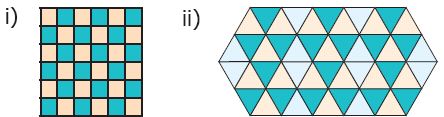
Colour the boxes in such a way that it posseses translation symmetry
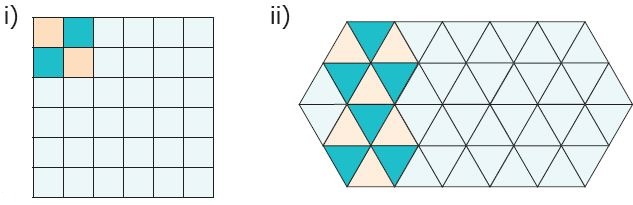
6.
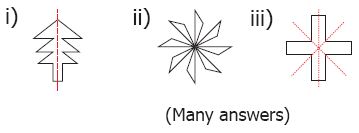
Draw the following :
i) A figure which has reflection symmetry but no rotational symmetry.
ii) A figure which has rotational symmetry but no reflection symmetry.
iii) A figure which has both reflection and rotational symmetry.
7.
Two plots have the same perimeter. One is a square of side 10 m and another is a rectangle of breadth 8 m. Which plot has the greater area and by how much?
8.
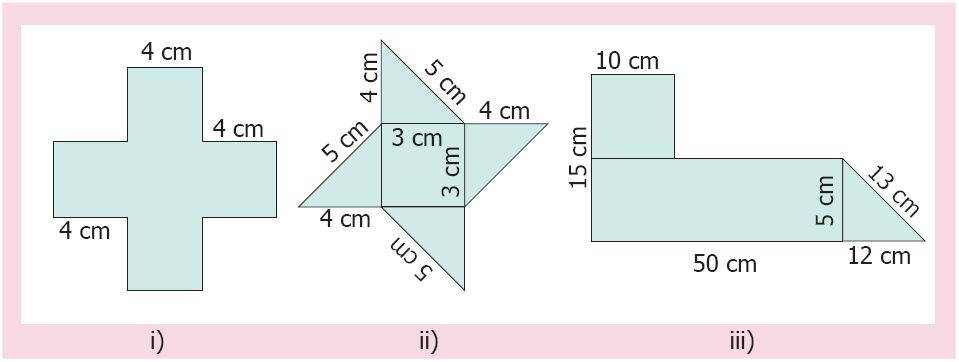
Find the perimeter and area of the following shapes
9.
Look at the picture and answer the following questions:
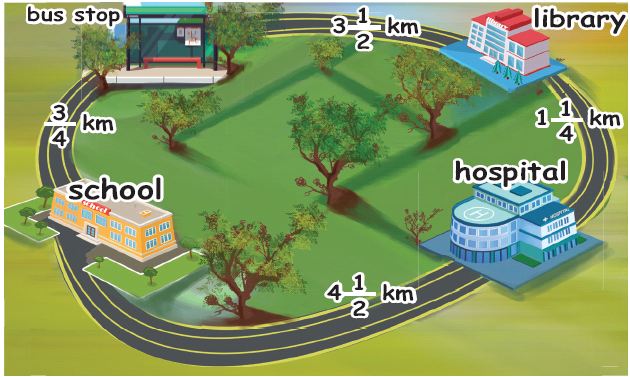
i) What is the distance from School to Library via Bus stop?
ii) What is the distance between School and Library via Hospital?
iii) Which is the shortest distance between (i) and (ii)?
iv) The distance between School and Hospital is ________ times the distance between School and Bus stop.
10.
Answer the following:
i) Find the sum of \(1\over7\)and \(3\over9\).
ii) What is the total of \(3{1\over3}\)and \(4{1\over6}\) ?
iii) Simplify: \(1{3\over5}+5{4\over7}\)
iv) Find the difference between \(8\over 9\)and \(2\over7\)
v) Subtract \(1{3\over 5}\)from \(2{1\over3}\)
vi) Simplify : \(7{2\over7}-3{4\over 21}\)
11.
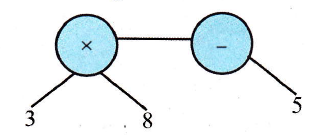
Use brackets in appropriate place to the expression 3 \(\times\) 8 − 5 which gives 19 and convert it into tree diagram for it.
12.
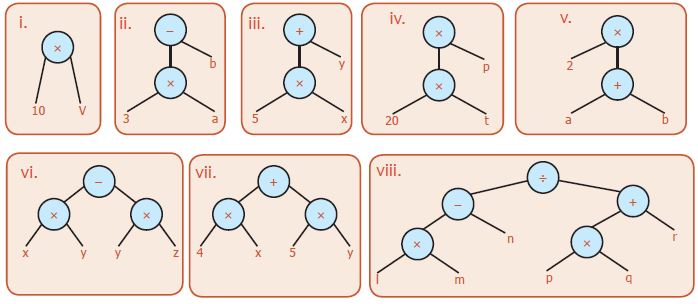
Convert the following algebraic expressions into tree diagrams.
(i) 10v
(ii) 3a−b
(iii) 5x + y
(iv) 20t \(\times\) p
(v) 2(a+b)
(vi) (x \(\times\) y) − (y \(\times\) z)
(vii) 4 x + 5y
(viii) (lm − n) \(\div \) (pq + r)
13.
Complete the following table :
| Types of Triangle /Its Angles | Acute angled triangle | Right angled triangle | Obtuse angled triangle |
| Any two angles | Always acute angles | i. | Always acute angles |
| Third angle | ii. | Right angle | iii. |
14.
Can a triangle be formed with the following angles? If yes, name the type of triangle.
(i) 60°, 60°, 60°
(ii) 90°, 55°, 35°
(iii) 60°, 40°, 42°
(iv) 60°, 90°, 90°
(v) 70°, 60°, 50°
(vi) 100°, 50°, 30°
15.
Complete the following table.
| Sl. No | C.P. in Rs. | M.P. in Rs | S.P. in Rs. | Discount in Rs. | Profit in Rs. | Loss in Rs. |
|---|---|---|---|---|---|---|
| i | 110 | 130 | 5 | |||
| ii | 110 | 130 | 20 | |||
| iii | 130 | 15 | 30 | |||
| iv | 130 | Nil | 25 | |||
| v | 125 | Nil | Nil | Nil | ||
| vi | 350 | 50 | 100 | Nil |
16.
Fill up the appropriate boxes in the following table:
| C.P. | S.P. | Profit | Loss | |
| (i) | Rs. 50 | Rs. 60 | ||
| (ii) | Rs. 70 | Rs. 60 | ||
| (iii) | Rs. 100 | Rs. 20 | ||
| (iv) | Rs. 80 | Rs.15 | ||
| (v) | Rs. 70 | Rs. 25 | ||
| (vi) | Rs. 100 | Rs. 30 |
17.
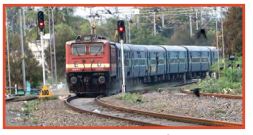
The arrival and departure timings of the Chennai - Trichy Express are given below.
| Station | Arrival | Departure |
| Chennai Egmore | - | 20:30 |
| Chengalpattu | 21:30 | 21:32 |
| Villupuram junction | 23:15 | 23:25 |
| Virudhachalam junction | 00:07 | 00:10 |
| Trichy | 04:30 | - |
(i) At what time does the train depart from Chennai Egmore to arrive at Trichy? The train departs from Egmore at 20:30 hours to arrive Trichy at 4:30 hours.
(ii) How long does it halt at Villupuram? It halts at Villupuram for 10 minutes.
(iii) How many halts are there in between Chennai and Trichy? There are 3 halts (1) Chengalpattu (2) Villupuram (3) Virudhachalam
(iv) Find the total journey time of the train from Chennai to Trichy.
18.
A handloom weaver takes 6 hours 20 minutes 30 seconds and 5 hours 50 minutes 45 seconds to weave two silk sarees. What is the total time to weave the two silk sarees?
19.
There are four Mobile Phones in a house. At 5 a.m, all the four Mobile Phones will ring together. Thereafter, the first one rings every 15 minutes, the second one rings every 20 minutes, the third one rings every 25 minutes and the fourth one rings every 30 minutes. At what time, will the four Mobile Phones ring together again?
20.
Find the HCF of the numbers 18, 24 and 30 by factor tree method.
21.
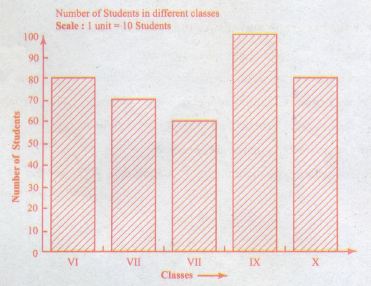
The above bar graph shows the number of students in different classes of a school. Read the graph and answer the following questions.
(a) How many students are in class X?
(b) How many students are in class VII?
(c) How many students are in class IX?
22.
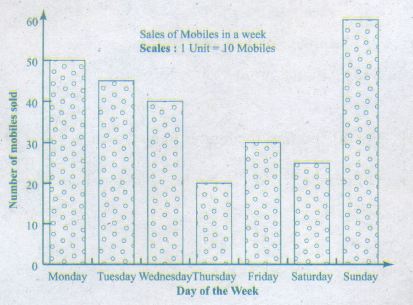
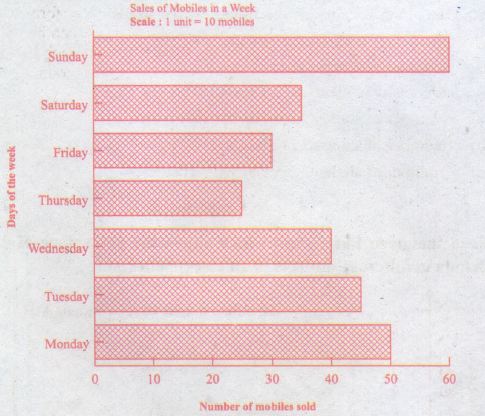
Ragavi's father is a mobile shop owner. She finds the following data of sale of mobiles in a week.
| Day | Number of Mobiles sold |
| Monday | 50 |
| Tuesday | 45 |
| Wednesday | 40 |
| Thursday | 20 |
| Friday | 35 |
| Saturday | 30 |
| Sunday | 55 |
Draw a vertical and horizontal bar graph
23.
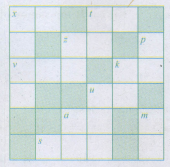
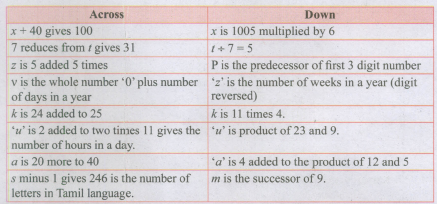
Find the variables from the clues given below and solve the cross-word puzzle.
24.
The rectangles made of identical square blocks with varying lengths but having only two square blocks as width are given below.

(i) How many smallest squares are there in each of the rectangles P, Q, Rand S?
(ii) Fill in the boxes
| Rectangles | P | Q | R | S | T |
| Number of small size squares along the breadth | 2 | 2 | ? | 2 | 2 |
| Number of squares along the length | 1 | 4 | 3 | ? | X |
| Total number of squares in rectangle | ? | 8 | ? | 10 | ? |
25.
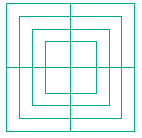
Count the number of squares in each of the following figures?
26.
The heights (in centimeters) of 40 children are.
110 112 112 116 119 111 113 115 118 120
110 113 114 111 114 113 110 120 118 115
112 110 116 111 115 120 113 111 113 120
115 111 116 112 110 111 120 111 120 111
Prepare a tally mark table.
27.
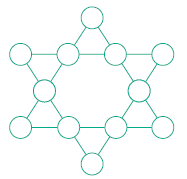
Place the number 1 to 12 in the 12 circles so that the sum of the numbers in each of the six lines of the star is 26. Use each number from 1 to 12 exactly once. Find more possible ways?
28.
The following table shows the number of vehicles sold in a year
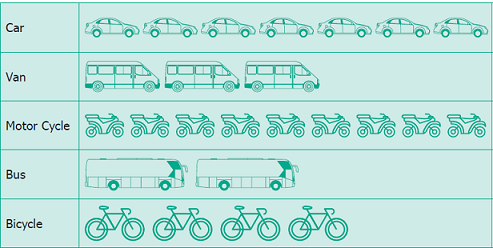
key: One picture represents 10 vehicles
Look at the pictograph and answer the following questions.
(i) How many motor cycles were sold in a year?
(ii) Number of buses sold in a year is 20. Say True or False.
(iii) How many bicycles were sold?
(iv) How many cars and vans were sold?
(v) How many vehicles were sold altogether?
29.
If the ratio of Green, Yellow and Black balls in a bag is 4 : 3 : 5, then
(a) Which is the most likely ball that you can choose from the bag?
(b) How many balls in total are there in the bag if you have 40 black balls in it?
(c) Find the number of green and yellow balls in the bag.
30.
Find the variables from the clues given below and solve the cross−word puzzle.
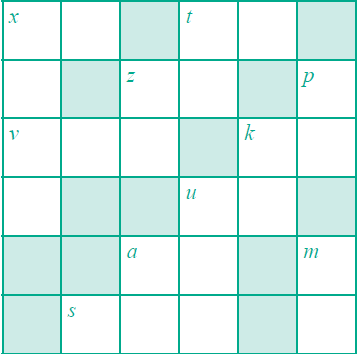
| Across | Down |
| x + 40 gives 100 | x is 1005 multiplied by 6 |
| 7 reduced from t gives 31 | t ÷ 7 = 5 |
| z is 5 added 5 times | p is the predecessor of first 3 digit number |
| v is the whole number zero plus number of days in a ordinary year | z is the number of weeks in a year (digits reversed) |
| k is 24 added to 25 | k is 11 times 4 |
| u is 2 added to two times 11 gives the number of hours in a day | u is product of 23 and 9 |
| a is 20 more to 40 | a is 4 added to the product of 12 and 5 |
| s minus 1 gives 246 is the number of letters in Tamil language | m is the successor of 9 |
31.
The rectangles made of identical square blocks with varying lengths but having only two square blocks as width are given below.

(i) How many small size squares are there in each of the rectangles P, Q, R and S?
(ii) Fill in the boxes.
| Rectangle | P | Q | R | S | T |
| Number of small size squares along the breadth | 2 | 2 | ? | 2 | 2 |
| Number of squares along the length | 1 | 4 | 3 | ? | x |
| Total number of squares in rectangle | ? | 8 | ? | 10 | ? |
32.
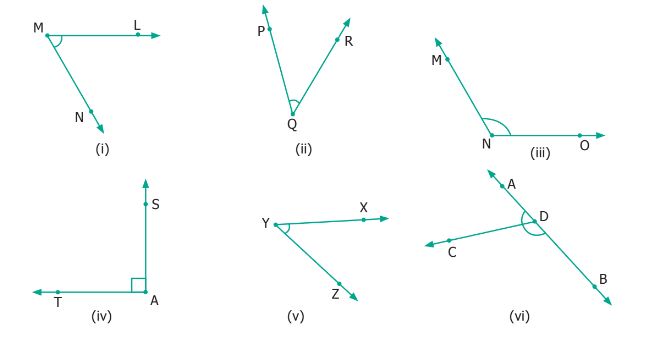
Pick out the Obtuse angles from the given figures.
33.
In a family, the amount spent in a month for buying Provisions and Vegetables are in the ratio 3 : 2. If the allotted amount is Rs. 4000, then what will be the amount spent for (i) Provisions and (ii) Vegetables?
34.
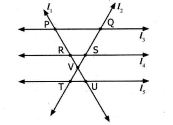
From the given figure, name
(i) all pairs of parallel lines.
(ii) all pairs of intersecting lines.
(iii) pair of lines whose point of intersection is ‘V’.
(iv) point of intersection of the lines ‘ l2’ and ‘l3’.
(v) point of intersection of the lines ‘l1’ and ‘l5’.
35.
The number of employees in the Indian Railways is about 10 lakh. Write this in the International System of numeration
36.
Read and expand the number 50000, 676097
1.
Take 2 cards from a deck of playing cards.
Given:
Joker card represents zero.
Black cards represents positive integers.
Red cards represents negative integer
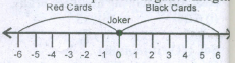
\(\therefore\) Joker > red cards \(\Rightarrow\) joker is greater.
red cards < black cards \(\Rightarrow\) black card is greater
black cards > Joker \(\Rightarrow\) black card is greater.
red cards < Joker
Also given,
A represent 1
J represent 11
Q represent 12 and
K represent 13
\(\therefore\) J > A, Q > A, Q > J, K > A, K > J, K > Q.
2.
There are 2 basement floors.
Ground flooris zero.
\(\therefore\) Basement floors denoted as +2
(i) No, -15 is greater than -26, (15 >- 26)
(ii) Given:
3 or -5
-3 is greater number.
- 5 is smaller number.
Reason: -3 and - 5 are negative integers.
\(\therefore\) -5 is smaller
(iii) Given:
7, -4
7\(\rightarrow\) Positive integer
-4 \(\rightarrow\) negative integer
\(\therefore\) 7 is greater.
(iv) -1 is the greatest negative integer
(v) 1 is the smallest positive integer
3.
Euclid's game
(28, 35, 41)
\(\Rightarrow\) (28, (35 - 28), (42 - 28))
\(\Rightarrow\) (28, 7, 14)
\(\Rightarrow\) (28 -7), 7, 14 - 7)
\(\Rightarrow\) (21, 7, 7) \(\Rightarrow\)((21 -7), 7, 7)
\(\Rightarrow\) (14, 7, 7)
\(\Rightarrow\) (14 - 7, 7, 7)
\(\Rightarrow\)(7, 7, 7)
\(\therefore\) HCF of (28, 35, 42) is 7
4.
| Time | Activity |
| 5.00 p.m. to 6.00 p.m. | Games |
| 6.00 p.m. to 8.00 p.m | Study |
| 8.00 p.m. to 8.30 p.m | Supper |
| 8.30 p.m. to 9.00 p.m | Recreation |
| 9.00 p.m. to 10.00 p.m | Study |
| 10.00 p.m | Sleep |
5.
6.
7.
Square of side = 10 m
Breadth of rectangle = 8 m
Square:
Area of the square = s2 sq. units
= 102 = 100m2
P = 4s = 4(10) = 40 m
Rectangle:
Area of the rectangle = I\(\times\) b sq. units
b = 8 m
P = 40 m
2 (l+ b) = 40
2(l + 8) = 40
2l + 16 = 40
2l = 40 -16
\(l=\cfrac { 24 }{ 2 } =12\)
Area of the rectangle = (12 \(\times\) 8) m2
Difference = Area of the square - Area of the rectangle
= 100 - % = 4m2
Square plot has the greater area and 4 m2
8.
(i) Given :
Perimeter = 12 times 4 cm
= 12 \(\times\) 4 = 48 cm
Area \(\Rightarrow\) Given = 5 squares
= 5 \(\times\) area of square
= 5 \(\times\) (sider)2
= 5 \(\times\) 42
\(\therefore\) A = 5 \(\times\) 16 = 80 Cm2
\(\therefore\) P = 48 cm, A = 80 cm2
(ii) Given :
Perimeter = 4 times 4 cm + 4 times 5cm
= 4 (4) + 4 (5)
= 16 + 20 = 36 cm
Area = 4 triangles + 1 square
= \(4\left( \frac { 1 }{ 2 } bh \right) +1\left( s \right) ^{ 2 }\)
= \(4\left( \frac { 1 }{ 2 } \left( 5 \right) \left( 4 \right) \right) +1\left( { 3 }^{ 2 } \right) \)
= 4 \(\times\) 5 \(\times\) 2 + 9
= 40 + 9 = 49 cm2
(iii) Given :
Perimeter = (50 + 12 + l3 + 40 + 10 +10 + 10 + 5) cm
= 150 cm
= \(\left( lb+\cfrac { 1 }{ 2 } bh+{ s }^{ 2 } \right) { cm }^{ 2 }\)
= \(\left( 50\times 5 \right) +\cfrac { 1 }{ 2 } \times 12\times 5+{ 10 }^{ 2 }\)
= 250 + 30 + 100
= 380 cm2
\(\therefore\) P = 150 cm, A = 380 cm2
9.
The distance from school to Library via Bus Stop.
= \(\left[ \cfrac { 3 }{ 4 } +3\cfrac { 1 }{ 2 } \right] \)
= \(\cfrac { 3 }{ 4 } +\cfrac { 7 }{ 2 } \)
= \(\cfrac { 3+(7\times 2) }{ 4 } =\cfrac { 3+14 }{ 4 } =\cfrac { 17 }{ 4 } \)
= \(4\frac { 1 }{ 4 } \) km
The distance between school and library via Hospital
= \(\left( 4\frac { 1 }{ 2 } +1\frac { 1 }{ 4 } \right) \)
= \(\cfrac { 9 }{ 2 } +\cfrac { 5 }{ 4 } \)
= \(\cfrac { (9\times 2) }{ 4 } =\cfrac { 18+5 }{ 4 } =\cfrac { 23 }{ 4 } \)
= \(5\frac { 3 }{ 4 } \)
(iii) The shortest between (i) and (ii)
via Bus stop = \(4\frac { 1 }{ 4 } \)
via Hospital = \(5\frac { 3 }{ 4 } \)
Ans: via Bus stop.
(iv) Distance between School and Hospital = \(4\frac { 1 }{ 2 }\ km \)
Distance between School and Bus stop = \(\frac{3}{4}\ km\)
Required Answer = \(4 \frac{1}{2} \div \frac{3}{4}\)
\(=\frac{9}{2} \div \frac{3}{4}=\frac{9}{2} \times \frac{4}{3}=6\)
The distance between school and Hospital is 6 times the distance between school and Bus stop.
10.
(i) \(\cfrac { 1 }{ 7 }\ and\ \cfrac { 3 }{ 9 } \)
To find: \(\cfrac { 1 }{ 7 } +\cfrac { 3 }{ 9 } \)
LCM of 7 and 9 is 63
\(\Rightarrow \cfrac { 1 }{ 7 } \times \cfrac { 9 }{ 9 } +\cfrac { 3 }{ 9 } \times \cfrac { 7 }{ 7 } \)
= \(\cfrac { 9 }{ 63 } +\cfrac { 21 }{ 63 } =\cfrac { 9+21 }{ 63 } =\cfrac { 30 }{ 63 } =\cfrac { 10 }{ 21 } \)
(ii) \(3\cfrac { 1 }{ 3 } \ and\ 4\cfrac { 1 }{ 6 } \)
To find : \(3\cfrac { 1 }{ 3 } +4\cfrac { 1 }{ 6 } \)
= \(\cfrac { 10 }{ 3 } +\cfrac { 25 }{ 6 } \)
LCM of 3 and 6 is 6
= \(\cfrac { 10\times 2 }{ 3\times 2 } +\cfrac { 25 }{ 6 } \)
= \(\cfrac { 20 }{ 6 } +\cfrac { 25 }{ 6 } =\cfrac { 20+25 }{ 6 } =\cfrac { 45 }{ 6 } =\cfrac { 15 }{ 2 } =7\cfrac { 1 }{ 2 } \)
(iii) \(\cfrac { 8 }{ 5 } +\cfrac { 39 }{ 7 } \)
LCM of 5 and 7 is 35
= \(\cfrac { 8\times 7 }{ 5\times 7 } +\cfrac { 39\times 5 }{ 7\times 5 } \)
= \(\cfrac { 56 }{ 35 } +\cfrac { 195 }{ 35 } =\cfrac { 56+195 }{ 35 } =\cfrac { 251 }{ 35 } \)
= \(7\cfrac { 6 }{ 35 } \)
(iv) \(\cfrac { 8 }{ 9 } and\cfrac { 2 }{ 7 } \)
To find \(\cfrac { 8 }{ 9 } -\cfrac { 2 }{ 7 } \)
LCM 9 and 7 is 63
= \(\cfrac { 8\times 7 }{ 9\times 7 } -\cfrac { 2\times 9 }{ 7\times 9 } \)
= \(\cfrac { 56 }{ 63 } -\cfrac { 18 }{ 63 } =\cfrac { 56-18 }{ 63 } =\cfrac { 38 }{ 63 } \)
(v) \(1\cfrac { 3 }{ 5 } ,2\cfrac { 1 }{ 3 } \)
To find \(2\cfrac { 1 }{ 3 } -1\cfrac { 3 }{ 5 } \)
\(\Rightarrow \cfrac { 7 }{ 3 } -\cfrac { 8 }{ 5 } \)
LCM 3 and 5 is 15
= \(\cfrac { 7\times 5 }{ 3\times 5 } -\cfrac { 8\times 3 }{ 5\times 3 } \)
= \(\cfrac { 35 }{ 15 } -\cfrac { 24 }{ 15 } =\cfrac { 35-24 }{ 15 } =\cfrac { 11 }{ 15 } \)
(vi) \(7\cfrac { 2 }{ 7 } -3\cfrac { 4 }{ 21 } \)
\(\cfrac { 51 }{ 7 } -\cfrac { 67 }{ 21 } \)
LCM of 7 and 21 is 21
\(\Rightarrow \cfrac { 51\times 3 }{ 7\times 3 } -\cfrac { 67 }{ 21 } \)
= \(\cfrac { 153 }{ 21 } -\cfrac { 67 }{ 21 } =\cfrac { 153-27 }{ 21 } \)
= \(\cfrac { 86 }{ 21 } =4\cfrac { 2 }{ 21 } \)
11.
Expression : (3 \(\times\) 8) - 5
Tree Diagram
12.
13.
| Types of Triangle /Its Angles | Acute angled triangle | Right angled triangle | Obtuse angled triangle |
| Any two angles | Always acute angles | i. Always acute angles | Always acute angles |
| Third angle | ii. acute angle | Right angle | iii. Obtuse angle |
14.
(i) 60°, 60°, 60°
The sum of the three angles of a triangle = 180°
Sum of three angles = 60° + 60° + 60° = 180° degrees
Yes, a triangle can be formed.
Type: Acute angled triangle.
(ii) 90°, 55°, 35°
The sum of three angles of a triangle = 90° + 55° + 35° = 180°
Yes, a triangle can be formed.
Type: Right angled triangle.
(iii) 60°, 40°, 42°
The sum of three angles of a triangle = 180°
Sum of the angles = 60° + 40° + 42° = 142°
No a triangle cannot be formed.
(iv) 60°, 90°, 90°
The sum of three angles of a triangle = 180°
Sum of the angles = 60° + 90° + 90°
= 240° \(\neq\) 180°
No a triangle cannot be formed.
(v) 70°, 60°, 50°
The sum of three angles of a triangle = 180°
Sum of the angles = 70° + 60° + 50° = 180° = 180° .
Yes, a triangle can be formed.
Type: Acute angled triangle.
(vi) 100°, 50°, 30°
The sum of three angles of a triangle = 180°
Sum of the angles = 100° + 50° + 30°
= 180° = 180°
Yes, a triangle cannot be formed.
Type: Obtuse angled triangle
15.
(i) C.P. = Rs. 110
M.P. = Rs. 130
Discount = Rs. 5
S.P. = M.P. - Discount
= Rs. 130 - Rs. 5
=Rs. 125
Profit = S.P. - C.P.
=Rs. 125 - Rs. 110
=Rs. 15
(ii) C.P. = Rs. 110
M.P. = Rs. 130
Discount = Rs. 20
S.P. = M.P. - Discount
= Rs. 130 - Rs. 20
= Rs.110
C.P. = S.P. \(\Rightarrow\) No profit or No loss.
(iii) M.P. = Rs. 130
Discount = Rs. 15
S.P. = M.P. - Discount
= Rs. 130 - Rs15
=Rs. 115
Profit = Rs. 30
Profit = S.P. - C.P.
Rs. 30 = Rs. 115 - C.P.
C.P. = Rs. 115 - Rs. 30
= Rs. 85
(iv) M.P. = Rs.130
Loss = Rs. 25
S.P. = M.P. - Discount
= Rs. 130 - Rs. 0
= Rs. 130
Loss = C.P. - S.P.
Rs. 25 = C.P. - Rs. 130
C.P. = Rs. 25 + Rs. 130
= Rs. 155
(v) M.P. = Rs. 125
Discount = Rs. 0
S.P. = M.P. - Discount
= Rs.125 - Rs. 0
= Rs. 125
No profit / No loss
C.P. = S.P.
C.P. = Rs. 125
(vi) S.P. = Rs. 350
Discount = Rs. 50
Profit = Rs. 100
M.P. = S.P.+ Discount
= Rs. 350+ Rs. 50 = Rs. 400
Profit = S.P. - C.P.
Rs 100 = Rs. 350 - C.P.
C.P. = Rs. 350 - Rs. 100
= Rs. 250
16.
(i) C.P. < S.P. \(\Rightarrow\) Profit = S.P. - C.P. = Rs. 60 - Rs. 50 = Rs. 10
(ii) C.P. > S.P. \(\Rightarrow\) Loss = C.P. - S.P. = Rs. 70 - Rs. 60 = Rs. 10
(iii) Profit = S.P. - C.P.
\(\Rightarrow\) Rs. 20 = S.P. - Rs. 100
\(\Rightarrow\) S.P. = Rs 20 + Rs. 100 = Rs. 120
(iv) Loss = C.P. - S.P.
\(\Rightarrow\) Rs. 15 = Rs. 80 - S.P.
\(\Rightarrow\) S.P. = Rs. 80 - Rs. 15 = Rs. 65
(v) Profit = S.P. - C.P.
\(\Rightarrow\) Rs. 25 = Rs. 70 - C.P.
\(\Rightarrow\) C.P. = Rs. 70 - Rs. 25 = Rs. 45
(vi) Loss = C.P. - S.P.
\(\Rightarrow\) Rs. 30 = C.P. - Rs. 100
\(\Rightarrow\) C.P. = Rs. 30 + Rs. 100 = Rs. 130
17.
If the journey crosses the midnight, calculate the time duration from starting hours to midnight, then from midnight to arrival time.
| Method-1 | Method-2 |
|---|---|
Duration up to midnight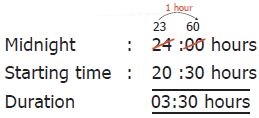 |
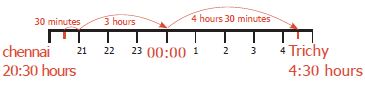 Total journey time = 3 hours 30 minutes+4 hours 30 minutes = 7 hours 60 minutes = 7 hours +1 hour = 8 hours |
| Duration from midnight to arrival = 4 hours 30 minutes Total journey time = Duration up to midnight + Duration from midnight to arrival = 3 hours 30 minutes + 4 hours 30 minutes = 7 hours 60 minutes = 7 hours + 1 hour = 8 hours |
|
18.
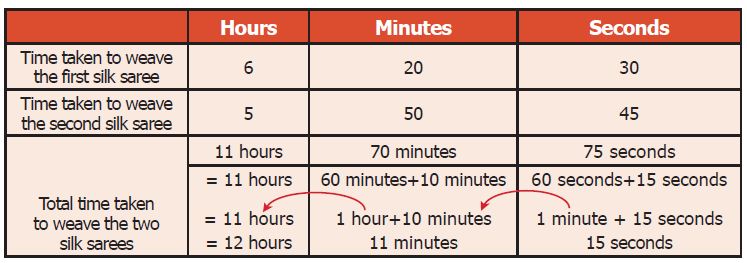
19.
This is a LCM related sum. So, we need to find the LCM of 15, 20, 25 and 30.
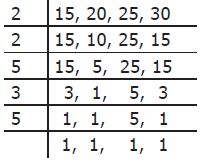
The LCM of 15, 20, 25 and 30 is 2 \(\times\) 2 \(\times\) 3 \(\times\) 5 \(\times\) 5
= 300 minutes = 5 \(\times\) 60 minutes = 5 \(\times\) 1 hour = 5 hours
Thus, the four Mobile Phones will ring together again at 10.00 a.m.
20.
Let us find the factors of 18, 24 and 30 (use of divisibility test rules will also help).
The factors of 18 are 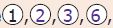 9 and 18.
The factors of 24 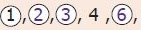 8, 12 and 24.
The factors of 30 are 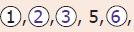 10, 15 and 30.
The factors that are common to all the three given numbers are 1, 2, 3 and 6 of which 6 is the highest.
Hence, HCF (18, 24, 30) = 6.
Note that 1 is a trivial factor of all numbers.
Let us find the factors of 24 by tree method.
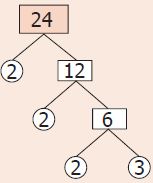
Here, 24 = 2 \(\times\) 2 \(\times\) 2 \(\times\) 3
Similarly, we can find the factors of 18 and 30.
21.
(a) Number of students in class X = 80
(b) Number of students in class VII = 70
(c) Number of students in class IX = 100.
22.
(i) Vertical Bar Graph.
(ii) Horizontal Bar Graph.
23.
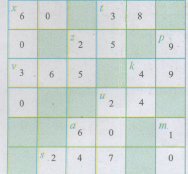
24.
| Rectangles | P | Q | R | S | T |
| Number of small size squares along the breadth | 2 | 2 | 2 | 2 | 2 |
| Number of squares along the length | 1 | 4 | 3 | 5 | X |
| Total number of squares in rectangle | 2 | 8 | 6 | 10 | 2x |
25.
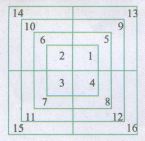
Smaller squares 4 \(\times\) 4 = 16 (As numbered).
As a whole bigger = 4.
Total squares = 20.
26.
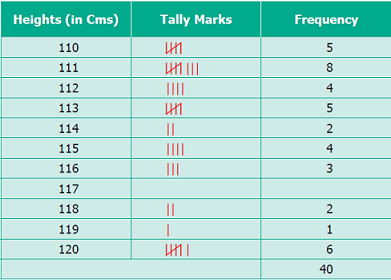
27.
The given star can be viewed as two magical triangular as.
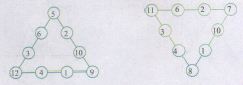
Now the required arrangement is
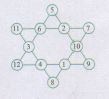
Some other arrangements are
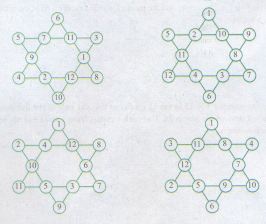
28.
1 picture represents 10 vehicles
(i) There were 9 × 10 = 90 motor cycles sold.
(ii) True.
(iii) There were 4 × 10 = 40 bicycles sold.
(iv) There were 7 cars and 3 vans pictures. Therefore 70 + 30 = 100 cars and vans sold.
(v) There were 7 cars, 3 vans, 9 motor cycles, 2 buses and 4 bicycles sold. Therefore, 70 + 30 + 90 + 20 + 40 = 250 vehicles sold.
29.
(a) green balls = 4, Yellow balls = 3, black balls = 5.
so, Black balls
(b) 5 parts of Black balls = 40 balls
\(\therefore \) 1 part of Black balls = \(\frac{40}{5}=8 \text { balls }\)
4part of Green balls = 4 \(\times\) 8 = 32
3 part of yellow balls = 3 \(\times\) 8 = 24
If there are 40 black balls, then total number of balls = 32 + 24 + 40 = 96 balls
(c) Number of green balls = 32
Number of Yellow balls = 24
30.
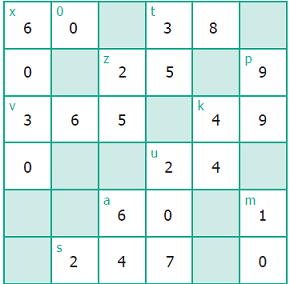
31.
(i) Number of small size square are P = 2; Q = 8; R = 6; S = 10
(ii)
| Rectangle | P | Q | R | S | T |
| Number of small size squares along the breadth | 2 | 2 | 2 | 2 | 2 |
| Number of squares along the length | 1 | 4 | 3 | 5 | x |
| Total number of squares in rectangle | 2 | 8 | 6 | 10 | 2x |
32.
i), iii) are obtuse angles
33.
(i) For Provisions:
Dividing the total amount Rs. 4000 into 3 + 2 = 5 equal parts then
3 out of 5 parts are spent for provisions & 2 out of 5 parts for vegetables
\(\therefore 4000\times\frac{3}{5}=2400\) for provisions
(ii) For vegetables:
\(4000\times\frac{2}{5}=1600\) for Vegetables
\(\therefore\) Rs.2400 spend on provisions & Rs.1600 spend on Vegetables
34.
(i) all pairs of parallel lines.
l3 and l4 ,l4 and l5 ,l3 and l5
(ii) all pairs of intersecting lines.
l1 and l2, l1 and l3 , l1 and l4 , l1 and l5 , l2 and l3 , l2 and l4, l2 and l5
(iii) pair of lines whose point of intersection is ‘V’.
l1 and l2
(iv) point of intersection of the lines ‘ l2’ and ‘l3’. l1 and l2
Q
(v) point of intersection of the lines ‘l1’ and ‘l5’.
U
35.
Employees in IndianRailways = 1,000,000 (One million)
36.
NUMBER : 50,000
Expanded form : 5 \(\times\) 10000
Read as : Fifty Thousand
NUMBER : 676097
Expanded form : 6 \(\times\) 100000 + 7 \(\times\) 10000 + 6 \(\times\) 1000 + 0 \(\times\) 100 + 9 \(\times\) 10 + 7 \(\times\) 1
Read as : Six Lakh Seventy Six Thousand Ninety Seven

6th Standard Syllabus & Materials
6th Standard
TN 6th Social Science T3 - GEO - Understanding Disaster Sample Question Papers Study Material - QB365 Set A
NEW6th Standard
TN 6th Social Science T3 - GEO - Globe Sample Question Papers Study Material - QB365 Set A
NEW6th Standard
TN 6th Social Science T3 - GEO - Asia and Europe Sample Question Papers Study Material - QB365 Set A
NEW6th Standard
TN 6th Social Science T3 - HIS - South Indian Kingdoms Sample Question Papers Study Material - QB365 Set A



Tamilnadu Stateboard 6th Standard Subjects
Tamilnadu Stateboard Standards




