
 100% FREE ACCESS
6th Standard Syllabus & Materials
6th Standard
TN 6th Tamil பருவம் 1 - இயல் 1 - மொழி -தமிழ்த்தேன் - இன்பத்தமிழ் Sample Question Papers Study Material - QB365 Set A
NEW6th Standard
TN 6th English T1 - Supplementary - The Apple Tree and The Farmer Sample Question Papers Study Material - QB365 Set A
NEW6th Standard
TN 6th English T1 - Prose - When The Trees Walked Sample Question Papers Study Material - QB365 Set A
NEW6th Standard
TN 6th Social Science T3 - CIV - Road Safety Sample Question Papers Study Material - QB365 Set A
NEW6th Standard
TN 6th Social Science T3 - CIV - Local Bodies - Rural and Urban Sample Question Papers Study Material - QB365 Set A
NEW6th Standard
TN 6th Social Science T3 - CIV - Democracy Sample Question Papers Study Material - QB365 Set A

Published on: 04/02/2020
6th Standard Maths Term 2 - Numbers Chapter Important Questions
Download Tamil Nadu 6th Standard Maths question papers, model tests, one-mark questions, important questions, and public exam papers in PDF format. Free study materials and answer keys for TN State Board students.
Questions + Answers key
Take MCQ Maths Test1.
I am a two digit prime number and the sum of my digits is 10. I am also one of the factors of 57. Who am I?
2.
Find the dates of any month in a calendar which are divisible by both 2 and 3.
3.
Each of the composite numbers has atleast three factors. Justify this statement with an example.
4.
Your friend says that every odd number is prime. Give an example to prove him/her wrong.
5.
The digits of the prime number 13 can be reversed to get another prime number 31. Find if any such pairs exist upto 100.
6.
The sum of any three odd natural numbers is odd. Justify this statement with an example.
7.
Write the smallest and the biggest three digit composite number.
8.
Write the smallest and the biggest two digit prime number.
9.
Express 31 and 55 as the sum of any three odd primes.
10.
Express 42 and 100 as the sum of two consecutive primes.
11.
The sum of distinct prime factors of 30 is_______.
12.
The number of distinct prime factors of the smallest 4 digit number is ___________
13.
3753 is divisible by 9 and hence divisible by _________ .
14.
The numbers 29 and________ are twin primes.
15.
The number of prime numbers between 11 and 60 is________.
16.
The greatest 4 digit number which is exactly divisible by 8, 9 and 12 is
9999
9996
9696
9936
17.
Which of the following pairs is co-prime?
51, 63
52, 91
71, 81
81, 99
18.
The number 87846 is divisible by
2 only
3 only
11 only
all of these
19.
If the number 6354 * 97 is divisible by 9, then the value * is
2
4
6
7
20.
The prime factorisation of 60 is 2 \(\times\) 2 \(\times\) 3 \(\times\) 5. Any other number which has the same prime factorisation as 60 is
30
120
90
impossible
21.
The factors of a number are 1, 2, 4, 5, 8, 10, 16, 20, 40 and 80. What is the number?
80
100
128
160
22.
The sum of the factors of 27 is
28
37
40
31
23.
Which of the following numbers is not a prime?
53
92
97
71
24.
The only even prime number is
4
6
2
0
25.
The difference between two successive odd numbers is
1
2
3
0
26.
What is the smallest 5 digit number that is exactly divisible by 72 and 108?
27.
Find the smallest number that can be divided by 254 and 508 which leaves the remainder 4.
28.
Find the ratio of the HCF and the LCM of the numbers 18 and 30.
29.
What is the greatest number that will divide 62, 78 and 109 leaving remainders 2, 3 and 4 respectively?
30.
Find the HCF of the numbers 40 and 56 by division method.
31.
Find the LCM of 156 and 124.
32.
Find the HCF of the numbers 18, 24 and 30 by factor tree method.
1.
Given Sum of my digits is 10.
Factors of 57 are 1, 3, 19, 57
Here, 19 and 57 are two digit prime numbers.
Therefore 19 = 1 + 9 = 10.
Therefore I am 19.
2.
One month have 30 or 31 days.
2, 4, 6, 8, 10, 12, 14, 16, 18, 20, 22, 24, 26, 28, 30 are divisible by 2.
3, 6, 9, 12, 15, 18, 21, 24, 27, 30 are divisible by 3.
Therefore 6, 12, 18, 24, 30 (excluding February) are divisible by both 2 and 3.
3.
Answer : Given statement is True.
Example : Let the composite number be 4.
4 has 3 factors namely, 1, 2 and 4.
Now, let 6 be the another composite.number,
6 has ⇾ 1, 2, 3, 6 4 factors.
Therefore Each of the composite numbers has atleast three factors.
4.
Answer : Given statement is false.
Example : Let the odd number be 9.
9 is an odd number, but not prime.
Therefore, every odd number is not prime.
5.
The given prime number 13 can be reversed
to get another prime number 31.
Similarly, other any such pairs are (17, 71), (37, 73) and (79, 97)
6.
Let 3 odd natural numbers are 3, 7 and 9.
Sum = 3 + 7 + 9 = 19 is odd.
This statement is true.
7.
The smallest 3 digit composite number = 100
The biggest three digit composite number = 999
8.
The Smallest two digit prime number = 11
The Biggest two digit prime number = 97
9.
31 = 5+7+19 (find another way, if possible)
55 = 3 + 23+29
10.
42 = 19+23;
100 = 47+53
11.
()
10
12.
()
2
13.
()
3
14.
()
31
15.
()
12
16.
(d)
9936
17.
(c)
71, 81
18.
(d)
all of these
19.
(a)
2
20.
(d)
impossible
21.
(a)
80
22.
(c)
40
23.
(b)
92
24.
(c)
2
25.
(b)
2
26.
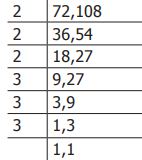
First let us find the LCM of 72 and 108 (by division method).
LCM of 72 and 108 = 2 \(\times\) 2 \(\times\) 2 \(\times\) 3 \(\times\) 3 \(\times\) 3 = 216
Now, all multiples of 216 will also be common multiples of 72 and 108.
The smallest 5 digit number = 10,000.
Now, 10,000 \(\div \) 216 gives quotient as 46 and remainder as 164.
Hence the next multiple of 216 i.e., 216 \(\times\) 47 = 10,152 is the required smallest 5 digit number that is exactly divisible by 72 and 108.
27.
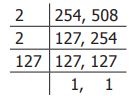
All common multiples of 254 and 508 will be divisible by both the numbers. Let us find the LCM of 254 and 508 (by division method).
LCM of 254, 508 = 2 \(\times\) 2 \(\times\) 127 = 508
Thus, 508 is the smallest common number that is divisible by 254 and 508. Now, as we need remainder 4 while dividing, the required number is 4 more than the LCM and so, the required number is 508 + 4 =512.
28.
Now, 18 = 2 \(\times\) 3 \(\times\) 3 and 30 = 2 \(\times\) 3 \(\times\) 5
and their HCF is 2 \(\times\) 3 = 6 and LCM is 2 \(\times\) 3 \(\times\) 3 \(\times\) 5 = 90
Hence, HCF : LCM = 6 : 90 = 1 : 15
29.
Get all the common factors of 62 − 2, 78 − 3 and 109 − 4, i.e., 60, 75 and 105 and see that the common factors will divide them all. The greatest number is the H.C.F of 60, 75 and 105.
60 = 2 \(\times\) 2 \(\times\) 3 \(\times\) 5 75 = 3 \(\times\) 5 \(\times\) 5 105 = 3 \(\times\) 5 \(\times\) 7
Hence, the HCF is 3 \(\times\) 5=15, which is the greatest number that will divide 62, 78, 109 leaving remainders 2, 3 and 4 respectively.
30.
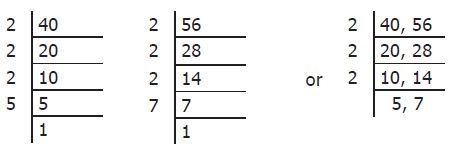
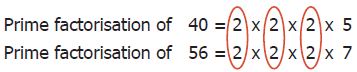
The product of common factors of 40 and 56
= 2 \(\times\) 2 \(\times\) 2 = 8 and so, HCF (40, 56) = 8
Dividing by the common factor 2, (in 3 steps)
HCF = Product of common factors
= 2 \(\times\) 2 \(\times\) 2 = 8
31.
Solution: By Division method
Step 1: Start with the smallest prime factor and go on dividing till all the numbers are divided as given below.
Step 2: LCM = product of all prime factors
= 2 \(\times\) 2 \(\times\) 3 \(\times\) 13 \(\times\) 31 = 4836
Thus, the LCM of 156 and 124 is 4836.
By Prime Factorisation method
Step 1: We write the prime factors of 156 and 124 as given below (use of divisibility test rules will also help).
156 = 2 \(\times\) 78 = 2 \(\times\) 2 \(\times\) 39 = 2 \(\times\) 2 \(\times\) 3 \(\times\) 13
124 = 2 \(\times\) 62 = 2 \(\times\) 2 \(\times\) 31
Step 2: The product of common factors is 2 \(\times\)2 and also the product of the factors that are not common is 3 \(\times\) 13 \(\times\) 31.
Step 3: Now, LCM = product of common factors x product of factors that are not common
= (2 \(\times\) 2) \(\times\) (3 \(\times\) 13 \(\times\) 31) = 4 \(\times\) 1209 = 4836
Thus, LCM of 156 and 124 is 4836.
(or)
156 = 2 \(\times\) 78 = 2 \(\times\) 2 \(\times\) 39 = 2 \(\times\) 2 \(\times\) 3 \(\times\) 13;
124 = 2 \(\times\) 62 = 2 \(\times\) 2 \(\times\) 31
The prime factor 2 appears a maximum of 2 times in the prime factorization of 156 and 124, the prime factor 3 appears only 1 time in the prime factorization of 156, the prime factor 13 appears only 1 time in the prime factorization of 156 and the prime factor 31 appears only 1 time in the prime factorization of 124.
Hence, the required LCM = (2 \(\times\) 2) \(\times\) 3 \(\times\) 13 \(\times\) 31 = 4836.
32.
Let us find the factors of 18, 24 and 30 (use of divisibility test rules will also help).
The factors of 18 are 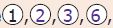 9 and 18.
The factors of 24 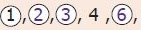 8, 12 and 24.
The factors of 30 are 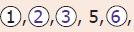 10, 15 and 30.
The factors that are common to all the three given numbers are 1, 2, 3 and 6 of which 6 is the highest.
Hence, HCF (18, 24, 30) = 6.
Note that 1 is a trivial factor of all numbers.
Let us find the factors of 24 by tree method.
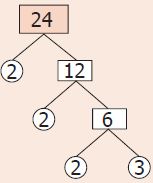
Here, 24 = 2 \(\times\) 2 \(\times\) 2 \(\times\) 3
Similarly, we can find the factors of 18 and 30.

6th Standard Syllabus & Materials
6th Standard
TN 6th Social Science T3 - GEO - Understanding Disaster Sample Question Papers Study Material - QB365 Set A
NEW6th Standard
TN 6th Social Science T3 - GEO - Globe Sample Question Papers Study Material - QB365 Set A
NEW6th Standard
TN 6th Social Science T3 - GEO - Asia and Europe Sample Question Papers Study Material - QB365 Set A
NEW6th Standard
TN 6th Social Science T3 - HIS - South Indian Kingdoms Sample Question Papers Study Material - QB365 Set A



Tamilnadu Stateboard 6th Standard Subjects
Tamilnadu Stateboard Standards




