
 100% FREE ACCESS
6th Standard Syllabus & Materials
6th Standard
TN 6th Tamil பருவம் 1 - இயல் 1 - மொழி -தமிழ்த்தேன் - இன்பத்தமிழ் Sample Question Papers Study Material - QB365 Set A
NEW6th Standard
TN 6th English T1 - Supplementary - The Apple Tree and The Farmer Sample Question Papers Study Material - QB365 Set A
NEW6th Standard
TN 6th English T1 - Prose - When The Trees Walked Sample Question Papers Study Material - QB365 Set A
NEW6th Standard
TN 6th Social Science T3 - CIV - Road Safety Sample Question Papers Study Material - QB365 Set A
NEW6th Standard
TN 6th Social Science T3 - CIV - Local Bodies - Rural and Urban Sample Question Papers Study Material - QB365 Set A
NEW6th Standard
TN 6th Social Science T3 - CIV - Democracy Sample Question Papers Study Material - QB365 Set A

Published on: 04/10/2019
Term 2 Numbers
Download Tamil Nadu 6th Standard Maths question papers, model tests, one-mark questions, important questions, and public exam papers in PDF format. Free study materials and answer keys for TN State Board students.
Questions + Answers key
Take MCQ Maths Test1.
The sum of any two successive odd numbers is always divisible by 4. Justify this statement with an example
2.
Wilson, Mathan and Guna can complete one round of a circular track in 10, 15 and 20 minutes respectively. If they start together at 7 a.m from the starting point, at what time will they meet together again at the starting point?
3.
The product of 2 two digit numbers is 300 and their HCF is 5. What are the numbers?
4.
Find A as required:
(i) The greatest 2 digit number 9A is divisible by 2.
(ii) The least number 567A is divisible by 3.
(iii) The greatest 3 digit number 9A6 is divisible by 6.
(iv) The number A08 is divisible by 4 and 9.
(v) The number 225A85 is divisible by 11.
5.
Find the smallest number that can be divided by 254 and 508 which leaves the remainder 4.
6.
A book seller has 175 English books, 245 Science books and 385 Mathematics books. He wants to sell the books in a box, subject-wise in equal numbers. What will be the greatest number of the boxes required? Also find the number of books for each subject in a box.
7.
Find the HCF of the numbers 40 and 56 by division method.
8.
There are four Mobile Phones in a house. At 5 a.m, all the four Mobile Phones will ring together. Thereafter, the first one rings every 15 minutes, the second one rings every 20 minutes, the third one rings every 25 minutes and the fourth one rings every 30 minutes. At what time, will the four Mobile Phones ring together again?
9.
Find the LCM of 156 and 124.
10.
Find the HCF of the numbers 18, 24 and 30 by factor tree method.
1.
Given statement
The sum of any two successive odd numbers is always divisible by 4.
Example:
Let any two successive odd numbers are
(i) 13, 15 (ii) 17, 19
(i) Sum = 13 + 15 = 28 is divisible by 4.
(ii) Sum = 17 + 19 = 36 is divisible by 4.
Therefore given statment is true.
2.
Given
Wilson, Mathan and Guna can complete 1 round of a circular track in 10,15 and 20 minutes respectively.
Starting point at 7 a.m.
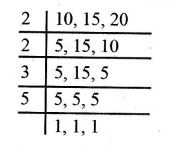
LCM = \(5 \times 2 \times 3 \times 2\) = 60 min = 1 hour = 1a.m.
⇒ 7a.m. + 1a.m. = 8a.m.
Therefore after 60 minutes at 8 a.m. will they meet together again at the starting point.
3.
Given
The product of 2 two digit numbers = 300, HCF = 5
300 = \(15 \times 20=60 \times 5=100 \times 3=2 \times 150=75 \times 4\)
But, given that, two digit numbers.
Therefore 60 \(\times\) 5, 100 \(\times\) 3, 2 \(\times\) 150, 75 \(\times\) 4 is not possible.
300 = 15 \(\times\) 20
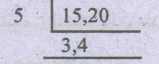
HCF = 5
Therefore numbers are 15, 20.
4.
i) The greatest 2 digit number 9A is divisible by 2.
Greatest two digit number = 99.
But, given 9A is divisible by 2,
So, two digit number = 98
Therefore A = 8
ii) The least number 567A is divisible by 3.
The least number = 5670
Sum of the digits = 5 + 6 + 7 + 0 = 18 is divisible by 3.
Therefore A = 0
iii) The greatest 3 digit number 9A6 is divisible by 6
The greatest 3 digit number = 999.
But, given 9A6 is divisible by 6.
Therefore 9A6 = 996.
Therefore A = 9
iv) The number A08 is divisible by 4 & 9
Given number = A08
A08 is divisible by 4 means 108.
A08 is divisible by 9 means 108.
Therefore 108 is divisible by both 4 & 9.
Therefore A = 1
v) The number 225A85 is divisible by H.
Given number = 225A85
Also given 225A85 is divisible by 11.
Difference between the sum of alternative digits = (2 + 5 + 8) - (2 + A + 5) = 15 - (2 + 8 + 5) = 15 - 15 = 0
Therefore 225A85 = 225885
Therefore A = 8
5.
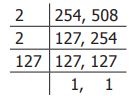
All common multiples of 254 and 508 will be divisible by both the numbers. Let us find the LCM of 254 and 508 (by division method).
LCM of 254, 508 = 2 \(\times\) 2 \(\times\) 127 = 508
Thus, 508 is the smallest common number that is divisible by 254 and 508. Now, as we need remainder 4 while dividing, the required number is 4 more than the LCM and so, the required number is 508 + 4 =512.
6.
This is a HCF related problem. So, we need to find the HCF of 175, 245 and 385.
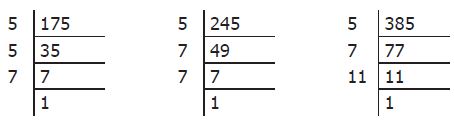
175 = 5 \(\times\) 5 \(\times\) 7; 245 = 5 \(\times\) 7 \(\times\) 7; 385 = 5 \(\times\) 7 \(\times\) 11
The HCF of 175, 245 and 385 is the product of the common factors 5 and 7 i.e, 5 \(\times\) 7=35
Since each box contains equal number of books, the greatest possible number of boxes = 35
The number of English books in each box = 175 \(\div \) 35 = 5
The number of Science books in each box = 245 \(\div \) 35 = 7
The number of Maths books in each box = 385 \(\div \) 35 = 11
Hence, the total number of books in each box is 5+7+11 = 23.
7.
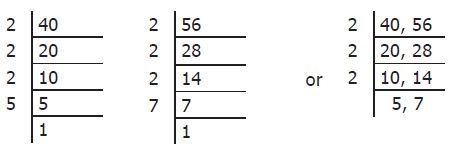
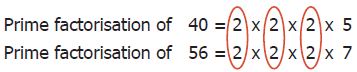
The product of common factors of 40 and 56
= 2 \(\times\) 2 \(\times\) 2 = 8 and so, HCF (40, 56) = 8
Dividing by the common factor 2, (in 3 steps)
HCF = Product of common factors
= 2 \(\times\) 2 \(\times\) 2 = 8
8.
This is a LCM related sum. So, we need to find the LCM of 15, 20, 25 and 30.
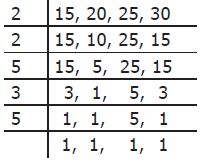
The LCM of 15, 20, 25 and 30 is 2 \(\times\) 2 \(\times\) 3 \(\times\) 5 \(\times\) 5
= 300 minutes = 5 \(\times\) 60 minutes = 5 \(\times\) 1 hour = 5 hours
Thus, the four Mobile Phones will ring together again at 10.00 a.m.
9.
Solution: By Division method
Step 1: Start with the smallest prime factor and go on dividing till all the numbers are divided as given below.
Step 2: LCM = product of all prime factors
= 2 \(\times\) 2 \(\times\) 3 \(\times\) 13 \(\times\) 31 = 4836
Thus, the LCM of 156 and 124 is 4836.
By Prime Factorisation method
Step 1: We write the prime factors of 156 and 124 as given below (use of divisibility test rules will also help).
156 = 2 \(\times\) 78 = 2 \(\times\) 2 \(\times\) 39 = 2 \(\times\) 2 \(\times\) 3 \(\times\) 13
124 = 2 \(\times\) 62 = 2 \(\times\) 2 \(\times\) 31
Step 2: The product of common factors is 2 \(\times\)2 and also the product of the factors that are not common is 3 \(\times\) 13 \(\times\) 31.
Step 3: Now, LCM = product of common factors x product of factors that are not common
= (2 \(\times\) 2) \(\times\) (3 \(\times\) 13 \(\times\) 31) = 4 \(\times\) 1209 = 4836
Thus, LCM of 156 and 124 is 4836.
(or)
156 = 2 \(\times\) 78 = 2 \(\times\) 2 \(\times\) 39 = 2 \(\times\) 2 \(\times\) 3 \(\times\) 13;
124 = 2 \(\times\) 62 = 2 \(\times\) 2 \(\times\) 31
The prime factor 2 appears a maximum of 2 times in the prime factorization of 156 and 124, the prime factor 3 appears only 1 time in the prime factorization of 156, the prime factor 13 appears only 1 time in the prime factorization of 156 and the prime factor 31 appears only 1 time in the prime factorization of 124.
Hence, the required LCM = (2 \(\times\) 2) \(\times\) 3 \(\times\) 13 \(\times\) 31 = 4836.
10.
Let us find the factors of 18, 24 and 30 (use of divisibility test rules will also help).
The factors of 18 are 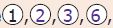 9 and 18.
The factors of 24 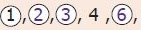 8, 12 and 24.
The factors of 30 are 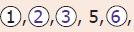 10, 15 and 30.
The factors that are common to all the three given numbers are 1, 2, 3 and 6 of which 6 is the highest.
Hence, HCF (18, 24, 30) = 6.
Note that 1 is a trivial factor of all numbers.
Let us find the factors of 24 by tree method.
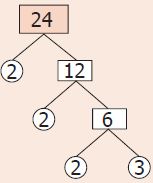
Here, 24 = 2 \(\times\) 2 \(\times\) 2 \(\times\) 3
Similarly, we can find the factors of 18 and 30.

6th Standard Syllabus & Materials
6th Standard
TN 6th Social Science T3 - GEO - Understanding Disaster Sample Question Papers Study Material - QB365 Set A
NEW6th Standard
TN 6th Social Science T3 - GEO - Globe Sample Question Papers Study Material - QB365 Set A
NEW6th Standard
TN 6th Social Science T3 - GEO - Asia and Europe Sample Question Papers Study Material - QB365 Set A
NEW6th Standard
TN 6th Social Science T3 - HIS - South Indian Kingdoms Sample Question Papers Study Material - QB365 Set A



Tamilnadu Stateboard 6th Standard Subjects
Tamilnadu Stateboard Standards




