
 100% FREE ACCESS
7th Standard Syllabus & Materials
7th Standard
TN 7th Tamil பருவம் -1 இயல் 1 - அமுதத்தமிழ் - ஒன்றல்ல இரண்டல்ல Important Questions And Answers Study Material - QB365 Set A
NEW7th Standard
TN 7th Tamil பருவம் -1 இயல் 1 - அமுதத்தமிழ் - எங்கள் தமிழ் Important Questions And Answers Study Material - QB365 Set A
NEW7th Standard
TN 7th English T1 - Poem - Your Space Important Questions And Answers Study Material - QB365 Set A
NEW7th Standard
TN 7th English T1 - Prose - A Prayer to the Teacher Important Questions And Answers Study Material - QB365 Set A
NEW7th Standard
TN 7th English T1 - Poem - The Listeners Important Questions And Answers Study Material - QB365 Set A
NEW7th Standard
TN 7th English T1 - Prose - The Wind on Haunted Hill Important Questions And Answers Study Material - QB365 Set A

Published on: 30/07/2019
Reproduction and Modification in Plants
Download Tamil Nadu 7th Standard Science question papers, model tests, one-mark questions, important questions, and public exam papers in PDF format. Free study materials and answer keys for TN State Board students.
Questions + Answers key
Take MCQ Science Test1.
Stilt Roots are seen in _______
Vanda
Sugar cane
Banyan
Carrot
2.
_________ is a parasite.
Cuscuta
Hibiscus
yeast
Spirogyra
3.
Breathing Roots are seen in ________
Tarpa
Avicennia
Eicchornia
pisum
4.
Climbing roots are seen in ______.
Betel
Black pepper
Both of them
None of them
5.
Asexual reproduction in yeast is _________.
Spore formation
Fragmentation
Pollination
Budding
6.
Vegetative propagation by leaves takes place in _________.
Bryophyllum
Fungi
Virus
Bacteria
7.
What is fertilization.
8.
What are thorns?
9.
Define – pollination.
10.
Write two types of reproduction in plants.
11.
In Gloriosa __________ is modified into a tendilleaf tip.
12.
The tissue seen in epiphytic roots is called ___________
13.
Onion and Garlic are example of _______.
14.
After fertilization the ovule becomes _________.
15.
The male reproductive part of a flower is ________.
16.
Leaves of Aloe vera are fleshy and store water.
17.
Ginger is an underground root.
18.
The transfer of pollen to the stigma is known as pollination.
19.
A complete flower has four whorls.
20.
Eicchomia
21.
Vanda
22.
Sucker
23.
Phylloclade
24.
Petal
25.
Differentiate self pollination and cross pollination (OR) Write the differences between self and cross pollination.
26.
Write notes on phyllode.
27.
Differentiate bisexual flower from unisexual flower?
28.
Identify the four plants shown in the following table. Name the different modifications in each of them.
| Name | Modification |
| Garlic | |
| Turnip | |
| Rose plant | |
| Maize |
29.
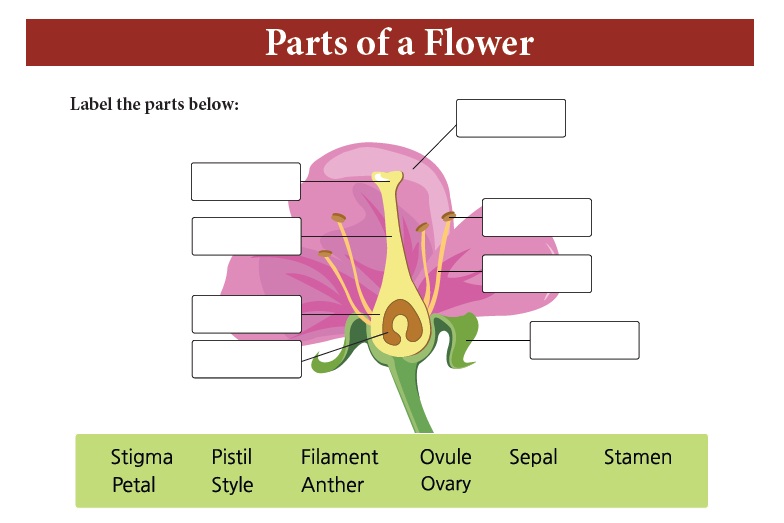
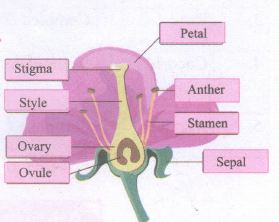
Label the picture given below. Parts of a Flower
30.
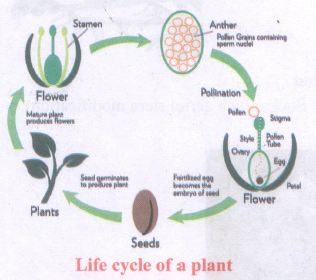
Draw a diagram to show the life cycle of a plant. (OR) Draw the life cycle of plant.
31.
Haustoria, Velamen, Prop Roots, Phylloda.
32.
Pollen, anther, ovule, filament
1.
(b)
Sugar cane
2.
(a)
Cuscuta
3.
(b)
Avicennia
4.
(c)
Both of them
5.
(d)
Budding
6.
(a)
Bryophyllum
7.
Male gamete fuses with the female gamete to form zygote. This process is known as fertilization.
8.
Leaves on the stem are modified into spine in green succulent plant is called as thorns.
9.
The process by which pollen grains reach stigma is called as pollination.
10.
Two types of reproduction are,
i) Sexual reproduction.
ii) Asexual reproduction.
11.
()
leaf tip
12.
()
Velamen
13.
()
Bulb
14.
()
seed
15.
()
Androecium
16.
True
17.
False
Correct Statement : Ginger is underground stem.
18.
True
19.
True
20.
offset
21.
epiphyte
22.
Chrysanthemum
23.
Opuntia
24.
Attracts insect
25.
| S.No | Self pollination | Cross Pollination |
| 1. | Pollen grains are transferred from the anther to the stigma of the same flower or to another flower of the same plant | Pollen grains are transferred from the anther of one flower to the stigma of another flower of the same kind or different plant. |
| 2. | Plants do not need to produce pollen grains in a large quantity. for self pollination | Plants need to produce pollen grains in larger quantities to increase the chance of pollination |
| 3. | It does not produce changes in the characteristics of new plants | Cross pollination does introduce variationsin characteristics of new plants. |
26.
In Acacia auriculiformis, petioles expand to form leaf like structure. They carry out the function of leaf (Photosynthesis). This modification is known as phyllode.
27.
| Bisexual flower | Unisexual flower |
| A flower have both androecium and gynoecium is known as bisexual flowers. | A flower with androecium or gynoecium and without either androecium or gynoecium is known as unisexual flowers. |
28.
| S.No | Name | Modification |
| 1. | Garlic | Stem (Bulb) |
| 2. | Turnip | Root (Top shaped root) |
| 3. | Rose plant | Leaf (Tendrils) and Stem (spine) |
| 4. | Maize | Root (Stilt root) |
29.
30.
31.
Phylloda
Reason: It is a leaf modification whereas others are root modifications
32.
Ovule
Reason: It is a part of Gynoecium whereas others are parts of Androecium.

7th Standard Syllabus & Materials
7th Standard
TN 7th English T1 - Supplementary - On Monday Morning Important Questions And Answers Study Material - QB365 Set A
NEW7th Standard
TN 7th English T1 - Prose - Eidgah Important Questions And Answers Study Material - QB365 Set A
NEW7th Standard
TN 7th Social Science T1 - ECO - Production Important Questions And Answers Study Material - QB365 Set A
NEW7th Standard
TN 7th Social Science T1 - GEO - Interior of the Earth Important Questions And Answers Study Material - QB365 Set A



Tamilnadu Stateboard 7th Standard Subjects
Tamilnadu Stateboard Standards




