
 100% FREE ACCESS
6th Standard Syllabus & Materials
6th Standard
TN 6th Tamil பருவம் 1 - இயல் 1 - மொழி -தமிழ்த்தேன் - இன்பத்தமிழ் Sample Question Papers Study Material - QB365 Set A
NEW6th Standard
TN 6th English T1 - Supplementary - The Apple Tree and The Farmer Sample Question Papers Study Material - QB365 Set A
NEW6th Standard
TN 6th English T1 - Prose - When The Trees Walked Sample Question Papers Study Material - QB365 Set A
NEW6th Standard
TN 6th Social Science T3 - CIV - Road Safety Sample Question Papers Study Material - QB365 Set A
NEW6th Standard
TN 6th Social Science T3 - CIV - Local Bodies - Rural and Urban Sample Question Papers Study Material - QB365 Set A
NEW6th Standard
TN 6th Social Science T3 - CIV - Democracy Sample Question Papers Study Material - QB365 Set A

Published on: 17/01/2019
6th Std Term 3 Fractions Full Study Material
Download Tamil Nadu 6th Standard Maths question papers, model tests, one-mark questions, important questions, and public exam papers in PDF format. Free study materials and answer keys for TN State Board students.
Questions + Answers key
Take MCQ Maths Test1.
By what number should \(3{1\over16}\)be multiplied to get \(9{3\over16}\) ?
2.
What fraction is to be subtracted from 9 \(\frac{3}{7}\)to get 3 \(\frac{1}{5}\)?
3.
Add the difference between \(1{1\over3}\) and \(3{1\over6}\) and the difference between \(4{1\over6}\ and\ 2{1\over3}\)
4.
Nilavan can walk \(4{1\over2}\)km in an hour. How much distance will he cover in \(3{1\over2}\)hours?
5.
Gowri purchased \(3{1\over2}\)kg of tomatoes, \(3\over4\)kg of brinjal and \(1{1\over4}\)kg of onion. What is the total weight of the vegetables she bought?
6.
A rod of length 6m is cut into small rods of length \(1{1\over2}\) each. How many small rods can be cut?
7.
An oil tin contains \(7{1\over2}\) litres of oil which is poured in \(2{1\over2}\) litres bottles How many bottles are required to fill \(7{1\over2}\) litres of oil?
8.
Simplify: \(9{1\over4}-3{5\over6}\)
9.
In the above situation, find the quantity of milk left over. So subtract \(3{1\over4}\)from \(5{1\over2}\)
10.
Convert \(5{3\over7}\)into an improper fraction.
11.
Simplify: \({3\over4}-{1\over2}\)
12.
Add \(2\over3\)and\(3\over5\)
13.
Arrange \({2\over 3},{1\over 6},{4\over 9}\) in ascending order
14.
Vinotha, Mugilarasi, Senthamizh were participating in the water filling competition. Each one was given a bottle of equal volume to fill water in it within 30 seconds. If Vinotha filled \(1\over 2\) portion of her bottle, Senthamizh filled \(3\over 4\) portion of her bottle and Mugilarasi filled \(1\over4\) portion of her bottle, then who would get the first, second and third prize?
15.
Find three equivalent fractions of \(3\over 4\) and \(2 \over 7\)
16.
The number which has its own reciprocal is ________
17.
\(8\div{1\over2}=\)_____
18.
\(5{1\over3}-3{1\over2}=\)_______
19.
The sum of a whole number and a proper fraction is called ______
20.
\(7{3\over4}+6{1\over2}=\)_________
21.
\(3{1\over4}\times3{1\over 3}=9{1\over16}\)
22.
The reciprocal of an improper fraction is always a proper fraction
23.
The mixed fraction of \(13\over4\)is \(3{1\over4}\)
24.
The sum of any two proper fractions is always an improper fraction
25.
\(3{1\over2}\)can be written as \(3+{1\over2}\)
26.
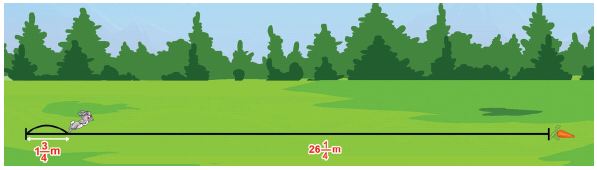
A rabbit has to cover \(26{1\over4}\)m to fetch its food. If it covers \(1{3\over4}\)m in one jump, then how many jumps will it take to fetch its food?
27.
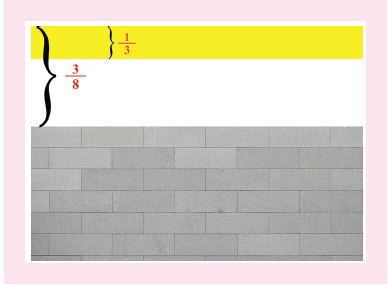
A painter painted \(3\over8\) of the wall of which one third is painted in yellow colour. What fraction is the yellow colour of the entire wall?
28.
Divide the following :
\(i) \ {3\over7}\div4\)
\(ii)\ {4\over3}\div{5\over9}\)
\(iii)\ 4{1\over5}\div3{3\over 4}\)
\(iv)\ 9{2\over3}\div1{2\over3}\)
29.
Multiply the following:
\(i)\ {2\over3}\times6\)
\(ii)\ 8{1\over3}\times5\)
\(iii)\ {3\over8}\times{4\over5}\)
\(iv)\ {3{5\over7}}\times1{1\over13}\)
30.
Convert mixed fractions into improper fractions and vice versa:
\(i)\ 3{7\over 18}\)
\(ii)\ {99\over7}\)
\(iii)\ {47\over6}\)
\(iv)\ 12{1\over9}\)
31.
Answer the following:
i) Find the sum of \(1\over7\)and \(3\over9\).
ii) What is the total of \(3{1\over3}\)and \(4{1\over6}\) ?
iii) Simplify: \(1{3\over5}+5{4\over7}\)
iv) Find the difference between \(8\over 9\)and \(2\over7\)
v) Subtract \(1{3\over 5}\)from \(2{1\over3}\)
vi) Simplify : \(7{2\over7}-3{4\over 21}\)
32.
Pugazh has been given four choices for his pocket money by his father. Which of the choices should he take in order to get the maximum money?
\(\frac{2}{3}\) of Rs. 150
\(\frac{3}{5}\) of Rs. 150
\(\frac{1}{5}\) of Rs. 150
\(\frac{4}{5}\) of Rs. 150
33.
If \({6\over7}={A\over49}\)then the value of A is
42
36
25
48
34.
The reciprocal of \(53\over17\) is
\(\frac{53}{17}\)
\(5 \frac{3}{17}\)
\(\frac{17}{53}\)
\(3 \frac{5}{17}\)
35.
The difference between \(3\over7\) and \(2\over9\) is
\(\frac{13}{63} \)
\(\frac{1}{9}\)
\(\frac{1}{7} \)
\(\frac{9}{16}\)
36.
Which of the following statement is incorrect?
\({1\over2}>{1\over3}\)
\({7\over8}>{6\over7}\)
\({8\over9}>{9\over10}\)
\({10\over11}>{9\over10}\)
37.
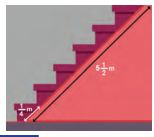
The length of the staircase is 5 \(\frac{1}{2}\) m If one step is set at \(\frac{1}{4}\) m then how many steps will be there in the staircase?
38.
Mangai bought \(6{3\over4}\) kg of apples. If Kalai bought \(1{1\over2}\) times as Mangai bought, then how many kilograms of apples did Kalai buy?
39.
Which is smaller? The difference between \(2{1\over2}\ and\ 3{2\over3}\) or the sum of \(1{1\over2}\ and\ 2{1\over4}\)
40.
From his office, a person wants to reach his house on foot which is at a distance of \(5{3\over4}\)km. If he had walked \(2{1\over 2}km\) how much distance still he has to walk to reach his house?
41.
Sankari purchased \(2{1\over2}\) m cloth to stich a long skirt and \(1{3\over 4}m\) cloth to stitch blouse. If the cost is Rs.120 per metre then find the cost of cloth purchased by her
1.
Let the number be 'x'
\(X\times 3\cfrac { 1 }{ 16 } =9\cfrac { 3 }{ 16 } \)
\(X\times \cfrac { 49 }{ 16 } =\cfrac { 147 }{ 16 } \)
\(X=\cfrac { 147 }{ 16 } \times \cfrac { 16 }{ 49 } \)
x = 3
\(\therefore\) Number = 3
2.
Let the fractions be 'x'
\(9\cfrac { 3 }{ 7 } -X=3\cfrac { 1 }{ 5 } \)
\(\cfrac { 66 }{ 7 } -X=\cfrac { 16 }{ 5 } \)
-X = \(\cfrac { 16 }{ 5 } -\cfrac { 66 }{ 7 } \)
-X = \(\cfrac { \left( 16\times 7 \right) -\left( 66\times 5 \right) }{ 35 } \)
-X = \(\cfrac { 112-330 }{ 35 } \)
-X = \(\cfrac { -218 }{ 35 } \)
X = \(6\cfrac { 8 }{ 35 } \)
\(\therefore 6\cfrac { 8 }{ 35 } \) is to be subtracted from \(9\cfrac { 3 }{ 7 } \)
3.
Difference between \(1\cfrac { 1 }{ 3 } \) and \(3\cfrac { 1 }{ 6 } \)
= \(3\cfrac { 1 }{ 6 } -1\cfrac { 1 }{ 3 } \)
= \(\cfrac { 19 }{ 6 } -\cfrac { 4 }{ 3 } \)
LCM of 6 and 3 is 6
= \(\cfrac { 19 }{ 6 } -\cfrac { 4\times 2 }{ 3\times 2 } =\cfrac { 19 }{ 6 } -\cfrac { 8 }{ 6 } =\cfrac { 19-8 }{ 6 } \)
= \(\cfrac { 11 }{ 6 } \)
Also given:
Difference between \(4\cfrac { 1 }{ 6 }\ and\ 2\cfrac { 1 }{ 3 } \)
= \(4\cfrac { 1 }{ 6 } -2\cfrac { 1 }{ 3 } \)
= \(\cfrac { 25 }{ 7 } -\cfrac { 7 }{ 3 } \)
LCM of 6 and 3 is 6
= \(\cfrac { 25 }{ 6 } -\cfrac { 7\times 2 }{ 3\times 2 } =\cfrac { 25 }{ 6 } -\cfrac { 14 }{ 6 } =\cfrac { 25-14 }{ 6 } \)
= \(\cfrac { 11 }{ 6 } \)
Adding (1) and (2), we get
= \(\cfrac { 11 }{ 6 } +\cfrac { 11 }{ 6 } =\cfrac { 11+11 }{ 6 } =\cfrac { 22 }{ 6 } \)
= \(\cfrac { 11 }{ 3 } =3\cfrac { 2 }{ 3 } \)
4.
Nilavan can walk in an hour = \(4\cfrac { 1 }{ 2 } km\)
= \(\cfrac { 9 }{ 2 } km\)
\(\therefore 3\cfrac { 1 }{ 2 } hours\ =\cfrac { 9 }{ 2 } \times 3\cfrac { 1 }{ 2 } \)
= \(\cfrac { 9 }{ 2 } \times \cfrac { 7 }{ 2 } =\cfrac { 9\times 7 }{ 2\times 2 } =\cfrac { 63 }{ 4 } \)
= \(15\cfrac { 3 }{ 4 } \)
\(\therefore 15\cfrac { 3 }{ 4 } \) km distance will he cover in \(3\cfrac { 1 }{ 2 } \)
5.
Gowri purchased the weight of
vegetables Tomatoes = \(3\cfrac { 1 }{ 2 } kg=\cfrac { 7 }{ 2 } kg\)
Brinjal = \(\cfrac { 3 }{ 4 } \) kg
Onion = \(1\cfrac { 1 }{ 4 } kg=\cfrac { 5 }{ 4 } kg\)
\(\therefore\) Total weight of the Vegetables = \(\left[ \cfrac { 7 }{ 2 } +\cfrac { 3 }{ 4 } +\cfrac { 5 }{ 4 } \right] kg\)
LCM of 2, 4 is 4
= \(\cfrac { \left( 7\times 2 \right) +3+5 }{ 4 } =\cfrac { 14+3+5 }{ 4 } =\cfrac { 22 }{ 4 } =\cfrac { 11 }{ 2 } \)
\(\therefore\) Total weight = \(5\cfrac { 1 }{ 2 } kg\)
6.
The number of small rods \(={6\div}1{1\over2}\)
\(={6\div}{3\over2}\)
\(=6\times{2\over3}\) (reciprocal of \(\frac{3}{2} \text { is } \frac{2}{3}\))
= 4 rods
7.
The number of bottles required = \({15\over 2}\div{5\over2}={15\over2}\times{2\over5}\) (reciprocal of \(\frac{5}{2} \text { is } \frac{2}{5}\) )
= 3 bottles
8.
Here 9 > 3 and \({11\over 4}<{5\over6}\)So we proceed as follows:
We convert the mixed fraction into improper fraction and then subtract
\(9{1\over4}={(9\times4)+1\over4}={37\over 4}\)
and \(3{5\over6}={(3\times4)+5\over 6}={23\over6}\)
Common multiple of 4 and 6 is 12
Now, \({37\over 4}-{23\over 6}={37\times3\over12}-{23\times2\over12}\)
\(={111\over12}-{46\over 12}={65\over 12}=5{5\over12}\)
9.
The quantity of milk left over = \(5{1\over2}-3{1\over4}\)
Here, note that 5 > 3 and \({1\over2}>{1\over4}\)
The whole numbers 5 and 3 and the fractional numbers \(1\over2\) and \(1\over4\)can be subtracted separately
So, \(5{1\over2}-3{1\over4}=(5-3)+\left({1\over 2}-{1\over4}\right)\)
\(=2+\left({2\over 4}-{1\over4}\right)\)
\(=2+{1\over4}={1\over4}\)litres
10.
\(Improper\ fraction={(Whole\ number\times Denominator)+Numerator\over Denominator}\)
\(5{3\over7}={(5\times7)+3\over 7}\)
\(={35+3\over7}={38\over7}\)
11.
Common multiple of 2 and 4 is 4
Equivalent fraction of \(1\over2\) is
\({1\over2}={1\times2\over 2\times2}={2\over4}\)
Now
\({3\over 4}-{1\over2}={3\over4}-{2\over4}={3-2\over4}={1\over 4}\)
Therefore, Vani has \(1\over4\) amount of water in the bottle. This can be verified by the following diagram

12.
These are unlike fractions, aren’t they ? So first we need to convert them into like fractions ? Is it possible ? Yes, always. How do we do so ? The common multiple of 3 and 5 is 15. Hence, we find the equivalent fractions of \(2\over 3\)and \(3\over5\) with denominator 15.
\({2\over3}={2\times5\over 3\times5}={10\over 15}\)
\({3\over5}={3\times3\over 5\times3}={9\over 15}\)
\({2\over 3}+{3\over5}={10\over 15}+{9\over 15}={19\over 15}\)
13.
Equivalent fractions of \(2\over 3\)are \({4\over 6},{6\over 9},{8\over 12},{10\over 15},{12\over 18},.....\)
Equivalent fractions of \(1\over 6\) are \({2\over12},{3\over 18}\) ,...
Equivalent fractions of \(4\over9\) is \({8\over18},....\)
Therefore \({3\over 18}<{8\over18}<{12\over 18}\)
The ascending order of given fractions is \({1\over 6},{4\over 9},{2\over3}\)
14.
The equivalent fractions need to be written until the denominator becomes 4 which is the LCM of 2 and 4.
Equivalent fraction of \(1\over 2\) is \(2\over4\)
| Vinotha's portion | Mugilarasi's portion | Senthamizh's portion |
|---|---|---|
| \({1\over 2}={2\over 4}\) | \(1\over 4\) | \(3\over 4\) |
Here \({1\over4}<{2\over 4}<{3\over 4}\) Therefore, Senthamizh would get the first prize, Vinotha would get the second prize and Mugilarasi would get the third prize.
15.
Equivalent Fraction of \(3\over 4\)
\({3\over 4}={3\times2\over 4\times 2}={6\over 8}\)
\({3\over 4}={3\times3\over 4\times 3}={9\over 12}\)
\({3\over 4}={3\times4\over 4\times 4}={12\over 16}\)
Equivalent Fraction of \(2 \over 7\)
\({2 \over 7}={2\times2\over 7\times2}={4\over 14}\)
\({2 \over 7}={2\times3\over 7\times3}={6\over 21}\)
\({2 \over 7}={2\times4\over 7\times4}={8\over 28}\)
Equivalent fractions of \({3\over4}:{3\over 4}={6\over 8}={9\over 12}={12\over 16}\)
Equivalent fractions of \({2\over7}:{3\over 7}={4\over 14}={6\over 21}={8\over 28}\)
16.
()
1
17.
()
16
18.
()
\(1{5\over6}\)
19.
()
Mixed Fraction
20.
()
\(14{1\over4}\)
21.
(b)
22.
(a)
23.
(a)
24.
(b)
25.
(a)
26.
Total distance = \(26\frac { 1 }{ 4 } \) m
= \(\cfrac { 105 }{ 4 } \)
A rabbit covers in 1 jump = \(1\frac { 3 }{ 4 } \)
= \(\cfrac { 7 }{ 4 } \)m
\(\cfrac { 7 }{ 4 } \) m = 1 jump
\(\cfrac { 105 }{ 4 } m=\cfrac { 7 }{ 7/4 } \times \cfrac { 105 }{ 4 } \)
= \(\cfrac { 4 }{ 7 } \times \cfrac { 105 }{ 4 } =15\)
27.
Given:
A painter painted = \(\cfrac { 3 }{ 8 } \) of the wall
Yellow colour painted = \(\cfrac { 1 }{ 3 } \times \cfrac { 3 }{ 8 } =\cfrac { 1 }{ 8 } \)
\(\therefore \cfrac { 1 }{ 8 } \) is the yellow colour of the entire wall
28.
(i) \(\cfrac { 3 }{ 7 } \div 4\)
= \(\cfrac { 3 }{ 7 } \times \cfrac { 1 }{ 4 } =\cfrac { 3\times 1 }{ 7\times 4 } =\cfrac { 3 }{ 28 } \)
(ii) \(\cfrac { 4 }{ 3 } \div \cfrac { 5 }{ 9 } \)
= \(\cfrac { 4 }{ 3 } \times \cfrac { 9 }{ 5 } \)
= \(\cfrac { 4\times 3 }{ 5 } =\cfrac { 12 }{ 5 } =2\cfrac { 2 }{ 5 } \)
(iii) \(4\cfrac { 1 }{ 5 } \div 3\cfrac { 3 }{ 4 } \)
= \(\cfrac { 21 }{ 5 } \div \cfrac { 15 }{ 4 } \)
= \(\cfrac { 21 }{ 5 } \times \cfrac { 4 }{ 15 } =\cfrac { 7\times 4 }{ 5\times 5 } =\cfrac { 28 }{ 25 } =1\cfrac { 3 }{ 25 } \)
(iv) \(9\cfrac { 2 }{ 3 } \div 1\cfrac { 2 }{ 3 } \)
= \(\cfrac { 29 }{ 3 } \div \cfrac { 5 }{ 3 } \)
= \(\cfrac { 29 }{ 3 } \times \cfrac { 3 }{ 5 } =\cfrac { 29 }{ 5 } 5\cfrac { 4 }{ 5 } \)
29.
(i) \(\cfrac { 2 }{ 3 } \times 6=2\times =4\)
(ii) \(8\cfrac { 1 }{ 3 } \times 5\)
= \(\cfrac { 25 }{ 3 } \times 5=\cfrac { 25\times 5 }{ 3 } =\cfrac { 125 }{ 3 } =41\cfrac { 2 }{ 3 } \)
(iii) \(\cfrac { 3 }{ 8 } \times \cfrac { 4 }{ 5 } \)
= \(\cfrac { 3 }{ 8 } \times \cfrac { 4 }{ 5 } =\cfrac { 3\times 1 }{ 2\times 5 } =\cfrac { 3 }{ 10 } \)
(iv) \(3\cfrac { 5 }{ 7 } \times 1\cfrac { 1 }{ 13 } \)
= \(\cfrac { 26 }{ 7 } \times \cfrac { 14 }{ 13 } \)
= 2 \(\times\) 2 = 14
30.
(i) \(3\cfrac { 7 }{ 8 } \)
Improper fraction = \(\cfrac { \left( 3\times 18 \right) +7 }{ 18 } \)
= \(\cfrac { 54+7 }{ 18 } =\cfrac { 61 }{ 18 } \)
(ii) \(\cfrac { 99 }{ 7 } \)
\(Mixed\ fraction=Qutient+\frac { Remainder }{ Divisor } \)
= \(14+\cfrac { 1 }{ 7 } \)
= \(14\cfrac { 1 }{ 7 } \)
(iii) \(\cfrac { 47 }{ 6 } \)
Mixed fraction = \(7\cfrac { 5 }{ 6 } \)
(iv) \(12\cfrac { 1 }{ 9 } \)
Mixed fraction = \(\cfrac { \left( 12\times 9 \right) +1 }{ 9 } \)
= \(\cfrac { 108+1 }{ 9 } =\cfrac { 109 }{ 9 }\)
31.
(i) \(\cfrac { 1 }{ 7 }\ and\ \cfrac { 3 }{ 9 } \)
To find: \(\cfrac { 1 }{ 7 } +\cfrac { 3 }{ 9 } \)
LCM of 7 and 9 is 63
\(\Rightarrow \cfrac { 1 }{ 7 } \times \cfrac { 9 }{ 9 } +\cfrac { 3 }{ 9 } \times \cfrac { 7 }{ 7 } \)
= \(\cfrac { 9 }{ 63 } +\cfrac { 21 }{ 63 } =\cfrac { 9+21 }{ 63 } =\cfrac { 30 }{ 63 } =\cfrac { 10 }{ 21 } \)
(ii) \(3\cfrac { 1 }{ 3 } \ and\ 4\cfrac { 1 }{ 6 } \)
To find : \(3\cfrac { 1 }{ 3 } +4\cfrac { 1 }{ 6 } \)
= \(\cfrac { 10 }{ 3 } +\cfrac { 25 }{ 6 } \)
LCM of 3 and 6 is 6
= \(\cfrac { 10\times 2 }{ 3\times 2 } +\cfrac { 25 }{ 6 } \)
= \(\cfrac { 20 }{ 6 } +\cfrac { 25 }{ 6 } =\cfrac { 20+25 }{ 6 } =\cfrac { 45 }{ 6 } =\cfrac { 15 }{ 2 } =7\cfrac { 1 }{ 2 } \)
(iii) \(\cfrac { 8 }{ 5 } +\cfrac { 39 }{ 7 } \)
LCM of 5 and 7 is 35
= \(\cfrac { 8\times 7 }{ 5\times 7 } +\cfrac { 39\times 5 }{ 7\times 5 } \)
= \(\cfrac { 56 }{ 35 } +\cfrac { 195 }{ 35 } =\cfrac { 56+195 }{ 35 } =\cfrac { 251 }{ 35 } \)
= \(7\cfrac { 6 }{ 35 } \)
(iv) \(\cfrac { 8 }{ 9 } and\cfrac { 2 }{ 7 } \)
To find \(\cfrac { 8 }{ 9 } -\cfrac { 2 }{ 7 } \)
LCM 9 and 7 is 63
= \(\cfrac { 8\times 7 }{ 9\times 7 } -\cfrac { 2\times 9 }{ 7\times 9 } \)
= \(\cfrac { 56 }{ 63 } -\cfrac { 18 }{ 63 } =\cfrac { 56-18 }{ 63 } =\cfrac { 38 }{ 63 } \)
(v) \(1\cfrac { 3 }{ 5 } ,2\cfrac { 1 }{ 3 } \)
To find \(2\cfrac { 1 }{ 3 } -1\cfrac { 3 }{ 5 } \)
\(\Rightarrow \cfrac { 7 }{ 3 } -\cfrac { 8 }{ 5 } \)
LCM 3 and 5 is 15
= \(\cfrac { 7\times 5 }{ 3\times 5 } -\cfrac { 8\times 3 }{ 5\times 3 } \)
= \(\cfrac { 35 }{ 15 } -\cfrac { 24 }{ 15 } =\cfrac { 35-24 }{ 15 } =\cfrac { 11 }{ 15 } \)
(vi) \(7\cfrac { 2 }{ 7 } -3\cfrac { 4 }{ 21 } \)
\(\cfrac { 51 }{ 7 } -\cfrac { 67 }{ 21 } \)
LCM of 7 and 21 is 21
\(\Rightarrow \cfrac { 51\times 3 }{ 7\times 3 } -\cfrac { 67 }{ 21 } \)
= \(\cfrac { 153 }{ 21 } -\cfrac { 67 }{ 21 } =\cfrac { 153-27 }{ 21 } \)
= \(\cfrac { 86 }{ 21 } =4\cfrac { 2 }{ 21 } \)
32.
(d)
\(\frac{4}{5}\) of Rs. 150
33.
(a)
42
34.
(c)
\(\frac{17}{53}\)
35.
(a)
\(\frac{13}{63} \)
36.
(d)
\({10\over11}>{9\over10}\)
37.
Length of the staircase = \(5\cfrac { 1 }{ 2 } \) m
To one step = \(\cfrac { 1 }{ 4 } \) m
No. of the steps will be there = \(\cfrac { 5\frac { 1 }{ 2 } }{ \frac { 1 }{ 4 } } \)
= \(\cfrac { \frac { 11 }{ 2 } }{ \frac { 1 }{ 4 } } \Rightarrow \cfrac { 11 }{ 2 } \times \cfrac { 4 }{ 1 } =22\)
22 steps will be there in the staircase.
38.
Mangai bought = \(6\cfrac { 3 }{ 4 } kg\) of apple
Kalai bought = \(1\cfrac { 1 }{ 2 } \) times as Mangai bought
= \(\left[ 1\cfrac { 1 }{ 2 } \times 6\cfrac { 3 }{ 4 } \right] kg\) of apples
= \(\cfrac { 3 }{ 2 } \times \cfrac { 27 }{ 4 } \)
= \(\cfrac { 81 }{ 8 } \)
\(\therefore \) Kalai bought = \(10\cfrac { 1 }{ 8 } \) kg of apples.
39.
Difference between \(2\cfrac { 1 }{ 2 }\ and\ 3\cfrac { 1 }{ 2 } \)
Difference = \(3\cfrac { 2 }{ 3 } -2\cfrac { 1 }{ 2 } \)
= \(\cfrac { 11 }{ 3 } -\cfrac { 5 }{ 2 } \)
= \(\cfrac { \left( 11\times 2 \right) -\left( 5\times 3 \right) }{ 6 } =\cfrac { 22-15 }{ 6 } \)
= \(\cfrac { 7 }{ 6 } \) ...(1)
Also given
Sum of \(1\cfrac { 1 }{ 2 }\ and\ 2\cfrac { 1 }{ 4 } \)
Sum =\(1\cfrac { 1 }{ 2 } +2\cfrac { 1 }{ 4 } \)
= \(\cfrac { 3 }{ 2 } +\cfrac { 9 }{ 4 } \)
= \(\cfrac { \left( 3\times 2 \right) +9 }{ 4 } =\cfrac { 6+9 }{ 4 } =\cfrac { 15 }{ 4 } \)
From (1) and (2),
Difference = \(\cfrac { 7 }{ 6 } \), Sum = \(\cfrac { 15 }{ 4 } \)
\(\cfrac { 7 }{ 6 } ,\cfrac { 15 }{ 4 } \)
\(\Rightarrow\) Lcm of 6 and 4 is 12
\(\cfrac { 7 }{ 6 } \times \cfrac { 2 }{ 2 } =\cfrac { 14 }{ 12 } ,\cfrac { 15 }{ 4 } \times \cfrac { 3 }{ 3 } =\cfrac { 45 }{ 12 } \)
\(\cfrac { 14 }{ 12 } <\cfrac { 45 }{ 12 } \Rightarrow \cfrac { 7 }{ 6 } <\cfrac { 15 }{ 4 } \)
\(\therefore \) The difference between \(2\cfrac { 1 }{ 2 }\ and\ 3\cfrac { 2 }{ 3 } \)
40.
Total distance = \(5\cfrac { 3 }{ 4 } km=\cfrac { 23 }{ 4 } km\)
He had walked = \(2\cfrac { 1 }{ 2 } km=\cfrac { 5 }{ 2 } km\)
Difference = \(\left( \cfrac { 23 }{ 4 } -\cfrac { 5 }{ 2 } \right) km\)
= \(\cfrac { 23-\left( 5\times 2 \right) }{ 4 } =\cfrac { 23-10 }{ 4 } =\cfrac { 13 }{ 4 } km\)
\(\therefore 3\cfrac { 1 }{ 4 } km\) distance still he has to walk to reach his house
41.
Sankari purchased
To stitch a long skirt = \(2\cfrac { 1 }{ 2 } \ m\ cloth=\cfrac { 5 }{ 2 } m\)
To Stitch blouse = \(1\cfrac { 3 }{ 4 } m=\cfrac { 7 }{ 4 } m\)
Total length of clothe = \(\cfrac { 5 }{ 2 } m+\cfrac { 7 }{ 4 } m|\)
= \(\cfrac { (5\times 2)+7 }{ 4 } =\cfrac { 10+7 }{ 4 } \)
= \(\cfrac { 17 }{ 4 } m\)
Cost of 1 m cloth = Rs. 120
\(\therefore \cfrac { 17 }{ 4 } m\ cloth=120\times \cfrac { 17 }{ 4 } \)
= Rs. 510
Cost of cloth purchased by Sankari = Rs. 510

6th Standard Syllabus & Materials
6th Standard
TN 6th Social Science T3 - GEO - Understanding Disaster Sample Question Papers Study Material - QB365 Set A
NEW6th Standard
TN 6th Social Science T3 - GEO - Globe Sample Question Papers Study Material - QB365 Set A
NEW6th Standard
TN 6th Social Science T3 - GEO - Asia and Europe Sample Question Papers Study Material - QB365 Set A
NEW6th Standard
TN 6th Social Science T3 - HIS - South Indian Kingdoms Sample Question Papers Study Material - QB365 Set A



Tamilnadu Stateboard 6th Standard Subjects
Tamilnadu Stateboard Standards




