
 100% FREE ACCESS
7th Standard Syllabus & Materials
7th Standard
TN 7th Tamil பருவம் -1 இயல் 1 - அமுதத்தமிழ் - ஒன்றல்ல இரண்டல்ல Important Questions And Answers Study Material - QB365 Set A
NEW7th Standard
TN 7th Tamil பருவம் -1 இயல் 1 - அமுதத்தமிழ் - எங்கள் தமிழ் Important Questions And Answers Study Material - QB365 Set A
NEW7th Standard
TN 7th English T1 - Poem - Your Space Important Questions And Answers Study Material - QB365 Set A
NEW7th Standard
TN 7th English T1 - Prose - A Prayer to the Teacher Important Questions And Answers Study Material - QB365 Set A
NEW7th Standard
TN 7th English T1 - Poem - The Listeners Important Questions And Answers Study Material - QB365 Set A
NEW7th Standard
TN 7th English T1 - Prose - The Wind on Haunted Hill Important Questions And Answers Study Material - QB365 Set A

Published on: 25/11/2019
Download Tamil Nadu 7th Standard Maths question papers, model tests, one-mark questions, important questions, and public exam papers in PDF format. Free study materials and answer keys for TN State Board students.
Questions + Answers key
Take MCQ Maths Test1.
Simplify and find the degree of the expression
(4m2 + 3n)− (3m + 9n2 )− (3m2 − 6n2 ) + (5m− n)
2.
In the following figures, polygons are formed by increasing the number of sides using matchsticks as given below.
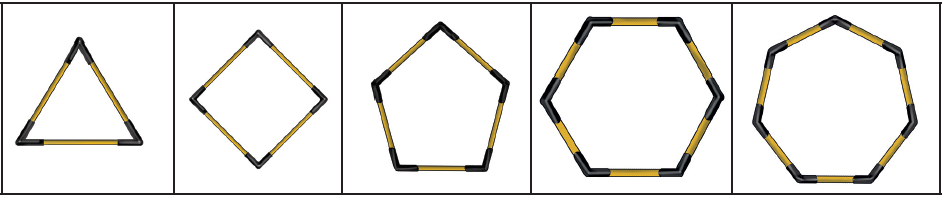
Find the number of sticks required to form the next three shapes by tabulation and generalisation.
3.
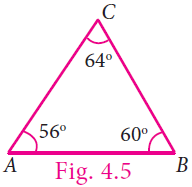
Can the following angles form a triangle?
(i) 800, 700, 500
(ii) 560, 640, 600
4.
Express the following numbers in exponential form with the given base:
243, base 3.
5.
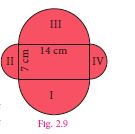
Find the perimeter of the given shape (Figure) (Take \(\pi =\frac { 22 }{ 7 } \)).
6.
Two automatic ice cream machines A and B designed to fill cups with 100 ml of ice cream were tested. Two cups of ice creams, one from machine A and one from machine B are weighed and found to be 99.56 ml from machine A and 99.65 ml from machine B. Can you say which machine gives more quantity of ice creams?
7.
The height of a person is 165 cm. Express this height in metre.
8.
If p(x) and q(x) are two expressions of degree 3, then the degree of p(x) + q(x) is
6
0
3
Undefined
9.
Choose the correct relationship between x and y from the given table.
| x | -2 | -1 | 0 | 1 | 2 | ... |
| y | 4 | 5 | 6 | 7 | 8 | ... |
y = x + 4
y = x + 5
y = x + 6
y = x + 7
10.
Identify the correct relationship between x and y from the given table.
| x | 1 | 2 | 3 | 4 | ... |
| y | 4 | 8 | 12 | 16 | ... |
y = 4x
y = x + 4
y = 4
y = 4 × 4
11.
The unit digit of the numeric expression 1071 + 1072 + 1073 is
0
3
1
2
12.
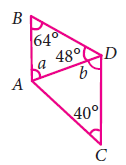
In the given figure, AB is parallel to CD. Then the value of b is
1120
680
1020
620
13.
The angles of a triangle are in the ratio 2: 3: 4. Then the angles are
20, 30, 40
40, 60, 80
80, 20, 80
10, 15, 20
14.
The formula used to find the area of the rectangular path is
π(R2 − r2 ) sq. units
(L × B) − (l × b) sq. units
LB sq. units
lb sq. units
15.
In the formula, C = 2πr, ‘r’ refers to
circumference
area
rotation
radius
16.
The simplest form of 0.35 is
\(\frac { 35 }{ 1000 } \)
\(\frac { 35 }{ 10 } \)
\(\frac { 7 }{ 20 } \)
\(\frac { 7 }{ 100 } \)
17.
3 + \(\frac { 4 }{ 100 } +\frac { 9 }{ 1000 } \) = ?
30.49
3049
3.0049
3.049
18.
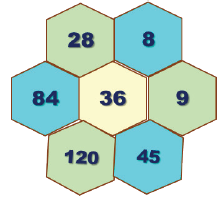
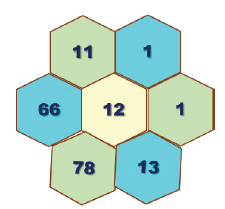
Verify whether the following hexagonal shapes form a part of the Pascal’s Triangle.
19.
Verify whether the following hexagonal shapes form a part of the Pascal’s Triangle.
20.
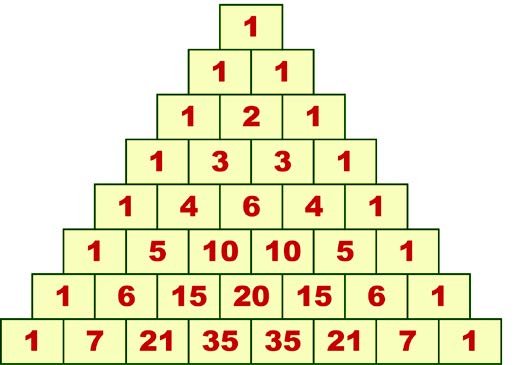
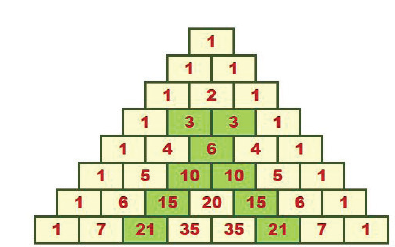
Find the trianglular numbers from the Pascal’s Triangle and colour them.
21.
Find the degree of the following terms.
-7ab
22.
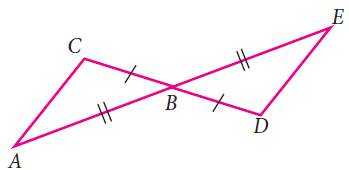
Using the given figure, prove that the triangles are congruent. Can you conclude that AC is parallel to DE.
23.
II. Construct a triangle ABC with given conditions.
(i) AB = 7 cm, AC = 6.5 cm and ∠A = 120°.
(ii) BC = 8 cm, AC = 6 cm and ∠C = 40°.
(iii) An isosceles obtuse triangle with equal sides 5 cm
24.
Simplify and express each of the following in exponential form:
45 x 42 x 44
25.
A goat is tethered with a rope of length 45 m at the centre of the circular grass land whose radius is 52 m. Find the area of the grass land that the goat cannot graze.
26.
The cost of fencing a circular race course at the rate of Rs.8 per metre is Rs.2112. Find the diameter of the race course.
27.
A picture is painted on a ceiling of a marriage hall whose length and breadth are 18 m and 7 m respectively. There is a border of 10 cm along each of its sides. Find the area of the border.
28.
Write the following decimal numbers in words.
0.7
29.
Represent the following decimal numbers on the number line.
2.1
30.
Compare the following decimal numbers and find out the smaller number.
0.99, 1.9
31.
Degree of the constant term is _________.
32.
The degree of the term a3b2c4d2 is ________.
33.
When the unit digit of the base and its expanded form of that number is 9, then the exponent must be ________ power.
34.
When base is 12 and exponent is 17, its exponential form is___________
35.
The exponential form 149 should be read as_________
36.
Tabulate the 3rd slanting row of the Pascal’s Triangle by taking the position of the numbers in the slanting row as x and the corresponding values as y.
| x | 1 | 2 | 3 | 4 | 5 | 6 | ... |
| y | 1 | 3 | 6 | 10 | 15 | 21 | ... |
Verify whether the relationship, y = \(\frac { x(x+1) }{ 2 } \) between x and y for the given values is true.
37.
Find the unit digit of the following exponential numbers:
2523
38.
39.
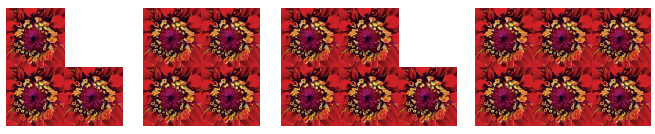
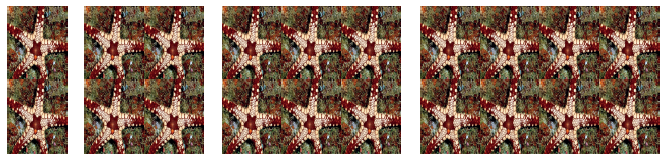
Match the given patterns of shapes with the appropriate number pattern and its generalization.
40.
729725
41.
12111
42.
2010
1.
(4m2 + 3n) − (3m+ 9n2 ) − (3m2 − 6n2 ) + (5m−n)
= 4m2 + 3n − 3m − 9n2 − 3m2 + 6n2 + 5m − n
= (4m2 − 3m2 ) + (3n − n) + (−3m+ 5m) + (−9n2 + 6n2)
= m2 + 2n + 2m − 3n2
Hence, the degree of the expression is 2.
2.
In the above pattern of polygons, in the first shape (x = 1), we get a closed shape called a triangle. Similarly the second shape (x = 2 ) gives a four sided polygon and the third shape (x = 3) is a five sided polygon and continuing in the same way two more shapes are formed. If the number of match sticks required to form each of the shapes is taken as y, then the values of x and y are tabulated as given below.
| x | 1 | 2 | 3 | 4 | 5 | ... |
| y | 3 | 4 | 5 | 6 | 7 | ... |
Observe the table and express y in terms of x as below:
when x = 1, y = 3 = 1 + 2
when x = 2 , y = 4 = 2 + 2
when x = 3, y = 5 = 3 + 2
when x = 4 , y = 6 = 4 + 2
when x = 5, y = 7 = 5 + 2
Hence, each of the values of y which we get from the table is 2 more than x. That is
y = x + 2 .
Therefore,
6th shape (x = 6) will have y = 8 = 6 + 2 (8 match sticks)
7th shape (x = 7) will have y = 9 = 7 + 2 (9 match sticks)
8th shape (x = 8) will have y = 10 = 8 + 2 (10 match sticks)
We clearly see that the next three shapes will require 8, 9 and 10 matchsticks.
3.
(i) Given angles 800, 700, 500
Sum of the angles = 800 + 700 + 500 = 2000 ≠ 1800
The given angles cannot form a triangle.
(ii) Given angles 560, 640, 600
Sum of the angles = 560+ 640+ 600 = 1800
The given angles can form a triangle.
4.
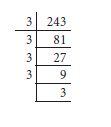
243 = 3 x 3 x 3 x 3 x 3 = 35
5.
In this shape, we have to calculate the circumference of semicircle on each side of the rectangle. The outer boundary of this figure is made up of semicircles of two different sizes. Diameters of each of the semicircles are 7 cm and 14 cm. We know that the circumference of the circle = πd units.
Circumference of the semicircular part = \(\frac { 1 }{ 2 } \)πd units
Hence, the circumference of the semicircle having diameter 7 cm is,
= \(\frac { 1 }{ 2 } \) x \(\frac { 22 }{ 7 } \) x 7 = 11 cm
Circumference of the pair of semicircular parts (II and IV) = 2 x 11 = 22 cm
Similarly, circumference of the semicircle having diameter 14 cm is,
= \(\frac { 1 }{ 2 } \) x \(\frac { 22 }{ 7 } \) x 14 = 22 cm
Circumference of the pair of semicircular parts (I and III) = 2 x 22 = 44 cm.
Perimeter of the given shape = 22 + 44 = 66 cm.
6.
Compare 99.56 and 99.65
Here the whole number parts of the given two numbers are equal.
Comparing the digits at tenths place, we get 5 < 6.
Therefore, 99.56 < 99.65
7.
Given, height of the person = 165 cm.
Hence, the height of the person = \(\frac { 165 }{ 100 } \) = 1.65 m
Since, 1 cm = \(\frac { 1 }{ 100 } \) m = 0.01 m
8.
(c)
3
9.
(c)
y = x + 6
10.
(a)
y = 4x
11.
(a)
0
12.
(b)
680
13.
(b)
40, 60, 80
14.
(b)
(L × B) − (l × b) sq. units
15.
(d)
radius
16.
(c)
\(\frac { 7 }{ 20 } \)
17.
(d)
3.049
18.
8 × 45 × 84 = 28 × 9 × 120
19.
1 × 13 × 66 = 11 × 1 × 78
20.
21.
Degree 2
22.
BC = BD
BE = AB
<CBA = <DBE
By SAS criterion \(\triangle C D B \cong \angle E B D\)
The two sides AC is parallel to DE.
23.
(i)
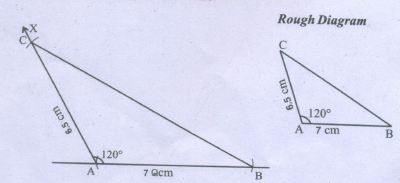
Steps:
1. Draw a line segmentAB = 7 cm.
2. At A, draw a ray AX making an angle of 1200 with AB.
3. With A as centre, draw an arc of radius 6.5 em to cut the ray AX at C.
4. Join BC.
(ii)
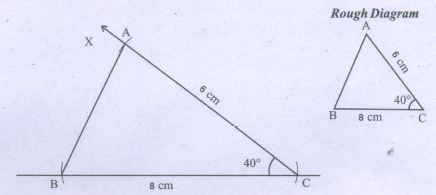
Steps:
1. Draw a line segment \(\overline { BC } =8cm\)
2. At e draw a ray ex making an angle of radius.
3. With e as centre draw an arc of radius 6 cm.
4. Join AB.
(iii)
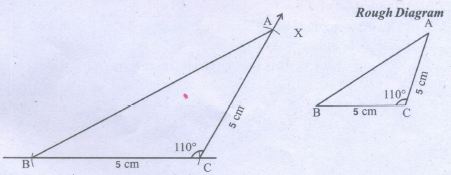
Steps:
1. Draw a line segment AB = 5 cm.
2. At B, draw a ray BX making an angle of 110° with AB.
3. With B as centre, draw an arc of radius 5 em to cut the ray BX at C.
4. Join AC.
24.
45+2 x 44 = 47 x 44 = 47+4
= 411
25.
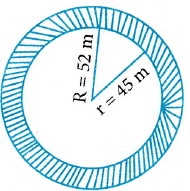
R =.52 m, r = 45 m
Area of the grass land that the goat cannot graze \(=\pi\left(R^{2}-r^{2}\right)
\)
\(=\pi\left(52^{2}-45^{2}\right)
\)
\(=\pi(2704-2025)
\)
\(=\frac{22}{7}(679)
\)
= 22 x 97 = 2134 m2.
26.
Cost of fencing a circular race course at the rate of Rs 8 per metre = Rs 2112
\(\beta \times 2 \pi r =2112
\)
\(8 \times 2 \times \frac{22}{7} \times r =2112
\)
\(r=2112 \times \frac{1}{8} \times \frac{1}{2} \times \frac{7}{22}\)
r = 42 m
Diameter of the race course = 2 x 42 = 84 m
27.
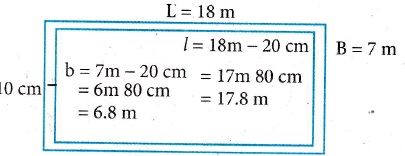
Length of marriage hall (L) = 18 m
Breadth of marriage hall (B) = 7 m
Area of the border = Area of outer rectangle - Area of inner rectangle
= L x B - l x b
= 18 x 7 - 17.8 x 6.8.
= 126 - 121.04 = 4.96 m2
28.
seven tenths
29.
.JPG)
30.
Comparing the whole number parts of the two decimal numbers.
We get 0 < 1
0.99 < 1.9
Smaller number is 0.99.
31.
()
0
32.
()
11
33.
()
odd
34.
()
1217
35.
()
14 power 9
36.
Observe the table carefully. To verify the relationship between x and y, let us substitute the values of x and get the values of y.
If x = 1, y = \(\frac { 1(1+1) }{ 2 } =\frac { 2 }{ 2 } =1\)
If x = 2 , y = \(\frac { 2(2+1) }{ 2 } =\frac { 6 }{ 2 } =3\)
If x = 3, y = \(\frac { 3(3+1) }{ 2 } =\frac { 12 }{ 2 } =6\)
If x = 4 , y = \(\frac { 4(4+1) }{ 2 } =\frac { 20 }{ 2 } =10\)
If x = 5, y = \(\frac { 5(5+1) }{ 2 } =\frac { 30 }{ 2 } =15\)
Hence, y = \(\frac { x(x+1) }{ 2 } \) is verified.
37.
2523
Unit digit of base 25 is 5 and power is 23
Thus, the unit digit of 2523 is 5.
38.
Sequence: 3, 4, 5, 6,… General form: y = x + 2
39.
Sequence: 2, 4, 6, 8… General from: y = 2n
40.
9
41.
1
42.
0

7th Standard Syllabus & Materials
7th Standard
TN 7th English T1 - Supplementary - On Monday Morning Important Questions And Answers Study Material - QB365 Set A
NEW7th Standard
TN 7th English T1 - Prose - Eidgah Important Questions And Answers Study Material - QB365 Set A
NEW7th Standard
TN 7th Social Science T1 - ECO - Production Important Questions And Answers Study Material - QB365 Set A
NEW7th Standard
TN 7th Social Science T1 - GEO - Interior of the Earth Important Questions And Answers Study Material - QB365 Set A



Tamilnadu Stateboard 7th Standard Subjects
Tamilnadu Stateboard Standards




