
 100% FREE ACCESS
7th Standard Syllabus & Materials
7th Standard
TN 7th Tamil பருவம் -1 இயல் 1 - அமுதத்தமிழ் - ஒன்றல்ல இரண்டல்ல Important Questions And Answers Study Material - QB365 Set A
NEW7th Standard
TN 7th Tamil பருவம் -1 இயல் 1 - அமுதத்தமிழ் - எங்கள் தமிழ் Important Questions And Answers Study Material - QB365 Set A
NEW7th Standard
TN 7th English T1 - Poem - Your Space Important Questions And Answers Study Material - QB365 Set A
NEW7th Standard
TN 7th English T1 - Prose - A Prayer to the Teacher Important Questions And Answers Study Material - QB365 Set A
NEW7th Standard
TN 7th English T1 - Poem - The Listeners Important Questions And Answers Study Material - QB365 Set A
NEW7th Standard
TN 7th English T1 - Prose - The Wind on Haunted Hill Important Questions And Answers Study Material - QB365 Set A

Published on: 03/12/2019
Force and Motion
Download Tamil Nadu 7th Standard Science question papers, model tests, one-mark questions, important questions, and public exam papers in PDF format. Free study materials and answer keys for TN State Board students.
Questions + Answers key
Take MCQ Science Test1.
If the distance travelled by a car is direct proportional to the duration of time. The car will travel with __________
uniform speed
non-uniform acceleration
uniform acceleration
uniform velocity
2.
If the velocity of a body does not change, then its acceleration is ____________
infinity
unity
zero
between zero and unity
3.
The slope of a velocity-time graph gives _______
velocity
distance
displacement
acceleration
4.
What is one way you might increase the stability of an object?
lower the centre of gravity
raise the centre of gravity
increase the height of the object
shorten the base of the object
5.
Suppose a boy is enjoying a ride on a marry go round which is moving with a constant speed of 10 m/s. It implies that the boy _______.
at rest
moving with no acceleration
in accelerated motion
moving with uniform velocity
6.
Mention any two conditions for stability of a body?
7.
What are three types of stability of an object?
8.
Correct your friend who says “The acceleration gives the idea of how fast the position changes”.
9.
“She moves at a constant speed in a constant direction”. Rephrase the same sentence in fewer words using concepts related to motion.
10.
All objects having uniform speed need not have uniform velocity. Describe with the help of examples.
11.
Define acceleration. Mention its formula and unit.
12.
What is uniform velocity? Give one example.
13.
Define velocity Mention its formula and unit.
14.
What is centre of gravity ?
15.
What do you mean by constant acceleration?
16.
Write the differences between distance and displacement
17.
Explain the types of stability with suitable examples.
1.
(a)
uniform speed
2.
(c)
zero
3.
(d)
acceleration
4.
(a)
lower the centre of gravity
5.
(d)
moving with uniform velocity
6.
1. Increase the area of its base.
2. Lower its centre of gravity
7.
1. Stable equilibrium
2. Unstable equilibrium
3. Neutral equilibrium
8.
There are two possible answers:
Velocity gives an idea of how fast the position changes. or Acceleration gives an idea of how fast the velocity changes.
9.
She moves in a straight line with constant velocity.
10.
An object moving in uniform circular motion is moving around the perimeter of the circle with a constant speed. While the speed of object is constant, its velocity is changing, Ex: Merry-go-round, roller coaster, planets orbiting the sun.
11.
Acceleration is the rate of change in velocity.
Formula: Acceleration = change in velocity / time
SI unit of acceleration is m/s2
12.
A body has uniform velocity, if it covers equal displacement in the same direction in equal intervals of time. Eg. light travels through vacuum.
13.
Velocity is the rate of change in displacement.
Formula: Velocity (v) = displacement / time
SI unit of velocity is meter / second (m/s).
14.
The centre of gravity of an object is the point through which the entire weight of the object appears to act.
15.
An object undergoes uniform acceleration when the change (increase or decrease) in its velocity for every unit of time is the same.
16.
| Distance | Displacement | |
| 1. | The total lenglh of a path taken by an object. | The shortest distance from the initial to the final position of an object |
| 2. | SI unit is meter | SI unit is meter |
17.
Stability:
Stability is a measure of the body's ability to maintain its original position.
The three types of stability are
(i) Stable equilibrium
(ii) Unstable equilibrium
(iii) Neutral equilibrium
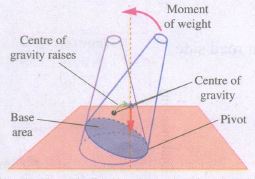
Stable Equilibrium:
i) The frustum can be tilted through quite a big angle without toppling.
ii) Its centre of gravity is raised when it is displaced.
iii) The vertical line through its centre of gravity still falls within its base.
iv) So it can return to its original position.
Unstable Equilibrium:
i) The frustum will topple with the slightest tilting. Its centre of gravity is lowered when it is displaced.
ii) The vertical line through its centre of gravity falls outside its base.
.JPG)
Neutral Equilibrium:
(i) It causes frustum to topple.
(ii) The frustum will rolls about but does not topple.
(iii) Its centre of gravity remains at the same height when it is displaced.
(iv) The body will stay in any position to which it has been displaced.
.JPG)

7th Standard Syllabus & Materials
7th Standard
TN 7th English T1 - Supplementary - On Monday Morning Important Questions And Answers Study Material - QB365 Set A
NEW7th Standard
TN 7th English T1 - Prose - Eidgah Important Questions And Answers Study Material - QB365 Set A
NEW7th Standard
TN 7th Social Science T1 - ECO - Production Important Questions And Answers Study Material - QB365 Set A
NEW7th Standard
TN 7th Social Science T1 - GEO - Interior of the Earth Important Questions And Answers Study Material - QB365 Set A



Tamilnadu Stateboard 7th Standard Subjects
Tamilnadu Stateboard Standards




