
 100% FREE ACCESS
7th Standard Syllabus & Materials
7th Standard
TN 7th Tamil பருவம் -1 இயல் 1 - அமுதத்தமிழ் - ஒன்றல்ல இரண்டல்ல Important Questions And Answers Study Material - QB365 Set A
NEW7th Standard
TN 7th Tamil பருவம் -1 இயல் 1 - அமுதத்தமிழ் - எங்கள் தமிழ் Important Questions And Answers Study Material - QB365 Set A
NEW7th Standard
TN 7th English T1 - Poem - Your Space Important Questions And Answers Study Material - QB365 Set A
NEW7th Standard
TN 7th English T1 - Prose - A Prayer to the Teacher Important Questions And Answers Study Material - QB365 Set A
NEW7th Standard
TN 7th English T1 - Poem - The Listeners Important Questions And Answers Study Material - QB365 Set A
NEW7th Standard
TN 7th English T1 - Prose - The Wind on Haunted Hill Important Questions And Answers Study Material - QB365 Set A

Published on: 03/12/2019
Matter Around Us
Download Tamil Nadu 7th Standard Science question papers, model tests, one-mark questions, important questions, and public exam papers in PDF format. Free study materials and answer keys for TN State Board students.
Questions + Answers key
Take MCQ Science Test1.
A molecule containing three atoms is called a __________ molecule
monoatomic
diatomic
triatomic
polyatomic
2.
_____________ is a substance that is made up of three oxygen atoms chemically combined.
Oxygen
Hydrogen
Ozone
CO2
3.
The most abundant type of atom is the universe is _____________
Helium
Hydrogen
Argon
Argon
4.
The metals which is a liquid at room temperature is _______.
Chlorine
Sulphur
Mercury
Silver
5.
Which of the following is a short and scientific way of representing one molecule of an element or compound?
Mathematical formula
Chemical formula
Mathematical symbol
Chemical symbol
6.
Name the elements is air?
7.
What is a chemical formula?
8.
What is a molecule?
9.
Classify the following as metals, non-metals and metalloids .
Sodium, Bismuth, Silver, Nitrogen, Silicon, carbon, chlorine, Iron, copper.
10.
Write the symbols for the following elements and classify them as solid, liquid and gas.
Aluminum, carbon, chlorine, mercury, hydrogen and helium
11.
(i) Draw the symbol for some elements as proposed by Dalton.
(ii) What are rules to be followed while assigning symbol to element.
12.
Explain the characteristics of compounds
13.
What changes take place in the movement and arrangement of particles during heating process?
14.
List out the metals, non-metals and metalloids which you use in your house, schools. Compare their properties.
15.
Write any two properties of a compound.
16.
Give an account of elements known to us
17.
What are the 3 most abundant atoms on the earth?
1.
(c)
triatomic
2.
(c)
Ozone
3.
(b)
Hydrogen
4.
(c)
Mercury
5.
(b)
Chemical formula
6.
Nitrogen, Oxygen, small amounts of Argon and Carbon-di-oxide. Other gases such as Neon, Helium and Methane are present in traceable amounts
7.
A chemical formula is a symbolic representation of one molecule of an element or a compound
8.
Molecule is the smallest unit of compound.
9.
Metals: Sodium, Bismuth, Silver, Iron, Copper.
Non-metals: Nitrogen, Carbon, Chlorine.
Metalloids: Silicon.
10.
| Element | Symbol | Nature |
| Aluminum | Al | Solid |
| Carbon | C | Solid |
| Chlorine | Cl | Gas |
| Mercury | Hg | Liquid |
| Hydrogen | H | Gas |
| Helium | He | Gas |
11.
(i) Symbol for some elements as proposed by Dalton.
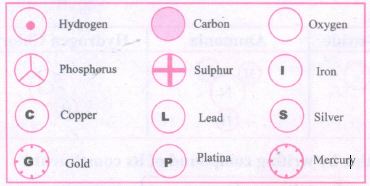
(ii) The following rules are followed while assigning symbol to an elements:
(a) Chemical symbols usually consist of one or two letters
(b) The symbols of most elements correspond to the first letter (which is capitalized) of their English name. For example, the symbol for oxygen is "O" and that for hydrogen is "H".
12.
i) A compound is formed only when the constituent elements combine in a fixed proportion.
ii) Compound exhibits entirely different properties of their constituent elements.
iii) A compound cannot be broken down by physical methods.
iv) A compound can be separated into its constituent elements by chemical methods only.
13.
When solid is heated, the particles gain energy and vibrate vigorously. The particles move slightly further apart from one another.
Hence, the volume increases due to the greater distance between the particles. But the size of the particles remains the same.
14.
| Properties | metals | Non-metals | metalloids | |
| 1. | Physical nature | Solids, a few liquids at room temperature. | Majority of gases. | Solids. |
| 2. | Appearance | Hard and lustrous. | Soft and non-lustrous. | Lustrous. |
| 3. | Conductivity | Good Conductors of heat and electricity. | Bad Conductors of heat and electricity. | Semiconductors. |
| 4. | Alloy formation | They can form. | They cannot form. | They can form. |
15.
(i) The properties of a compound are different from those of its constituent elements.
(ii) A compound cannot be broken down by physical methods. This is because a compound is made up of different elements that are chemically combined. Sodium chloride cannot be separated by physical methods such as filtration
16.
There are 118 known elements till date. 94 of these elements occur naturally while 24 elements have been created artificially in the laboratory
17.
On earth the three most abundant atom are iron, oxygen, and silicon.

7th Standard Syllabus & Materials
7th Standard
TN 7th English T1 - Supplementary - On Monday Morning Important Questions And Answers Study Material - QB365 Set A
NEW7th Standard
TN 7th English T1 - Prose - Eidgah Important Questions And Answers Study Material - QB365 Set A
NEW7th Standard
TN 7th Social Science T1 - ECO - Production Important Questions And Answers Study Material - QB365 Set A
NEW7th Standard
TN 7th Social Science T1 - GEO - Interior of the Earth Important Questions And Answers Study Material - QB365 Set A



Tamilnadu Stateboard 7th Standard Subjects
Tamilnadu Stateboard Standards




