
 100% FREE ACCESS
7th Standard Syllabus & Materials
7th Standard
TN 7th Tamil பருவம் -1 இயல் 1 - அமுதத்தமிழ் - ஒன்றல்ல இரண்டல்ல Important Questions And Answers Study Material - QB365 Set A
NEW7th Standard
TN 7th Tamil பருவம் -1 இயல் 1 - அமுதத்தமிழ் - எங்கள் தமிழ் Important Questions And Answers Study Material - QB365 Set A
NEW7th Standard
TN 7th English T1 - Poem - Your Space Important Questions And Answers Study Material - QB365 Set A
NEW7th Standard
TN 7th English T1 - Prose - A Prayer to the Teacher Important Questions And Answers Study Material - QB365 Set A
NEW7th Standard
TN 7th English T1 - Poem - The Listeners Important Questions And Answers Study Material - QB365 Set A
NEW7th Standard
TN 7th English T1 - Prose - The Wind on Haunted Hill Important Questions And Answers Study Material - QB365 Set A

Published on: 03/12/2019
Measurement
Download Tamil Nadu 7th Standard Science question papers, model tests, one-mark questions, important questions, and public exam papers in PDF format. Free study materials and answer keys for TN State Board students.
Questions + Answers key
Take MCQ Science Test1.
The shortest distance between the earth and the sun is called as _______ position.
Light year
normal
perihelion
aphelion
2.
The unit of volume is ____________
m3
m2
cm3
km
3.
Light year is the unit of ________.
Distance
time
density
both length and time
4.
Two spheres have equal mass and volume in the ratio 2:1. The ratio of their density is ________.
1:2
2:1
4:1
1:4
5.
SI unit of density is ________.
kg/m2
kg/m3
kg/m
g/m3
6.
How will you determine the volume of a liquid?
7.
Mention the formula to calculate area of a circle?
8.
What is the area of 10 squares each having side of 1 m?
9.
Name the liquid in which an iron ball sinks.
10.
Give the formula to find the density of objects.
11.
Define astronomical unit
12.
A sphere is made from copper whose mass is 3000 kg. If the density of copper is 8900 kg/m, find the volume of the sphere.
13.
A box is made up of iron and it has a volume of 125 cm3. Find its mass. (Density of iron is 7.8 g / cm3).
14.
Distinguish between the volume of liquid and capacity of a container.
15.
What are derived quantities?
16.
How will you find the area of irregular objects?
17.
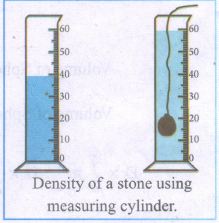
How will you determine the density of a stone using a measuring jar?
1.
(c)
perihelion
2.
(a)
m3
3.
(a)
Distance
4.
(a)
1:2
5.
(b)
kg/m3
6.
By using measuring cylinder.
7.
π x r2 = πr2
8.
Area of a square = side \(\times \) side
= 1 m \(\times \) 1 m
= 1 m2 or 1 square metre
Area of 10 squares = 1 square metre \(\times \) 10
= 10 square metre
9.
Iron ball sinks in all the liquids apart from mercury.
10.
Density (D) = mass (M) / volume (V).
11.
One astronomical unit is defined as the average distance between the earth and the sun. 1AU = 1.496 x 10¹¹m or 149.6 x 10⁶ m
12.
Density = Mass / Volume
Hence, Volume = Mass / Density
\(=3000 / 8900=30 / 89 \\ =0.34 \mathrm{~m}^{3}\)
13.
Density = Mass / Volume
Hence, Mass = Volume \(\times\) Density
= 125 \(\times\) 7.8 = 975 g.
14.
| S.No | Volume of liquid | Capacity of a container |
| 1. | The volume of liquid is equal to lhe volume of space it fills in the measuring container. | The malimum volume of liquid that a container can hold is known as the capacity of container |
15.
Physical quantities which can be obtained by multiplying, dividing or by mathematically combining the fundamental quantities are known as derived quantities.
Ex: Area, volume
16.
(i) Place the irregular object on a graph sheet and draw its outline. Then remove the object
(ii) To find the area enclosed by the outline count the number of small squares.
(iii) If more than half-a-square is inside the boundary, count it as one otherwise neglect it.
(iv) The area of each small square is 1sq. mm.
(v) Area of the irregular object = No. of squares x 1 sq.mm.
17.
i) Take a measuring cylinder and pour some water into it.
ii) Note down the volume of water from the readings of the measuring cylinder. Take it as V1.
iii) Now take a small stone and tie it with a thread.
iv) Immerse the stone inside the water by holding the thread.
v) The stone should not touch the walls of the measuring cylinder.
vi) Note down the volume of water and take it to be V2
vii) The volume of the stone is equal to the raise in the volume of water.
viii) Volume of stone = V2 - V1

7th Standard Syllabus & Materials
7th Standard
TN 7th English T1 - Supplementary - On Monday Morning Important Questions And Answers Study Material - QB365 Set A
NEW7th Standard
TN 7th English T1 - Prose - Eidgah Important Questions And Answers Study Material - QB365 Set A
NEW7th Standard
TN 7th Social Science T1 - ECO - Production Important Questions And Answers Study Material - QB365 Set A
NEW7th Standard
TN 7th Social Science T1 - GEO - Interior of the Earth Important Questions And Answers Study Material - QB365 Set A



Tamilnadu Stateboard 7th Standard Subjects
Tamilnadu Stateboard Standards




