
 100% FREE ACCESS
7th Standard Syllabus & Materials
7th Standard
TN 7th Tamil பருவம் -1 இயல் 1 - அமுதத்தமிழ் - ஒன்றல்ல இரண்டல்ல Important Questions And Answers Study Material - QB365 Set A
NEW7th Standard
TN 7th Tamil பருவம் -1 இயல் 1 - அமுதத்தமிழ் - எங்கள் தமிழ் Important Questions And Answers Study Material - QB365 Set A
NEW7th Standard
TN 7th English T1 - Poem - Your Space Important Questions And Answers Study Material - QB365 Set A
NEW7th Standard
TN 7th English T1 - Prose - A Prayer to the Teacher Important Questions And Answers Study Material - QB365 Set A
NEW7th Standard
TN 7th English T1 - Poem - The Listeners Important Questions And Answers Study Material - QB365 Set A
NEW7th Standard
TN 7th English T1 - Prose - The Wind on Haunted Hill Important Questions And Answers Study Material - QB365 Set A

Published on: 16/09/2019
Download Tamil Nadu 7th Standard Science question papers, model tests, one-mark questions, important questions, and public exam papers in PDF format. Free study materials and answer keys for TN State Board students.
Questions + Answers key
Take MCQ Science Test1.
Centella is an example of __________
Stolon
Runner
Corm
Rhizome
2.
A molecule containing three atoms is called a __________ molecule
monoatomic
diatomic
triatomic
polyatomic
3.
Average speed of a moving object is equal to the magnitude of its average velocity when it travels.
in a straight line without turning back
in a circle
back and forth
in a zig-zag path
4.
Which of the following figures represent uniform motion of a moving object correctly?


5.
Which of the following is an example for animation?
Sound communication
Visual communication
Vector communication
Raster communication
6.
The metals which is a liquid at room temperature is _______.
Chlorine
Sulphur
Mercury
Silver
7.
Which of the following is a derived quantity?
mass
time
area
length
8.
What is an inflorescence?
9.
Name the element which is used for making computer chips
10.
Give one example where the displacement is zero but the distance travelled is not zero
11.
All objects having uniform speed need not have uniform velocity. Describe with the help of examples.
12.
What do you understand by chemical formula of a compound? What is its significance?
13.
What is tendril?
14.
What are the agents of pollination?
15.
What is the density of gold?
16.
Name the units used to measure the distance between celestial objects.
17.
Name some of the derived quantities.
18.
LlNUX
19.
Virtual Reality in 3D
20.
Nightblindness
21.
Allergies
22.
Sulphur
23.
Circle
24.
Light travelling through vacuum
25.
Iron
26.
Petal
27.
Video Story
28.
___________ revolve around the nucleus of the atom in specific orbits.
29.
____________ is the smallest particle of a chemical element.
30.
____________ is the distance trtavelled by a body per unit time
31.
The area of irregularly shaped figures can be calculated with the help of a _________
32.
The _______ revolve around the nucleus.
33.
_________is the most abundant gas in the atmosphere.
34.
List the diseases affecting the eye, their causative agents, impact and Remedial measures.
35.
Explain the postulates of Dalton's atomic theory.
36.
How will you find the area of irregular objects?
37.
Write down the properties of metalloids
38.
How will you determine the density of a stone using a measuring jar?
39.
An atom of an element has no electron, will that atom have any mass or not? Can an atom exist without electron? If so then give example.
40.
What changes take place in the movement and arrangement of particles during heating process?
41.
Why do all plants lack breathing roots?
42.
How do Epiphytic roots differ from Sucking roots?
43.
Why is hydrogen considered as an element?
44.
How do hot air balloons float?
45.
What is non-uniform velocity? Give example
46.
A sphere is made from copper whose mass is 3000 kg. If the density of copper is 8900 kg/m, find the volume of the sphere.
47.
A solid cylinder of mass 280 kg has a volume of 4 m3. Find the density of cylinder.
48.
Distinguish between speed and velocity.
49.
The fundamental particle not present in a hydrogen atom is neutron.
50.
Lead is also known as plumbum.
1.
(b)
Runner
2.
(c)
triatomic
3.
(a)
in a straight line without turning back
4.
(d)
5.
(b)
Visual communication
6.
(c)
Mercury
7.
(c)
area
8.
(i) A group of flowers is called an inflorescence. e.g sunflower.
(ii)The sunflower is not a single flower. It is a group of flower clustered together.
(iii) Tidax procumbens also an inflorescence.
9.
Silicon
10.
When an object travels is a circular path (ie. the initial and positions are same).
11.
An object moving in uniform circular motion is moving around the perimeter of the circle with a constant speed. While the speed of object is constant, its velocity is changing, Ex: Merry-go-round, roller coaster, planets orbiting the sun.
12.
i) Chemical formula is a symbolic representation of one molecule of an element or a compound
ii) It provides information about the elements present in a molecule and the number of atoms of each element.
Significance:
The types of atoms and the number of each types of atoms in one molecule of substance can be known by chemical formula.
13.
In climbers, the leaf of plant would be modified into elongated structure to help the plants climb efficiently is known as tendril.
14.
Insects, birds, animals, wind and water are the agents of pollination.
15.
Density of gold is 19,300 kg/m3
16.
Astronomical unit and light year.
17.
Area, Volume, Speed, Electric charge and Density.
18.
Operating system
19.
Real image
20.
Poor light
21.
Pollen
22.
Polyatomic molecule
23.
π x r2
24.
Uniform velocity
25.
Fe
26.
Attracts insect
27.
Microsoft Photostory
28.
()
Electron
29.
()
Atom
30.
()
speed
31.
()
graph sheet
32.
()
electrons
33.
()
Nitrogen
34.
| S. NO: | Name of the Disease | Causative Agents | Impacts / Consequences | Remedial measures |
| 1. | Night Blindness | Lack of vitamin A, a disorder of the cells in your retina | Makes it hard to see well at night or in | Eat foods rich in antioxidant, vitamins and minerals. |
| 2. | Conjuncitvitis (Pink eye) | Caused by a virus and bacteria | One or both eyes can be affected. Highly contagious; can be spread by coughing and sneezing | Antibiotic eye drops or ointments, home remedy |
| 3. | Color blindness | genetic condition | 1. Difficulty distinguishing between colors. 2. Inability to see shades or tones of the same color |
There is no known cure for color blindness. Contact lenses and glasses are available with filters to help color deficiencies |
35.
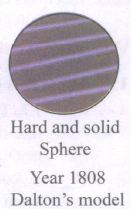
John Dalton proposed the atomic theory in the year 1808.
(i) He proposed that matter consists of very small particles which he named as atoms.
(ii) An atom is smallest indivisible particle, it is spherical in shape.
(iii) His theory does not propose anything about the positive and negative charges of an atom.
36.
(i) Place the irregular object on a graph sheet and draw its outline. Then remove the object
(ii) To find the area enclosed by the outline count the number of small squares.
(iii) If more than half-a-square is inside the boundary, count it as one otherwise neglect it.
(iv) The area of each small square is 1sq. mm.
(v) Area of the irregular object = No. of squares x 1 sq.mm.
37.
Properties of metalloids :
(i) Metalloids exhibit the properties of both metals and non-metals.
(ii) Unusually they look like metals but behave largely like non-metals,
(iii) They can form alloys like metals.
38.
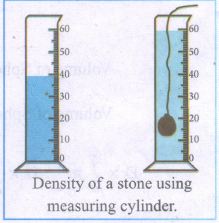
i) Take a measuring cylinder and pour some water into it.
ii) Note down the volume of water from the readings of the measuring cylinder. Take it as V1.
iii) Now take a small stone and tie it with a thread.
iv) Immerse the stone inside the water by holding the thread.
v) The stone should not touch the walls of the measuring cylinder.
vi) Note down the volume of water and take it to be V2
vii) The volume of the stone is equal to the raise in the volume of water.
viii) Volume of stone = V2 - V1
39.
(i) Yes, an atom of an element has no electron will have the mass.
(ii) (Atomic mass, only depends on the mrmber of protons and the number of neutrons inside the nucleus. It is independent of number of electrons.)
(iii) Atom can exist with out electron and becomes a cation.
Ex:
1) Hydrogen atoms (Z = 1) has only one electrons.
2) It loses one electron and becomes H+ ion
3) H → H+ + 1e-
(atom) (Ion)
40.
When solid is heated, the particles gain energy and vibrate vigorously. The particles move slightly further apart from one another.
Hence, the volume increases due to the greater distance between the particles. But the size of the particles remains the same.
41.
Mangrove plants are found in swampy regions where there is water logging and oxygen available for roots will be less. The breathing roots grow above the soil and have pores for gaseous exchange. This helps the roots to get more oxygen with the help of breathing roots
42.
| Epiphytic roots | Sucking roots |
| Vanda is an epiphytic plant, which grows on trees. The velamen tissue present in the epiphytic root, absorbs moisture, to perform photosynthesis. | Cuscuta a parasite plant, climb the trees and other vegetation and use the haustorial roots Sucking roots to penetrate the tissue of the host plant and suck nutrients from them. They are usually found in parasitic plants that depend on the host plants for nutrients. |
43.
Hydrogen is considered as an element because,
(i) Hydrogen cannot be broken into new substance by ordinary physical or chemical means. (i.e) by applying heat, light.
(ii) Hydrogen has one kind of atoms.
44.
When air inside the hot air balloon is heated with a burner, it expands. The expansion causes the density of the air inside the balloon to decrease. Hence, the air inside the balloon has a lower density that the air outside of the balloon. This difference is density allows the hot-air balloon to float.
45.
If either speed or direction changes, then the velocity is non uniform. Eg. a train starting and moving out of the station.
46.
Density = Mass / Volume
Hence, Volume = Mass / Density
\(=3000 / 8900=30 / 89 \\ =0.34 \mathrm{~m}^{3}\)
47.
Density of cylinder \(=\frac { mass \ of \ cylinder }{ volume \ of \ cylinder }\)
\(=\frac{280}{4}=70 \mathrm{~kg} / \mathrm{m}^{3}\)
48.
| S.No | Speed | Velocity |
| 1. | Speed is the rate of change of distance | Velocity is the rate of change in displacement |
| 2. | Speed = distance / time | Velocity = displacement / time |
| 3. | SI unit of speed is m/s | SI unit of velocity is m/s |
| 4. | Speed = \(\frac{Distance \ travelled}{time \ taken}\) | Velocity = \(\frac{Displacement}{time \ takem}\) |
49.
(a)
50.
(a)

7th Standard Syllabus & Materials
7th Standard
TN 7th English T1 - Supplementary - On Monday Morning Important Questions And Answers Study Material - QB365 Set A
NEW7th Standard
TN 7th English T1 - Prose - Eidgah Important Questions And Answers Study Material - QB365 Set A
NEW7th Standard
TN 7th Social Science T1 - ECO - Production Important Questions And Answers Study Material - QB365 Set A
NEW7th Standard
TN 7th Social Science T1 - GEO - Interior of the Earth Important Questions And Answers Study Material - QB365 Set A



Tamilnadu Stateboard 7th Standard Subjects
Tamilnadu Stateboard Standards




