
 100% FREE ACCESS
7th Standard Syllabus & Materials
7th Standard
TN 7th Tamil பருவம் -1 இயல் 1 - அமுதத்தமிழ் - ஒன்றல்ல இரண்டல்ல Important Questions And Answers Study Material - QB365 Set A
NEW7th Standard
TN 7th Tamil பருவம் -1 இயல் 1 - அமுதத்தமிழ் - எங்கள் தமிழ் Important Questions And Answers Study Material - QB365 Set A
NEW7th Standard
TN 7th English T1 - Poem - Your Space Important Questions And Answers Study Material - QB365 Set A
NEW7th Standard
TN 7th English T1 - Prose - A Prayer to the Teacher Important Questions And Answers Study Material - QB365 Set A
NEW7th Standard
TN 7th English T1 - Poem - The Listeners Important Questions And Answers Study Material - QB365 Set A
NEW7th Standard
TN 7th English T1 - Prose - The Wind on Haunted Hill Important Questions And Answers Study Material - QB365 Set A

Published on: 01/10/2019
Term 1 - Atomic Structure
Download Tamil Nadu 7th Standard Science question papers, model tests, one-mark questions, important questions, and public exam papers in PDF format. Free study materials and answer keys for TN State Board students.
Questions + Answers key
Take MCQ Science Test1.
The atomic number of an element is 9. It has 10 neutrons. Find the element from the periodic table. What will be its mass number?
2.
What are isotones? Give one example.
3.
Distinguish Isotopes from Isobar.
4.
Explain the following terms.
(i) Proton,
(ii) Electron,
(iii) Neutron.
5.
Define valency? What is the valency of the element with atomic number 8? What is the compound format by this element with hydrogen?
6.
What are nucleons? Why are they called so? Write the properties of the nucleons.
7.
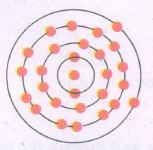
The atomic number and the mass number of an element is 26 and 56 respectively. Calculate the number of electrons, protons and neutrons in its atom. Draw the structure.
8.
Draw the structure of an atom and explain the position of the sub-atomic particles.
9.
Find what is common salt? Name the elements present in it? Write the formula of common salt. What are the atomic number and the mass number of the elements? Write the ions in the compound.
10.
An atom of an element has no electron, will that atom have any mass or not? Can an atom exist without electron? If so then give example.
1.
Atomic number Z = 9
No. of neutrons n = l0
Mass number A = ?
No. of neutrons n = A - Z
Mass number A = n + Z
= 10 + 9 = 19
The symbol of the element is 9Fe19 Fluorine
2.
(i) Atoms of the different elements can have the same number of neutrons are called "Isotones".
(ii) Ex : 29Ca40 and 19K39
(iii) Numbers of neutrons = A - Z = 20
3.
| Isotopes | Isobar |
| i) Having same atomic number,different mass number. | i) Having same mass number, different atomic number. |
| ii) Atoms of same element Ex : 1H1, 1H2, 1H3 |
ii) Atoms of different elements Ex : 20Ca40, 18Ar40 |
4.
(i) Proton (p): The proton is the positively charged particle and is located in the nucleus. Its positive charge is of the same magnitude as that of the electron's negative charge.
(ii) Neutron (n): Neutron is inside the nucleus. The neutron does not have any charge. Except hydrogen (protium), the nuclei of all atoms contain neutrons
(iii) Electron (e): This is a negatively charged particle. Electrons revolve around the nucleus of the atom in specific orbits. The mass of an electron is negligible as compared to that of a proton or neutron.
5.
(i) Valency is defined as the combining capacity of an element.
(ii) The valency of the element with atomic number 8, Oxygen (2,6) is = 2.
(iii) The compound formed by oxygen with hydrogen is water. \(\mathrm{O}_{2}+2 \mathrm{H}_{2} \rightarrow 2 \mathrm{H}_{2} \mathrm{O}\)
6.
i) Protons and neutrons in the nucleus of an atom are called as nucleons.
ii) They are located in the nucleus of an atom and are called so.
Properties:
i) Atomic mass is only depends on the mass of nucleous.
ii) They make the atom electrically neutral. (Protons - Positive, Neutrons - Neutral)
iii) Nucleons are similar in properties like mass except charge.
7.
Atomic number (Z) = 26, Mass number (A) = 56
No. of protons P = 26
No. of electrons e = 26
No. of neutrons n = A - Z
= 56 - 26 = 30
Atomic structure of 26Fe56 is
8.
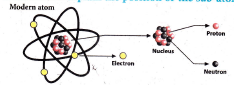
Sub-atomic particles:
(i) Proton (p): This is the positively charged particle and it is located at the nucleus.
(ii) Neutron (n): Neutron is inside the nucleus. The neutron does not have any charge. Except hydrogen (protium), the nucleus of all atoms contain neutrons.
(iii) Electron(e): This is a negatively charged particle. Electrons revolve around the nucleus of the atom in specific orbits.
9.
(i) Common salt is sodium chloride.
(ii) Sodium and chlorine elements are present in it.
(iii) The molecular formula of sodium chloride is NaCl.
| Elements | Atomic number | Mass number | Ions present |
| Sodium | 11 | 23 | Na+ |
| Chlorine | 17 | 35.5 | Cl- |
10.
(i) Yes, an atom of an element has no electron will have the mass.
(ii) (Atomic mass, only depends on the mrmber of protons and the number of neutrons inside the nucleus. It is independent of number of electrons.)
(iii) Atom can exist with out electron and becomes a cation.
Ex:
1) Hydrogen atoms (Z = 1) has only one electrons.
2) It loses one electron and becomes H+ ion
3) H → H+ + 1e-
(atom) (Ion)

7th Standard Syllabus & Materials
7th Standard
TN 7th English T1 - Supplementary - On Monday Morning Important Questions And Answers Study Material - QB365 Set A
NEW7th Standard
TN 7th English T1 - Prose - Eidgah Important Questions And Answers Study Material - QB365 Set A
NEW7th Standard
TN 7th Social Science T1 - ECO - Production Important Questions And Answers Study Material - QB365 Set A
NEW7th Standard
TN 7th Social Science T1 - GEO - Interior of the Earth Important Questions And Answers Study Material - QB365 Set A



Tamilnadu Stateboard 7th Standard Subjects
Tamilnadu Stateboard Standards




