
 100% FREE ACCESS
7th Standard Syllabus & Materials
7th Standard
TN 7th Tamil பருவம் -1 இயல் 1 - அமுதத்தமிழ் - ஒன்றல்ல இரண்டல்ல Important Questions And Answers Study Material - QB365 Set A
NEW7th Standard
TN 7th Tamil பருவம் -1 இயல் 1 - அமுதத்தமிழ் - எங்கள் தமிழ் Important Questions And Answers Study Material - QB365 Set A
NEW7th Standard
TN 7th English T1 - Poem - Your Space Important Questions And Answers Study Material - QB365 Set A
NEW7th Standard
TN 7th English T1 - Prose - A Prayer to the Teacher Important Questions And Answers Study Material - QB365 Set A
NEW7th Standard
TN 7th English T1 - Poem - The Listeners Important Questions And Answers Study Material - QB365 Set A
NEW7th Standard
TN 7th English T1 - Prose - The Wind on Haunted Hill Important Questions And Answers Study Material - QB365 Set A

Published on: 16/09/2019
Term 1 Five Mark
Download Tamil Nadu 7th Standard Science question papers, model tests, one-mark questions, important questions, and public exam papers in PDF format. Free study materials and answer keys for TN State Board students.
Questions + Answers key
Take MCQ Science Test1.
Draw the structure of an atom and explain the position of the sub-atomic particles.
2.
Write about any three Communicable diseases in details.
3.
Explain the types of stability with suitable examples.
4.
Differentiate metals and non metals.
5.
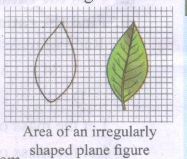
Describe the graphical method to find the area of an irregularly shaped plane figure.
6.
Write a brief account on pollination.
7.
With the help of Microsoft Photostory how will you create a video?
1.
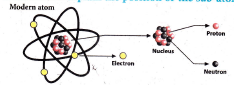
Sub-atomic particles:
(i) Proton (p): This is the positively charged particle and it is located at the nucleus.
(ii) Neutron (n): Neutron is inside the nucleus. The neutron does not have any charge. Except hydrogen (protium), the nucleus of all atoms contain neutrons.
(iii) Electron(e): This is a negatively charged particle. Electrons revolve around the nucleus of the atom in specific orbits.
2.
Tuberculosis:
(i) Causative agent : Mycobacterium tuberculae bacteria.
(ii) Transmission : Spread from one person to another through air by spitting and prolonged contact with patient.
(iii) Symptoms : Fever, weight loss, chronic cough, bloody spitting and difficulty in breathing
(iv) Prevention and treatment : BCG vaccinations. Giving special attention to the patient. Regular medication like DOT
Chicken pox:
(i) Causative agent : varicella zoster virus.
(ii) Transmission : Spread through air and contact with infected person.
(iii) Symptoms : Appearance of rashes on the whole body, fever, headache and tiredness.
(iv) Prevention and treatment : Chicken pox vaccine is the best way to prevent. Special attention should be given to infected person
Robies:
(i) Causative agent: Virus (rhabdo virus)
(ii) Transmission : By the bite of the infected dog, cat, etc.
(iii) Symptoms: Hydrophobia, fever for 2-12 weeks and exaggerations
(iv) Prevention and treatment : Fatality can be prevented by timely vaccination before onset of symptoms.
3.
Stability:
Stability is a measure of the body's ability to maintain its original position.
The three types of stability are
(i) Stable equilibrium
(ii) Unstable equilibrium
(iii) Neutral equilibrium
Stable Equilibrium:
i) The frustum can be tilted through quite a big angle without toppling.
ii) Its centre of gravity is raised when it is displaced.
iii) The vertical line through its centre of gravity still falls within its base.
iv) So it can return to its original position.
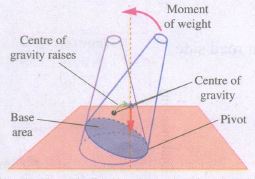
Unstable Equilibrium:
i) The frustum will topple with the slightest tilting. Its centre of gravity is lowered when it is displaced.
ii) The vertical line through its centre of gravity falls outside its base.
.JPG)
Neutral Equilibrium:
(i) It causes frustum to topple.
(ii) The frustum will rolls about but does not topple.
(iii) Its centre of gravity remains at the same height when it is displaced.
(iv) The body will stay in any position to which it has been displaced.
.JPG)
4.
| Metals | Non-metals |
| (i) Lustrous and have shiny surface. | (i) Non-lustrous and have non-shiny surface. |
| (ii) They are generally hard. | (ii) They are generally Soft. |
| (iii) They are ductile. | (iii) They are non-ductile. |
| (iv) Good conductors of heat and electricity. | (iv) Bad conductors of heat and electricity. |
| (v) Metals are making sound when struck.(Sonorous) | (v) Non-metals do not make sound when struck. (Non-sonorous) |
5.
Take a leaf from any one of trees in your neighbourhood. Place the leaf on a graph sheet and draw the outline of the leaf with a pencil. Remove the leaf. You can see the outline of the leaf on the graph sheet.
i) Now count the number of whole squares enclosed within the outline of the leaf. Take it to be M
ii) Then count the number of squares that are more than half. Take it as N
iii) Next, Count the number of squares which are half of a whole square. Note it to be P.
iv) Finally, count the number of squares that are less than half. Let it be a Q.
v) Now the approximate area of the leaf can be calculated using the following formula.
Approximate area of the leaf = M+(3/4)N+(1/2)P+(1/4)
This formula can be used to calculate the area of any irregularly shaped plane figures.
6.
The process by which pollen grains reach stigma of the flower is called as pollination. Pollination can be classified into two types based on their mode of transmission.
i) Artificial pollination:
The transfer of pollen grains from anther to stigma by manually is called as artificial pollination
ii) Natural Pollination:
1) The transfer of pollen grains from anther to stigma by insect or any other natural sources is called as natural pollination.
2) Pollination can be classified into another two types based on their site of transmission
i) Self pollination:
Pollen grains are transferred from the anther to the stigma of the same flower or to another flower of the same plant is known as self pollination.
ii) Cross pollination:
Pollen grains are transferred from the anther of one flower to the stigma of another flower of the same kind or different plant known as cross pollination.
7.
Step 1: Open the application of 'Microsoft Photostory'. In that select "Begin A New Story" and click on Next.
Step 2: Click "Import Picture" in the next screen. Select 'Saved pictures' for video. If required, We can edit the image and click on Next.
Step 3: Now we can input small text, animation, audio effect for the picture then click Next.
Step 4: To provide background music, we can select a music file through "Select Music" and click on Next.
Step 5: select a title for the story, then through SETTINGS change the format of the video.
Step 6: Now our video is ready to view. Click "VIEW YOUR STORY". You can see your video now.

7th Standard Syllabus & Materials
7th Standard
TN 7th English T1 - Supplementary - On Monday Morning Important Questions And Answers Study Material - QB365 Set A
NEW7th Standard
TN 7th English T1 - Prose - Eidgah Important Questions And Answers Study Material - QB365 Set A
NEW7th Standard
TN 7th Social Science T1 - ECO - Production Important Questions And Answers Study Material - QB365 Set A
NEW7th Standard
TN 7th Social Science T1 - GEO - Interior of the Earth Important Questions And Answers Study Material - QB365 Set A



Tamilnadu Stateboard 7th Standard Subjects
Tamilnadu Stateboard Standards




