
 100% FREE ACCESS
7th Standard Syllabus & Materials
7th Standard
TN 7th Tamil பருவம் -1 இயல் 1 - அமுதத்தமிழ் - ஒன்றல்ல இரண்டல்ல Important Questions And Answers Study Material - QB365 Set A
NEW7th Standard
TN 7th Tamil பருவம் -1 இயல் 1 - அமுதத்தமிழ் - எங்கள் தமிழ் Important Questions And Answers Study Material - QB365 Set A
NEW7th Standard
TN 7th English T1 - Poem - Your Space Important Questions And Answers Study Material - QB365 Set A
NEW7th Standard
TN 7th English T1 - Prose - A Prayer to the Teacher Important Questions And Answers Study Material - QB365 Set A
NEW7th Standard
TN 7th English T1 - Poem - The Listeners Important Questions And Answers Study Material - QB365 Set A
NEW7th Standard
TN 7th English T1 - Prose - The Wind on Haunted Hill Important Questions And Answers Study Material - QB365 Set A

Published on: 01/10/2019
Term 1 Measurement
Download Tamil Nadu 7th Standard Science question papers, model tests, one-mark questions, important questions, and public exam papers in PDF format. Free study materials and answer keys for TN State Board students.
Questions + Answers key
Take MCQ Science Test1.
Define one light year.
2.
What is meant by area?
3.
What is measurement?
4.
A box is made up of iron and it has a volume of 125 cm3. Find its mass. (Density of iron is 7.8 g / cm3).
5.
Define the density of objects.
6.
How will you find the area of irregular objects?
7.
How will you find the volume of an irregularly shaped object (stone) by using measuring cylinder?
8.
How will you determine the density of a stone using a measuring jar?
9.
Describe the graphical method to find the area of an irregularly shaped plane figure.
1.
One light year is defined as the distance traveled by light in vacuum during the period of one year. 1 light year = 9.46 x 10¹⁵ m.
2.
Area is the measure of the region inside a closed line.
3.
Comparison of an unknown quantity with a standard quantity is called measurement
4.
Density = Mass / Volume
Hence, Mass = Volume \(\times\) Density
= 125 \(\times\) 7.8 = 975 g.
5.
Density of a substance is defined as the mass of the substance contained in unit volume (1 m3).
Density (D) = mass (M)/volume(V)
D = M/V
SI unit of density - kg/m3
6.
(i) Place the irregular object on a graph sheet and draw its outline. Then remove the object
(ii) To find the area enclosed by the outline count the number of small squares.
(iii) If more than half-a-square is inside the boundary, count it as one otherwise neglect it.
(iv) The area of each small square is 1sq. mm.
(v) Area of the irregular object = No. of squares x 1 sq.mm.
7.
(i) Take a measuring cylinder and pour some water into it.
(ii) Note down the volume of water from the readings of the measuring cylinder.
(iii) Take it as V1
(iv) Now take Q small stone and tie it with a thread.
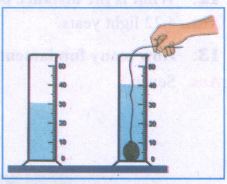
(v) Immerse the stone inside the water by holding the thread.
(vi) This has to be done such that the stone does not touch the walls of the measuring cylinder.
(vii) Now the level of water has raised.
(viii) Note down the volume. of water and take it to be V2
The volume of the stone is equal to the raise in the volume of water.
V1 = 30cc, V2 = 40cc
Volume of stone = V2 - V1 = 40 - 30 = 10 cc
8.
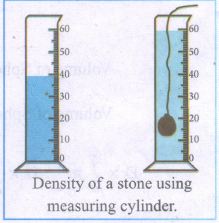
i) Take a measuring cylinder and pour some water into it.
ii) Note down the volume of water from the readings of the measuring cylinder. Take it as V1.
iii) Now take a small stone and tie it with a thread.
iv) Immerse the stone inside the water by holding the thread.
v) The stone should not touch the walls of the measuring cylinder.
vi) Note down the volume of water and take it to be V2
vii) The volume of the stone is equal to the raise in the volume of water.
viii) Volume of stone = V2 - V1
9.
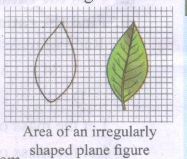
Take a leaf from any one of trees in your neighbourhood. Place the leaf on a graph sheet and draw the outline of the leaf with a pencil. Remove the leaf. You can see the outline of the leaf on the graph sheet.
i) Now count the number of whole squares enclosed within the outline of the leaf. Take it to be M
ii) Then count the number of squares that are more than half. Take it as N
iii) Next, Count the number of squares which are half of a whole square. Note it to be P.
iv) Finally, count the number of squares that are less than half. Let it be a Q.
v) Now the approximate area of the leaf can be calculated using the following formula.
Approximate area of the leaf = M+(3/4)N+(1/2)P+(1/4)
This formula can be used to calculate the area of any irregularly shaped plane figures.

7th Standard Syllabus & Materials
7th Standard
TN 7th English T1 - Supplementary - On Monday Morning Important Questions And Answers Study Material - QB365 Set A
NEW7th Standard
TN 7th English T1 - Prose - Eidgah Important Questions And Answers Study Material - QB365 Set A
NEW7th Standard
TN 7th Social Science T1 - ECO - Production Important Questions And Answers Study Material - QB365 Set A
NEW7th Standard
TN 7th Social Science T1 - GEO - Interior of the Earth Important Questions And Answers Study Material - QB365 Set A



Tamilnadu Stateboard 7th Standard Subjects
Tamilnadu Stateboard Standards




