
 100% FREE ACCESS
7th Standard Syllabus & Materials
7th Standard
TN 7th Tamil பருவம் -1 இயல் 1 - அமுதத்தமிழ் - ஒன்றல்ல இரண்டல்ல Important Questions And Answers Study Material - QB365 Set A
NEW7th Standard
TN 7th Tamil பருவம் -1 இயல் 1 - அமுதத்தமிழ் - எங்கள் தமிழ் Important Questions And Answers Study Material - QB365 Set A
NEW7th Standard
TN 7th English T1 - Poem - Your Space Important Questions And Answers Study Material - QB365 Set A
NEW7th Standard
TN 7th English T1 - Prose - A Prayer to the Teacher Important Questions And Answers Study Material - QB365 Set A
NEW7th Standard
TN 7th English T1 - Poem - The Listeners Important Questions And Answers Study Material - QB365 Set A
NEW7th Standard
TN 7th English T1 - Prose - The Wind on Haunted Hill Important Questions And Answers Study Material - QB365 Set A

Published on: 20/09/2019
Download Tamil Nadu 7th Standard Science question papers, model tests, one-mark questions, important questions, and public exam papers in PDF format. Free study materials and answer keys for TN State Board students.
Questions + Answers key
Take MCQ Science Test1.
_______ is positively charged.
Proton
Electron
Molecule
Neutron
2.
Suppose a boy is enjoying a ride on a marry go round which is moving with a constant speed of 10 m/s. It implies that the boy _______.
at rest
moving with no acceleration
in accelerated motion
moving with uniform velocity
3.
Pollinators are _________.
Wind
Water
Insect
All the above
4.
Who uses the Photoshop software more ?
Teacher
Doctor
Painter
Photographer
5.
An element which is always lustrous, malleable and ductile is _______.
non-meta
metal
metalloid
gas
6.
Define - Atom.
7.
What is hygiene?
8.
Define the following terms with an example of each:
a. Element
b. Compound
c. Metal
d. Non-metal
e. Metalloid
9.
What is Raster Graphics?
10.
Name the liquid in which an iron ball sinks.
11.
What is centre of gravity ?
12.
Define molecule.
13.
What is cross pollination?
14.
What is one light year?
15.
Mass
16.
Speed of ship
17.
Cholera
18.
Phylloclade
19.
Raster
20.
The _______ revolve around the nucleus.
21.
In _______ equilibrium its centre of gravity remains at the same height when it is displaced.
22.
Tuberculosis is caused by the bacterium__________.
23.
Density of mercury is ________.
24.
A substance which contains less number of molecules per unit volume is said to be denser.
25.
Water is denser than kerosene.
26.
Leaves of Aloe vera are fleshy and store water.
27.
A complete flower has four whorls.
28.
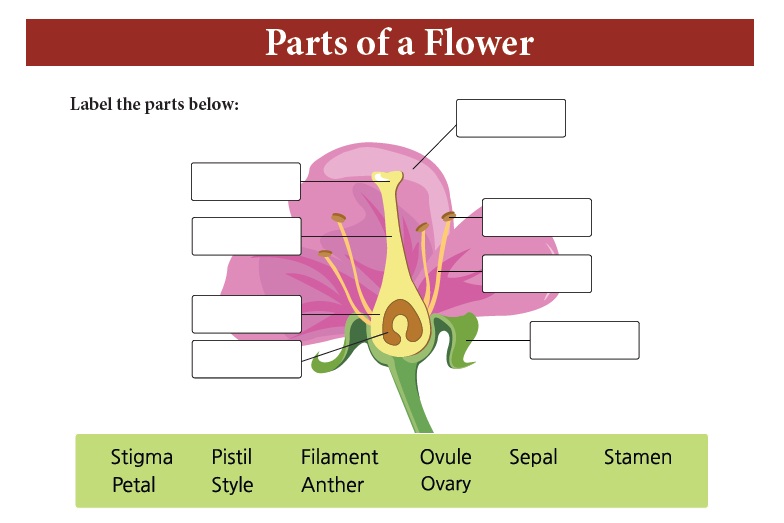
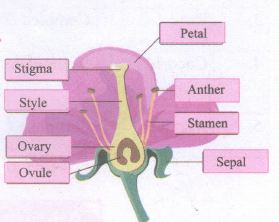
Label the picture given below. Parts of a Flower
29.
Write about any three Communicable diseases in details.
30.
Differentiate between elements and compounds
31.
Geetha takes 15 minutes from her house to reach her school on a bicycle. If the bicycle has a speed of 2 m/s, calculate the distance between her house and the school.
32.
| Dog | _______ |
| _____ | Dengue |
33.
| Tuberculosis | ________ |
| _______ | Virus |
34.
| Element | Latin Name | Symbol |
| Mercury | - | Hg |
| Lead | Plumbum | - |
| Iron | - | Fe |
| Potassium | Kalium | - |
1.
(a)
Proton
2.
(d)
moving with uniform velocity
3.
(d)
All the above
4.
(d)
Photographer
5.
(b)
metal
6.
An atom is the smallest particle of a chemical element that retains its chemical properties.
7.
Hygiene refers to the good habits and the practices which is followed to prevent diseases, maintain good health, especially through cleanliness, consumption of safe drinking water and proper disposal of sewage.
8.
a) Element:
Simplest form of matter is called an element.
Ex: Sodium Chlorine, Hydrogen and Oxygen.
b) Compound:
A compound is formed by the chemical combination of the atoms of two or more elements in definite proportions.
Ex: Water (H2O).
c) Metal:
Metals are generally hard and shiny elements.
Ex: Copper, Lead
d) Non-metol:
Non-metals are generally dull and soft.
Ex: Oxygen, Hydrogen, Chlorine.
e) Metalloid:
Metalloids exhibit the properties of both metals and non-metals.
Ex: Silicon, Arsenic, Boron
9.
Raster graphics are created on the basis of pixels. When we enlarge this types of photos, we could see the pictures as rectangular layers or grids.
10.
Iron ball sinks in all the liquids apart from mercury.
11.
The centre of gravity of an object is the point through which the entire weight of the object appears to act.
12.
A molecule is made up of two or more atoms chemically combined.
13.
Pollen grains are transferred from the anther of one flower to the stigma of another flower of the same kind or different plant is known as cross pollination.
14.
One light year is defined as the distance travelled by light in vacuum during the period of one year.
1 Light year = 9.46 \(\times\) 1015m
15.
amount of a substance
16.
Knot
17.
Cramps in legs
18.
Opuntia
19.
Pixels
20.
()
electrons
21.
()
neutral
22.
()
Mycobacterium tuberculae
23.
()
13,600 kg/m3
24.
False
Correct Statement: A substance which contains less number of molecules per unit volume is said to be rarer.
25.
True
26.
True
27.
True
28.
29.
Tuberculosis:
(i) Causative agent : Mycobacterium tuberculae bacteria.
(ii) Transmission : Spread from one person to another through air by spitting and prolonged contact with patient.
(iii) Symptoms : Fever, weight loss, chronic cough, bloody spitting and difficulty in breathing
(iv) Prevention and treatment : BCG vaccinations. Giving special attention to the patient. Regular medication like DOT
Chicken pox:
(i) Causative agent : varicella zoster virus.
(ii) Transmission : Spread through air and contact with infected person.
(iii) Symptoms : Appearance of rashes on the whole body, fever, headache and tiredness.
(iv) Prevention and treatment : Chicken pox vaccine is the best way to prevent. Special attention should be given to infected person
Robies:
(i) Causative agent: Virus (rhabdo virus)
(ii) Transmission : By the bite of the infected dog, cat, etc.
(iii) Symptoms: Hydrophobia, fever for 2-12 weeks and exaggerations
(iv) Prevention and treatment : Fatality can be prevented by timely vaccination before onset of symptoms.
30.
| Elements | Compunds |
| (i) An element is the simplest substance | (i) They formed by the cornbination of two or more elements. |
| (ii) They combine to form compounds | (ii) They can be splited into elements. |
| (iii) Atoms are the fundamental particle of an element | (iii) Molecules are the fundamental particles of a compound. |
31.
Speed (S) = 2m / s
Time (t) = 15 minutes = 15 \(\times\) 60 = 900 s
Distance (D) = ?
\(S = \frac{D}{t} \)
D = S \(\times\) t
D = 2 \(\times\) 900
D = 1800 m
Distance between her house and school = 1800 m.
32.
| Dog | Rabies |
| Mosquito | Dengue |
33.
| Tuberculosis | Bacteria |
| Hepatitis | Virus |
34.
| Element | Latin Name | Symbol |
| Mercury | Hydrargyrum | Hg |
| Lead | Plumbum | Pb |
| Iron | Ferrum | Fe |
| Potassium | Kalium | K |

7th Standard Syllabus & Materials
7th Standard
TN 7th English T1 - Supplementary - On Monday Morning Important Questions And Answers Study Material - QB365 Set A
NEW7th Standard
TN 7th English T1 - Prose - Eidgah Important Questions And Answers Study Material - QB365 Set A
NEW7th Standard
TN 7th Social Science T1 - ECO - Production Important Questions And Answers Study Material - QB365 Set A
NEW7th Standard
TN 7th Social Science T1 - GEO - Interior of the Earth Important Questions And Answers Study Material - QB365 Set A



Tamilnadu Stateboard 7th Standard Subjects
Tamilnadu Stateboard Standards




