
 100% FREE ACCESS
7th Standard Syllabus & Materials
7th Standard
TN 7th Tamil பருவம் -1 இயல் 1 - அமுதத்தமிழ் - ஒன்றல்ல இரண்டல்ல Important Questions And Answers Study Material - QB365 Set A
NEW7th Standard
TN 7th Tamil பருவம் -1 இயல் 1 - அமுதத்தமிழ் - எங்கள் தமிழ் Important Questions And Answers Study Material - QB365 Set A
NEW7th Standard
TN 7th English T1 - Poem - Your Space Important Questions And Answers Study Material - QB365 Set A
NEW7th Standard
TN 7th English T1 - Prose - A Prayer to the Teacher Important Questions And Answers Study Material - QB365 Set A
NEW7th Standard
TN 7th English T1 - Poem - The Listeners Important Questions And Answers Study Material - QB365 Set A
NEW7th Standard
TN 7th English T1 - Prose - The Wind on Haunted Hill Important Questions And Answers Study Material - QB365 Set A

Published on: 04/10/2019
Term 2 Cell Biology
Download Tamil Nadu 7th Standard Science question papers, model tests, one-mark questions, important questions, and public exam papers in PDF format. Free study materials and answer keys for TN State Board students.
Questions + Answers key
Take MCQ Science Test1.
On the lines given below, write about what you have learned from the activities done in this lesson.
Let me tell you about some of the important things I’ve learned about cells. First, I’ll start with…_______.
2.
Write a short note on nucleus.
3.
Write correct sequence from cell to organism?
4.
Distinguish between the following pairs Smooth ER and Rough ER Cell wall and cell membrane Chloroplast and mitochondria
5.
Why the cell is very important for us?
6.
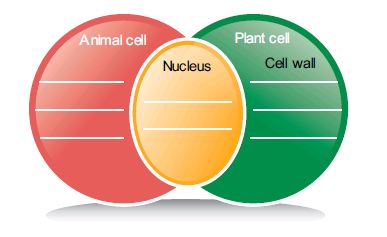
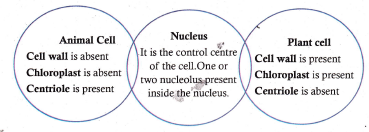
Compare the plant cell and the animal cell and complete the illustration given below.
7.
In a situation, how to explain, while your friend ask what is this, never seen before?
8.
Write about any three organelles in detail.
9.
Virus is called Acellular. Why?
1.
Cells are the basic structural and functional unit of living organism. It can seen only under a microscope. Inside the cell many tiny particles called cell organelles. These organelles are responsible for providing needs of the cell. Cell membrane is a protector. Mitochondria is a powerhouse of the cell. In plants chloroplast is a food producers. Lysosomes are digestive componenets of the cell, Endoplasmic reticulum synthesise protein, Iipid and steroids. Nucleus is the brain of the cell.
2.
Plant and animal cells have a nucleus inside the cytoplasm. It is surrounded by a nuclear envelope. One or two nucleolus and the chromatin body are present inside the nucleus. During cell division the chromatin body is organised in a chromosome
3.
Cell, tissue, organ, organ system, organism
4.
Smooth ER and Rough ER
| S.No | Smooth ER | Rough ER |
| 1. | It is a network of tubular sacs without ribosomes on the membrane. | It is a network of tubular sacs with ribosomes on the memebrane. |
| 2. | They play a role in the synthesis of lipids steroids. | It helps in synthesis of protein. |
Cell wall and Cell membrane
| S.No | Cell wall | Cell membrane |
| 1. | It is present in plant cell. | It is present in animal cell |
| 2. | It is made up of cellulose | It is made up of protein and lipids. |
Chloroplast and Mitochondria
| S.No | Chloroplast | Mitochondria |
| 1. | It is found in only plant cell. | It is present in both plant and animal cell. |
| 2. | It is a food producer. | It is the powerhouse of the cell. |
5.
The building wall is made up of numerous bricks. In similar manner, all living organisms made up of cell. Cell is the fundamental life of organism. So cell is very important for us.
6.
7.
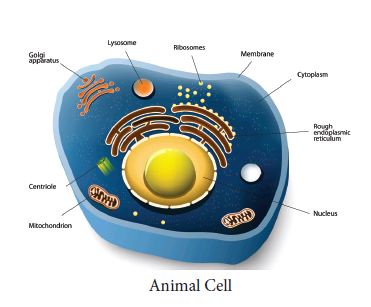
This is Animal cell. The boundary of the cell is known as cell membrane. Inside the cell membrane many tiny organelles present in the cytoplasm. The cell organelles are golgi apparatus, Lysosomes, Ribosomes, Rough and Smooth endoplasmic reticulum, mitochondria and nucleus, Mitochondria is the power house of the cell. The energy produced with in the mitochondrian is used for all the metabalic activities of the cell. Lysosomes are called as suicidal bags because they are the main digestive compartments. Endoplasmic reticulum synthesis of protein lipid and steriods. Nucleus is the brain of the cell. It controls all the processes of chemical reactions that take place inside the cell.
8.
(i) Golgi Complex:
Membrane bounded sacs are stacked on top of the other with associated secretory vesicles are collectively known as golgi complex. Functions of golgi complex are the production of secretory substances, packaging and secretion. This is the secret behind the change in the colour and taste of fruits.
(ii) Lysosome:
You will find organelles called as lysosomes, which are very small to view using a light microscope. They are the main digestive compartments of the cell. They lyse a cell, hence they are called "suicidal bag".
(iii) Nucleus:
Plant and animal cells have a nucleus inside the cytoplasm. It is surrounded by a nuclear envelope. One or two nucleolus and the chromatin body are present inside the nucleus. During cell division, the chromatin body is organised into a chromosome. Storage of genetic material and transfers heredity characters from generation to generation are the functions of chromosome.
9.
Virus is called Acellular because they are not built up out of cells. They are much smaller than cells.
They reproduce only in the living host cells. So virus is called Acellular organisam.

7th Standard Syllabus & Materials
7th Standard
TN 7th English T1 - Supplementary - On Monday Morning Important Questions And Answers Study Material - QB365 Set A
NEW7th Standard
TN 7th English T1 - Prose - Eidgah Important Questions And Answers Study Material - QB365 Set A
NEW7th Standard
TN 7th Social Science T1 - ECO - Production Important Questions And Answers Study Material - QB365 Set A
NEW7th Standard
TN 7th Social Science T1 - GEO - Interior of the Earth Important Questions And Answers Study Material - QB365 Set A



Tamilnadu Stateboard 7th Standard Subjects
Tamilnadu Stateboard Standards




