
 100% FREE ACCESS
7th Standard Syllabus & Materials
7th Standard
TN 7th Tamil பருவம் -1 இயல் 1 - அமுதத்தமிழ் - ஒன்றல்ல இரண்டல்ல Important Questions And Answers Study Material - QB365 Set A
NEW7th Standard
TN 7th Tamil பருவம் -1 இயல் 1 - அமுதத்தமிழ் - எங்கள் தமிழ் Important Questions And Answers Study Material - QB365 Set A
NEW7th Standard
TN 7th English T1 - Poem - Your Space Important Questions And Answers Study Material - QB365 Set A
NEW7th Standard
TN 7th English T1 - Prose - A Prayer to the Teacher Important Questions And Answers Study Material - QB365 Set A
NEW7th Standard
TN 7th English T1 - Poem - The Listeners Important Questions And Answers Study Material - QB365 Set A
NEW7th Standard
TN 7th English T1 - Prose - The Wind on Haunted Hill Important Questions And Answers Study Material - QB365 Set A

Published on: 25/11/2019
Download Tamil Nadu 7th Standard Social Science question papers, model tests, one-mark questions, important questions, and public exam papers in PDF format. Free study materials and answer keys for TN State Board students.
Questions + Answers key
Take MCQ Social Science Test
1.
Who becomes the Chief Minister?
Leader of the Majority party
Leader of the opposition party
Both
None
2.
The word State government refers to ______.
Government departments in the states
Legislative Assembly
both a and b
none of the above
3.
In which district courtallam waterfalls is located?
Dharmapuri
Tirunelveli
Namakkal
Theni
4.
Where is the largest solar power project situated in India?
Kamuthi
Aralvaimozhi
Muppandal
Neyveli
5.
Which one of the following is renewable resource?
Gold
Iron
Petrol
solar energy
6.
How was the Prime Minister of Maratha kings known?
Deshmukh
Peshwa
Panditrao
Patil
7.
Who was the teacher and guardian of Shivaji?
Dadaji Kondadev
Kavi Kalash
Jijabai
Ramdas
8.
Who introduced the Persian style of architecture in India?
Humayun
Babur
Jahangir
Akbar
9.
Who ended the Sultanate in Madurai?
Saluva Narasimha
Devaraya II
Kumara Kampana
Tirumaladeva Raya
10.
The elected representatives who are not the member of ruling party are called_________.
11.
Every individual person is a medium of _________.
12.
Suruli falls is also called as ________.
13.
________ is used in making electrical batteries.
14.
The spread of the _________ movement in Maharashtra helped the Maratha people develop consciousness and oneness.
15.
The Sufi saint who received Akbar’s utmost respect was _________.
16.
_________was the capital of Aravidu dynasty.
17.
MLAs
18.
Web media
19.
Limestone
20.
Shambhuji
21.
Prataparudra
22.
Assertion: India has a federal system of government.
Reason: According to our constitution the power is divided between central and state governments.
a. A is correct and R explains A
b. A is correct and R does not explain A
c. A is correct and R is wrong
d. Both are wrong
23.
Assertion (A) : The Vijayanagar army was considered one of the feared armies in India.
Reason (R) : Vijayanagar armies used both firearm and cavalry.
a) R is not the correct explanation of A
b) R is correct explanation of A
c) A is correct and R is wrong
d) (A) and (R) are Correct
24.
Shahji
Shivaji
Shambhuji
Shahu
Rahuji Bhonsle.
25.
Harihara II
Muhammad I
Krishnadeva Raya
Devaraya I.
26.
Hymns composed in Sanskrit by the Bhakti saints were sung by people of all castes and classes.
27.
Babur inherited Farghana, a small kingdom in Central Asia.
28.
There were 18 monarchs of the Bahmani dynasty
29.
Who appoints the chief minister and other ministers?
30.
State any two responsibility of media.
31.
Chauth and Sardeshmukhi.
32.
The five independent kingdoms of Deccan Sultanate.
33.
What is the role of Chief Minister and other Council of Ministers at the state level?
34.
Explain the Geographical components of Tourism?
35.
Examine the essential features of Maratha administration under Shivaji.
36.
Shah Jahan’s time witnessed the climax of Mughal splendour. Support this statement in comparison with the times of other Mughal rulers.
37.
Discuss the causes for the decline of Vijayanagar rule. To what extent the Bahmani sultans contributed to it?
38.
Highlight the boundaries of Vijayanagar Empire and Bahmani kingdom.
39.
Name any five hill stations in India?
40.
Define - Resource.
41.
Write the circumstance that led to the Battle of Panipat in 1526.
1.
(a)
Leader of the Majority party
2.
(c)
both a and b
3.
(b)
Tirunelveli
4.
(a)
Kamuthi
5.
(d)
solar energy
6.
(b)
Peshwa
7.
(a)
Dadaji Kondadev
8.
(b)
Babur
9.
(c)
Kumara Kampana
10.
()
Opposition party
11.
()
Expression
12.
()
Cloud Land falls (or) Meghamalai falls
13.
()
Manganese
14.
()
Bhakti
15.
()
Salim Chishti
16.
()
Penukonda
17.
Legislative Assembly
18.
Google website
19.
Sedimentary rock
20.
Son of Shivaji
21.
Ruler of Odisha
22.
a. A is correct and R explains A
23.
b) R is correct explanation of A
24.
Rahuji Bhonsle
25.
Muhammad I
26.
(b)
27.
(a)
28.
(a)
29.
The Governor appoints the Chief Minister and other Ministers.
30.
(i) The media has a massive responsibility in providing facts.
(ii) The media should help people to express their opinion on important social.
31.
Shivaji claimed suzerainty, but he did not administer them himself. He protected the people from loot and plunder for which they were required to pay Chauth (one-fourth of the revenue as protection money) and Sardeshmuki (an extra one-tenth, as the chieftain's due).
32.
The five independent Deccan kingdoms were Bidar, Bijapur, Ahmednagar, Berar and Golconda.
33.
(i) The Chief Minister is the real executive head of the state administration.
(ii) He allocates the portfolios among the ministers.
(iii) The Council of Ministers are collectively responsible to the State Legislature.
(iv) All the ministers work as a team under the Chief Minister.
(v) The Chief Minister formulates programmes and policies for the welfare of the people of the state.
(vi) The Council of Ministers is collectively responsible to the Legislative Assembly of the state.
34.
(i) Landforms:
Mountains, Plateaus, Canyons, Valleys, Caves, Cirques, Sand dunes, Coral reefs, Cliffs, etc.,
(ii) Water:
Rivers, Lakes, Waterfalls, Hot springs and Geysers, Snow and Glacier, Water Currents, Tides and Waves.
(iii) Vegetation:
Forest, Grasslands, Moors, Deserts etc.,
(iv) Climate:
Sunshine, Clouds, Admirable Temperature, Rain and Snow.
(v) Animal life:
(a) Wildlife: Birds, Game Reserves, Zoos.
(b) Hunting and Fishing
(vi) Setflement features:
(a) Towns, Cities, Villages
(b) Historical remains and Monuments
(vii) Culture:
Ways of life, traditions, folklore, arts and crafts.
35.
Shivaji's political system consisted of three circles. At the centre was the swaraj. Shivaji would not allow the people to be harassed in any way. In the second circle, Shivaji claimed suzerainty, He protected the people from loot and plunder for which they were required to pay chauth (one fourth of the revenue as protection money) and sardeshmukhi (an extra one-tenth, as the chieftain's due). In the third circle, Shivaji's only objective was plunder. Deshmukhs held sway over rural regions and their control was over between twenty and hundred villages. Each village had a powerful headman (patil), who was assisted by a village accountant of a keeper of records (kulkami).
Army:
Shivaji gave utmost attention to his army and training of its personnel. In the beginning, the backbone of his army was the infantry. In the plains, his cavalry force grew in size and importance. Every soldier was selected personally by Shivaji. Retired captains holding a high reputation were put in charge of guarding the forts.
Ashtapradha
Shivaji designated eight ministers as the Ashtapradhan, each holding an important portfolio. Peshwa was the equivalent of a modem prime minister in the Maratha Empire. Originally, they were subordinates to the Chhatrapati.Shivaji was influenced by the Mughal revenue system. The assessments were made on the actual yield, with three-fifths left to the cultivator and two-fifths taken by the government. In judicial administration, civil cases continued to be decided by the panchayat, the village council, while criminal law was based on the shastras, the Hindu law hooks.
Responsibilities of the Astarpradhan:
Pantpradhan / Peshwa - Prime Minister
Amatya / Mazumdar - Finance Minister
Shurunavis/Sacheev - Secretary
Waqia-Navis - Interior Minister
Sar-i-Naubat / Senapati - Commander-in-Chief
Sumant / Dubeer - Foreign Minister
Nyayadhish - Chief Justice
Panditrao - High Priest
36.
(i) The famous peacock throne, covered with expensive jewels, was made during Shah Jahan's time for the emperor to sit on. The world famous Taj Mahal, the Moti Masjid, the pearl mosque at Agra, the Jama Masjid of Delhi, the Diwan-iKhas and Diwan - i Am in his palace exhibit his taste for Art and Architecture.
(ii) Babur built many structures at Agra, Biana, Dholpur, Gwalior and Kiul in Persian style of Architecture.
(iii) Sher shah built a mausoleum at Sasaram. Diwan-i-khas, Diwan-i-Am, panch Mahal Rang Mahal, Salim Chishti's tomb and Buland Darwazawere built during Akbar's time.
(iv) Jahangir completed Akbar's, tomb at Sikandara and the beautiful building containing the tomb of Itmad-ud-daula, at Agra.
(v) During Aurangzeb's reign, architecture did not receive much patronage.
37.
The main causes of the decline of the Vijayanagar empire were
(i) After Krishna Devaraya, the rulers were inefficient in the Vijayanagar empire. Making use of the situation the commanders declared independence.
(ii) There were frequent wars between Vijayanagar and Bahmani kingdom which made the country economically weak.
(ii) Finally, the sultans of Deccan kingdoms formed a league against Vijayanagar. The combined forces of the enemies defeated Vijayanagar in the Battle of Talikota in 1565 A.D.
(iv) These Sultans destroyed the buildings, palaces, temples and the capital city of Hampi.
38.
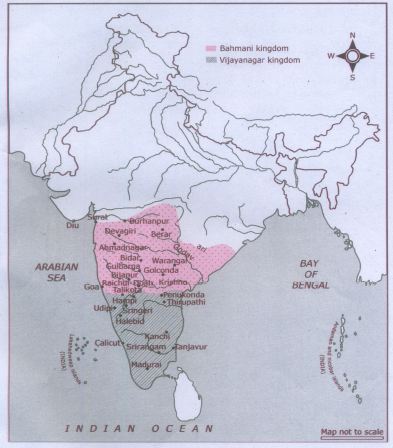
39.
Kodaikanal, Ooty - TamilNadu
Nainital, Mussoorie - Uttarakhand
Darjeeling - West Bengal
Gulmarg - Jammu & Kashmir
Shillong - Meghalaya
40.
Anything which can be used for satisfying the human needs is called resource. Natural resources are resources that exist without action of humankind.
41.
Babur did not have any ambition beyond Punjab till 1524. Then a greater opportunity came knocking. Dilawar Khan, who was Daulat Khan Lodi's son, and Alam Khan, who was the uncle of Sultan of Delhi, arrived in Kabul to seek Babur's help in removing Ibrahirn Lodi from power. Babur defeated Ibrahim Lodi in the famous Battle of Panipat in 1526.

7th Standard Syllabus & Materials
7th Standard
TN 7th English T1 - Supplementary - On Monday Morning Important Questions And Answers Study Material - QB365 Set A
NEW7th Standard
TN 7th English T1 - Prose - Eidgah Important Questions And Answers Study Material - QB365 Set A
NEW7th Standard
TN 7th Social Science T1 - ECO - Production Important Questions And Answers Study Material - QB365 Set A
NEW7th Standard
TN 7th Social Science T1 - GEO - Interior of the Earth Important Questions And Answers Study Material - QB365 Set A



Tamilnadu Stateboard 7th Standard Subjects
Tamilnadu Stateboard Standards



