
 100% FREE ACCESS
7th Standard Syllabus & Materials
7th Standard
TN 7th Tamil பருவம் -1 இயல் 1 - அமுதத்தமிழ் - ஒன்றல்ல இரண்டல்ல Important Questions And Answers Study Material - QB365 Set A
NEW7th Standard
TN 7th Tamil பருவம் -1 இயல் 1 - அமுதத்தமிழ் - எங்கள் தமிழ் Important Questions And Answers Study Material - QB365 Set A
NEW7th Standard
TN 7th English T1 - Poem - Your Space Important Questions And Answers Study Material - QB365 Set A
NEW7th Standard
TN 7th English T1 - Prose - A Prayer to the Teacher Important Questions And Answers Study Material - QB365 Set A
NEW7th Standard
TN 7th English T1 - Poem - The Listeners Important Questions And Answers Study Material - QB365 Set A
NEW7th Standard
TN 7th English T1 - Prose - The Wind on Haunted Hill Important Questions And Answers Study Material - QB365 Set A

Published on: 11/12/2019
Reproduction and Modification in Plants
Download Tamil Nadu 7th Standard Science question papers, model tests, one-mark questions, important questions, and public exam papers in PDF format. Free study materials and answer keys for TN State Board students.
Questions + Answers key
Take MCQ Science Test1.
Climbing roots are seen in ______.
Betel
Black pepper
Both of them
None of them
2.
Pollinators are _________.
Wind
Water
Insect
All the above
3.
Reproductive part of a plant is _________.
Root
Stem
Leaf
Flower
4.
Asexual reproduction in yeast is _________.
Spore formation
Fragmentation
Pollination
Budding
5.
Vegetative propagation by leaves takes place in _________.
Bryophyllum
Fungi
Virus
Bacteria
6.
What are thorns?
7.
What are the agents of pollination?
8.
Define – pollination.
9.
What are the two important parts of a flower?
10.
Write two types of reproduction in plants.
11.
Write a note on phylloclade.
12.
How do Epiphytic roots differ from Sucking roots?
13.
Write a note an roots modified for mechanical support.
14.
Write notes on phyllode.
15.
What is cross pollination?
16.
Draw a diagram to show the life cycle of a plant. (OR) Draw the life cycle of plant.
17.
Write a note an sub aerial modifications of the stem.
18.
Explain the underground stems.
19.
Write a brief account on pollination.
1.
(c)
Both of them
2.
(d)
All the above
3.
(d)
Flower
4.
(d)
Budding
5.
(a)
Bryophyllum
6.
Leaves on the stem are modified into spine in green succulent plant is called as thorns.
7.
Insects, birds, animals, wind and water are the agents of pollination.
8.
The process by which pollen grains reach stigma is called as pollination.
9.
The important parts of flower is,
(i) Androecium (male reproductive part)
(ii) Gynoecium (female reproductive part)
10.
Two types of reproduction are,
i) Sexual reproduction.
ii) Asexual reproduction.
11.
(i) Plants growing in deserts try to store water. If the surface area is large, more water is lost by evaporation.
(ii) In plants like cactus, the stem is thick and becomes flat like leaves to do photosynthesis.
(iii) The leaves are reduced to small spines with less surface area. This kind of modification is called phylloclade. e.g. cactus.
12.
| Epiphytic roots | Sucking roots |
| Vanda is an epiphytic plant, which grows on trees. The velamen tissue present in the epiphytic root, absorbs moisture, to perform photosynthesis. | Cuscuta a parasite plant, climb the trees and other vegetation and use the haustorial roots Sucking roots to penetrate the tissue of the host plant and suck nutrients from them. They are usually found in parasitic plants that depend on the host plants for nutrients. |
13.
Many Plants require additional support. Such plants develop roots on their aerial parts to provide mechanical support. These roots grow downward and act as supportive organs. There are three types of modified roots for support.
(i) Prop roots : Roots are modified to provide mechanical support as seen in Banyan tree. These roots grow vertically from horizontal branches of a tree.
(ii) Stilt roots : In sugarcane, and maize adventitious roots arise from the nodes in cluster at the base of the stem. These roots are called stilt roots which gives additional support.
(iii) Climbing roots : In betel and black pepper, nodes or interrnodes bear roots which help in climbing.
14.
In Acacia auriculiformis, petioles expand to form leaf like structure. They carry out the function of leaf (Photosynthesis). This modification is known as phyllode.
15.
Pollen grains are transferred from the anther of one flower to the stigma of another flower of the same kind or different plant is known as cross pollination.
16.
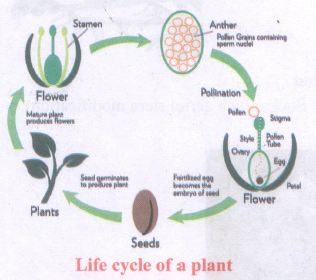
17.
Sub- aerial Modifications : Stem of some plants remains sub- aerial which grow horizontally on the surface of the soil for the purpose of reproduction. There are four types.
(i) Runner: The stem grows laterally on the surface of the soil, breaks up to produce roots where it touches the ground to give rise to new plants. Eg: Centella (Vallarai).
(ii) Stolon: Stolon is a slender branch of the stem that grows upwards to some distance and then bends towards the ground. Upon touching the ground, it gives rise to a new plant. Eg.Wild strawberry.
(iii) Sucker: Sucker is a short and weak lateral branch that grows diagonally upwards and directly gives rise to a new shoot. Eg. Chrysanthemum.
(iv) Offset: An offset is a short and thick branch that arises from the axial part of a leaf. It has thick internodes. It produces a tuft of leaves and cluster of small roots below. Eg: Eichhornia.
18.
In underground modified stem, whole stem is burried under the ground and it has definite growth. Some stems that grow under the ground to store food. There are four types of underground stems they are,
i) Rhizome:
It is underground thick stem with nodes and internodes with scale leaves at the node.
(Eg) Ginger and turmeric.
ii) Corm:
This underground stem is round in shape and flat at the top and bottom. The daughter plants are arise from their buds. (Eg) Colocasia.
iii) Tuber:
It is an enlarged spherical underground stem and stores food. It has many dormant buds and it grows into a new plant. (Eg) Potato.
iv) Bulb:
It is a condensed stem which is disc like and stores food in the fleshy leaves.
The bulb has two types of leaves
1) Fleshy leaves - Inner part of stem
2) Scaly leaves - Upper part of stem
(E.g) Garlic and onion
19.
The process by which pollen grains reach stigma of the flower is called as pollination. Pollination can be classified into two types based on their mode of transmission.
i) Artificial pollination:
The transfer of pollen grains from anther to stigma by manually is called as artificial pollination
ii) Natural Pollination:
1) The transfer of pollen grains from anther to stigma by insect or any other natural sources is called as natural pollination.
2) Pollination can be classified into another two types based on their site of transmission
i) Self pollination:
Pollen grains are transferred from the anther to the stigma of the same flower or to another flower of the same plant is known as self pollination.
ii) Cross pollination:
Pollen grains are transferred from the anther of one flower to the stigma of another flower of the same kind or different plant known as cross pollination.

7th Standard Syllabus & Materials
7th Standard
TN 7th English T1 - Supplementary - On Monday Morning Important Questions And Answers Study Material - QB365 Set A
NEW7th Standard
TN 7th English T1 - Prose - Eidgah Important Questions And Answers Study Material - QB365 Set A
NEW7th Standard
TN 7th Social Science T1 - ECO - Production Important Questions And Answers Study Material - QB365 Set A
NEW7th Standard
TN 7th Social Science T1 - GEO - Interior of the Earth Important Questions And Answers Study Material - QB365 Set A



Tamilnadu Stateboard 7th Standard Subjects
Tamilnadu Stateboard Standards




