
 100% FREE ACCESS
7th Standard Syllabus & Materials
7th Standard
TN 7th Tamil பருவம் -1 இயல் 1 - அமுதத்தமிழ் - ஒன்றல்ல இரண்டல்ல Important Questions And Answers Study Material - QB365 Set A
NEW7th Standard
TN 7th Tamil பருவம் -1 இயல் 1 - அமுதத்தமிழ் - எங்கள் தமிழ் Important Questions And Answers Study Material - QB365 Set A
NEW7th Standard
TN 7th English T1 - Poem - Your Space Important Questions And Answers Study Material - QB365 Set A
NEW7th Standard
TN 7th English T1 - Prose - A Prayer to the Teacher Important Questions And Answers Study Material - QB365 Set A
NEW7th Standard
TN 7th English T1 - Poem - The Listeners Important Questions And Answers Study Material - QB365 Set A
NEW7th Standard
TN 7th English T1 - Prose - The Wind on Haunted Hill Important Questions And Answers Study Material - QB365 Set A

Published on: 14/12/2019
Rise of Marathas and Peshwas
Download Tamil Nadu 7th Standard Social Science question papers, model tests, one-mark questions, important questions, and public exam papers in PDF format. Free study materials and answer keys for TN State Board students.
Questions + Answers key
Take MCQ Social Science Test
1.
Who proclaimed wars and freed Malwa and Gujarat from Mughal domination?
Balaji Vishwanath
Bajirao
Balaji Bajirao
Shahu
2.
What was the backbone of Shivaji’s army in the beginning?
Artillery
Cavalry
Infantry
Elephantry
3.
Name the family priest of Shambhuji who influenced him in his day-to-day administration.
Shahu
Anaji Datta
Dadaji Kondadev
Kavi Kalash
4.
How was the Prime Minister of Maratha kings known?
Deshmukh
Peshwa
Panditrao
Patil
5.
Who was the teacher and guardian of Shivaji?
Dadaji Kondadev
Kavi Kalash
Jijabai
Ramdas
6.
Shambhuji succeeded Shivaji after a succession tussle with_______.
7.
______ was the foreign minister in the Ashtapradhan.
8.
The imperial moment of the Marathas sadly ended at _______ in 1761.
9.
_____ was the key official of revenue administration of Peshwa.
10.
The spread of the _________ movement in Maharashtra helped the Maratha people develop consciousness and oneness.
11.
Afzal khan
12.
Jijabai
13.
Shahu
14.
Shambhuji
15.
Shaji Bhonsle
16.
Battle of Panipat fought in 1761.
17.
Execution of Shambhuji by Mughal Army.
18.
Role of Kamavisdar in Maratha revenue administration.
19.
Chauth and Sardeshmukhi.
20.
The impact of Bhakti movement on Marathas.
21.
Compare the revenue administration of the Peshwas with that of Shivaji.
22.
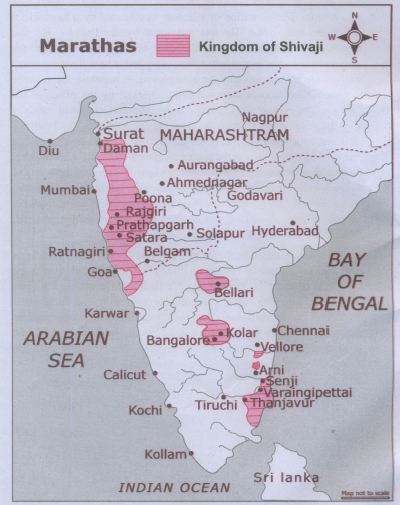
Maratha Empire with prominent cities and forts.
1.
(b)
Bajirao
2.
(c)
Infantry
3.
(d)
Kavi Kalash
4.
(b)
Peshwa
5.
(a)
Dadaji Kondadev
6.
()
Anaji Datto
7.
()
Sumant / Dubeer
8.
()
Panipat
9.
()
Kamavisdar
10.
()
Bhakti
11.
General of Bijapur
12.
Mother of Shivaji
13.
Shivaji’s grandson
14.
Son of Shivaji
15.
Shivaji's father
16.
The imperial moment of the Marathas sadly ended at Panipat near Delhi in 1761. The king of the Afghans, Ahmad Shah Abdali, invaded eight times before finally marching onto Delhi. The Marathas were now divided among several commanders, who approached the battle with different tactics. Artillery decided the battle in January 1761. The mobile artillery of the Afghans proved lethal against both Maratha cavalry and infantry.
17.
Marathas under Shambhuji were in no position to resist the Mughals. Aurangzeb himself arrived in the Deccan in 1681. Aurangzeb's main goal was the annexation of Bijapur and Golconda. These two sultanates fell to Aurangzeb by 1687. In little over a year, Shambhuji was captured by the Mughals and, after torture, put to death.
18.
The revenue administration of Peshwas was headed by a key official called the kamavisdar. He was appointed by the Peshwa. He was empowered to maintain a small body of soldiers to police the administrative area, from where tribute or tax had to be collected.
19.
Shivaji claimed suzerainty, but he did not administer them himself. He protected the people from loot and plunder for which they were required to pay Chauth (one-fourth of the revenue as protection money) and Sardeshmuki (an extra one-tenth, as the chieftain's due).
20.
The spread of the Bhakti movement in Maharashtra helped the Maratha people develop consciousness of their identity and oneness. It promoted a feeling of unity, especially in terms of social equality, among the Marathas.
21.
Revenue administration of Shivaji :
(i) Shivaji abolished the zamindari system.
(ii) Loans were provided to the farmers in the times of famine.
(iii) The state also collected custom duties and professional taxes.
(iv) The two important taxes collected during his time were Chauth and Sardeshmuki.
Revenue administration of Peshwas:
(i) The revenue administration of peshwas was headed by a key official called the kamavisdar.
(ii) He was expowered to maintain a small body of soldiers to police the administrative area, from where tribute or tax had to be collected.
(iii) A prospective tax or revenue collector who won the contract was expected to have a reputation for wealth and probity.
(iv) He was required to pay a portion of the whole of the anticipated revenue - one third to one half-either out of his own wealth or from the money borrowed from bankers.
22.

7th Standard Syllabus & Materials
7th Standard
TN 7th English T1 - Supplementary - On Monday Morning Important Questions And Answers Study Material - QB365 Set A
NEW7th Standard
TN 7th English T1 - Prose - Eidgah Important Questions And Answers Study Material - QB365 Set A
NEW7th Standard
TN 7th Social Science T1 - ECO - Production Important Questions And Answers Study Material - QB365 Set A
NEW7th Standard
TN 7th Social Science T1 - GEO - Interior of the Earth Important Questions And Answers Study Material - QB365 Set A



Tamilnadu Stateboard 7th Standard Subjects
Tamilnadu Stateboard Standards



