
 100% FREE ACCESS
7th Standard Syllabus & Materials
7th Standard
TN 7th Tamil பருவம் -1 இயல் 1 - அமுதத்தமிழ் - ஒன்றல்ல இரண்டல்ல Important Questions And Answers Study Material - QB365 Set A
NEW7th Standard
TN 7th Tamil பருவம் -1 இயல் 1 - அமுதத்தமிழ் - எங்கள் தமிழ் Important Questions And Answers Study Material - QB365 Set A
NEW7th Standard
TN 7th English T1 - Poem - Your Space Important Questions And Answers Study Material - QB365 Set A
NEW7th Standard
TN 7th English T1 - Prose - A Prayer to the Teacher Important Questions And Answers Study Material - QB365 Set A
NEW7th Standard
TN 7th English T1 - Poem - The Listeners Important Questions And Answers Study Material - QB365 Set A
NEW7th Standard
TN 7th English T1 - Prose - The Wind on Haunted Hill Important Questions And Answers Study Material - QB365 Set A

Published on: 14/12/2019
Vijayanagar and Bahmani Kingdoms
Download Tamil Nadu 7th Standard Social Science question papers, model tests, one-mark questions, important questions, and public exam papers in PDF format. Free study materials and answer keys for TN State Board students.
Questions + Answers key
Take MCQ Social Science Test
1.
Name the Bahmani King who was a linguist and a poet.
Ala-ud-din Hasan Shah
Muhammad I
Sultan Firoz
Mujahid
2.
Who ended the Sultanate in Madurai?
Saluva Narasimha
Devaraya II
Kumara Kampana
Tirumaladeva Raya
3.
Who was the last ruler of the Sangama Dynasty?
Rama Raya
Tirumaladeva Raya
Devaraya II
Virupaksha Raya II
4.
Which was the most common animal depicted on the pillars of Vijayanagara style?
Elephant
Horse
Cow
Deer
5.
Who was the greatest ruler of Sangama Dynasty?
Bukka
Devaraya II
Harihara II
Krishna Devaraya
6.
Tenali Ramakrishna
7.
Abdur Razzaq
8.
Krishna Devaraya
9.
Prataparudra
10.
Vijayanagara
11.
There were 18 monarchs of the Bahmani dynasty
12.
Kingship of Vijayanagar administration was hereditary, based on the principle of primo geniture.
13.
Alasani Peddana was the greatest of all Astadiggajas.
14.
Krishnadeva Raya, who reigned for 20 years, was the most illustrious rulers of Sangama dynasty.
15.
The educational reforms of Ala-ud-din Hasan Shah.
16.
The five independent kingdoms of Deccan Sultanate.
17.
The structure of governance in Vijayanagar kingdom.
18.
Battle of Talikota.
19.
The four dynasties of Vijayanagara kingdom with reference to prominent rulers of each dynasty.
20.
Discuss the career and achievements of Krishna Devaraya.
21.
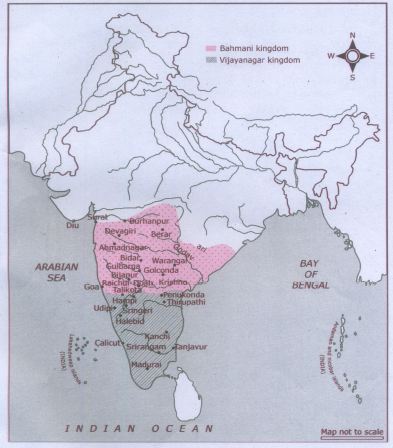
Highlight the boundaries of Vijayanagar Empire and Bahmani kingdom.
1.
(c)
Sultan Firoz
2.
(c)
Kumara Kampana
3.
(d)
Virupaksha Raya II
4.
(b)
Horse
5.
(b)
Devaraya II
6.
Pandurangamahatyam
7.
Persian emissary
8.
Astadiggajas
9.
Ruler of Odisha
10.
City of victory
11.
(a)
12.
(a)
13.
(a)
14.
(b)
15.
(i) Alaud-din Hasan Shah was educated at Multan. He took special care in founding a school to educate his sons.
(ii) He opened institutions for the purpose of education to the children of noble families in the art of soldiery.
16.
The five independent Deccan kingdoms were Bidar, Bijapur, Ahmednagar, Berar and Golconda.
17.
(i) The empire was divided into different mandalams (provinces), nadus (districts), sthalas (taluks) and finally into gramas (villages).
(ii) Each province was administered by a governor called Mandalesvara.
(iii) The lowest unit of the administration was the village. Each village had a grama sabha. Gauda, village headman, looked after the affairs of the village.
(iv) The army consisted of the infantry cavalry and elephant corps.
18.
The sultans of Deccan kingdoms succeeded in forming a league to fight the Vijayanagar Empire. The combined forces of the enemies met in Talikota in 1565. In the ensuing battle, known as Rakasa Tangadi (Battle of aE Talikota), Vijayanagar was defeated.
19.
1) Sangama dynasty (1336-1485) - Devaraya II
2) Saluva dynasty (1485-1505) - Saluva Narsimha
3) Thuluva dynasty (1505-1570) - Krishnadeva Raya
4) Aravidu dynasty (1570-1646) - Tirumaladeva Raya
20.
Discuss the career and achievements of Krishna Devaraya.
(i) Krishnadevataya who reigned for 20 years was, the most illustrious rulers of the Tuluva dynasty.
(ii) He brought under control the independent chieftains in the Tungabhadra river basin.
(ii) The Bahmani sultan, Mahmud Shah had been overthrown and kept in imprisonment by his minister. Krishnadevaraya freed the sultan and restored him to the throne. Prataparudra negotiated for peace and offered to marry off his daughter to him.
(iv) Accepting the offer, krishnadevaraya returned the territory he had conquered from Prataparudra.
(v) Krishnadevaraya, with the assistance of the Portuguese gunners, could easily defeat the Sultan of Golconda and subsequently take over Raichur from the ruler of Bijapur.
A Great Builder
(i) Krishnadevaraya built huge irrigation tanks and reservoirs for harvesting rainwater.
(ii) He built the famous temples of Krishnaswamy, Hazara Ramaswamy and Vithalaswamy in the capital city of Hampi.
(iii) He distributed the wealth he gained in wars to all major temples of South India for the purpose of constructing temple gateways (gopura), called 'Rayagopuram,' in his honour.
(iv) He had good friendly relationship with the Portuguese and Arabian traders, which increased the Empire's income through customs.
Patron of Literature, Art and Architecture
Krishnadevaraya patronised art and literature. Eight eminent luminaries in literature known as astadiggajas adorned his court.
21.

7th Standard Syllabus & Materials
7th Standard
TN 7th English T1 - Supplementary - On Monday Morning Important Questions And Answers Study Material - QB365 Set A
NEW7th Standard
TN 7th English T1 - Prose - Eidgah Important Questions And Answers Study Material - QB365 Set A
NEW7th Standard
TN 7th Social Science T1 - ECO - Production Important Questions And Answers Study Material - QB365 Set A
NEW7th Standard
TN 7th Social Science T1 - GEO - Interior of the Earth Important Questions And Answers Study Material - QB365 Set A



Tamilnadu Stateboard 7th Standard Subjects
Tamilnadu Stateboard Standards



