
 100% FREE ACCESS
7th Standard Syllabus & Materials
7th Standard
TN 7th Tamil பருவம் -1 இயல் 1 - அமுதத்தமிழ் - ஒன்றல்ல இரண்டல்ல Important Questions And Answers Study Material - QB365 Set A
NEW7th Standard
TN 7th Tamil பருவம் -1 இயல் 1 - அமுதத்தமிழ் - எங்கள் தமிழ் Important Questions And Answers Study Material - QB365 Set A
NEW7th Standard
TN 7th English T1 - Poem - Your Space Important Questions And Answers Study Material - QB365 Set A
NEW7th Standard
TN 7th English T1 - Prose - A Prayer to the Teacher Important Questions And Answers Study Material - QB365 Set A
NEW7th Standard
TN 7th English T1 - Poem - The Listeners Important Questions And Answers Study Material - QB365 Set A
NEW7th Standard
TN 7th English T1 - Prose - The Wind on Haunted Hill Important Questions And Answers Study Material - QB365 Set A

Published on: 13/05/2022
QB365 provides detailed and simple solution for every book back questions in class 7 Maths subject.It will helps to get more idea about question pattern in every book back questions with solution.
latest Book back QuestionsDownload Tamil Nadu 7th Standard Maths question papers, model tests, one-mark questions, important questions, and public exam papers in PDF format. Free study materials and answer keys for TN State Board students.
Questions + Answers key
Take MCQ Maths Test1.
Can row sum of elements in a Pascal’s Triangle form a pattern?
2.
Find the unit digit of the large numbers:
4917
3.
Find the unit digit of the large numbers:
6410
4.
Find the unit digit of the following exponential numbers:
4631
5.
Find the unit digit of the following exponential numbers:
2523
6.
A garden is made up of a rectangular portion and two semicircular regions on either sides. If the length and width of the rectangular portion are 16 m and 8 m respectively, calculate (π = 3.14)
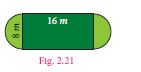
The perimeter of the garden
7.
A gardener walks around a circular park of distance 154 m. If he wants to level the park at the rate of Rs.25 per sq.m, how much amount will he need? (use \(\pi =\frac { 22 }{ 7 } \))
8.
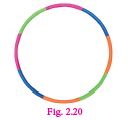
Find the area of a hula loop whose diameter is 28 cm (use \(\pi =\frac { 22 }{ 7 } \)).
9.
Express the following as fractions
A juice container has 4.5 litres of mango juice.
10.
Find the decimal form of the following fractions.
23 + \(\frac { 6 }{ 10 } \)+ \(\frac { 8 }{ 1000 } \)
11.
Find the decimal form of the following fractions.
999 + 99 + 9 + \(\frac { 9 }{ 10 } \) + \(\frac { 9 }{ 100 } \)
12.
Convert the following into simplest fractions.
0.862
13.
Convert the following into simplest fractions.
3.46
14.
Write the following fractions as decimals.
3\(\frac { 1 }{ 5 } \)
15.
Write the following fractions as decimals.
\(\frac { 1 }{ 50 } \)
16.
Write the following fractions as decimals.
\(\frac { 9 }{ 1000 } \)
17.
Write the following fractions as decimals.
\(\frac { 3 }{ 4 } \)
18.
Express the following fractions as decimal numbers.
\(\frac { 5 }{ 100 } \)
19.
Express the following as fractions
A capsule contains 0.85 mg of medicine.
20.
Write each of the following as decimals.
Four hundred four and five hundredths
21.
Find the decimal form of the following fractions.
153 + 96 + 7 + \(\frac { 5 }{ 10 } \) + \(\frac { 2 }{ 1000 } \)
22.
Convert the following into simplest fractions.
0.04
23.
Write the following fractions as decimals.
\(\frac { 2 }{ 5 } \)
24.
Express the following fractions as decimal numbers.
\(\frac { 3 }{ 5 } \)
25.
Write the shaded portion of the figures given below as a fraction and as a decimal number.
(i)
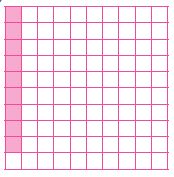
(ii)
.JPG)
(iii)
.JPG)
1.
The row sum of elements of a Pascal’s Triangle are shown below:
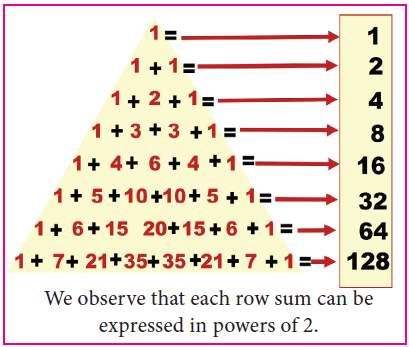
First row = 21 − 1 = 1
Second row = 22 − 1 = 2 x 1 = 2
Third row = 23 − 1 = 2 x 2 = 4
Fourth row = 24 − 1 = 2 x 2 x 2 = 8
Fifth row = 25 − 1 = 2 × 2 × 2 × 2 = 16
Sixth row = 26 − 1 = 2 × 2 × 2 × 2 × 2 = 32
Seventh row = 27 − 1 = 2 × 2 × 2 × 2 × 2 × 2 = 64
Eighth row = 28 − 1 = 2 × 2 × 2 × 2 × 2 × 2 × 2 = 128
Here x denotes the row and y denotes the corresponding row sum. The values of x and y can be tabulated as follows:
| x | 1 | 2 | 3 | 4 | 5 | 6 | 7 | 8 | ... |
| y | 1 | 2 | 4 | 8 | 16 | 32 | 64 | 128 | ... |
The relationship between x and y is y = 2x – 1.
2.
4917
Unit digit of base 49 is 9 and power is 17 (odd power).
Therefore, unit digit of 4917 is 9.
3.
6410
Unit digit of base 64 is 4 and power is 10 (even power). Therefore, unit digit of 6410 is 6.
4.
4631
Unit digit of base 46 is 6 and power is 31
Thus, the unit digit of 4631 is 6.
5.
2523
Unit digit of base 25 is 5 and power is 23
Thus, the unit digit of 2523 is 5.
6.
The perimeter of the rectangular garden
Perimeter include two lengths each of 16 m and two semi circular arcs of diameter 8 m.
Circumference of the semicircle = \(\frac { \pi d }{ 2 } \) units
= \(\frac { \pi \times 8 }{ 2 } \) = 4π
= 4 x 3.14
= 12.56 m
Therefore, circumference of two semicircles = 2 x 12.56
= 25.12 m
Total perimeter = length + length + circumference of two semicircles
= 16 +16 + 25.12
= 32 + 25.12
= 57.12 m
7.
The distance covered by the man is nothing but the circumference of the circle.
Given that the distance covered = 154 m
Therefore circumference of the circle = 154 m
That is, 2πr = 154
2 x \(\frac { 22 }{ 7 } \)x r = 154
r = 154 x \(\frac { 7 }{ 44 } \)
r = 3.5 x 7
= 24.5
Area of the park = πr2 sq.units
= \(\frac { 22 }{ 7 } \)× 24.5 x 24.5
= 22 x 3.5 x 24.5
= 1886.5 m2
Cost of levelling the park per sq.m = Rs.25.
Cost of levelling the park of 1886.5 m2 = 1886.5 x 25 = Rs.47,162.50
8.
Given the diameter (d) = 28 cm
Radius (r) = \(\frac { 28 }{ 2 } \) = 14 cm
Area of a circle = πr2 sq.units
= \(\frac { 22 }{ 7 } \) x 14 x 14
So, the area of the circle = 616 cm2.
9.
4.5 = 4 + \(\frac { 5 }{ 10 } \)
= 4\(\frac { 5 }{ 10 } \) = 4\(\frac { 1 }{ 2 } \)
A juice container has 4\(\frac { 1 }{ 2 } \) litres of mango juice.
10.
23 + \(\frac { 6 }{ 10 } \) + \(\frac { 8 }{ 1000 } \) = 23 + 6 x \(\frac { 1 }{ 10 } \) + 0 x \(\frac { 1 }{ 100 } \) + 8 x \(\frac { 1 }{ 1000 } \)
= 23.608 (since hundredths place is not there, it is taken as '0')
11.
999 + 99 + 9 + \(\frac { 9 }{ 10 } \) + \(\frac { 9 }{ 100 } \) = 1107 + 9 x \(\frac { 1 }{ 10 } \) + 9 x \(\frac { 1 }{ 100 } \)
= 1107.99
12.
0.862 = \(\frac { 862 }{ 1000 } \)
= \(\frac { 862\div 2 }{ 1000\div 2 } \) = \(\frac { 431 }{ 500 } \)
13.
3.46 = 3 + \(\frac { 46 }{ 100 } \)
= 3 + \(\frac { 46\div 2 }{ 100\div 2 } \)
= 3 + \(\frac { 23 }{ 50 } \)
= 3 \(\frac { 23 }{ 50 } \)
14.
In 3\(\frac { 1 }{ 5 } \), keep the whole number 3 as such, we can find a fraction equivalent to \(\frac { 1 }{ 5 } \)with denominator 10.
3 + \(\frac { 1 }{ 5 } \) = 3 + \(\frac { 1\times 2 }{ 5\times 2 } =3+\frac { 2 }{ 10 }\) = 3.2
15.
We have to find a fraction equivalent to \(\frac { 1 }{ 50 } \) whose denominator is 100.
\(\frac { 1 }{ 50 } \) = \(\frac { 1\times 2 }{ 50\times 2 } =\frac { 2 }{ 100 }\) = 0.02
16.
In \(\frac { 9 }{ 1000 } \), tenth and hundredth place is zero.
Therefore, \(\frac { 9 }{ 1000 } \) = 0.009
17.
We have to find a fraction equivalent to \(\frac { 3 }{ 4 } \) with denominator 100. Since there is no whole number that gives 10 when multiplied by 4, let us make the denominator as 100.
so, \(\frac { 3 }{ 4 } \) = \(\frac { 3\times 25 }{ 4\times 25 } =\frac { 75 }{ 100 } \) = 0.75
18.
\(\frac { 5 }{ 100 } \) = 0.05
19.
0.85 = 0 + \(\frac { 8 }{ 10 } \)+\(\frac { 5 }{ 100 } \)
= \(\frac { 85 }{ 100 } \)=\(\frac { 17 }{ 20 } \)
A capsule holds \(\frac { 17 }{ 20 } \) mg of medicine
20.
Four hundred four and five hundredths.
= 404 + \(\frac { 5 }{ 100 } \)
= 404 + 0 x \(\frac { 1 }{ 10 } \) + 5 x \(\frac { 1 }{ 100 } \) = 404.05
21.
153 + 96 + 7 + \(\frac { 5 }{ 10 } \) + \(\frac { 2 }{ 1000 } \) = 256 + 5 x \(\frac { 1 }{ 10 } \) + 0 x \(\frac { 1 }{ 100 } \) + 2 x \(\frac { 1 }{ 1000 } \)
= 256.502 (since hundredths place is not there, it is taken as '0' )
22.
0 04 = \(\frac { 4 }{ 100 } =\frac { 1 }{ 25 } \)
23.
We have to find a fraction equivalent to \(\frac { 2 }{ 5 } \) whose denominator is 10.
\(\frac { 2 }{ 5 } \) = \(\frac { 2\times 2 }{ 5\times 2 } =\frac { 4 }{ 10 } \) = 0.4
24.
\(\frac { 3 }{ 5 } \) = \(\frac { 6 }{ 10 } \) = 0.6
25.
| No. | Shaded portions | Fraction | Decimal number |
| (i) | 9 squares out of 100 squares | \(\frac { 9 }{ 100 } \) | 0.09 |
| (ii) | 18 squares out of 100 squares | \(\frac { 18 }{ 100 } \) | 0.18 |
| (iii) | 99 squares out of 100 squares | \(\frac { 99 }{ 100 } \) | 0.99 |

7th Standard Syllabus & Materials
7th Standard
TN 7th English T1 - Supplementary - On Monday Morning Important Questions And Answers Study Material - QB365 Set A
NEW7th Standard
TN 7th English T1 - Prose - Eidgah Important Questions And Answers Study Material - QB365 Set A
NEW7th Standard
TN 7th Social Science T1 - ECO - Production Important Questions And Answers Study Material - QB365 Set A
NEW7th Standard
TN 7th Social Science T1 - GEO - Interior of the Earth Important Questions And Answers Study Material - QB365 Set A



Tamilnadu Stateboard 7th Standard Subjects
Tamilnadu Stateboard Standards




