
 100% FREE ACCESS
7th Standard Syllabus & Materials
7th Standard
TN 7th Tamil பருவம் -1 இயல் 1 - அமுதத்தமிழ் - ஒன்றல்ல இரண்டல்ல Important Questions And Answers Study Material - QB365 Set A
NEW7th Standard
TN 7th Tamil பருவம் -1 இயல் 1 - அமுதத்தமிழ் - எங்கள் தமிழ் Important Questions And Answers Study Material - QB365 Set A
NEW7th Standard
TN 7th English T1 - Poem - Your Space Important Questions And Answers Study Material - QB365 Set A
NEW7th Standard
TN 7th English T1 - Prose - A Prayer to the Teacher Important Questions And Answers Study Material - QB365 Set A
NEW7th Standard
TN 7th English T1 - Poem - The Listeners Important Questions And Answers Study Material - QB365 Set A
NEW7th Standard
TN 7th English T1 - Prose - The Wind on Haunted Hill Important Questions And Answers Study Material - QB365 Set A

Published on: 13/05/2022
7th Standard English Medium Maths Subject Term 3 Book Back 5 Mark Questions with Solution Part - II
latest Book back QuestionsDownload Tamil Nadu 7th Standard Maths question papers, model tests, one-mark questions, important questions, and public exam papers in PDF format. Free study materials and answer keys for TN State Board students.
Questions + Answers key
Take MCQ Maths Test1.
Draw concentric circles for the following measurement of radii / diameters. Find out the width of circular ring.
d = 6.2 cm and r = 6.2 cm
2.
Draw concentric circles for the following measurement of radii / diameters. Find out the width of circular ring.
r = 3.5 cm and r = 6.5 cm
3.
Draw circles for the following measurements of radius (r)/ diameters(d).
r = 6.5 cm.
4.
Draw circles for the following measurements of radius (r)/ diameters(d).
d = 12 cm
5.
The following data shows that the number of hours spent by the students for study.
| Number of study hours | 1 | 2 | 3 | 4 | 5 | 6 |
| Number of students | 4 | 2 | 1 | 2 | 1 | 0 |
Find the mode.
6.
Find the mode of the following data 123, 132, 145, 176, 180, 120.
7.
Find the mode of the given set of numbers. 5, 7, 10, 12, 4, 5, 3, 10, 3, 4, 5,7, 9, 10, 5, 12, 16, 20, 5
8.
Solve graphically: 6y − 5 ≤ 2y + 7, where y is an integer.
9.
Represent the solutions of 3x + 9 ≤ 12 in a number line, where x is an integer.
10.
If one worker earns Rs.200 per day, how many workers can be employed with in a monthly budget of Rs.3 Lakh?
11.
Solve: 2x + 4 < 18, where x is a natural number.
12.
A sum of Rs. 46,000 was lent out at simple interest and at the end of 1 year and 9 months, the total amount was Rs. 52,440. Find the rate of interest per year.
13.
In what time will Rs. 5,600 amount to Rs. 6,720 at 6% per annum?
14.
Find the simple interest on Rs. 25,000 at 8% per annum for 3 years?
15.
Malar bought 1.75 m of fabric from a roll of 25 m. Express the fabric bought in terms of percentage?
16.
Convert the given decimals to percentage.
2.25
17.
Convert the given decimals to percentage
0.3
18.
Convert the given decimals to percentage.
0.85
19.
A car covers 16.8 km in 0.21 hours. What is the distance covered by the car in one hour.
20.
Divide 6.3 ÷ 3 using area model.
21.
Subtract 32.042 from 86.9.
22.
Subtract 2.85 from 4.97.
23.
Everyday Malar travels 1.820 km by bus and 295 m by walk to reach the school. Find the distance of school from her house in km.
24.
Subtract 7.5 – 3.4 .
25.
Find the value of 0.72 − 0.51 by using grids.
1.
\(\mathrm{r}_{1}=\frac{6.2}{2}=3.1 \mathrm{~cm}\)
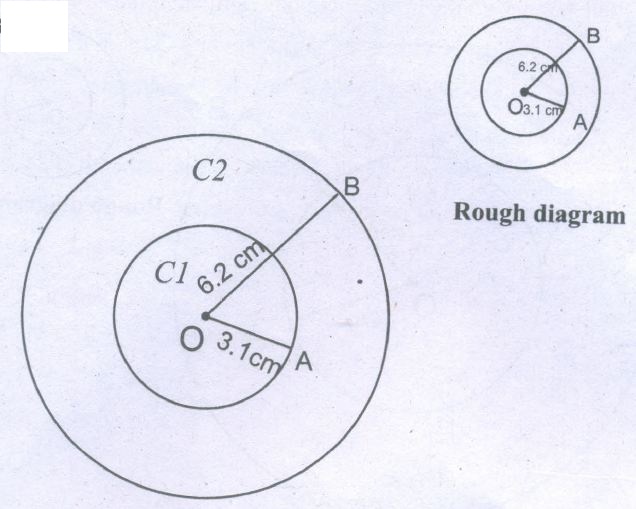
Step 1: Draw a rough diagram and mark the given measurements.
Step 2: Take a point O and mark it as the centre.
Step 3: With O as centre and draw a circle of radius OA.= 3.1 cm
Step 4: With O as centre and draw another circle of radius OB = 3.1 cm.
Thus the concentric circles C1, and C2 are drawn.
Width of the circular ring = OB - OA = 6.2 - 3.1 = 3.1 cm
2.
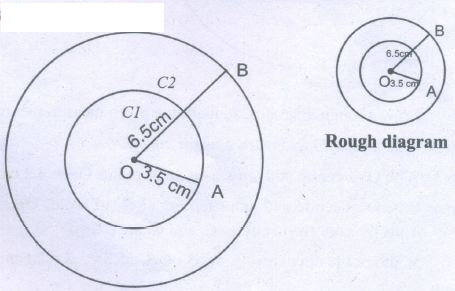
Step 1:Draw a rough diagram and mark the given measurements
Step 2: Take a point O and mark it as the centre.
Step 3: With O as centre and draw a circle of radius OA = 3.5 cm
Step 4: With O as centre and draw another circle of radius OB = 6.5 cm.
Thus the concentric circles C1 and C2 are drawn.
Width of the circular ring = OB -OA
= 6.5 - 3.5 = 3cm
3.
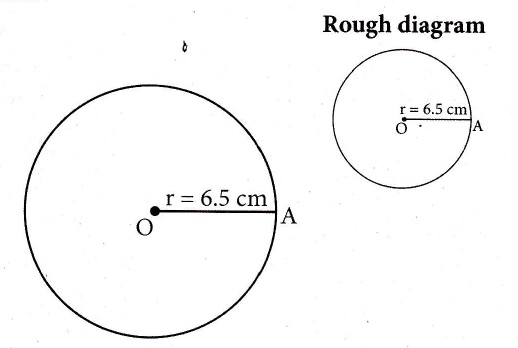
Step 1 : Draw a rough diagram and mark the given measurements.
Step 2: Mark a point O on the paper.
Step 3: Extend the compass distance equal to the radius 6.5cm.
Step 4: At center O, Hold the compass firmly and place the pointed end of the compass.
Step 5: Slowly rotate the compass around to get the circle.
4.
\(r=\frac{12}{2}=6 \mathrm{~cm}\)
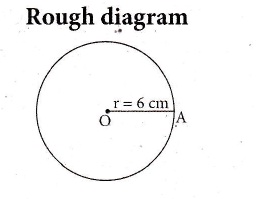
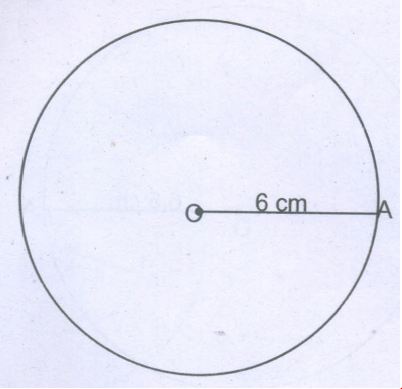
Step 1 : Draw a rough diagram and mark,the given measurements.
Step 2: Mark a point O on the paper.
Step 3: Extend the compass distance equal to the radius 6 cm.
Step 4: At center O, Hold the compass firmly and place the pointed end of the compass.
Step 5: Slowly rotate the compass around to get the circle.
5.
Since the one hour study time is spent by maximum number of students, the mode of the data is 1 hour.
6.
From the above data, we can see that there is no repetition of values in the given data. Each observation occurs only once, so there is no mode.
7.
Arranging the numbers in ascending order without leaving any value, we get,
3, 3, 4, 4, 5, 5, 5, 5, 5, 7, 7, 9, 10, 10, 10, 12, 12, 16, 20
Mode of this data is 5, because it occurs more number of times than the other values.
8.
6y − 5 ≤ 2y + 7
6y − 2y − 5 ≤ 2y − 2y + 7 [Subtracting 2y from both sides]
4y − 5 ≤ 7
4y − 5 + 5 ≤ 7 + 5 [Adding 5 on both sides]
4y ≤ 12
\(\cfrac { 4y }{ 4 } \le \cfrac { 12 }{ 4 } \) [Dividing by 4 on both sides]
y ≤ 3
Since the solution belongs to integers, the solutions are 3, 2, 1, 0, –1, –2,..... It’s graph on the number line is shown below.

9.
3x + 9 ≤ 12
\(\cfrac { 3x }{ 3 } +\cfrac { 9 }{ 3 } \le \cfrac { 12 }{ 3 } \) [Dividing the inequation by 3 on both sides]
x + 3 ≤ 4
x + 3 – 3 ≤ 4–3 [Subtracting 3 from both sides]
x ≤ 1
Since the solution belongs to integers, the solutions are 1, 0, −1, −2, …. It’s graph on the number line is shown below:

10.
Let the number of workers be x.
Then, the wages that x workers will earn per day = Rs.200x
The wages that x workers will earn per month = Rs.(200x x 30) = Rs.6000x
Given that, this amount cannot exceed Rs.300000.
Otherwise, it can be written as 6000 x ≤ 300000
\(\frac {6000x}{6000 } \le \frac {300000 }{6000 } \)
\(x\le 50\)
Thus, up to 50 workers can be employed on a monthly budget of Rs.300000.
11.
2x + 4 < 18
2x + 4 – 4 < 18 − 4 [Subtracting 4 from both sides]
2x < 14 [Divide by 2 on both sides]
x < 7
Since the solution belongs to natural numbers, that are less than 7, we take the values of the x as 1, 2, 3, 4, 5 and 6.
Therefore, the solutions are 1, 2, 3, 4, 5 and 6.
12.
A = P + I
I = A – P
= 52440 – 46000
= Rs. 6,440
r = ?
1 Year and 9 months = \(1\cfrac { 9 }{ 12 } \)
= \(1\cfrac { 3 }{ 4 } \) = \(\cfrac { 7 }{ 4 } \)
we know that, \(I=\cfrac { Pnr }{ 100 } \)
Therefore, \(6440=\cfrac { 46000\times r\times \frac { 7 }{ 4 } }{ 100 } \)
\(r=\cfrac { 6440\times 4\times 100 }{ 46000\times 7 } \)
= 8%
13.
Principal (P) = Rs. 5,600
Rate (r) = 6% per annum
Amount = Rs. 6,720
Amount = principal + interest
Interest = Amount – Principal
= 6720 − 5600 = 1120
We know that Simple Interest \(\left( I \right) =\cfrac { Pnr }{ 100 } \)
\(1120=\cfrac { 6720\times 6\times n }{ 100 } \)
Therefore, \(n=\cfrac { 1120\times 100 }{ 5600\times 6 } =3\cfrac { 1 }{ 3 } years\)
14.
Here, the Principal (P) = Rs. 25,000
Rate of interest (r) = 8% per annum
Time (n) = 3 years
Simple Interest (I) = \(\cfrac { Pnr }{ 100 } \)
= \(\cfrac { 2500\times 3\times 8 }{ 100 } =6000\)
Hence, Simple Interest (I) is Rs. 6,000.
15.
Total length of the fabric = 25 m
Length of the fabric bought = 1.75 m
Percentage of the fabric bought = \(\cfrac { 1.75 }{ 25 } \times \cfrac { 100 }{ 100 } =\cfrac { 175 }{ 25\times 100 } =\cfrac { 7 }{ 100 } =7\%\)
16.
\(2.25=\cfrac { 225 }{ 100 } \times 100\%=225\%\)
17.
\(0.3=\cfrac { 3 }{ 10 } \times 100\%=30%\)
18.
\(0.85=0.85\times 100\%=\cfrac { 85 }{ 100 } \times 100\%=85\%\)
19.
The distance covered by the car in one hour = \(\cfrac { 16.8 }{ 0.21 } \)
Multiply the divisor by 100 to make it a whole number. Hence multiply the dividend also by 100.
Therefore,\(\cfrac { 16.8\times 100 }{ 0.21\times 100 } =\cfrac { 1680 }{ 21 } =80\)
20.
The decimal number 6.3 is shown in Figure
Since 6.3 is divided by 3, we seperate the areas into 3 equal groups using three different colours as in Figure
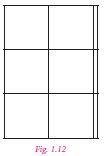
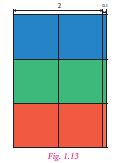
Each group to represents 2.1, which is the quotient.
Therefore, 6.3 ÷3 = 2.1.
(ii) Division by 10, 100 and 1000
Let us learn how to divide decimal numbers by 10, 100 and 1000.
For example, consider 51.7 ÷ 10
Now, \(51.7=\cfrac { 517 }{ 10 } \)
Therefore, \(\cfrac { 51.7 }{ 10 } =\cfrac { 517 }{ 10 } \times \cfrac { 1 }{ 10 } =\cfrac { 517 }{ 100 } =5.17\)
Similarly, \(51.7\div 100=\cfrac { 517 }{ 10 } \times \cfrac { 1 }{ 100 } =\cfrac { 517 }{ 10000 } =0.0517\)
Also,\(\\ \\ \\ 51.7\div 1000=\cfrac { 517 }{ 10 } \times \cfrac { 1 }{ 10000 } =\cfrac { 517 }{ 10000 } =0.0517\)
When decimal numbers are divided in powers of 10, it can be noted that the decimal number so obtained contains the same number of decimal digits as that of zeros in powers of 10.
Let us see whether there is a pattern for dividing numbers by 10, 100 and 1000.
Observe the following and complete it.
21.
| 86.900 | |
| (-) | 32.042 |
| 54.858 |
Therefore, 86.9 – 32.042 = 54.858.
22.
4.97 – 2.85 = ?
Let us use the place value grid.
| Decimal No. | Ones | Tenth | Hundredth |
| 4.97 | 4 | 9 | 7 |
| 2.85 | 2 | 8 | 8 |
| 2.12 | 2 | 1 | 2 |
Therefore, 4.97 – 2.85 = 2.12.
23.
100 m = 1 km, 1m = \(\cfrac { 1 }{ 1000 } km\)
Hence, 295 m = \(\\ \\ \\ \cfrac { 295 }{ 1000 } \) m
= 0.295km
Distance travelled by bus = 1.820 km
Distance covered by walk = 0.295 km
Total distance = 1.820 + 0.295
= 1.820 + 0.295
= 2.115 km
Therefore, the school is situated at the distance of 2.115 km from her house.
24.
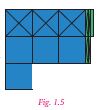
First represent the decimal number 7.5 using 7 squares and 5 rectangular strips. Cross out 3 squares from 7 squares and 4 rectangular strips from 5 rectangular strips to get the difference (see Figure). Hence, 7.5 – 3.4 = 4.1.
25.
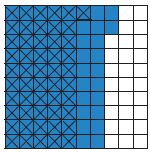
Take a square of 100 boxes. Shade 72 boxes to represent 0.72.
Then strike out 51 boxes out of 72 shaded boxes to subtract 0.51 from 0.72.
The left over shaded boxes represent the required value.
Therefore, 0.72 – 0.51 = 0.21.

7th Standard Syllabus & Materials
7th Standard
TN 7th English T1 - Supplementary - On Monday Morning Important Questions And Answers Study Material - QB365 Set A
NEW7th Standard
TN 7th English T1 - Prose - Eidgah Important Questions And Answers Study Material - QB365 Set A
NEW7th Standard
TN 7th Social Science T1 - ECO - Production Important Questions And Answers Study Material - QB365 Set A
NEW7th Standard
TN 7th Social Science T1 - GEO - Interior of the Earth Important Questions And Answers Study Material - QB365 Set A



Tamilnadu Stateboard 7th Standard Subjects
Tamilnadu Stateboard Standards




