
 100% FREE ACCESS
7th Standard Syllabus & Materials
7th Standard
TN 7th Tamil பருவம் -1 இயல் 1 - அமுதத்தமிழ் - ஒன்றல்ல இரண்டல்ல Important Questions And Answers Study Material - QB365 Set A
NEW7th Standard
TN 7th Tamil பருவம் -1 இயல் 1 - அமுதத்தமிழ் - எங்கள் தமிழ் Important Questions And Answers Study Material - QB365 Set A
NEW7th Standard
TN 7th English T1 - Poem - Your Space Important Questions And Answers Study Material - QB365 Set A
NEW7th Standard
TN 7th English T1 - Prose - A Prayer to the Teacher Important Questions And Answers Study Material - QB365 Set A
NEW7th Standard
TN 7th English T1 - Poem - The Listeners Important Questions And Answers Study Material - QB365 Set A
NEW7th Standard
TN 7th English T1 - Prose - The Wind on Haunted Hill Important Questions And Answers Study Material - QB365 Set A

Published on: 17/06/2021
QB365 provides detailed and simple solution for every Book back Questions in class 7 Science Subject. It
will helps to get more idea about question pattern in every book back questions with solution.
Download Tamil Nadu 7th Standard Science question papers, model tests, one-mark questions, important questions, and public exam papers in PDF format. Free study materials and answer keys for TN State Board students.
Questions + Answers key
Take MCQ Science Test1.
Why do antiseptics differ from disinfectants? Give one example of each.
2.
How do plastics impact animals and the environment?
3.
Name the four different types of galaxies.
4.
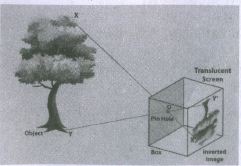
Draw a diagram of a pin hole camera showing the rays of light passing between the Object and its image.
5.
Write the levels of classification.
6.
Distinguish between the following pairs Smooth ER and Rough ER Cell wall and cell membrane Chloroplast and mitochondria
7.
Distinguish physical and chemical changes.
8.
Define an electric current.
9.
Why do we use Mercury in thermometers? Can water be used instead of mercury? What are the problems in using it?
10.
What are isotones? Give one example.
11.
What steps you will follow to keep the Teeth healthy?
12.
Distinguish between speed and velocity.
13.
Define molecule.
14.
What is cross pollination?
15.
Define the density of objects.
1.
| S.No | Antiseptics | Disinfectants |
| 1. | All antiseptics are disinfectants | All disinfectants are not antiseptics |
| 2. | It can be applied on the live tissues like skin, mucous | It can be applied on inanimate objects like surface, lab working tables, floor |
| 3. | Example-ethanol | Example-formaldehyde |
2.
i) Plastics do not decompose or biodegrade.
ii) One-time use plastics are responsible for littering the environment and clogging drains.
iii) Standing water breeds mosquitoes which cause malaria, dengue and chikungunya.
iv) Animals confuse plastic for food and eat it by accident.
v) Plastics cannot be digested and stays in intestine leads to harmful diseases.
vi) Microbeads present in household products washed down in drains and end up in soil pollution and water pollution
3.
(i) Spiral galaxy
(ii) Elliptical galaxy
(iii) Barred spiral galaxy
(iv) Irregular galaxy
4.
5.
The levels of classification are
1. kingdom
2. phylum
3. classes
4. order
5. families
6. genus and
7. species
6.
Smooth ER and Rough ER
| S.No | Smooth ER | Rough ER |
| 1. | It is a network of tubular sacs without ribosomes on the membrane. | It is a network of tubular sacs with ribosomes on the memebrane. |
| 2. | They play a role in the synthesis of lipids steroids. | It helps in synthesis of protein. |
Cell wall and Cell membrane
| S.No | Cell wall | Cell membrane |
| 1. | It is present in plant cell. | It is present in animal cell |
| 2. | It is made up of cellulose | It is made up of protein and lipids. |
Chloroplast and Mitochondria
| S.No | Chloroplast | Mitochondria |
| 1. | It is found in only plant cell. | It is present in both plant and animal cell. |
| 2. | It is a food producer. | It is the powerhouse of the cell. |
7.
\(\begin{array}{|c|l|l|} \hline \text { S.No. } &{\text { Physical change }} &{\text { Chemical change }} \\ \hline \text { 1. } & \text { No new substance are formed } & \text { New substance are formed } \\ \hline 2 . & \text { Chemical properties do not change } & \text { Chemical properties changed } \\ \hline 3 . & \text { It is a temporary action. } & \text { It is a permanent action. } \\ \hline 4 . & \text { It is a reversible reaction } & \text { It is a irreversible reaction. } \\ \hline \end{array}\)
8.
The flow of electric charges constitute an electric current. An electric current is measured by the amount of electric charge moving per unit time at any point in the circuit
9.
a) Its expansion is uniform (for equal amounts of heat it expands by equal length)
b) It is opaque and shining
c) It is a good conductor of heat.
d) It does not stick to the sides of the glass tube.
e) So mercury is used in the thermometer
f) Water cannot used in thermometer.
1) Its expansion is not in uniform.
2) It is stick to the sides of the glass tube.
10.
(i) Atoms of the different elements can have the same number of neutrons are called "Isotones".
(ii) Ex : 29Ca40 and 19K39
(iii) Numbers of neutrons = A - Z = 20
11.
i) We have to brush two times a day,it will prevent the formation of tartar and plaque on your teeth and gums.
ii) We have to floss it will remove food particles, plaque and bacteria which buildup between your teeth
12.
| S.No | Speed | Velocity |
| 1. | Speed is the rate of change of distance | Velocity is the rate of change in displacement |
| 2. | Speed = distance / time | Velocity = displacement / time |
| 3. | SI unit of speed is m/s | SI unit of velocity is m/s |
| 4. | Speed = \(\frac{Distance \ travelled}{time \ taken}\) | Velocity = \(\frac{Displacement}{time \ takem}\) |
13.
A molecule is made up of two or more atoms chemically combined.
14.
Pollen grains are transferred from the anther of one flower to the stigma of another flower of the same kind or different plant is known as cross pollination.
15.
Density of a substance is defined as the mass of the substance contained in unit volume (1 m3).
Density (D) = mass (M)/volume(V)
D = M/V
SI unit of density - kg/m3

7th Standard Syllabus & Materials
7th Standard
TN 7th English T1 - Supplementary - On Monday Morning Important Questions And Answers Study Material - QB365 Set A
NEW7th Standard
TN 7th English T1 - Prose - Eidgah Important Questions And Answers Study Material - QB365 Set A
NEW7th Standard
TN 7th Social Science T1 - ECO - Production Important Questions And Answers Study Material - QB365 Set A
NEW7th Standard
TN 7th Social Science T1 - GEO - Interior of the Earth Important Questions And Answers Study Material - QB365 Set A



Tamilnadu Stateboard 7th Standard Subjects
Tamilnadu Stateboard Standards




