
 100% FREE ACCESS
7th Standard Syllabus & Materials
7th Standard
TN 7th Tamil பருவம் -1 இயல் 1 - அமுதத்தமிழ் - ஒன்றல்ல இரண்டல்ல Important Questions And Answers Study Material - QB365 Set A
NEW7th Standard
TN 7th Tamil பருவம் -1 இயல் 1 - அமுதத்தமிழ் - எங்கள் தமிழ் Important Questions And Answers Study Material - QB365 Set A
NEW7th Standard
TN 7th English T1 - Poem - Your Space Important Questions And Answers Study Material - QB365 Set A
NEW7th Standard
TN 7th English T1 - Prose - A Prayer to the Teacher Important Questions And Answers Study Material - QB365 Set A
NEW7th Standard
TN 7th English T1 - Poem - The Listeners Important Questions And Answers Study Material - QB365 Set A
NEW7th Standard
TN 7th English T1 - Prose - The Wind on Haunted Hill Important Questions And Answers Study Material - QB365 Set A

Published on: 17/06/2021
QB365 provides detailed and simple solution for every Book back Questions in class 7 Science Subject. It
will helps to get more idea about question pattern in every book back questions with solution.
Download Tamil Nadu 7th Standard Science question papers, model tests, one-mark questions, important questions, and public exam papers in PDF format. Free study materials and answer keys for TN State Board students.
Questions + Answers key
Take MCQ Science Test1.
Explain briefly about antibiotic and analgesic?
2.
Explain the waxing and waning phases in Venus
3.
What are the difference between luminous and non-luminous objects? Give two examples of each.
4.
Write short notes on – Binomial Nomenclature.
5.
How the iron blade is fixed into a wooden handle in tools used to dig the soil?
6.
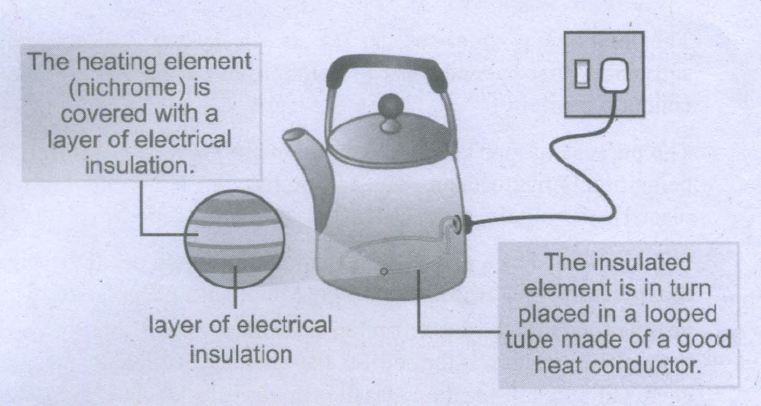
Explain the heating effect of electric current.
7.
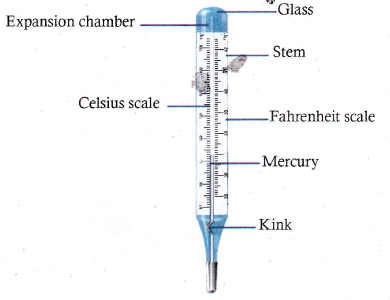
Draw the diagram of a clinical thermometer and label its parts.
8.
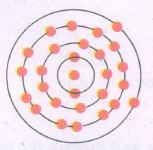
The atomic number and the mass number of an element is 26 and 56 respectively. Calculate the number of electrons, protons and neutrons in its atom. Draw the structure.
9.
Write about any three Communicable diseases in details.
10.
Explain the types of stability with suitable examples.
11.
Explain the characteristics of compounds
12.
Describe the graphical method to find the area of an irregularly shaped plane figure.
13.
Write a brief account on pollination.
14.
With the help of Microsoft Photostory how will you create a video?
1.
Antibiotics :
a) The biosynthesized chemicals are isolated from the plants microorganisms and used as medicines against infectious diseases. These substances are called as antibiotics.
b) Examples of antibiotics are chloramphenicols, tetracyclines, penicillin derivatives, cephalosporins and derivatives
c) The world's first antibiotic penicillin was discovered by Alexander Fleming
d) The overuse of antibiotics make it inactive or less effective. It will lead to antibiotic resistance.
e) The research on antibiotics is of great importance to combat the virulent and mutated microorganisms.
Analgesics:
a) Injury, burn, pressure from sharp objects and other conditions cause pain in our body.
b) The unpleasant feeling may be a burning sensation in the tissue around the injury, throbbing headache or ache of arthritis.
c) Pain is created in the brain and not at the spot of the injury.
d) Analgesics or painkillers are the pain-suppressing chemicals released by the body,
e) They suppress the feeling of pain.
f) Analgesic drug selectively relieves pain by acting either in CNS or on peripheral pain mechanism
g) without significantly altering consciousness.
i) Example: paracetamol.
j) Paracetamol interact with the receptors and reduce the intensity of pain signals to the brain
k) It also suppresses the release of substances called prostaglandins that increase pain and body temperature
2.
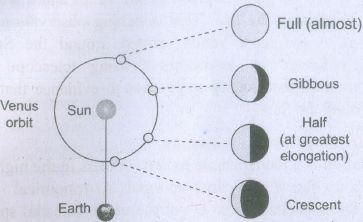
Galilio found that his observation of Venus gave the observational evidence to support the heliocentric theory. Galileo observed Venus.in 1610-1611 with a telescope. To naked eye, Venus is just a gleaming bright spot. However, through a telescope, the shape of the planet can be seen. Galilio was startled to find that like Moon Venus too exhibited phases. The shape varied from crescent to gibbous. Also the size of the planet varied. When the planet was in gibbous phase the size was small, and when it was thin crescent the size was many folds higher.
As the Venus went around the epicycle, Venus would exhibit phases. Also at times the planet would be nearer, making the apparent size grow bigger and at times far making the apparent size smaller. Thus the variation in the brightness can also be explained. It became clear to Galilio that the geocentric epicycle model will not help in accounting for the observed phases of the Venus.
If the Venus was going around the Sun, and its orbit is inside that of Earth, Venus would appear always near the Sun in the sky. It can never be seen in the midnight sky. Secondly, when it is near the Earth, it would be brighter and bigger compared to when it is on the other side of the Sun. Thirdly only if the Venus is revolving around the Sun, itcan exhibit gibbous phase, and the size of the gibbous phase smaller than the crescent phase. If the Venus was revolving around the Earth, we can never see the gibbous phase of the Venus and it would be seen only if it is orbiting the sun. This clinching observational evidence proved that at the least Venus orbited around the Sun. Further evidences collected by astronomers using telescope and other advanced modern instruments gave enough evidence that all planets revolve around the Sun.
3.
| S.No | Luminous Objects | Non-Luminous objects |
|---|---|---|
| 1 | The bodies which are able to emit their own light are called liminous objects. | The bodies which are not able to emit their own light are called non-luminous objects. |
| 2 | Luminous objects are seen without any other light source. | Non-luminous objects cannot be seen without other light source. |
| 3 | Example: The Sun, Incandescent lamp, candle | Example: The moon, The Earth |
4.
(i) Gaspard Bauhin in 1623, introduced naming of organisms with two names which is known as Binomial nomenclature, and it was implemented by Carolus Linnaeus in 1753. He is known as 'Father of Modern Taxonomy".
(ii) Binomial nomenclature is an universal system of naming organisms. As per this system, each organism has two names - the first is the Genus name and the second is the Species name. Genus name begins with a capital letter and Species name begins with a small letter.
(iii) Example: The nomenclature for onion is Allium sativam. Genus name is Allium, species name is sativum.
(iv) Vernacular name is a local name that is familiar for a particular place. Binomial name is an universal name which never changes. Binomial nomenclature and classification helps scientists to identify any organisms and to place them at a particular hierarchy.
5.
Iron blade is heated so that it expands and fixes on the wooden handle then it cooled. so that it contracts and firmly attaches to the handle
6.
i) When an electric current passes through a wire, the electrical energy is converted to hear. In heating appliances, the heating element is made up of materials with high melting point. An example of such a material is nichrome (an alloy of nickel, iron and chromium).
ii) The heating effect of current of electric current has many practical applications.
iii) The electric bulb, geyser, iron box, immersible water heater are based on this effect.
iv) These appliances have heating coils of high resistance.
Factors affecting Heating Effect of current
1) Electric Current
2) Resistance
3) Time for which current flows
Electric Fuse:
Electric fuse is a safety device which is used in household wiring and in many appliances. Electric fuse has a body made of ceramic and two points for connecting the fuse wire. The fuse wire melts whenever there is overload of the current in the wire. This breaks the circuit and helps in preventing damage to costly appliances and to the wiring. In electrical devices, a glass fuse is often used. This is a small glass tube, in which lies the fuse wire.
7.
8.
Atomic number (Z) = 26, Mass number (A) = 56
No. of protons P = 26
No. of electrons e = 26
No. of neutrons n = A - Z
= 56 - 26 = 30
Atomic structure of 26Fe56 is
9.
Tuberculosis:
(i) Causative agent : Mycobacterium tuberculae bacteria.
(ii) Transmission : Spread from one person to another through air by spitting and prolonged contact with patient.
(iii) Symptoms : Fever, weight loss, chronic cough, bloody spitting and difficulty in breathing
(iv) Prevention and treatment : BCG vaccinations. Giving special attention to the patient. Regular medication like DOT
Chicken pox:
(i) Causative agent : varicella zoster virus.
(ii) Transmission : Spread through air and contact with infected person.
(iii) Symptoms : Appearance of rashes on the whole body, fever, headache and tiredness.
(iv) Prevention and treatment : Chicken pox vaccine is the best way to prevent. Special attention should be given to infected person
Robies:
(i) Causative agent: Virus (rhabdo virus)
(ii) Transmission : By the bite of the infected dog, cat, etc.
(iii) Symptoms: Hydrophobia, fever for 2-12 weeks and exaggerations
(iv) Prevention and treatment : Fatality can be prevented by timely vaccination before onset of symptoms.
10.
Stability:
Stability is a measure of the body's ability to maintain its original position.
The three types of stability are
(i) Stable equilibrium
(ii) Unstable equilibrium
(iii) Neutral equilibrium
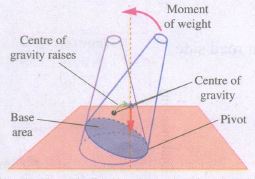
Stable Equilibrium:
i) The frustum can be tilted through quite a big angle without toppling.
ii) Its centre of gravity is raised when it is displaced.
iii) The vertical line through its centre of gravity still falls within its base.
iv) So it can return to its original position.
Unstable Equilibrium:
i) The frustum will topple with the slightest tilting. Its centre of gravity is lowered when it is displaced.
ii) The vertical line through its centre of gravity falls outside its base.
.JPG)
Neutral Equilibrium:
(i) It causes frustum to topple.
(ii) The frustum will rolls about but does not topple.
(iii) Its centre of gravity remains at the same height when it is displaced.
(iv) The body will stay in any position to which it has been displaced.
.JPG)
11.
i) A compound is formed only when the constituent elements combine in a fixed proportion.
ii) Compound exhibits entirely different properties of their constituent elements.
iii) A compound cannot be broken down by physical methods.
iv) A compound can be separated into its constituent elements by chemical methods only.
12.
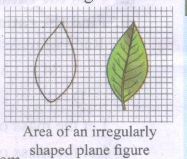
Take a leaf from any one of trees in your neighbourhood. Place the leaf on a graph sheet and draw the outline of the leaf with a pencil. Remove the leaf. You can see the outline of the leaf on the graph sheet.
i) Now count the number of whole squares enclosed within the outline of the leaf. Take it to be M
ii) Then count the number of squares that are more than half. Take it as N
iii) Next, Count the number of squares which are half of a whole square. Note it to be P.
iv) Finally, count the number of squares that are less than half. Let it be a Q.
v) Now the approximate area of the leaf can be calculated using the following formula.
Approximate area of the leaf = M+(3/4)N+(1/2)P+(1/4)
This formula can be used to calculate the area of any irregularly shaped plane figures.
13.
The process by which pollen grains reach stigma of the flower is called as pollination. Pollination can be classified into two types based on their mode of transmission.
i) Artificial pollination:
The transfer of pollen grains from anther to stigma by manually is called as artificial pollination
ii) Natural Pollination:
1) The transfer of pollen grains from anther to stigma by insect or any other natural sources is called as natural pollination.
2) Pollination can be classified into another two types based on their site of transmission
i) Self pollination:
Pollen grains are transferred from the anther to the stigma of the same flower or to another flower of the same plant is known as self pollination.
ii) Cross pollination:
Pollen grains are transferred from the anther of one flower to the stigma of another flower of the same kind or different plant known as cross pollination.
14.
Step 1: Open the application of 'Microsoft Photostory'. In that select "Begin A New Story" and click on Next.
Step 2: Click "Import Picture" in the next screen. Select 'Saved pictures' for video. If required, We can edit the image and click on Next.
Step 3: Now we can input small text, animation, audio effect for the picture then click Next.
Step 4: To provide background music, we can select a music file through "Select Music" and click on Next.
Step 5: select a title for the story, then through SETTINGS change the format of the video.
Step 6: Now our video is ready to view. Click "VIEW YOUR STORY". You can see your video now.

7th Standard Syllabus & Materials
7th Standard
TN 7th English T1 - Supplementary - On Monday Morning Important Questions And Answers Study Material - QB365 Set A
NEW7th Standard
TN 7th English T1 - Prose - Eidgah Important Questions And Answers Study Material - QB365 Set A
NEW7th Standard
TN 7th Social Science T1 - ECO - Production Important Questions And Answers Study Material - QB365 Set A
NEW7th Standard
TN 7th Social Science T1 - GEO - Interior of the Earth Important Questions And Answers Study Material - QB365 Set A



Tamilnadu Stateboard 7th Standard Subjects
Tamilnadu Stateboard Standards




