
 100% FREE ACCESS
7th Standard Syllabus & Materials
7th Standard
TN 7th Tamil பருவம் -1 இயல் 1 - அமுதத்தமிழ் - ஒன்றல்ல இரண்டல்ல Important Questions And Answers Study Material - QB365 Set A
NEW7th Standard
TN 7th Tamil பருவம் -1 இயல் 1 - அமுதத்தமிழ் - எங்கள் தமிழ் Important Questions And Answers Study Material - QB365 Set A
NEW7th Standard
TN 7th English T1 - Poem - Your Space Important Questions And Answers Study Material - QB365 Set A
NEW7th Standard
TN 7th English T1 - Prose - A Prayer to the Teacher Important Questions And Answers Study Material - QB365 Set A
NEW7th Standard
TN 7th English T1 - Poem - The Listeners Important Questions And Answers Study Material - QB365 Set A
NEW7th Standard
TN 7th English T1 - Prose - The Wind on Haunted Hill Important Questions And Answers Study Material - QB365 Set A

Published on: 13/05/2022
QB365 provides detailed and simple solution for every Book back Questions in class 7 Science Subject. It
will helps to get more idea about question pattern in every book back questions with solution.
Download Tamil Nadu 7th Standard Science question papers, model tests, one-mark questions, important questions, and public exam papers in PDF format. Free study materials and answer keys for TN State Board students.
Questions + Answers key
Take MCQ Science Test1.
Compare the images formed by plane mirror with that by pinhole camera.
2.
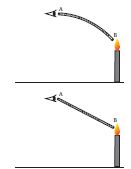
Describe the pictures.
3.
Differentiate between a reflection and a shadow.
4.
What are the difference between luminous and non-luminous objects? Give two examples of each.
1.
| S.No | Images formed by Pinhole camera | Images formed in Plane mirror |
|---|---|---|
| 1 | The image is real. | The image is virtual. |
| 2 | The image may not be equal to the size of the object. | The image is equal to the size of the object. |
| 3 | The image is inverted. | The image is erect. |
2.
(i) Fig: (A) Light rays cannot travel in curvilinear path. It cannot bend the path itself. So the observer could not see the light source, candle.
(ii) Fig: (B) Light rays travel in straight line (rectilinear path). The observer can see the light source, candle
3.
| S.no | Reflection | Shadow |
|---|---|---|
| 1 | Bouncing back of light rays from a smooth polished surface is called reflection of light |
Shadow is formed when an opaque object is placed in the path of light |
| 2 | Reflected ray of light can be seen | No light can be seen. |
| 3 | Produces an image which can be upright or inverted. |
Shadow is never inverted It is always upright. |
| 4 | Surface of the object plays a major role in reflection. |
Llght permeability of object plays a major role in shadow formation |
4.
| S.No | Luminous Objects | Non-Luminous objects |
|---|---|---|
| 1 | The bodies which are able to emit their own light are called liminous objects. | The bodies which are not able to emit their own light are called non-luminous objects. |
| 2 | Luminous objects are seen without any other light source. | Non-luminous objects cannot be seen without other light source. |
| 3 | Example: The Sun, Incandescent lamp, candle | Example: The moon, The Earth |

7th Standard Syllabus & Materials
7th Standard
TN 7th English T1 - Supplementary - On Monday Morning Important Questions And Answers Study Material - QB365 Set A
NEW7th Standard
TN 7th English T1 - Prose - Eidgah Important Questions And Answers Study Material - QB365 Set A
NEW7th Standard
TN 7th Social Science T1 - ECO - Production Important Questions And Answers Study Material - QB365 Set A
NEW7th Standard
TN 7th Social Science T1 - GEO - Interior of the Earth Important Questions And Answers Study Material - QB365 Set A



Tamilnadu Stateboard 7th Standard Subjects
Tamilnadu Stateboard Standards




