
 100% FREE ACCESS
7th Standard Syllabus & Materials
7th Standard
TN 7th Tamil பருவம் -1 இயல் 1 - அமுதத்தமிழ் - ஒன்றல்ல இரண்டல்ல Important Questions And Answers Study Material - QB365 Set A
NEW7th Standard
TN 7th Tamil பருவம் -1 இயல் 1 - அமுதத்தமிழ் - எங்கள் தமிழ் Important Questions And Answers Study Material - QB365 Set A
NEW7th Standard
TN 7th English T1 - Poem - Your Space Important Questions And Answers Study Material - QB365 Set A
NEW7th Standard
TN 7th English T1 - Prose - A Prayer to the Teacher Important Questions And Answers Study Material - QB365 Set A
NEW7th Standard
TN 7th English T1 - Poem - The Listeners Important Questions And Answers Study Material - QB365 Set A
NEW7th Standard
TN 7th English T1 - Prose - The Wind on Haunted Hill Important Questions And Answers Study Material - QB365 Set A

Published on: 17/06/2021
QB365 provides detailed and simple solution for every Book back Questions in class 7 Social Science Subject. It will helps to get more idea about question pattern in every book back questions with solution.
Download Tamil Nadu 7th Standard Social Science question papers, model tests, one-mark questions, important questions, and public exam papers in PDF format. Free study materials and answer keys for TN State Board students.
Questions + Answers key
Take MCQ Social Science Test
1.
What is a constituency?
2.
Media is the fourth pillar of democracy. Justify.
3.
Execution of Shambhuji by Mughal Army.
4.
Explain the three divisions of Tripitaka.
5.
Write name of taxation types and draw its diagram.
6.
Mention the 2 safety gears for safe driving.
7.
Describe consumer protection.
8.
What is gender equality?
9.
What are the six concepts of Disaster management cycle.
10.
Give a short note about the lifestyle of an Eskimos.
11.
Throw light on the paintings of Sittanavasal.
12.
How did Guru Nanak help to found Sikhism?.
13.
Name any five hill stations in India?
14.
Name the types of coal based on carbon content.
15.
A book which contains different kinds of maps.
1.
The constituency is the division in the state on the basis of the population. The entire state divided into several constituencies.
2.
Media ensures the transparency in the working of all the above three systems. This fourth pillar of democracy ensures that all people living in far off areas of country are aware of what's happening in rest of the country.
3.
Marathas under Shambhuji were in no position to resist the Mughals. Aurangzeb himself arrived in the Deccan in 1681. Aurangzeb's main goal was the annexation of Bijapur and Golconda. These two sultanates fell to Aurangzeb by 1687. In little over a year, Shambhuji was captured by the Mughals and, after torture, put to death.
4.
(i) The Pali canon Tripitaka has three divisions, also known as the Threefold Basket. They include Vinaya Pitaka, Sutta Pitaka and Abhidhqmma pitaka.
(ii) Vinaya Pitaka contains the rules of the order of Buddist monks, which must be observed for achieving purity of conduct.
(iii) Sutta Pitaka lays down the principles of religion by citing discourses as evidence.
(iv) Abhidhamma Pitaka is the latest of the Tripitaka. It deals with ethics, philosophy and meta-physics.
5.
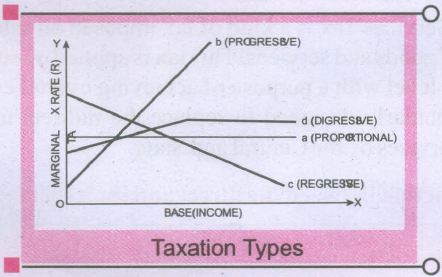
There are four types of Taxation:
1. Proportional Tax
2. Progressive Tax
3. Regressive Tax and
4. Degressive Tax
6.
(i) Use of helmets for two wheelers and
(ii) Seat belts for four wheelers are the two safety gears for safe driving.
7.
Consumer protection is a group of laws enacted to protect the rights of consumers, fair trade, competition and accurate information in the market place.
8.
Gender equality is the state of equal case of access to resources and opportunities regardless of gender.
9.
Preparation, Mitigation, Preparedness, Response, Recovery and Development are the six Disaster management cycles.
10.
(i) Eskimos live in the very cold and inhospitable region where plenty of fish varieties are available.
(ii) They are able to dress themselves in thick warm clothes made of fur. They live in igloos.
(iii) Their lives were very simple and they could not alter the environment to any extent.
(iv) They specially designed a house by ice and is known as igloos.
11.
(i) Caves at Sittanavasal, have outstanding early Pandya paintings.
(ii) Sittanavasal was a residential cave of the Jain monks. They painted the walls with fresco painting.
(iii) The lotus pond is notable for its excellent execution of colours and exposition of the scene.
(iv) The image of lotus flowers, leaves spread all over the pond, animals, elephants, buffalos, swans and a man who plucks the flowers look brilliant.
12.
(i) Guru Nanak is considered the first guru by the Sikhs.
(ii) The teachings of Guru Nanak formed the basis of Sikhism, a new religious order, founded in the late 15th century.
(iii) His and his successors' teachings are collected in the Guru Granth Sahib, which is the holy book of the Sikhs.
13.
Kodaikanal, Ooty - TamilNadu
Nainital, Mussoorie - Uttarakhand
Darjeeling - West Bengal
Gulmarg - Jammu & Kashmir
Shillong - Meghalaya
14.
Coal is classified into four types based on carbon content.
They are:
1. Anthracite
2. Bituminous
3. Lignite
4. Peat.
15.
Atlas

7th Standard Syllabus & Materials
7th Standard
TN 7th English T1 - Supplementary - On Monday Morning Important Questions And Answers Study Material - QB365 Set A
NEW7th Standard
TN 7th English T1 - Prose - Eidgah Important Questions And Answers Study Material - QB365 Set A
NEW7th Standard
TN 7th Social Science T1 - ECO - Production Important Questions And Answers Study Material - QB365 Set A
NEW7th Standard
TN 7th Social Science T1 - GEO - Interior of the Earth Important Questions And Answers Study Material - QB365 Set A



Tamilnadu Stateboard 7th Standard Subjects
Tamilnadu Stateboard Standards



