
 100% FREE ACCESS
7th Standard Syllabus & Materials
7th Standard
TN 7th Tamil பருவம் -1 இயல் 1 - அமுதத்தமிழ் - ஒன்றல்ல இரண்டல்ல Important Questions And Answers Study Material - QB365 Set A
NEW7th Standard
TN 7th Tamil பருவம் -1 இயல் 1 - அமுதத்தமிழ் - எங்கள் தமிழ் Important Questions And Answers Study Material - QB365 Set A
NEW7th Standard
TN 7th English T1 - Poem - Your Space Important Questions And Answers Study Material - QB365 Set A
NEW7th Standard
TN 7th English T1 - Prose - A Prayer to the Teacher Important Questions And Answers Study Material - QB365 Set A
NEW7th Standard
TN 7th English T1 - Poem - The Listeners Important Questions And Answers Study Material - QB365 Set A
NEW7th Standard
TN 7th English T1 - Prose - The Wind on Haunted Hill Important Questions And Answers Study Material - QB365 Set A

Published on: 30/07/2019
Geometry
Download Tamil Nadu 7th Standard Maths question papers, model tests, one-mark questions, important questions, and public exam papers in PDF format. Free study materials and answer keys for TN State Board students.
Questions + Answers key
Take MCQ Maths Test1.
Construct a perpendicular bisector of the line segment AB = 6 cm.
2.
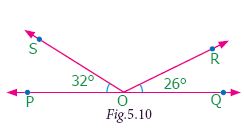
From Fig find the measure of ∠ROS.
3.
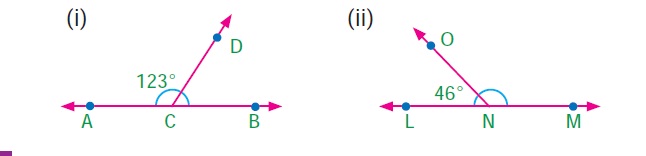
Find the missing angle.
4.
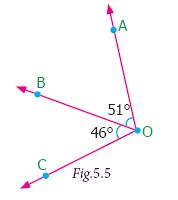
In Fig., find \(\angle \)AOC.
5.
Can two adjacent angles be supplementary?
6.
Two parallel lines are cut by a transversal. For each pair of interior angles on the same side of the transversal, if one angle exceeds the twice of the other angle by 48°. Find the angles.
7.
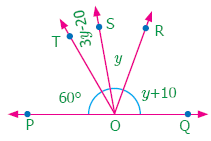
Find the value of y.
8.
Two angles are in the ratio 11: 25. If they are linear pair, find the angles.
9.
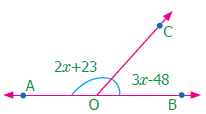
In the given figure, find the value of x.
10.
Mention two real-life situations where we use parallel lines.
11.
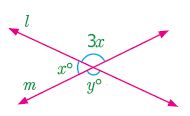
Find the angles x° and y° in the figure shown.
12.
The angles at a point are x°, 2x°, 3x°, 4x° and 5x°. Find the value of the largest angle?
13.
If the three angles at a point are in the ratio 1 : 4 : 7, find the value of each angle?
14.
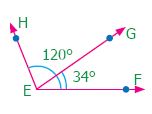
Find the angle \(\angle\)GEH from the given figure.
15.
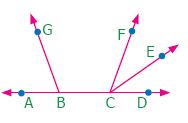
Name the pairs of adjacent angles.
16.
In the diagram, what is the value of angle x?
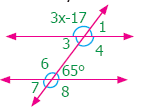
43°
44°
132°
134°
17.
Which of the following statements is ALWAYS TRUE when parallel lines are cut by a transversal
corresponding angles supplementary.
alternate interior angles supplementary.
alternate exterior angles supplementary.
interior angles on the same side of the transversal are supplementary.
18.
A line which intersects two or more lines in different points is known as
parallel lines
transversal
non-parallel lines
intersecting line
19.
The measure of \(\angle\)BOC is
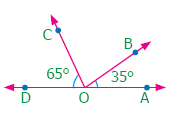
90°
180°
80°
100°
20.
Vertically opposite angles are
not equal in measure
complementary
supplementary
equal in measure
21.
Adjacent angles have
no common interior, no common arm, no common vertex
one common vertex, one common arm, common interior
one common arm, one common vertex, no common interior
one common arm, no common vertex, no common interior
22.
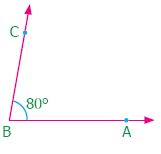
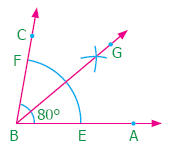
Construct bisector of the ∠ABC with the measure 80°.
23.
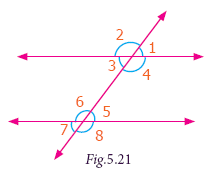
(i) Name the angle that corresponds to \(\angle\)1.
(ii) Name the angle that is alternate interior to \(\angle\)3.
(iii) Name the angle that is alternate exterior to \(\angle\)8.
(iv) Name the angle that corresponds to \(\angle\)8.
(v) Name the angle that is alternate exterior to \(\angle\)7.
(vi) Name the angle that is alternate interior to \(\angle\)6.
1.
Step 1: Draw a line. Mark two points A and B on it so that AB = 6 cm.
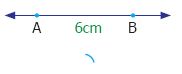
Step 2: Using compass with A as center and radius more than half of the length of AB, draw two arcs of same length, one above AB and one below AB.
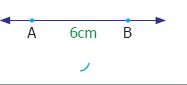
Step 3: With the same radius and B as center draw two arcs to cut the arcs drawn in step 2. Mark the points of intersection of the arcs as C and D.
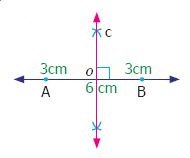
Step 4: Join C and D. CD will intersect AB. Mark the point of intersection as O CD is the required perpendicular bisector of AB.
Measure ∠AOC. Measure the length of AO and OB. What do you observe?
2.
We know that \(\angle\)QOR + \(\angle\)ROS + \(\angle\)SOP = 180°
26° + \(\angle\)ROS + 32° = 180°
\(\angle\)ROS + 58° = 180°
Subtracting 58° on both sides
We get, \(\angle\)ROS = 180° – 58° = 122°
3.
(i) Since the angles are linear pair, \(\angle\)ACD + \(\angle\)BCD = 180°
123° + \(\angle\)BCD = 180°
Subtracting 123° on both sides
123° + \(\angle\)BCD – 123° = 180° – 123°
\(\angle\)BCD = 57°
(ii) Since the angles are linear pair, \(\angle\)LNO + \(\angle\)MNO = 180°
46° + \(\angle\)MNO = 180°
Subtracting 46° on both sides
46° + \(\angle\)MNO – 46° = 180° – 46°
\(\angle\)MNO = 134°
4.
\(\angle \)AOC = \(\angle \)AOB + \(\angle \)BOC
= 46° + 51°
= 97°
5.
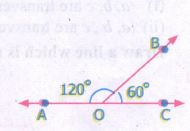
Yes, In the figure
∠AOB and ∠BOC are adjacent angles.
Also ∠AOB + ∠BOC = 180°
∴ ∠AOB and ∠BOC are supplementary
6.
Let the angles be x and y. Given that one angle exceeds the twice of the other angle by 48o
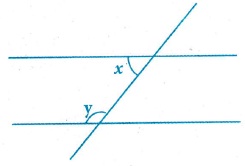
y = 2x + 48o
x + y = 180o (x and y are interior angles)
x + 2x + 48 = 180o
3x + 48 = 180o
3x = 132
x = 44o
y = 2x + 48o
= 2 x 44 + 48
= 88 + 48
y = 136
7.
From the figure
60 + 3y - 20 + y + y + 10 = 180.
5y + 50 = 180o
5y = l30o
Y = 26o
8.
Let the angles be 11x and 25x. Since the angles are linear pair.
11x + 25x = 180o
36x = 180o
x = 5
The angles are 11x = 11 x 5 = 55o and
25x = 25 x 5 = 125o
9.
From the figure
2x + 23 + 3x - 18 = 180o [linear pair]
5x + 5 = 180o
5x = 175o
x = 35o
10.
The two real - life situations where we use parallel lines are
(i) Railway tracks
(ii) Edges of a door frame
11.
From the figure
∴ x + 3x = 180° (Linear pair of angles)
4x = 180°
x = \(\frac{180°}{4}\)
x = 45o
ii) y = 3x (Vertically opposite angles)
y = 3 x 45o
y = 135o
12.
Sum of angles at a point = 360°
∴ x + 2x + 3x + 4x + 5x = 360°
15x = 360°
x = \(\frac{360°}{15}\)
x = 24o
From the given angles the largest angle is 5x
= 5 x 24° = 120°
The largest angle is 120°.
13.
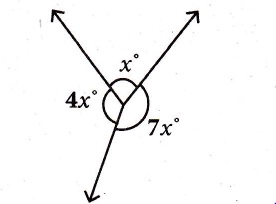
Let the three angles be x, 4x and 7x .
The sum of three angles at a points is supplementary
∴ x + 4x + 7x = 360°
12x = 360°
xo = \(\frac{{360}^o}{12}\)
x = 30°
If x = 30o then
4x = 4 x 30° = 120°
7x = 7 x 30° = 210°.
∴ The three angles are 30°, 120° and 210°.
14.
From the figure
∠FEH = ∠FEG + ∠GEH
120° = 34° + ∠GEH
120° - 34° = ∠GEH
∠GEH = 86°
15.
From the figure the pair ofadjacent angles are
i) \(\angle\)ABG and, \(\angle\)CBG
ii) \(\angle\) DCE and \(\angle\)ECF
iii) \(\angle\)ECE and \(\angle\)ACF
iv) \(\angle\)ACF and \(\angle\)ECD.
v) \(\angle\)BCF and \(\angle\)FCE
16.
(b)
44°
17.
(d)
interior angles on the same side of the transversal are supplementary.
18.
(b)
transversal
19.
(c)
80°
20.
(d)
equal in measure
21.
(c)
one common arm, one common vertex, no common interior
22.
Step 1: Draw the given angle ∠ABC with the measure 80° using protractor.
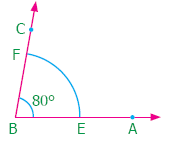
Step 2: With B as center and convenient radius, draw an arc to cut BA and BC. Mark the points of intersection as E on BA and F on BC.
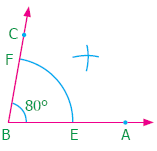
Step 3: With the same radius and E as center, draw an arc in the interior of ∠ABC and another arc of same measure with center at F to cut the previous arc.
Step 4: Mark the point of intersection as G. Draw a ray BX through G. BG is the required bisector of the given angle ∠ABC
23.
(i) The angle that corresponds to \(\angle\)1 is \(\angle\)5
(ii) The angle that is alternate interior to \(\angle\)3 is \(\angle\)5
(iii) The angle that is alternate exterior to \(\angle\)8 is \(\angle\)2
(iv) The angle that corresponds to \(\angle\)8 is \(\angle\)4
(v) The angle that is alternate exterior to \(\angle\)7 is \(\angle\)1
(vi) The angle that is alternate interior to \(\angle\)6 is \(\angle\)4

7th Standard Syllabus & Materials
7th Standard
TN 7th English T1 - Supplementary - On Monday Morning Important Questions And Answers Study Material - QB365 Set A
NEW7th Standard
TN 7th English T1 - Prose - Eidgah Important Questions And Answers Study Material - QB365 Set A
NEW7th Standard
TN 7th Social Science T1 - ECO - Production Important Questions And Answers Study Material - QB365 Set A
NEW7th Standard
TN 7th Social Science T1 - GEO - Interior of the Earth Important Questions And Answers Study Material - QB365 Set A



Tamilnadu Stateboard 7th Standard Subjects
Tamilnadu Stateboard Standards




