
 100% FREE ACCESS
7th Standard Syllabus & Materials
7th Standard
TN 7th Tamil பருவம் -1 இயல் 1 - அமுதத்தமிழ் - ஒன்றல்ல இரண்டல்ல Important Questions And Answers Study Material - QB365 Set A
NEW7th Standard
TN 7th Tamil பருவம் -1 இயல் 1 - அமுதத்தமிழ் - எங்கள் தமிழ் Important Questions And Answers Study Material - QB365 Set A
NEW7th Standard
TN 7th English T1 - Poem - Your Space Important Questions And Answers Study Material - QB365 Set A
NEW7th Standard
TN 7th English T1 - Prose - A Prayer to the Teacher Important Questions And Answers Study Material - QB365 Set A
NEW7th Standard
TN 7th English T1 - Poem - The Listeners Important Questions And Answers Study Material - QB365 Set A
NEW7th Standard
TN 7th English T1 - Prose - The Wind on Haunted Hill Important Questions And Answers Study Material - QB365 Set A

Published on: 25/09/2019
Measurements
Download Tamil Nadu 7th Standard Maths question papers, model tests, one-mark questions, important questions, and public exam papers in PDF format. Free study materials and answer keys for TN State Board students.
Questions + Answers key
Take MCQ Maths Test1.
Find the altitude ofthe rhombus whose area is 315 cm2 and its perimeter is 180 cm.
2.
The area of a trapezium is 828 sq. cm. If the lengths of its parallel sides are 19.6 cm and 16.4 cm, find the distance between them.
3.
Find the area of the trapezium whose height is 14 cm and the parallel sides are 18 cm and 9 cm of length
4.
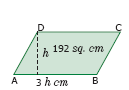
The base of the parallelogram is thrice its height. If the area is 192 sq. cm, find the base and height
5.
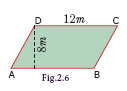
One of the sides and the corresponding height of the parallelogram are 12 m and 8 m respectively. Find the area of the parallelogram.
6.
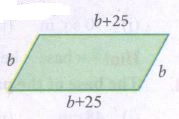
The perimeter of a parallelogram is 150 cm. One of its sides is greater than the other by 25 cm. Find the length of the sides of the parallelogram.
7.
Find the height of the parallelogram whose base is four times the height and whose area is 576 sq. cm.
8.
One of the diagonals of a rhombus is thrice as the other. If the sum of the length of the diagonals is 24 cm, then find the area of the rhombus
9.
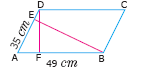
The area of the parallelogram ABCD is 1470 sq cm.
If AB = 49 cm and AD = 35 cm then, find the heights DF and BE
10.
The area of the rhombus is 576 sq. cm and the length of one of its diagonal is half of the length of the other diagonal then find the length of the diagonals
11.
A square and a parallelogram have the same area. If the side of the square is 48 m and the height of the parallelogram is 18 m, find the length of the base of the parallelogram
12.
The area of a trapezium is 1080 sq. cm. If the lengths of its parallel sides are 55.6 cm and 34.4 cm, find the distance between them.
13.
The area of a rhombus is 100 sq. cm and length of one of its diagonals is 8 cm. Find the length of the other diagonal
14.
Janaki has a piece of fabric in the shape of a parallelogram. Its height is 12 m and its base is 18 m. She cuts the fabric into four equal parallelograms by cutting the parallel sides through its mid-points. Find the area of each new parallelogram.
15.
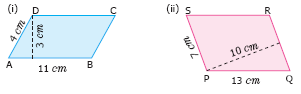
Find the area and perimeter of the following parallelograms:
16.
when the non-parallel sides of a trapezium are equal then it is known as
a square
a rectangle
an isosceles trapezium
a parallelogram
17.
The area of the trapezium, if the parallel sides are measuring 8 cm and 10 cm and the height 5 cm is
45 sq. cm
40 sq. cm
18 sq. cm
50 sq. cm
18.
The height of the rhombus whose area 96 sq. m and side 24 m is
8 m
10 m
2 m
4 m
19.
The area of the rhombus with side 4 cm and height 3 cm is
7 sq. cm
24 sq. cm
12 sq. cm
10 sq. cm
20.
The perimeter of a parallelogram whose adjacent sides are 6 cm and 5 cm is
12 cm
10 cm
24 cm
22 cm
21.
The floor of an office building consists of 200 rhombus shaped tiles and each of its length of the diagonals are 40 cm and 25 cm. Find the total cost of polishing the floor at 45 per sq m.
22.
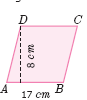
Find the area of the rhombus whose side is 17 cm and the height is 8 cm.
1.
Given perimeter of the rhombus = 180 cm
∴ One side of the rhombus = \(\frac { 180 }{ 4 } \) = 45 cm
Given area of the rhombus = 315 cm2
b x h = 315
45 x h = 315
= \(\frac { 315 }{ 45 } \)
h = 7cm
Altitude of the rhombus = 7 cm
2.
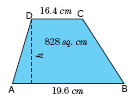
Given, Area of the Trapezium = 828 cm²
\(\cfrac { 1 }{ 2 } \times h(a+b)=828\)
\(\cfrac { 1 }{ 2 } \times h(19.6+16.4)=828\)
\(\cfrac { 1 }{ 2 } \times h(36)=828\)
h (18) = 828
\(h=\cfrac { 828 }{ 18 } \)
h - = 46 m
Therefore, distance between the parallel sides = 46 cm
3.
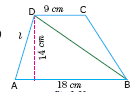
Given, height (h) = 14 cm
parallel sides are (a) = 18 cm and (b) = 9 cm
Area of the trapezium = \(\cfrac { 1 }{ 2 } \times h(a+b)\)
= \(\cfrac { 1 }{ 2 } \times 14\left( 18+9 \right) \)
= 7(27)
= 189 sq. cm
Therefore, area of the trapezium is 189 sq. cm.
4.
Let the height of the parallelogram = h cm
Then the base of the parallelogram = 3h cm
Area of the parallelogram = 192 sq. cm
b x h = 192
3h x h = 192
3h² = 192
h² = 64
h x h = 8 x 8
h = 8 cm
base = 3h = 3 x 8 = 24 cm
Therefore, base of the parallelogram is 24 cm and height is 8 cm.
5.
Given: b = 12 m, h = 8 m
Area of the parallelogram = b x h sq.units
= 12 x 8 = 96 sq.m
Therefore, Area of the parallelogram = 96 sq.m.
6.
Given perimeter = 150 cm
Let one side of the parallelogram be 'b' cm
Then the other side = b + 25 cm
b + (b + 25) + b + (b + 25) = 150
b + b + 25 + b + b + 25 = 150
4b + 50 = 150 = 4b =100
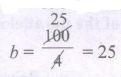
∴ One side b = 25 cm
Other side b + 25 = 50 cm
7.
base = 4 times of the height
b = 4h
Area of parallelogram = 576
b x h = 576
4h x h = 576
4h2 = 576
h2 = I44 cm
h = 12 cm
Ans : Height of the parallelogram is 12 cm.
8.
Given : One of the diagonals of a rhombus is thrice the other
\(\Rightarrow \ \mathrm{d}_{2}=3 \mathrm{~d}_{1}\) ............(1)
Sum of the length of the diagonals = 24 cm
d1+ d2 = 24cm
3 d1 + 3d2 = 24
4d1 = 24
\(d_{1}=\frac{24}{4}=6 \mathrm{~cm}\)
d1 = 6 cm
d2 = 3d1
= 3 x 6
d2 = 18 cm
Area of the rhombus \(=\frac{1}{2} \mathrm{~d}_{1} \times \mathrm{d}_{2} \text { sq.units }
\)
\(=\frac{1}{2} \times 6 \times 18
\)
= 54 sq.cm
9.
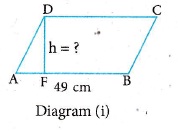
In diagram (i)
Consider DF as height (h) and AB as base (b)
Area of the parallelogram = 1470 sq.cm
b x h = 1470
49 x h = 1470
h = 30
height, DF = 30 cm
.jpg)
In diagram (ii),
Consider BE as height (h) and AD as base (b)
Area of the parallelogram = 1470 sq.cm
b x h = 1470
35 x h = 1470
height BE = 42 cm
Ans: DF = 30 cm and BE = 42 cm
10.
Length of one diagonal \(=\frac{1}{2}\) length of other diagonal
\(\mathrm{d}_{2}=\frac{1}{2} \mathrm{~d}_{1}\)
Area of the rhombus = 576
\(\frac{1}{2} \times\left(d_{1} \times d_{2}\right)=576
\)
\(\frac{1}{2} \times d_{1} \times \frac{1}{2} d_{1}=576
\)
d1 x d1 = 576 x 2 x 2
d1 x d1 = 24 x 24 x 2 x 2
d1 = 24 x 2
d1 = 48 cm
\(\mathrm{d}_{2}=\frac{1}{2} \mathrm{~d}_{1}=\frac{1}{2} \times 48\)
d2 = 24 cm
The length of the diagonals are 24 cm and 48 cm.
11.
Given : Area of a parallelogram = Area of a square
b x h = a x a
b x 18 = 48 x 48
\(b=\frac{48 \times 48}{18}\)
Base (b) = 128 m
12.
Given : A = 1080 sq.cm, a = 55.6 cm, b = 34.4 cm
Distance between them, h = ?
Area of trapezium = 1080 sq.cm
\(\frac{1}{2} \times h(a+b) =1080
\)
\(\frac{1}{2} \times h(55.6+34.4) =1080
\)
\(\frac{1}{2} \times h \times 90 =1080
\)
\(h =\frac{1080 \times 2}{90}
\)
Distance, h = 24 cm.
13.
Given : Area = 100 sq.cm, d1 = 8 cm, d2 = ?
Area of rhombus = 100 sq.cm
\(\frac{1}{2} \times\left(d_{1} \times d_{2}\right)=100 \)
\(\frac{1}{2} \times\left(8 \times d_{2}\right)=100 \)
8 x d2 = 100 x 2
\(\mathrm{d}_{2}=\frac{100 \times 2}{8} \Rightarrow \mathrm{d}_{2}=25 \mathrm{~cm}\)
14.
h = 12 m,b = 18 m
Area of a parallelogram (fabric) = b x h = 18 x 12
= 216 m2 (or) sq.m
She cuts the fabric into 4 equal parallelograms
Area of a new parallelogram = 54 m2
15.
(i) Area of a parallelogram
= b x h sq.units
= 11 x 3 = 33 cm2
Perimeter of the parallelogram
= sum of the length of the four sides.
= 11+ 4 + 11 + 4 = 30 cm.
(ii) Area of a parallelogram
= b x h sq.units
= 7 x 10 = 70 cm2
Perimeter of the parallelogram
= sum of the length of the four sides.
= 13 + 7 + 13 + 7 = 40 cm
16.
(c)
an isosceles trapezium
17.
(a)
45 sq. cm
18.
(d)
4 m
19.
(c)
12 sq. cm
20.
(d)
22 cm
21.
Given, the length of the diagonals of a rhombus shaped tile are 40 cm and 25 cm
The area of one tile = \(\cfrac { 1 }{ 2 } \times \left( { d }_{ 1 }\times { d }_{ 2 } \right) sq.units\)
= \(\cfrac { 1 }{ 2 } \times 40\times 25\)
= 500 sq.cm
Therefore, the area of 200 such tiles = 200 x 500
= 100000 sq. cm
= \(\cfrac { 100000 }{ 10000 } \)(1sq.m = 1000 sq.cm)
= 10 sq.m
Therefore, the cost of polishing 200 such tiles at the rate of Rs 45 per sq. cm
= 10 x 45 = Rs. 450.
22.
Base = 17 cm, height = 8 cm
Area of the rhombus = b x h sq. units
= 17 x 8 = 136
Therefore, area of the rhombus = 136 sq. cm

7th Standard Syllabus & Materials
7th Standard
TN 7th English T1 - Supplementary - On Monday Morning Important Questions And Answers Study Material - QB365 Set A
NEW7th Standard
TN 7th English T1 - Prose - Eidgah Important Questions And Answers Study Material - QB365 Set A
NEW7th Standard
TN 7th Social Science T1 - ECO - Production Important Questions And Answers Study Material - QB365 Set A
NEW7th Standard
TN 7th Social Science T1 - GEO - Interior of the Earth Important Questions And Answers Study Material - QB365 Set A



Tamilnadu Stateboard 7th Standard Subjects
Tamilnadu Stateboard Standards




