
 100% FREE ACCESS
7th Standard Syllabus & Materials
7th Standard
TN 7th Tamil பருவம் -1 இயல் 1 - அமுதத்தமிழ் - ஒன்றல்ல இரண்டல்ல Important Questions And Answers Study Material - QB365 Set A
NEW7th Standard
TN 7th Tamil பருவம் -1 இயல் 1 - அமுதத்தமிழ் - எங்கள் தமிழ் Important Questions And Answers Study Material - QB365 Set A
NEW7th Standard
TN 7th English T1 - Poem - Your Space Important Questions And Answers Study Material - QB365 Set A
NEW7th Standard
TN 7th English T1 - Prose - A Prayer to the Teacher Important Questions And Answers Study Material - QB365 Set A
NEW7th Standard
TN 7th English T1 - Poem - The Listeners Important Questions And Answers Study Material - QB365 Set A
NEW7th Standard
TN 7th English T1 - Prose - The Wind on Haunted Hill Important Questions And Answers Study Material - QB365 Set A

Published on: 04/02/2020
7th Standard Science Important Questions
Download Tamil Nadu 7th Standard Science question papers, model tests, one-mark questions, important questions, and public exam papers in PDF format. Free study materials and answer keys for TN State Board students.
Questions + Answers key
Take MCQ Science Test1.
What is the use of Ranger?
2.
What is Tux Math?
3.
What is the Shortcut key for Save option?
4.
Write the binomial name of
a) Human being
b) Paddy
5.
What is binomial nomenclature?
6.
Write two examples of Monera.
7.
Define – dichotomous key
8.
Why lysosomes are known as scavengers of the cell?
9.
What does cell membrane do?
10.
What are the main things in a nucleus?
11.
Which organelle uses energy from sunlight to make starch?
12.
What type of energy changes is associated when ice melts?
13.
Growing of nails is a periodic change. Why?
14.
Cold milk is heated and it becomes hot. Which type of change it is?
15.
State two examples of periodic changes.
16.
What is a battery?
17.
Name some devices that run using heat effect of electric current.
18.
Define fuse.
19.
What is the S.I unit of electrical conductivity?
20.
What is the use of kink in clinical thermometer?
21.
A clinical thermometer is not used to measure the temperature of air, why?
22.
Jyothi was prepared to measure the temperature of hot water with a clinical thermometer. Is it right or wrong? Why?
23.
Temperature of Srinagar (J&K) is — 40C and in Kodaikanal is 30C which of them has greater temperature? What is the difference between the temperatures of these two places?
24.
Name the types of pictures?
25.
What is 'Photoshop'?
26.
Name two disease which can be prevented by vaccination.
27.
List two measures to maintain community hygiene
28.
What are breathing Roots or Pneumatophores?
29.
Differentiate Phyllode and Phylloclade.
30.
Name the sub aerial modifications of stem.
31.
Describe a stamen.
32.
In the notation of an atom ZXA. What does A & Z represent?
33.
What is isotone?
34.
What is the mass of a proton?
35.
What is a neutron?
36.
What is the atomicity of H2SO4?
37.
What is a molecule?
38.
How many elements are known at present?
39.
Mention any two conditions for stability of a body?
40.
Give some examples for scalar quantity
41.
Is displacement a scalar quantity?
42.
What is the distance between the earth and proxima centauri star?
43.
Which one of the following has more density. Water or cooking oil.
44.
Which one of the following has more volume. Iron block or a wooden block of same mass.
45.
How will you determine the volume of a liquid?
46.
How do you find the area of irregularly shaped figures?
47.
What is the SI unit of electric charge?
48.
What is the fundamental unit of amount of substance?
49.
Write the SI unit of speed
50.
Find the volume of (Take \(\pi\) = 22/7)
i. a cube whose side is 3 cm.
ii. a cylinder whose radius is 3 m and height is 7 m.
51.
Find the area of the following regular shaped figures: (Take \(\pi\) = 22/7)
(a) A rectangle whose length is 12 m and breadth is 4 m.
(b) A circle whose radius is 7 m.
(c) A triangle whose base is 6 m and height is 8 m.
52.
What is the area of 10 squares each having side of 1 m?
53.
What is the characteristics of proton?
54.
Name the sub-atomic particles.
55.
Define - Atom.
56.
Ravi said, Ganga had minor burn, so I washed with water. Do you agree with his statement? Explain, Why?
57.
Sobi frequently playing with her mobile. Suggest your ideas to protect her eye from irritation?
58.
How to keep your hair clean and healthy?
59.
Write about the right way of protecting the eyes?
60.
Correct your friend who says “The acceleration gives the idea of how fast the position changes”.
61.
“She moves at a constant speed in a constant direction”. Rephrase the same sentence in fewer words using concepts related to motion.
62.
All objects having uniform speed need not have uniform velocity. Describe with the help of examples.
63.
Classify the following as elements and compounds.
Water, Common salt, Sugar, Carbon dioxide, Iodine and Lithium
64.
Write the symbols for the following elements and classify them as solid, liquid and gas.
Aluminum, carbon, chlorine, mercury, hydrogen and helium
65.
What do you understand by chemical formula of a compound? What is its significance?
66.
Classify the following molecules as the molecules of element or compound
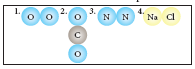
67.
Write the chemical formula and name the elements present in the following compounds:
a. Sodium chloride
b. Potassium hydroxide
c. Carbon dioxide
d. Calcium oxide
e. Sulphur dioxide
68.
Write notes on 2D and 3D pictures.
69.
What is Raster Graphics?
70.
What are thorns?
71.
What is tendril?
72.
What are the agents of pollination?
73.
Define – pollination.
74.
Write two types of reproduction in plants.
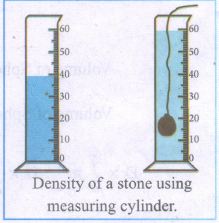
75.
What is the density of gold?
76.
Name the units used to measure the distance between celestial objects.
77.
Name the liquid in which an iron ball sinks.
78.
Give the formula to find the density of objects.
79.
Write down the formula used to find the volume of a cylinder.
80.
Give the value of one light year.
81.
Name some of the derived quantities.
82.
Write any two merits of Five Kingdom classification.
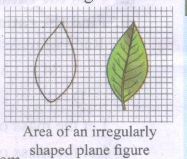
83.
Write the levels of classification.
84.
Write correct sequence from cell to organism?
85.
Distinguish between the following pairs Smooth ER and Rough ER Cell wall and cell membrane Chloroplast and mitochondria
86.
What is the difference between dissolution of sugar and burning of sugar?
87.
How can a change occur in a substance?
88.
Distinguish physical and chemical changes.
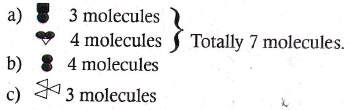
89.
Differentiate parallel and serial circuits.
90.
Define an electric current.
91.
Swathi kept a laboratory thermometer in hot water for some time and took it out to read the temperature. Ramani said it was a wrong way of measuring temperature. Do you agree with Ramani? Explain your answer.
92.
Why do we use Mercury in thermometers? Can water be used instead of mercury? What are the problems in using it?
93.
Richa had a pet dog. She vaccinated him regularly. He suddenly bit a stranger. Do you think that the person could have got Rabies.
94.
What can we do to maintain personal hygiene?
95.
We should use a handkarchief when we sneeze, Justify.
96.
Write a note on Chicken pox.
97.
Write a note on non-communicable diseases.
98.
Why do all plants lack breathing roots?
99.
Parasitic plants lack leaves
100.
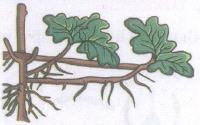
Identify the plant and the modification seen in it.
101.
Differentiate self pollination and cross pollination (OR) Write the differences between self and cross pollination.
102.
What are traps or Insectivorous plants?
103.
Write a note on phylloclade.
104.
How do Epiphytic roots differ from Sucking roots?
105.
Write a note an roots modified for mechanical support.
106.
What makes atoms stick together?
107.
From the symbol 15P31, state.
(i) Mass number of phosphorus.
(ii) Atomic number of phosphorus.
108.
What are the limitations of Thomson's model of an atom?
109.
Define Isobars? Give example
110.
Define isotopes? Give example.
111.
What is atomic mass number. Mention its formula?
112.
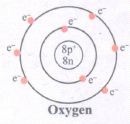
Draw the atomic structure of Oxygen
113.
Is the structure of the atom the same as the structure of the solar system
114.
Write the difference between a mixture and compund.
115.
Why is hydrogen considered as an element?
116.
How do hot air balloons float?
117.
What happens to matter during heating?
118.
Write any two properties of a compound.
119.
Give an example of a metal which
(a) is liquid at room temperature.
(b) is the best conductor of heat.
120.
What are metalloids? Give examples
121.
Give an account of elements known to us
122.
What are the 3 most abundant atoms on the earth?
123.
What is an atom?
124.
What is stability? Mention its types.
125.
What is non-uniform velocity? Give example
126.
Define speed Mention its formula and unit.
127.
A train starting from a railway station and moving with uniform acceleration attains a speed of 40 km/h in 10 minutes. Find its acceleration?
128.
Saranya jogs from one end A to the other end B of a straight road of length 320m in 2min 40 seconds. Then she turns back and jogs 100m to point C in 1 min. what is her average velocity in jogging.
129.
Write note on the following:
(i) Nautical mile
(ii) knot.
130.
Explain the concept which is used in the continuous movement of Thanjavur doll?
131.
Mention the real life applications of centre of gravity.
132.
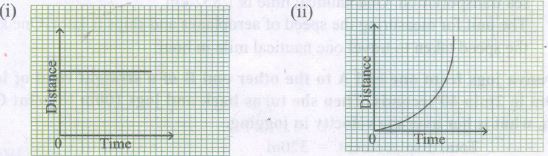
Draw distance-time graphs for the following
(i) a stationary body
(ii) a body moving with variable velocity.
133.
A body moves is a circle of radius '2R' what is the distance covered and displacement of the body after 2 complete rounds?
134.
Wooden block occupies more volume than the iron ball of same mass. Give reason.
135.
Define one light year.
136.
Define astronomical unit
137.
What is the relation between density, volume and mass?
138.
What is capacity of a container?
139.
What is meant by area?
140.
What is measurement?
141.
What do you mean by 'unit'?
142.
What is physical quantity? give example.
143.
Define mass Mention its unit.
144.
A solid cylinder of mass 280 kg has a volume of 4 m3. Find the density of cylinder.
145.
Differentiate mass number from atomic number.
146.
Distinguish Isotopes from Isobar.
147.
Why first aid is essential?
148.
What is centre of gravity ?
149.
What do you mean by constant acceleration?
150.
Show the shape of the distance – time graph for the motion in the following cases.
a. A bus moving with a constant speed.
b. A car parked on a road side.
151.
Calculate the atomicity of H2SO4.
152.
What is atomicity of elements?
153.
Give an example for the elements derived from their Latin names
154.
What are compounds? Give two examples.
155.
Write the chemical formula for the following elements
a. Hydrogen
b. Nitrogen
c. Ozone
d. Sulphur
156.
Write notes on phyllode.
157.
Differentiate between Raster and Vector images.
158.
Define - Astronomical unit?
159.
What is one light year?
160.
Define the density of objects.
161.
What are derived quantities?
162.
Give an account on the classification of invertebrates with few general features and examples.
163.
In a situation, how to explain, while your friend ask what is this, never seen before?
164.
Write about any three organelles in detail.
165.
Explain the construction and working of a dry cell.
166.
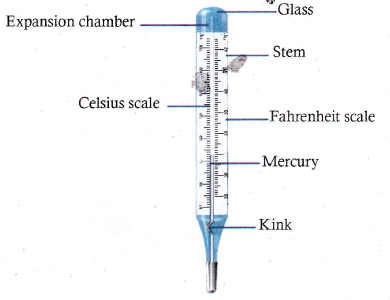
Draw the diagram of a clinical thermometer and label its parts.
167.
List the diseases affecting the eye, their causative agents, impact and Remedial measures.
168.
Write a note on causes and symptoms of Anaemia.
169.
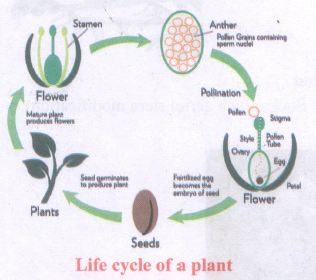
Draw a diagram to show the life cycle of a plant. (OR) Draw the life cycle of plant.
170.
Write a note an sub aerial modifications of the stem.
171.
Explain the postulates of Dalton's atomic theory.
172.
Explain the following terms.
(i) Proton,
(ii) Electron,
(iii) Neutron.
173.
What are the conclusions/observations made by Rutherford?
174.
What was the model of an atom proposed by Thomson?
175.
(i) Draw the symbol for some elements as proposed by Dalton.
(ii) What are rules to be followed while assigning symbol to element.
176.
The motion of a car is given in the following data draw distance - time graph.
(a) Car at rest
| Time / s | 0 | 1 | 2 | 3 | 4 | 5 |
| Speed / ms | 0 | 20 | 20 | 20 | 20 | 20 |
(b) Car travelling at uniform speed of 10 ms-1
| Time / s | 0 | 1 | 2 | 3 | 4 | 5 |
| Speed / ms | 0 | 10 | 20 | 30 | 40 | 50 |
(c) Car travelling at increasing speed
| Time / s | 0 | 1 | 2 | 3 | 4 | 5 |
| Speed / ms | 0 | 5 | 20 | 45 | 80 | 125 |
(d) Car travelling at decreasing speed
| Time / s | 0 | 1 | 2 | 3 | 4 | 5 |
| Speed / ms | 0 | 45 | 80 | 105 | 120 | 125 |
177.
Draw velocity-time graph for the following data:
1. Bus at rest
| Time / s | 0 | 1 | 2 | 3 | 4 | 5 |
| Speed / ms-1 | 0 | 0 | 0 | 0 | 0 | 0 |
2. Bus travelling at uniform speed of m/s
| Time / s | 0 | 1 | 2 | 3 | 4 | 5 |
| Speed / ms-1 | 10 | 10 | 10 | 10 | 10 | 10 |
3. Bus travelling at uniform acceleration
| Time / s | 0 | 1 | 2 | 3 | 4 | 5 |
| Speed / ms-1 | 10 | 10 | 20 | 30 | 40 | 50 |
4. Bus travelling at uniform deceleration
| Time / s | 0 | 1 | 2 | 3 | 4 | 5 |
| Speed / ms-1 | 50 | 40 | 30 | 20 | 10 | 0 |
5. Bus travelling with increasing acceleration
(non - uniform acceleration)
| Time / s | 0 | 1 | 2 | 3 | 4 | 5 |
| Speed / ms-1 | 0 | 2 | 8 | 18 | 32 | 50 |
178.
Write the differences between distance and displacement
179.
How will you find the area of irregular objects?
180.
How will you find the volume of an irregularly shaped object (stone) by using measuring cylinder?
181.
Define valency? What is the valency of the element with atomic number 8? What is the compound format by this element with hydrogen?
182.
What are nucleons? Why are they called so? Write the properties of the nucleons.
183.
The atomic number and the mass number of an element is 26 and 56 respectively. Calculate the number of electrons, protons and neutrons in its atom. Draw the structure.
184.
Draw the structure of an atom and explain the position of the sub-atomic particles.
185.
How the disease are transmitted from one person to the other person?
186.
List the situations in which first aid is given. What would you do if a person suffers from skin burns?
187.
Write about any three Communicable diseases in details.
188.
Write about the experiment to find the centre of gravity of the irregularly shaped plate.
189.
Explain the types of stability with suitable examples.
190.
Write down the properties of metalloids
191.
Write any five characteristics of compounds.
192.
Differentiate between elements and compounds
193.
Explain the characteristics of compounds
194.
Differentiate metals and non metals.
195.
How will you determine the density of a stone using a measuring jar?
196.
Describe the graphical method to find the area of an irregularly shaped plane figure.
197.
Explain the underground stems.
198.
Write a brief account on pollination.
199.
With the help of Microsoft Photostory how will you create a video?
200.
Which kingdom has saprophytic, parasitic and symbiotic nutrition. Why?
201.
Boiling of water is a physical change; but boiling of egg is a chemical change. Why?
202.
A very hot glass on putting in cold water cracks. What does this change indicate?
203.
Peeled and unpeeled banana does not look the same. Does that mean peeling banana is a chemical change?
204.
A student made a circuit by using an electric cell, a switch, a torch bulb (fitted in the bulb holder) and copper connecting wires. When he turned on the switch, the torch bulb did not glow at all. The student checked the circuit and found that all the wire connections were tight.
What could be the possible reason for the torch bulb not glowing even when the circuit appears to be complete?
205.
Go to a veterinary doctor (a doctor who treats animals). Discuss and find out the normal temperature of domestic animals and birds.
206.
An atom of an element has no electron, will that atom have any mass or not? Can an atom exist without electron? If so then give example.
207.
A person is sleeping during day time. Why does this happen with some people that they feel sleepy during day time in office or in the classroom. Have you ever come across such situation? Explain.

208.
In the diagram below, the circle, square and triangle represent the atoms of different elements.
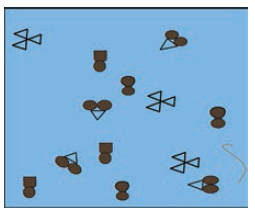
In the diagram above, identify all combinations that represent
a. A molecule of a compound
b. A molecule of an element consisting of two atoms
c. A molecule of an element consisting of three atoms
209.
What changes take place in the movement and arrangement of particles during heating process?
210.
Aakash noticed that the metal latch on gate was difficult to open during hot sunny days. However, it was not difficult to open the same latch at night. Aakash observed that the latch and the gate are exposed to the sun during day time.
a. Formulate a hypothesis based on the information provided.
b. Briefly state how you would test the hypothesis.
211.
Ginger is considered to be a stem, not a root. Why?
1.
Ranger is used for addition, subtraction, multiplication, and division to ten.
2.
Tux Math is an open source arcade - style video game for learning arithmetic. The main goal is to make learning effective and fun.
3.
Save option shortcut key is Ctrl+S.
4.
a) Human being - Homo sapiens
b) Paddy - Oryza sativa
5.
Binomial nomenclature is an universal system of naming organisms. As per this system, each organism has two names like Genus name and Species name.
6.
Bacteria and Blue green algae are examples for monera.
7.
It is a tool used to classify organisms based on their similarities and differences.
8.
Lysosomes are the main digestive compartments of the cell. They lyse a cell. So it is called as scavengers of the cell.
9.
Cell membrane is the boundary of animal cell.
10.
Chromatin and nucleolus are the main things of nucleus.
11.
Chloroplast is a organelle uses energy from sunlight to make starch.
12.
Melting is associated when ice melts.
13.
It grows regular interval time. so it is called periodic change.
14.
It is a exothermic change.
15.
Rotation and Revolution of the earth, Beating of the heart.
16.
Batteries are a collection of one or more cells.
17.
Electric bulb, geyser, iron box, immersible water heater are the devices that run using heat effect of electric current.
18.
Fuse is a safety device which is used in household wiring and in many appliances.
19.
SI unit of electrical conductivity is Siemens / meter (S/m)
20.
The kink prevents the mercury from flowing back into the bulb when the thermometer is taken out of the patients mouth.
21.
Gas molecules are randomly moved. So it is not possible to measure temperature of air by clinical thermometer.
22.
It is wrong. Clinical thermometer indicates only 35°C to 42°C. So hot water is greater than 42°C. So it is wrong.
23.
Kodaikanal temperature is greater. The different temperature is
-4°C + 3°C = 7°C
24.
Pictures are of two types,
(i) Vector,
(ii) Raster.
25.
Photoshop is a software used to beautify and edit the photos. It is used by Photographers.
26.
Polio, Tuberculosis.
27.
(i) The surroundings should be kept clean.
(ii) Drains should be covered properly.
28.
(i) Mangrove plants roots which are seen above the ground for the purpose of gaseous exchange.
(ii) These roots are erect, peg like structures with numerous pores through which air circulates.
(iii) These roots are called breathing roots, or pneumatophores. e.g Avicennia.
29.
| Phyllode | Phylloclade |
| Petioles are modified to form leaf like structure. e.g. Acacia. | stem is modified to form leaf like structure. e.g. Cactus. |
30.
Runner, stolum, sucker, offset.
31.
(i) A stamen consists of two parts.
(ii) A stalk called filament and a lobe called anther. The anther contains pollen grains.
32.
A - mass number, Z - atomic number.
33.
Atoms of different elements with different atomic number and different mass numbers but the same number of neutrons are called isotones.
34.
1.6726 x 10⁻²⁷ kg.
35.
Neutron is an elementary particle that carries no charge
36.
H2SO4
H2 = 2 Hydrogen atoms
S = 1 Sulphur atom
O4 = 4 Oxygen atoms
Hence its atomicity is 2 + 1 + 4 = 7
37.
Molecule is the smallest unit of compound.
38.
118.
39.
1. Increase the area of its base.
2. Lower its centre of gravity
40.
Mass, distance, speed, temperature.
41.
No, displacement is a vector quantity as it depends on direction.
42.
4.22 light years.
43.
Water
44.
Wooden block.
45.
By using measuring cylinder.
46.
Graphical method.
47.
Coulomb (C)
48.
mole (mol)
49.
m/s
50.
a. Volume of a cube = side \(\times\) side \(\times\) side
= 3 cm \(\times\) 3 cm \(\times\) 3 cm = 27 cubic cm or \(\mathrm{cm}^{3}\)
b. Volume of a cylinder \(=\pi \times(\text { radius })^{2} \times \text { height }\)
\(=22 / 7 \times 3 \times 3 \times 7=198 \mathrm{~m}^{3} .\)
51.
(a) Area of rectangle = length \(\times\) breadth
= 12 \(\times\) 4 = 48 m2
(b) Area of circle
\(=\pi \times r^{2}=(22 / 7) \times 7 \times 7 \\ =154 \mathrm{~m}^{2}\)
(c) Area of triangle
\(=1 / 2 \times \text { base } \times \text { height } \\ =1 / 2 \times 6 \times 8=24 \mathrm{~m}^{2}\)
52.
Area of a square = side \(\times \) side
= 1 m \(\times \) 1 m
= 1 m2 or 1 square metre
Area of 10 squares = 1 square metre \(\times \) 10
= 10 square metre
53.
(i) One of the nucleon located in the nucleus.
(ii) Positively charged particle (+1).
(iii) Mass of a proton is 1.6726 \(\times\) 10-27 kg.
54.
Protons, neutrons and electrons.
55.
An atom is the smallest particle of a chemical element that retains its chemical properties.
56.
I agree this statement. Because if we washed with cold water leads to prevent from more tissue damage.
57.
Don't use mobile frequently. If you are using frequently it may leads to loss your vision. Because of heavy light focus can damage our lens leads to irritation.
58.
The regular hair wash and massage of the scalp will remove the dead skin cells, excess oil and dust.
59.
We have to eat foods rich in antioxidant vitamins and minerals, use of antibiotic eye drops or ointment to protect the eyes.
60.
There are two possible answers:
Velocity gives an idea of how fast the position changes. or Acceleration gives an idea of how fast the velocity changes.
61.
She moves in a straight line with constant velocity.
62.
An object moving in uniform circular motion is moving around the perimeter of the circle with a constant speed. While the speed of object is constant, its velocity is changing, Ex: Merry-go-round, roller coaster, planets orbiting the sun.
63.
Elemenls: Iodine and Lithium.
Compounds: Water, Common salt, Sugar and Carbon dioxide.
64.
| Element | Symbol | Nature |
| Aluminum | Al | Solid |
| Carbon | C | Solid |
| Chlorine | Cl | Gas |
| Mercury | Hg | Liquid |
| Hydrogen | H | Gas |
| Helium | He | Gas |
65.
i) Chemical formula is a symbolic representation of one molecule of an element or a compound
ii) It provides information about the elements present in a molecule and the number of atoms of each element.
Significance:
The types of atoms and the number of each types of atoms in one molecule of substance can be known by chemical formula.
66.
Molecules of elements: O2 and N2
Molecules of Compounds: CO2 and NaCl.
67.
| Compound | Chemical fromula | Name of the elements | |
| a. | Sodium chloride | NaCI | Sodium (Na), Chlorine (CI) |
| b. | Potassium hydroxide | KOH | Potassium (K), Oxygen (O), Hydrogen(H) |
| c. | Carbon dioxide | CO2 | Carbon (C), Oxygen (O2) |
| d. | Calcium oxide | CaO | Calcium (C), Oxygen (O2) |
| e. | Sulphur dioxide | SO2 | Sulphur (S), Oxygen (O2) |
68.
(i) The two dimensional (2D) images have only the two dimensions - length and height.
(ii) But three dimensional images (3D) have length, height and width. 3D images appear in front of our eyes like it happens in the real world.
69.
Raster graphics are created on the basis of pixels. When we enlarge this types of photos, we could see the pictures as rectangular layers or grids.
70.
Leaves on the stem are modified into spine in green succulent plant is called as thorns.
71.
In climbers, the leaf of plant would be modified into elongated structure to help the plants climb efficiently is known as tendril.
72.
Insects, birds, animals, wind and water are the agents of pollination.
73.
The process by which pollen grains reach stigma is called as pollination.
74.
Two types of reproduction are,
i) Sexual reproduction.
ii) Asexual reproduction.
75.
Density of gold is 19,300 kg/m3
76.
Astronomical unit and light year.
77.
Iron ball sinks in all the liquids apart from mercury.
78.
Density (D) = mass (M) / volume (V).
79.
Volume of a cylinder = π r2 h
80.
One light year = 9.46 \(\times\) 1015m
81.
Area, Volume, Speed, Electric charge and Density.
82.
Merits of five kingdom:
i) This system of classification is more scientific and natural.
ii) This system of classification clearly indicates the cellular organisation, mode of nutrition and characters for early evolution of life.
83.
The levels of classification are
1. kingdom
2. phylum
3. classes
4. order
5. families
6. genus and
7. species
84.
Cell, tissue, organ, organ system, organism
85.
Smooth ER and Rough ER
| S.No | Smooth ER | Rough ER |
| 1. | It is a network of tubular sacs without ribosomes on the membrane. | It is a network of tubular sacs with ribosomes on the memebrane. |
| 2. | They play a role in the synthesis of lipids steroids. | It helps in synthesis of protein. |
Cell wall and Cell membrane
| S.No | Cell wall | Cell membrane |
| 1. | It is present in plant cell. | It is present in animal cell |
| 2. | It is made up of cellulose | It is made up of protein and lipids. |
Chloroplast and Mitochondria
| S.No | Chloroplast | Mitochondria |
| 1. | It is found in only plant cell. | It is present in both plant and animal cell. |
| 2. | It is a food producer. | It is the powerhouse of the cell. |
86.
\(\begin{array}{|l|l|} \hline {\text { Dissolution of sugar }} & \text { Burning of sugar } \\ \hline \text { It forms a solution } & \text { It forms ash. } \\ \hline \text { It is a physical change } & \text { Chemical properties changed } \\ \hline \text { It will be reversible } & \text { It is irreversible } \\ \hline \text { No heat changed } & \text { Heat released } \\ \hline \end{array}\)
87.
i) Temperature variation can change the substance.
ii) Every substance has a melting point. It attain the melting temperature substance can change.
88.
\(\begin{array}{|c|l|l|} \hline \text { S.No. } &{\text { Physical change }} &{\text { Chemical change }} \\ \hline \text { 1. } & \text { No new substance are formed } & \text { New substance are formed } \\ \hline 2 . & \text { Chemical properties do not change } & \text { Chemical properties changed } \\ \hline 3 . & \text { It is a temporary action. } & \text { It is a permanent action. } \\ \hline 4 . & \text { It is a reversible reaction } & \text { It is a irreversible reaction. } \\ \hline \end{array}\)
89.
| S.No | Porollel circuit | Series circuit |
| 1. | Connected by branches | Single loop connection |
| 2. | Bulbs brighter | Bulbs dimmer |
| 3. | Each bulb fully powered | Bulbs share power |
| 4. | All bulbs stay glow if one goes out | All bulbs go out if one goes out |
90.
The flow of electric charges constitute an electric current. An electric current is measured by the amount of electric charge moving per unit time at any point in the circuit
91.
Yes, Ramani's statement is correct. I agree Ramani statement. because laboratory thermometer has no kink. When thermometer is taken out from the hot water, the mercury level will fall. We can't measure the correct temperature.
92.
a) Its expansion is uniform (for equal amounts of heat it expands by equal length)
b) It is opaque and shining
c) It is a good conductor of heat.
d) It does not stick to the sides of the glass tube.
e) So mercury is used in the thermometer
f) Water cannot used in thermometer.
1) Its expansion is not in uniform.
2) It is stick to the sides of the glass tube.
93.
No, since the dog was vaccinated regularly, there is no chance of the person suffering from Rabies. But still the person should seek medical advise for the treatment
94.
(i) We must brush our teeth at least twice a day.
(ii) We must have a shower daily.
(iii) We must wash our hair regularly.
(iv) We must wash our face and hands regularly.
(v) We should keep food covered with a lid.
(vi) We should wear washed and clean clothes.
(vii) We must wear slippers while we go out of the house.
(viii) Drinking water must be stored in a clean and safe place.
95.
When we are suffering from cold etc, the virus comes out with the droplets and spreads in air. This can infect a healthy individual. Thus we should use a handkerchief while sneezing.
96.
(i) Causal-agent: Chickenpox (chicken pox), also known as varicella, is a highly contagious infection caused by the varicella zoster virus.
(ii) This disease spreads through air and contact with an infected person.
(iii) Symptoms: A appearance of rashes on the whole body, fever, headache and tiredness.
(iv) Prevention and treatment: The chickenpox (Varicella) vaccine is the best way to prevent chickenpox. Special attention should be given to the infected persons.
97.
(i) Communicable diseases do not spread from person to person. They are caused by other factors.
(ii) Antibiotics, or medicines that fight against germs, do not help to cure noncommunicable diseases.
(iii) Problems caused by wearing out of body parts: Rheumatism, heart attack, epileptic seizures, stroke, migraine headaches, Cataract and cancer.
(iv) Problems caused by external harmful agents entering the body: Allergies, asthma, poisons, snakebite, cough from smoking, stomach ulcer, alcoholism.
(v) Problems caused by a lack of trace elements in the body: Anaemia, pellagra, night blindness and xerophthalmia, goiter and hypothyroidism.
98.
Mangrove plants are found in swampy regions where there is water logging and oxygen available for roots will be less. The breathing roots grow above the soil and have pores for gaseous exchange. This helps the roots to get more oxygen with the help of breathing roots
99.
Parasites are plants which live on other living plants and derive nutrients from them. They are non-green and do not photosynthesize. They have sucking roots to absorb the nutrients directly from the host tissue. Thus they lack leaves.
100.
Chrysanthemum
Modification: Sucker (sub aerial stem modification).
101.
| S.No | Self pollination | Cross Pollination |
| 1. | Pollen grains are transferred from the anther to the stigma of the same flower or to another flower of the same plant | Pollen grains are transferred from the anther of one flower to the stigma of another flower of the same kind or different plant. |
| 2. | Plants do not need to produce pollen grains in a large quantity. for self pollination | Plants need to produce pollen grains in larger quantities to increase the chance of pollination |
| 3. | It does not produce changes in the characteristics of new plants | Cross pollination does introduce variationsin characteristics of new plants. |
102.
(i) These plants grow in nitrogen deficient places. In Nepenthes, the leaves are modified into a flask like structure, which is used to attract insects and other tiny animals.
(ii) The inner wall of the leaf secretes digestive enzymes that help to digest the insects and extract the nitrogen needed for the plant. E.g: Nepenthes.
103.
(i) Plants growing in deserts try to store water. If the surface area is large, more water is lost by evaporation.
(ii) In plants like cactus, the stem is thick and becomes flat like leaves to do photosynthesis.
(iii) The leaves are reduced to small spines with less surface area. This kind of modification is called phylloclade. e.g. cactus.
104.
| Epiphytic roots | Sucking roots |
| Vanda is an epiphytic plant, which grows on trees. The velamen tissue present in the epiphytic root, absorbs moisture, to perform photosynthesis. | Cuscuta a parasite plant, climb the trees and other vegetation and use the haustorial roots Sucking roots to penetrate the tissue of the host plant and suck nutrients from them. They are usually found in parasitic plants that depend on the host plants for nutrients. |
105.
Many Plants require additional support. Such plants develop roots on their aerial parts to provide mechanical support. These roots grow downward and act as supportive organs. There are three types of modified roots for support.
(i) Prop roots : Roots are modified to provide mechanical support as seen in Banyan tree. These roots grow vertically from horizontal branches of a tree.
(ii) Stilt roots : In sugarcane, and maize adventitious roots arise from the nodes in cluster at the base of the stem. These roots are called stilt roots which gives additional support.
(iii) Climbing roots : In betel and black pepper, nodes or interrnodes bear roots which help in climbing.
106.
Electrons carry a negative electric charge, and protons carry a positive charge. The attraction between them holds electrons in orbits.
107.
(i) 31
(ii) 15.
108.
J.J. Thomson's theory does not propose anything about the positive and negative charges of an atom. Hence, it was not able to explain many of the properties of substances.
109.
Atoms that have the same mass number but different atomic numbers are called Isobars. Eg: Calcium - 40 and Argon - 40
110.
Atoms of the same element can have different number of neutrons. Such atoms will have same atomic number but different mass numbers. These atoms are called isotopes. For example Hydrogen has three isotopes Hydrogen (1H1), Deuterium (1H2), Tritium (1H3).
111.
Atomic mass number (A) is equal to the sum of the number of protons(p) and neutrons (n) in the nucleus
Atomic mass or mass number = Number of Protons + Number of Neutrons
112.
113.
Yes It is similar to the solar system. It has a core center called nucleus and it has paths called orbits around the nucleus.
114.
| Mixture | Compound |
| When two or more substances are mixed at random it forms a mixture | A compound is a pure substance that is formed when the atoms of two or more elements combine chemically is definite proportion |
| The constituents can be separated easily by physical methods | The constituents can be separated only by chemical methods |
115.
Hydrogen is considered as an element because,
(i) Hydrogen cannot be broken into new substance by ordinary physical or chemical means. (i.e) by applying heat, light.
(ii) Hydrogen has one kind of atoms.
116.
When air inside the hot air balloon is heated with a burner, it expands. The expansion causes the density of the air inside the balloon to decrease. Hence, the air inside the balloon has a lower density that the air outside of the balloon. This difference is density allows the hot-air balloon to float.
117.
(i) SOLID: When solid is heated, the particles gain energy and vibrate more vigorously.
(ii) LIQUID: Melting occurs when the melting point is reached. The solid changes to its liquid state.
(iii) LIQUID: When a liquid is heated the particles gain energy and vibrate more vigorously.
(iv) GAS: Boiling occurs when the boiling point is reached. The liquid changes to its gaseous State.
118.
(i) The properties of a compound are different from those of its constituent elements.
(ii) A compound cannot be broken down by physical methods. This is because a compound is made up of different elements that are chemically combined. Sodium chloride cannot be separated by physical methods such as filtration
119.
a) Mercury,
b) Silver, Copper
120.
Metalloids are the elements which have properties intermediate, between those of metals and non-metals. Ex. : Boron, Silicon, Germanium, Arsenic, Antimony.
121.
There are 118 known elements till date. 94 of these elements occur naturally while 24 elements have been created artificially in the laboratory
122.
On earth the three most abundant atom are iron, oxygen, and silicon.
123.
The smallest unit of an element that exhibits the properties of the element is called as 'atom'.
124.
Stability is a measure of the body's ability to maintain its original position.
The three types of stability are
(a) Stable equilibrium
(b) Unstable equilibrium
(c) Neutral equilibrium
125.
If either speed or direction changes, then the velocity is non uniform. Eg. a train starting and moving out of the station.
126.
Speed is the rate of change of distance
Formula: Speed = distance /time
Unit is meter/second (m/s)
127.
Initial velocity (u) = 0 km/h
Final velocity (v) = 40 km/h
Time (t) = 10 min = \(\frac{10}{60h}=\frac{1}{6h}\)
Acceleration (a) = \(\frac{v-u}{t}=\frac{40-0}{\frac{1}{6}}\) = 40 x 6 = 240 km/h
128.
Total displacement = 320m
From A to C displacement = 320 - 100 = 220 m
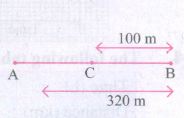
Time taken = 3 min 40 see
= 180 + 40 = 220 s
.JPG)
Average velocity = 1 m/s
129.
(i) Nautical mile is the unit for measuring the distance in the field of aviation and sea transportation. One nautical mile is 1.852 km.
(ii) The unit for measuring the speed of aeroplanes and ships is knot. One knot is the speed taken to travel one nautical mile in hour.
130.
The centre of gravity and the total weight of the doll is concentrated at its bottom most point, generating a dance-like continuous movement with slow oscillations.
131.
(i) Luggage compartment of a tour bus is located at the bottom and not on the roof.
(ii) Racing cars are built low and broad for stability.
(iii) Table lamps and fans are designed with large heavy bases to make them stable.
132.
133.
Distance covered after 2 complete rounds
= 2 x circumference of a circle
Distance = 2 x 2 π(2R) = 8π(2R)
After 2 complete rounds, the body comes back to its initial position.
so, displacement = 0
134.
The matter (atoms and molecules) is more densely packed in iron. Whereas is wooden block the matter is loosely packed.
In the language of science, we will say that the density of iron is more than the density of wooden block
135.
One light year is defined as the distance traveled by light in vacuum during the period of one year. 1 light year = 9.46 x 10¹⁵ m.
136.
One astronomical unit is defined as the average distance between the earth and the sun. 1AU = 1.496 x 10¹¹m or 149.6 x 10⁶ m
137.
Density = \(\frac{mass}{volume}\)
138.
The volume of liquid which a container can hold is called its capacity
139.
Area is the measure of the region inside a closed line.
140.
Comparison of an unknown quantity with a standard quantity is called measurement
141.
The known measure of a physical quantity is called the unit of measurement
142.
A quantity that can be measured is called a physical quantity.
For example, the length of a piece of cloth, the time at which school begins.
143.
Mass is the amount of matter contained in a body. It's unit is kilogram (kg).
144.
Density of cylinder \(=\frac { mass \ of \ cylinder }{ volume \ of \ cylinder }\)
\(=\frac{280}{4}=70 \mathrm{~kg} / \mathrm{m}^{3}\)
145.
| Atomic number | Mass number |
| Atomic number = No of protons (or) No of electrons | Mass number = No of protons + No of neutrons |
| Z = P or e | A = P+n |
| Ex: Atomic number (z) of helium is 2 | Ex: Mass nurnber (A) of helium is 4 |
146.
| Isotopes | Isobar |
| i) Having same atomic number,different mass number. | i) Having same mass number, different atomic number. |
| ii) Atoms of same element Ex : 1H1, 1H2, 1H3 |
ii) Atoms of different elements Ex : 20Ca40, 18Ar40 |
147.
(i) To save the life
(ii) To prevent further bleeding and determine the condition of the patient.
(iii) To relive the pain
(iv) To provide a medical care available at the earliest.
148.
The centre of gravity of an object is the point through which the entire weight of the object appears to act.
149.
An object undergoes uniform acceleration when the change (increase or decrease) in its velocity for every unit of time is the same.
150.
(a) A bus moving with constant speed.
.JPG)
\(\begin{array}{|l|c|c|c|c|c|} \hline \text { Time } & 0 & 1 & 2 & 3 & 4 \\ \hline \text { Distance } & 0 & 10 & 20 & 30 & 40 \\ \hline \end{array}\)
(b) A car parked on road side.
.JPG)
\(\begin{array}{|l|c|c|c|c|c|} \hline \text { Time } & 1 & 2 & 3 & 4 & 5 \\ \hline \text { Distance } & 20 & 20 & 20 & 20 & 20 \\ \hline \end{array}\)
151.
(i) H2SO4 consists of 2H atoms, 1 S atom and 4 O atoms.
(ii) Hence, Atomicity = 2 + 1 + 4 = 7
152.
The total number of atoms present in one molecule of an element, Compound or a substance is called atomicity
153.
| Name | Latin Name | Symbol |
| Copper | Cuprum | Cu |
| Gold | Aurum | Au |
| Potassium | Kalium | K |
154.
A compound is a chemical substance formed by the combination of two or more elements in definite proportions.
Example:
H2O:
\(2 \mathrm{H}_{2}+\mathrm{O}_{2} \rightarrow 2 \mathrm{H}_{2} \mathrm{O}\)
(2 : 1)
NaCI:
\(2 \mathrm{Na}+\mathrm{Cl}_{2} \rightarrow 2 \mathrm{NaCl}\)
(2 : 1)
155.
| Elements | Chemical Formula |
| Hydrogen | H2 |
| Nitrogen | N2 |
| Ozone | O3 |
| Sulphur | S8 |
156.
In Acacia auriculiformis, petioles expand to form leaf like structure. They carry out the function of leaf (Photosynthesis). This modification is known as phyllode.
157.
| Raster graphics | Vector graphics |
| Raster graphics are created on the basis of pixels. When we enlarge this type of photos we could see the pictures as rectangular layers or grids. | Vector graphics are created on the basis of mathematics, even when we enlarge the picture it's accuracy won't change. |
158.
One astronomical unit is defined as the average distance between the earth and the sun.
1 AU = 1.4965 106 km = 1.496 \(\times\) 1011m.
159.
One light year is defined as the distance travelled by light in vacuum during the period of one year.
1 Light year = 9.46 \(\times\) 1015m
160.
Density of a substance is defined as the mass of the substance contained in unit volume (1 m3).
Density (D) = mass (M)/volume(V)
D = M/V
SI unit of density - kg/m3
161.
Physical quantities which can be obtained by multiplying, dividing or by mathematically combining the fundamental quantities are known as derived quantities.
Ex: Area, volume
162.
| S.No | General Characters | Division |
| 1. | Microscopic unicellular, pseudopodia, flagella and cilia for locomotion reproduce by fission or conjugation. | Phylum Protozoa Eg. Amoeba, Euglena and Paramoecium |
| 2. | Multicellular organisms with holes in the body. Skeleton formed of spicules, asexual and sexual reproduction | Phylum Porifera Eg. Leucosolenia Spongilla, Sycon. |
| 3. | Multicellular organisms Diploblastic, sessile or free swimming, solitary or colonial, asexual and sexual reproduction | Phylum Coelenterata Eg. Hydra, Sea anemone, Jelly fish Corals. |
| 4. | Acoelomates, parasites inside the body of animals and human beings, mostly hermaphrodite (bisexual). | Phylum Platyhelminthes Eg. Planaria, Liver fluke, Blood fluke,Tapeworm |
| 5. | Unsegmented body, mostly parasites in human beings and animals, causing diseases, asexual reproduction | Phylum Aschelminthes or Nematoda Eg. Ascaris lumbricoides |
| 6. | Triploblastic, segmented body, mostly hermaphrodite, (bisexual and unisexual) | Phylum Annelida Eg. Earthworm, Nereis, Leech. |
| 7. | Segmented body, thick chitinous cuticle forming an exoskeleton, paired and jointed legs, unisexual exhibits sexual dimorphism. | Phylum Arthropoda Eg. Crab, Prawn Millipede, Insects Scorpion, and Spider. |
| 8. | Soft bodied, unsegniented, muscular head foot and visceral mass, mantle, a calcareous shell, sexual reproduction. | Phylum Mollusca Eg. Cuttle Fish,Snail, Octopus. |
| 9. | Exclusively marine, spines and spicules over the body, water vascular system, tube feet, for feeding, respiration and locomotion, sexual reproduction. | Phylum Echinodermata Eg. Starfish, Sea - Urchin Brittle star, Sea cucumber and Sea-lily. |
163.
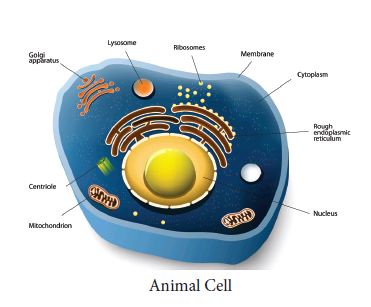
This is Animal cell. The boundary of the cell is known as cell membrane. Inside the cell membrane many tiny organelles present in the cytoplasm. The cell organelles are golgi apparatus, Lysosomes, Ribosomes, Rough and Smooth endoplasmic reticulum, mitochondria and nucleus, Mitochondria is the power house of the cell. The energy produced with in the mitochondrian is used for all the metabalic activities of the cell. Lysosomes are called as suicidal bags because they are the main digestive compartments. Endoplasmic reticulum synthesis of protein lipid and steriods. Nucleus is the brain of the cell. It controls all the processes of chemical reactions that take place inside the cell.
164.
(i) Golgi Complex:
Membrane bounded sacs are stacked on top of the other with associated secretory vesicles are collectively known as golgi complex. Functions of golgi complex are the production of secretory substances, packaging and secretion. This is the secret behind the change in the colour and taste of fruits.
(ii) Lysosome:
You will find organelles called as lysosomes, which are very small to view using a light microscope. They are the main digestive compartments of the cell. They lyse a cell, hence they are called "suicidal bag".
(iii) Nucleus:
Plant and animal cells have a nucleus inside the cytoplasm. It is surrounded by a nuclear envelope. One or two nucleolus and the chromatin body are present inside the nucleus. During cell division, the chromatin body is organised into a chromosome. Storage of genetic material and transfers heredity characters from generation to generation are the functions of chromosome.
165.
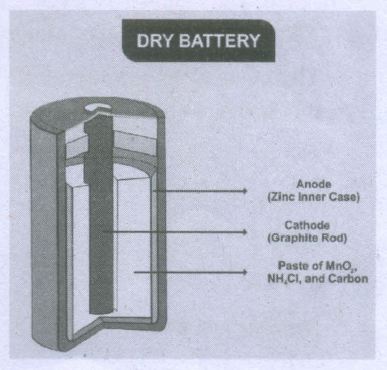
(i) Dry cells are normaly used in small devices such as remote control for T.V., torch, camera and toys.
A dry cells is a portable form of a leclanche cell. It consists of zinc vessel which acts as a negative electrode or anode the vessal contains a moist paste of saw dusts saturated with a solution of ammonium chloride and zinc chloride. The ammonium chloride acts as an electrolyte.
(ii) Electrolytes are substances that become ions in solution and acquire the capacity to conduct electricity.
(iii) The purpose of zinc chloride is to maintain the moistness of the paste being highly hygroscopic. The carbon rod covered with a brass cap is placed in the middle of vessel. It acts as positive electrode or cathode.
(iv) It is surrounded by a closely packed mixture of charcoal and manganese dioxide (MnO2) in a muslin bag. Here MnO2 acts as depolarizer. The zinc vessel is sealed at the top with pitch or shellac. A small hole is provided in it to allow the gases formed by the chemical action to escape. The chemical action inside the cell is the same as in leclanche cell
166.
167.
| S. NO: | Name of the Disease | Causative Agents | Impacts / Consequences | Remedial measures |
| 1. | Night Blindness | Lack of vitamin A, a disorder of the cells in your retina | Makes it hard to see well at night or in | Eat foods rich in antioxidant, vitamins and minerals. |
| 2. | Conjuncitvitis (Pink eye) | Caused by a virus and bacteria | One or both eyes can be affected. Highly contagious; can be spread by coughing and sneezing | Antibiotic eye drops or ointments, home remedy |
| 3. | Color blindness | genetic condition | 1. Difficulty distinguishing between colors. 2. Inability to see shades or tones of the same color |
There is no known cure for color blindness. Contact lenses and glasses are available with filters to help color deficiencies |
168.
Anaemia Causes:
It is caused by eating food with less iron content and can also be caused due to feeding some other foods instead of breast milk for babies.
The signs of anemia are:
(i) Pale or transparent skin, the inner surface of eye lids are pale, white fingernails, pale gums, weakness and fatigue.
(ii) In severe cases, face and feet may be swollen, the heartbeat is rapid and with shortness of breath.
(iii) Children and women who eat mud are usually anaemic. Consuming iron containing food
(i) Food - Moringa leaves, Dates, Liver (Sheep and Chicken), Green leafy vegetables like beans, peas, lentils and Greed banana.
(ii) Pills- Cod liver oil tablet, Ferrous sulfate.
169.
170.
Sub- aerial Modifications : Stem of some plants remains sub- aerial which grow horizontally on the surface of the soil for the purpose of reproduction. There are four types.
(i) Runner: The stem grows laterally on the surface of the soil, breaks up to produce roots where it touches the ground to give rise to new plants. Eg: Centella (Vallarai).
(ii) Stolon: Stolon is a slender branch of the stem that grows upwards to some distance and then bends towards the ground. Upon touching the ground, it gives rise to a new plant. Eg.Wild strawberry.
(iii) Sucker: Sucker is a short and weak lateral branch that grows diagonally upwards and directly gives rise to a new shoot. Eg. Chrysanthemum.
(iv) Offset: An offset is a short and thick branch that arises from the axial part of a leaf. It has thick internodes. It produces a tuft of leaves and cluster of small roots below. Eg: Eichhornia.
171.
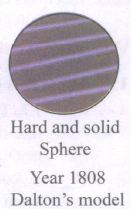
John Dalton proposed the atomic theory in the year 1808.
(i) He proposed that matter consists of very small particles which he named as atoms.
(ii) An atom is smallest indivisible particle, it is spherical in shape.
(iii) His theory does not propose anything about the positive and negative charges of an atom.
172.
(i) Proton (p): The proton is the positively charged particle and is located in the nucleus. Its positive charge is of the same magnitude as that of the electron's negative charge.
(ii) Neutron (n): Neutron is inside the nucleus. The neutron does not have any charge. Except hydrogen (protium), the nuclei of all atoms contain neutrons
(iii) Electron (e): This is a negatively charged particle. Electrons revolve around the nucleus of the atom in specific orbits. The mass of an electron is negligible as compared to that of a proton or neutron.
173.
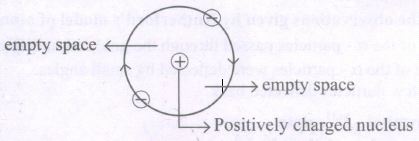
(i) Based on his experiment. Rutherford proposed his famous theory.
(ii) The fact that most alpha particles pass through the gold sheet means that the atom consists mainly of empty space.
(iii) The part from which the positively charged particles are turned back is positively charged but very small in size as compared to the empty space
174.
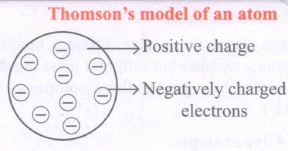
(i) J.J. Thomson's theory proposed that the atom has positively charged part like the red part of the watermelon and in it are embedded, like the seeds, negatively charged particles which he called electrons.
(ii) According to this theory as the positive and negative charges are equal, the atom as a whole does not have any resultant charge
(iii) Thomson's greatest contribution was to prove by experimentation the existence of the negatively charged particles or electrons in an atom
175.
(i) Symbol for some elements as proposed by Dalton.
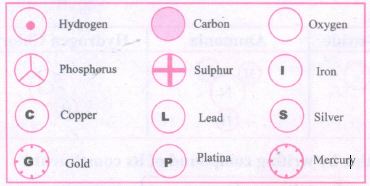
(ii) The following rules are followed while assigning symbol to an elements:
(a) Chemical symbols usually consist of one or two letters
(b) The symbols of most elements correspond to the first letter (which is capitalized) of their English name. For example, the symbol for oxygen is "O" and that for hydrogen is "H".
176.
.JPG)
.JPG)
.JPG)
.JPG)
177.
.JPG)
.JPG)
.JPG)
.JPG)
.JPG)
178.
| Distance | Displacement | |
| 1. | The total lenglh of a path taken by an object. | The shortest distance from the initial to the final position of an object |
| 2. | SI unit is meter | SI unit is meter |
179.
(i) Place the irregular object on a graph sheet and draw its outline. Then remove the object
(ii) To find the area enclosed by the outline count the number of small squares.
(iii) If more than half-a-square is inside the boundary, count it as one otherwise neglect it.
(iv) The area of each small square is 1sq. mm.
(v) Area of the irregular object = No. of squares x 1 sq.mm.
180.
(i) Take a measuring cylinder and pour some water into it.
(ii) Note down the volume of water from the readings of the measuring cylinder.
(iii) Take it as V1
(iv) Now take Q small stone and tie it with a thread.
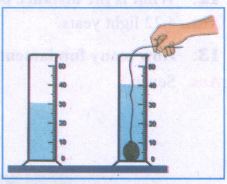
(v) Immerse the stone inside the water by holding the thread.
(vi) This has to be done such that the stone does not touch the walls of the measuring cylinder.
(vii) Now the level of water has raised.
(viii) Note down the volume. of water and take it to be V2
The volume of the stone is equal to the raise in the volume of water.
V1 = 30cc, V2 = 40cc
Volume of stone = V2 - V1 = 40 - 30 = 10 cc
181.
(i) Valency is defined as the combining capacity of an element.
(ii) The valency of the element with atomic number 8, Oxygen (2,6) is = 2.
(iii) The compound formed by oxygen with hydrogen is water. \(\mathrm{O}_{2}+2 \mathrm{H}_{2} \rightarrow 2 \mathrm{H}_{2} \mathrm{O}\)
182.
i) Protons and neutrons in the nucleus of an atom are called as nucleons.
ii) They are located in the nucleus of an atom and are called so.
Properties:
i) Atomic mass is only depends on the mass of nucleous.
ii) They make the atom electrically neutral. (Protons - Positive, Neutrons - Neutral)
iii) Nucleons are similar in properties like mass except charge.
183.
Atomic number (Z) = 26, Mass number (A) = 56
No. of protons P = 26
No. of electrons e = 26
No. of neutrons n = A - Z
= 56 - 26 = 30
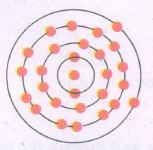
Atomic structure of 26Fe56 is
184.
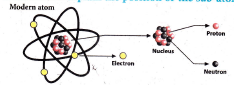
Sub-atomic particles:
(i) Proton (p): This is the positively charged particle and it is located at the nucleus.
(ii) Neutron (n): Neutron is inside the nucleus. The neutron does not have any charge. Except hydrogen (protium), the nucleus of all atoms contain neutrons.
(iii) Electron(e): This is a negatively charged particle. Electrons revolve around the nucleus of the atom in specific orbits.
185.
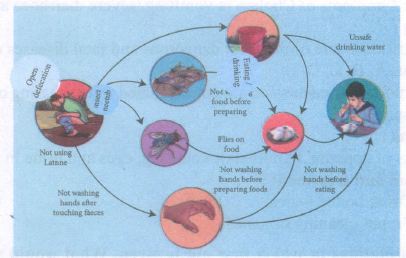
Disease are spread through air, water and some other organisms.
(i) Air = Spitting and coughing (Tuberculosis, chicken pox )
(ii) Contaminated waer = Drinking and cleaning by using unboiled water ( Cholera, Hepatitis).
(iii) Insects = Biting of infected insects like mosquito and flies. Dengue, Typhoid)
(iv) Animals = Through biting of in affected animals like dog, rabbit, cat etc,(Rabies).
186.
First aid is the immediate treatment given to the victim of trauma or sudden illness before medical help is made available. For the following situation we have to give first aid,
i) Any vehicle accident other incident.
ii) Any burns due to heat, chemical or electricity
iii) If cut and scratches occur on the surface of the skin.
First Aid for skin Burning:
i) Affected area should be washed with cold water if severe burns occur, use of water should be avoided.
ii) Antiseptic cream should be applied.
iii) The burnt area should be covered with a clean non-sticking cloth or bandages.
187.
Tuberculosis:
(i) Causative agent : Mycobacterium tuberculae bacteria.
(ii) Transmission : Spread from one person to another through air by spitting and prolonged contact with patient.
(iii) Symptoms : Fever, weight loss, chronic cough, bloody spitting and difficulty in breathing
(iv) Prevention and treatment : BCG vaccinations. Giving special attention to the patient. Regular medication like DOT
Chicken pox:
(i) Causative agent : varicella zoster virus.
(ii) Transmission : Spread through air and contact with infected person.
(iii) Symptoms : Appearance of rashes on the whole body, fever, headache and tiredness.
(iv) Prevention and treatment : Chicken pox vaccine is the best way to prevent. Special attention should be given to infected person
Robies:
(i) Causative agent: Virus (rhabdo virus)
(ii) Transmission : By the bite of the infected dog, cat, etc.
(iii) Symptoms: Hydrophobia, fever for 2-12 weeks and exaggerations
(iv) Prevention and treatment : Fatality can be prevented by timely vaccination before onset of symptoms.
188.
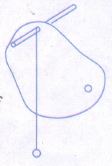
Apparatus: Irregularly shaped plate, string, pendulum bob, stand.
i) Make three holes in the lamina.
ii) Suspend the lamina from the optical pin through one of the holes as shown.
iii) Suspend the plumbline from the pin and mark the position of the plumbline on the lamina.
iv) Draw lines on the lamina representing the positions of the plumbline.
v) Repeat the above steps for the holes.
vi) Label the intersection of the three lines as X is the position of the centre of gravity of the lamina.
189.
Stability:
Stability is a measure of the body's ability to maintain its original position.
The three types of stability are
(i) Stable equilibrium
(ii) Unstable equilibrium
(iii) Neutral equilibrium
Stable Equilibrium:
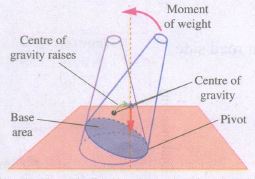
i) The frustum can be tilted through quite a big angle without toppling.
ii) Its centre of gravity is raised when it is displaced.
iii) The vertical line through its centre of gravity still falls within its base.
iv) So it can return to its original position.
Unstable Equilibrium:
i) The frustum will topple with the slightest tilting. Its centre of gravity is lowered when it is displaced.
ii) The vertical line through its centre of gravity falls outside its base.
.JPG)
Neutral Equilibrium:
(i) It causes frustum to topple.
(ii) The frustum will rolls about but does not topple.
(iii) Its centre of gravity remains at the same height when it is displaced.
(iv) The body will stay in any position to which it has been displaced.
.JPG)
190.
Properties of metalloids :
(i) Metalloids exhibit the properties of both metals and non-metals.
(ii) Unusually they look like metals but behave largely like non-metals,
(iii) They can form alloys like metals.
191.
i) A compound is formed only when the constituent elements combine in a fixed proportion.
ii) Compound exhibits entirely different properties of their constituent elements.
iii) A compound cannot be broken down by physical methods.
iv) A compound can be separated into its constituent elements by chemical methods only.
v) Compound is made up of different elements that are chemically combined.
192.
| Elements | Compunds |
| (i) An element is the simplest substance | (i) They formed by the cornbination of two or more elements. |
| (ii) They combine to form compounds | (ii) They can be splited into elements. |
| (iii) Atoms are the fundamental particle of an element | (iii) Molecules are the fundamental particles of a compound. |
193.
i) A compound is formed only when the constituent elements combine in a fixed proportion.
ii) Compound exhibits entirely different properties of their constituent elements.
iii) A compound cannot be broken down by physical methods.
iv) A compound can be separated into its constituent elements by chemical methods only.
194.
| Metals | Non-metals |
| (i) Lustrous and have shiny surface. | (i) Non-lustrous and have non-shiny surface. |
| (ii) They are generally hard. | (ii) They are generally Soft. |
| (iii) They are ductile. | (iii) They are non-ductile. |
| (iv) Good conductors of heat and electricity. | (iv) Bad conductors of heat and electricity. |
| (v) Metals are making sound when struck.(Sonorous) | (v) Non-metals do not make sound when struck. (Non-sonorous) |
195.
i) Take a measuring cylinder and pour some water into it.
ii) Note down the volume of water from the readings of the measuring cylinder. Take it as V1.
iii) Now take a small stone and tie it with a thread.
iv) Immerse the stone inside the water by holding the thread.
v) The stone should not touch the walls of the measuring cylinder.
vi) Note down the volume of water and take it to be V2
vii) The volume of the stone is equal to the raise in the volume of water.
viii) Volume of stone = V2 - V1
196.
Take a leaf from any one of trees in your neighbourhood. Place the leaf on a graph sheet and draw the outline of the leaf with a pencil. Remove the leaf. You can see the outline of the leaf on the graph sheet.
i) Now count the number of whole squares enclosed within the outline of the leaf. Take it to be M
ii) Then count the number of squares that are more than half. Take it as N
iii) Next, Count the number of squares which are half of a whole square. Note it to be P.
iv) Finally, count the number of squares that are less than half. Let it be a Q.
v) Now the approximate area of the leaf can be calculated using the following formula.
Approximate area of the leaf = M+(3/4)N+(1/2)P+(1/4)
This formula can be used to calculate the area of any irregularly shaped plane figures.
197.
In underground modified stem, whole stem is burried under the ground and it has definite growth. Some stems that grow under the ground to store food. There are four types of underground stems they are,
i) Rhizome:
It is underground thick stem with nodes and internodes with scale leaves at the node.
(Eg) Ginger and turmeric.
ii) Corm:
This underground stem is round in shape and flat at the top and bottom. The daughter plants are arise from their buds. (Eg) Colocasia.
iii) Tuber:
It is an enlarged spherical underground stem and stores food. It has many dormant buds and it grows into a new plant. (Eg) Potato.
iv) Bulb:
It is a condensed stem which is disc like and stores food in the fleshy leaves.
The bulb has two types of leaves
1) Fleshy leaves - Inner part of stem
2) Scaly leaves - Upper part of stem
(E.g) Garlic and onion
198.
The process by which pollen grains reach stigma of the flower is called as pollination. Pollination can be classified into two types based on their mode of transmission.
i) Artificial pollination:
The transfer of pollen grains from anther to stigma by manually is called as artificial pollination
ii) Natural Pollination:
1) The transfer of pollen grains from anther to stigma by insect or any other natural sources is called as natural pollination.
2) Pollination can be classified into another two types based on their site of transmission
i) Self pollination:
Pollen grains are transferred from the anther to the stigma of the same flower or to another flower of the same plant is known as self pollination.
ii) Cross pollination:
Pollen grains are transferred from the anther of one flower to the stigma of another flower of the same kind or different plant known as cross pollination.
199.
Step 1: Open the application of 'Microsoft Photostory'. In that select "Begin A New Story" and click on Next.
Step 2: Click "Import Picture" in the next screen. Select 'Saved pictures' for video. If required, We can edit the image and click on Next.
Step 3: Now we can input small text, animation, audio effect for the picture then click Next.
Step 4: To provide background music, we can select a music file through "Select Music" and click on Next.
Step 5: select a title for the story, then through SETTINGS change the format of the video.
Step 6: Now our video is ready to view. Click "VIEW YOUR STORY". You can see your video now.
200.
Kingdom fungi has saprophytic parasitic and symbiotic nutrition. It is a non green Eukaryotic. So it cannot prepare food. So it is saprophytic, parasitic and symbiotic nutrition
201.
(i) Boiling of water is a physical change because it is a reversible action. No new substance is formed.
(ii) Boiling of egg is a chemical change because it is a irreversible action and new substance are formed.
202.
Suddenly variation of temperature it shrinks so it will be cracks. so heat is obsorbed suddenly heat liberated it indicates a exothermic reaction.
203.
(i) Yes, it is a chemical change.
(ii) Banana fruits contain an enzyme cailed polyphenol oxidase which cause chemical reaction when exposed to oxygen. Now the peeling banana colour is changed. So it is a chemical change.
204.
1) The electric cell produce weak energy.
2) The bulb filament is broken. (dead)
3) The both wires are connected to the same terminal of the cell.
4) Battery or cell is dead.
205.
\(\begin{array}{|l|c|} \hline \text { Animals and birds } & \text { Temperature (celsius) } \\ \hline \text { Dog } & 37.5-39.09 \\ \hline \text { Cat } & 38.0-39.5 \\ \hline \text { Rabbit } & 38.5-39.5 \\ \hline \text { Pigeon } & 41.0-44.1 \\ \hline \text { Crow } & 40.0 \\ \hline \text { Chicken } & 41.7 \\ \hline \end{array}\)
206.
(i) Yes, an atom of an element has no electron will have the mass.
(ii) (Atomic mass, only depends on the mrmber of protons and the number of neutrons inside the nucleus. It is independent of number of electrons.)
(iii) Atom can exist with out electron and becomes a cation.
Ex:
1) Hydrogen atoms (Z = 1) has only one electrons.
2) It loses one electron and becomes H+ ion
3) H → H+ + 1e-
(atom) (Ion)
207.
(i) Yes, I have came across such situation in some times. Because of the following reasons it may occur.
(ii) Due to heavy work body will become to tired.
(iii) If the mind is not take proper rest also leads to this situation.
(iv) To overcome these situation we have to keep our body and mind with proper rest.
208.
209.
When solid is heated, the particles gain energy and vibrate vigorously. The particles move slightly further apart from one another.
Hence, the volume increases due to the greater distance between the particles. But the size of the particles remains the same.
210.
a) The matter begun to 'expand' when heated - 'Expansion'.
b) Ring and metal ball experiment is suitable for this hypothesis.
When the ball is heated, the ball has expanded and will not be able to pass through the ring until it has cooled.
211.
Mostly leaves are arise from the stem in plants. In ginger the arial leaves are arise from underground and also the scaly leaves are also present in the rhizome. So ginger is consider as stem.

7th Standard Syllabus & Materials
7th Standard
TN 7th English T1 - Supplementary - On Monday Morning Important Questions And Answers Study Material - QB365 Set A
NEW7th Standard
TN 7th English T1 - Prose - Eidgah Important Questions And Answers Study Material - QB365 Set A
NEW7th Standard
TN 7th Social Science T1 - ECO - Production Important Questions And Answers Study Material - QB365 Set A
NEW7th Standard
TN 7th Social Science T1 - GEO - Interior of the Earth Important Questions And Answers Study Material - QB365 Set A



Tamilnadu Stateboard 7th Standard Subjects
Tamilnadu Stateboard Standards




