
 100% FREE ACCESS
7th Standard Syllabus & Materials
7th Standard
TN 7th Tamil பருவம் -1 இயல் 1 - அமுதத்தமிழ் - ஒன்றல்ல இரண்டல்ல Important Questions And Answers Study Material - QB365 Set A
NEW7th Standard
TN 7th Tamil பருவம் -1 இயல் 1 - அமுதத்தமிழ் - எங்கள் தமிழ் Important Questions And Answers Study Material - QB365 Set A
NEW7th Standard
TN 7th English T1 - Poem - Your Space Important Questions And Answers Study Material - QB365 Set A
NEW7th Standard
TN 7th English T1 - Prose - A Prayer to the Teacher Important Questions And Answers Study Material - QB365 Set A
NEW7th Standard
TN 7th English T1 - Poem - The Listeners Important Questions And Answers Study Material - QB365 Set A
NEW7th Standard
TN 7th English T1 - Prose - The Wind on Haunted Hill Important Questions And Answers Study Material - QB365 Set A

Published on: 30/08/2019
Measurement
Download Tamil Nadu 7th Standard Science question papers, model tests, one-mark questions, important questions, and public exam papers in PDF format. Free study materials and answer keys for TN State Board students.
Questions + Answers key
Take MCQ Science Test1.
SI unit of density is ________.
kg/m2
kg/m3
kg/m
g/m3
2.
Which of the following is correct?
1L = 1cc
1L = 10 cc
1L = 100 cc
1L = 1000 cc
3.
Which of the following is a derived quantity?
mass
time
area
length
4.
Name the liquid in which an iron ball sinks.
5.
Give the formula to find the density of objects.
6.
Write down the formula used to find the volume of a cylinder.
7.
A sphere is made from copper whose mass is 3000 kg. If the density of copper is 8900 kg/m, find the volume of the sphere.
8.
Distinguish between the volume of liquid and capacity of a container.
9.
Density of mercury is ________.
10.
One cubic metre is equal to ______ cubic centimetre.
11.
Volume of irregularly shaped objects are measured using the law of ________.
12.
A ball of iron floats in mercury.
13.
Water is denser than kerosene.
14.
Volume of liquids can be found using measuring containers.
15.
The region covered by the boundary of the plane figure is called its volume
16.
Describe the graphical method to find the area of an irregularly shaped plane figure.
17.
There are three spheres A, B, C as shown below:
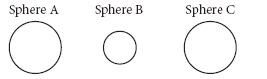
Sphere A and B are made of the same material. Sphere C is made of a different material. Spheres A and C have equal radii. The radius of sphere B is half that of A. Density of A is double that of C. Now answer the following questions:
i. Find the ratio of masses of spheres A and B.
ii. Find the ratio of volumes of spheres A and B.
iii. Find the ratio of masses of spheres A and C.
1.
(b)
kg/m3
2.
(d)
1L = 1000 cc
3.
(c)
area
4.
Iron ball sinks in all the liquids apart from mercury.
5.
Density (D) = mass (M) / volume (V).
6.
Volume of a cylinder = π r2 h
7.
Density = Mass / Volume
Hence, Volume = Mass / Density
\(=3000 / 8900=30 / 89 \\ =0.34 \mathrm{~m}^{3}\)
8.
| S.No | Volume of liquid | Capacity of a container |
| 1. | The volume of liquid is equal to lhe volume of space it fills in the measuring container. | The malimum volume of liquid that a container can hold is known as the capacity of container |
9.
()
13,600 kg/m3
10.
()
10,00,000 or 106
11.
()
water displacement
12.
True
13.
True
14.
True
15.
False
Correct Statement: The region covered by the boundary of the plane figure is called its area.
16.
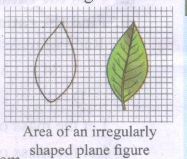
Take a leaf from any one of trees in your neighbourhood. Place the leaf on a graph sheet and draw the outline of the leaf with a pencil. Remove the leaf. You can see the outline of the leaf on the graph sheet.
i) Now count the number of whole squares enclosed within the outline of the leaf. Take it to be M
ii) Then count the number of squares that are more than half. Take it as N
iii) Next, Count the number of squares which are half of a whole square. Note it to be P.
iv) Finally, count the number of squares that are less than half. Let it be a Q.
v) Now the approximate area of the leaf can be calculated using the following formula.
Approximate area of the leaf = M+(3/4)N+(1/2)P+(1/4)
This formula can be used to calculate the area of any irregularly shaped plane figures.
17.
i) Find the ratio of masses of spheres A and B.
Sphere A and B are made of the same material
\(\therefore\) The Density of A and B are equal. Take it as D
\(D =\frac{M}{V} \)
\(\therefore M =D \times V\)
Volume of sphere \(A=V_{1}\)
Volume of sphere \(B=V_{2}\)
Mass of sphere \(A=M_{1}\)
Mass of sphere \(\mathrm{B}=\mathrm{M}_{2}\)
\(\therefore \mathrm{M}_{\mathrm{l}} =\mathrm{D} \times \mathrm{V}_{1} \)
\(\mathrm{M}_{2} =\mathrm{D} \times \mathrm{V}_{2}\)
The radius of sphere B is half that of A
So, we can take the radius of sphere A(r)=2
Volume of sphere \(\mathrm{A}\left(\mathrm{V}_{1}\right)=\frac{4}{3} \pi \mathrm{r}^{3}=\frac{4}{3} \times \pi \times 2 \times 2 \times 2\)
Volume of sphere \(A\left(V_{1}\right)=\frac{32 \pi{}}{3}\)
We can take the radius of sphere B(r)=1
Volume of sphere \(B\left(V_{2}\right)=\frac{4}{3} \times \pi \times 1 \times 1 \times 1\)
Volume of sphere \(\mathrm{B}\left(\mathrm{V}_{2}\right)=4 / 3 \neq 0\)
Mass of sphere \(\mathrm{A} \mathrm{M}_{1}=\mathrm{D} \times \frac{32 \pi}{3}\)
Mass of sphere \(\mathrm{B} \mathrm{M}=\mathrm{D} \times \frac{4}{3} \pi\)
Ratio of masses of spheres A and B = \(\frac{\mathrm{M}_{1}}{\mathrm{M}_{2}}\)
\(= \frac{\not D \times \not 32 \times \not \frac{\pi}{3}}{\not D \times \not 4 \not \frac{\pi}{3}} \)
\(\mathrm{M}_{1} / \mathrm{M}_{2} =8 / 1 \)
\(\mathrm{M}_{1} \cdot \mathrm{M}_{2} =8: 1\)
Ratio of masses of spheres A and B = 8 : 1
ii) Find the ratio of volume spheres A and B
Volume of sphere \(A\left(V_{1}\right)=\frac{32 \pi}{3}\)
Volume of sphere \(B\left(V_{2}\right)=\frac{4}{2} \pi\)
Ratio of volume of spheres A and B = \(\frac{V_{1}}{V_{2}}\)
\(=\frac{\not 32 \times \not \frac{\pi}{3}}{\not 4 \not \frac{\pi}{3}}=8 / 1\)
So Ratio of volume of spheres A and B = 8 : 1
\(V_{1}: V_{2}=8: 1\)
iii) Find the ratio of masses of spheres A and C
i) Spheres A and C have equal radii so the volume of A and C equal and take it as V
ii) Density of A is double that of C now we can take.
Density of A=2 D
Density of C=D
\(\mathrm{M} =\mathrm{D} \times \mathrm{V} \)
\(\text { Mass of sphere } \mathrm{A} =\mathrm{M}_{1} \quad \mathrm{M}_{1}=2 \mathrm{D} \times \mathrm{V} \)
\(\text { Mass of sphere } \mathrm{C} =\mathrm{M}_{3} \quad \mathrm{M}_{3}=\mathrm{D} \times \mathrm{V} \)
\(\mathrm{M}_{1}: \mathrm{M}_{3} =2 \mathrm{D} \times \mathrm{V} / \mathrm{D} \times \mathrm{V}=2 / 1 \)
\(\mathrm{M}_{\mathrm{1}}: \mathrm{M}_{3} =2: \mathrm{1} \)
Ratio of masses of sphere A and C = 2 : 1

7th Standard Syllabus & Materials
7th Standard
TN 7th English T1 - Supplementary - On Monday Morning Important Questions And Answers Study Material - QB365 Set A
NEW7th Standard
TN 7th English T1 - Prose - Eidgah Important Questions And Answers Study Material - QB365 Set A
NEW7th Standard
TN 7th Social Science T1 - ECO - Production Important Questions And Answers Study Material - QB365 Set A
NEW7th Standard
TN 7th Social Science T1 - GEO - Interior of the Earth Important Questions And Answers Study Material - QB365 Set A



Tamilnadu Stateboard 7th Standard Subjects
Tamilnadu Stateboard Standards




