
 100% FREE ACCESS
7th Standard Syllabus & Materials
7th Standard
TN 7th Tamil பருவம் -1 இயல் 1 - அமுதத்தமிழ் - ஒன்றல்ல இரண்டல்ல Important Questions And Answers Study Material - QB365 Set A
NEW7th Standard
TN 7th Tamil பருவம் -1 இயல் 1 - அமுதத்தமிழ் - எங்கள் தமிழ் Important Questions And Answers Study Material - QB365 Set A
NEW7th Standard
TN 7th English T1 - Poem - Your Space Important Questions And Answers Study Material - QB365 Set A
NEW7th Standard
TN 7th English T1 - Prose - A Prayer to the Teacher Important Questions And Answers Study Material - QB365 Set A
NEW7th Standard
TN 7th English T1 - Poem - The Listeners Important Questions And Answers Study Material - QB365 Set A
NEW7th Standard
TN 7th English T1 - Prose - The Wind on Haunted Hill Important Questions And Answers Study Material - QB365 Set A

Published on: 25/09/2019
Measurement
Download Tamil Nadu 7th Standard Science question papers, model tests, one-mark questions, important questions, and public exam papers in PDF format. Free study materials and answer keys for TN State Board students.
Questions + Answers key
Take MCQ Science Test1.
________ is a derived quantity
length
mass
time
area
2.
The SI unit of speed is __________
m/s2
m/s
km/h
m2/s
3.
The unit of volume is ____________
m3
m2
cm3
km
4.
Light year is the unit of ________.
Distance
time
density
both length and time
5.
Which of the following is correct?
1L = 1cc
1L = 10 cc
1L = 100 cc
1L = 1000 cc
6.
What is the distance between the earth and proxima centauri star?
7.
Write the SI unit of speed
8.
Find the volume of (Take \(\pi\) = 22/7)
i. a cube whose side is 3 cm.
ii. a cylinder whose radius is 3 m and height is 7 m.
9.
What is the density of gold?
10.
Name the liquid in which an iron ball sinks.
11.
Write down the formula used to find the volume of a cylinder.
12.
Name some of the derived quantities.
13.
What is one light year?
14.
What are derived quantities?
15.
The SI unit of density is ______
16.
The materials with higher density are called __________
17.
The area of a leaf can be measured using a ________.
18.
Density of mercury is ________.
19.
Volume of irregularly shaped objects are measured using the law of ________.
20.
Triangle
21.
Temperature
22.
Mass
23.
Density
24.
Area
25.
How will you find the area of irregular objects?
26.
Describe the graphical method to find the area of an irregularly shaped plane figure.
27.
A liquid having a mass of 250 g fills a space of 1000 cc. Find the density of the liquid.
1.
(d)
area
2.
(b)
m/s
3.
(a)
m3
4.
(a)
Distance
5.
(d)
1L = 1000 cc
6.
4.22 light years.
7.
m/s
8.
a. Volume of a cube = side \(\times\) side \(\times\) side
= 3 cm \(\times\) 3 cm \(\times\) 3 cm = 27 cubic cm or \(\mathrm{cm}^{3}\)
b. Volume of a cylinder \(=\pi \times(\text { radius })^{2} \times \text { height }\)
\(=22 / 7 \times 3 \times 3 \times 7=198 \mathrm{~m}^{3} .\)
9.
Density of gold is 19,300 kg/m3
10.
Iron ball sinks in all the liquids apart from mercury.
11.
Volume of a cylinder = π r2 h
12.
Area, Volume, Speed, Electric charge and Density.
13.
One light year is defined as the distance travelled by light in vacuum during the period of one year.
1 Light year = 9.46 \(\times\) 1015m
14.
Physical quantities which can be obtained by multiplying, dividing or by mathematically combining the fundamental quantities are known as derived quantities.
Ex: Area, volume
15.
()
kg/m3
16.
()
denser
17.
()
graph sheet
18.
()
13,600 kg/m3
19.
()
water displacement
20.
\(\frac12\times b \times h\)
21.
kelvin (K)
22.
amount of a substance
23.
kg / m3
24.
m2
25.
(i) Place the irregular object on a graph sheet and draw its outline. Then remove the object
(ii) To find the area enclosed by the outline count the number of small squares.
(iii) If more than half-a-square is inside the boundary, count it as one otherwise neglect it.
(iv) The area of each small square is 1sq. mm.
(v) Area of the irregular object = No. of squares x 1 sq.mm.
26.
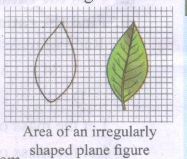
Take a leaf from any one of trees in your neighbourhood. Place the leaf on a graph sheet and draw the outline of the leaf with a pencil. Remove the leaf. You can see the outline of the leaf on the graph sheet.
i) Now count the number of whole squares enclosed within the outline of the leaf. Take it to be M
ii) Then count the number of squares that are more than half. Take it as N
iii) Next, Count the number of squares which are half of a whole square. Note it to be P.
iv) Finally, count the number of squares that are less than half. Let it be a Q.
v) Now the approximate area of the leaf can be calculated using the following formula.
Approximate area of the leaf = M+(3/4)N+(1/2)P+(1/4)
This formula can be used to calculate the area of any irregularly shaped plane figures.
27.
\(\mathrm{M}=250 \mathrm{~g}=250 / 1000 \mathrm{~kg}=0.25 \mathrm{~kg} \)
\(\mathrm{~V}=1000 \mathrm{~cc}=\frac{1000}{1000000}=\frac{1}{1000} \mathrm{~m}^{3}\)
Density of liquid \(\mathrm{D}=\mathrm{M} / \mathrm{V}\)
\(\mathrm{M}=\frac{250}{1000} \mathrm{~kg} {~;} \mathrm{~V}=\frac{1}{1000} \mathrm{~m}^{3}\)
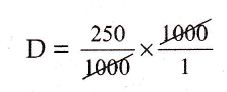
Density of liquid D = 250 kg/m3

7th Standard Syllabus & Materials
7th Standard
TN 7th English T1 - Supplementary - On Monday Morning Important Questions And Answers Study Material - QB365 Set A
NEW7th Standard
TN 7th English T1 - Prose - Eidgah Important Questions And Answers Study Material - QB365 Set A
NEW7th Standard
TN 7th Social Science T1 - ECO - Production Important Questions And Answers Study Material - QB365 Set A
NEW7th Standard
TN 7th Social Science T1 - GEO - Interior of the Earth Important Questions And Answers Study Material - QB365 Set A



Tamilnadu Stateboard 7th Standard Subjects
Tamilnadu Stateboard Standards




