
 100% FREE ACCESS
7th Standard Syllabus & Materials
7th Standard
TN 7th Tamil பருவம் -1 இயல் 1 - அமுதத்தமிழ் - ஒன்றல்ல இரண்டல்ல Important Questions And Answers Study Material - QB365 Set A
NEW7th Standard
TN 7th Tamil பருவம் -1 இயல் 1 - அமுதத்தமிழ் - எங்கள் தமிழ் Important Questions And Answers Study Material - QB365 Set A
NEW7th Standard
TN 7th English T1 - Poem - Your Space Important Questions And Answers Study Material - QB365 Set A
NEW7th Standard
TN 7th English T1 - Prose - A Prayer to the Teacher Important Questions And Answers Study Material - QB365 Set A
NEW7th Standard
TN 7th English T1 - Poem - The Listeners Important Questions And Answers Study Material - QB365 Set A
NEW7th Standard
TN 7th English T1 - Prose - The Wind on Haunted Hill Important Questions And Answers Study Material - QB365 Set A

Published on: 06/08/2019
Download Tamil Nadu 7th Standard Science question papers, model tests, one-mark questions, important questions, and public exam papers in PDF format. Free study materials and answer keys for TN State Board students.
Questions + Answers key
Take MCQ Science Test1.
Describe a stamen.
2.
What is a molecule?
3.
What are the types of physical quantity?
4.
What is atomic number?
5.
Define - Atom.
6.
How to keep your hair clean and healthy?
7.
What is hygiene?
8.
“She moves at a constant speed in a constant direction”. Rephrase the same sentence in fewer words using concepts related to motion.
9.
Classify the following as elements and compounds.
Water, Common salt, Sugar, Carbon dioxide, Iodine and Lithium
10.
Define the following terms with an example of each:
a. Element
b. Compound
c. Metal
d. Non-metal
e. Metalloid
11.
What is Raster Graphics?
12.
Define – pollination.
13.
Write two types of reproduction in plants.
14.
What is the density of gold?
15.
Name some of the derived quantities.
16.
Tuberculosis: Lungs :: Rabies: _______.
17.
K : Potassium :: C : __________.
18.
velocity : metre/ second : : Acceleration : ________
19.
Area: m2 :: Volume _______
20.
Mercury: Liquid at room temperature:: Oxygen_______.
21.
Identify the four plants shown in the following table. Name the different modifications in each of them.
| Name | Modification |
| Garlic | |
| Turnip | |
| Rose plant | |
| Maize |
22.
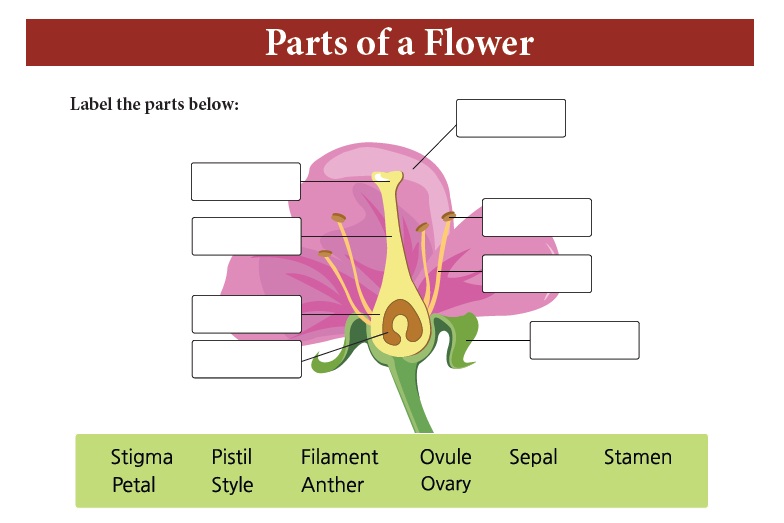
Label the picture given below. Parts of a Flower
23.
| Tuberculosis | ________ |
| _______ | Virus |
24.
Complete the table by writing the symbols of the following elements
| Element | Symbol |
| Aluminium | Al |
| Nickel | |
| Bromine | |
| Helium | |
| Magnesium |
25.
| Molecule | Chlorine Gas | Nitrogen Gas |
| Molecule Diagram |
.JPG) |
? |
| Molecule Model (Ball and Stick) |
? | .JPG) |
26.
| Underground stem | __ (1)__ | Ginger |
| __ (2)__ | Runner | __ (3)__ |
| Leaf modification | __ (4)__ | Acacia |
| Root modification | sucking Roots | __ (5)__ |
1.
(i) A stamen consists of two parts.
(ii) A stalk called filament and a lobe called anther. The anther contains pollen grains.
2.
Molecule is the smallest unit of compound.
3.
(i) Fundamental quantity
(ii) Derived quantity.
4.
The number of electrons or protons is an atom is called the atomic number (Z) of an atom.
5.
An atom is the smallest particle of a chemical element that retains its chemical properties.
6.
The regular hair wash and massage of the scalp will remove the dead skin cells, excess oil and dust.
7.
Hygiene refers to the good habits and the practices which is followed to prevent diseases, maintain good health, especially through cleanliness, consumption of safe drinking water and proper disposal of sewage.
8.
She moves in a straight line with constant velocity.
9.
Elemenls: Iodine and Lithium.
Compounds: Water, Common salt, Sugar and Carbon dioxide.
10.
a) Element:
Simplest form of matter is called an element.
Ex: Sodium Chlorine, Hydrogen and Oxygen.
b) Compound:
A compound is formed by the chemical combination of the atoms of two or more elements in definite proportions.
Ex: Water (H2O).
c) Metal:
Metals are generally hard and shiny elements.
Ex: Copper, Lead
d) Non-metol:
Non-metals are generally dull and soft.
Ex: Oxygen, Hydrogen, Chlorine.
e) Metalloid:
Metalloids exhibit the properties of both metals and non-metals.
Ex: Silicon, Arsenic, Boron
11.
Raster graphics are created on the basis of pixels. When we enlarge this types of photos, we could see the pictures as rectangular layers or grids.
12.
The process by which pollen grains reach stigma is called as pollination.
13.
Two types of reproduction are,
i) Sexual reproduction.
ii) Asexual reproduction.
14.
Density of gold is 19,300 kg/m3
15.
Area, Volume, Speed, Electric charge and Density.
16.
Nervous system
17.
Carbon
18.
metre/second2
19.
m3
20.
Gas at room temperature
21.
| S.No | Name | Modification |
| 1. | Garlic | Stem (Bulb) |
| 2. | Turnip | Root (Top shaped root) |
| 3. | Rose plant | Leaf (Tendrils) and Stem (spine) |
| 4. | Maize | Root (Stilt root) |
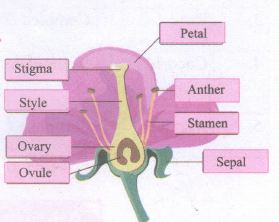
22.
23.
| Tuberculosis | Bacteria |
| Hepatitis | Virus |
24.
| Element | Symbol |
| Aluminium | Al |
| Nickel | Ni |
| Bromine | Br |
| Helium | He |
| Magnesium | Mg |
25.
| Molecule | Chlorine Gas | Nitrogen Gas |
| Molecule Diagram |
|
.JPG) |
| Molecule Model (Ball and Stick) |
.JPG) |
|
26.
| Underground stem | Rhizome | Ginger |
| Sub aerial stem | Runner | Centella |
| Leaf modification | phylloda | Acacia |
| Root modification | sucking Roots | Cuscuta |

7th Standard Syllabus & Materials
7th Standard
TN 7th English T1 - Supplementary - On Monday Morning Important Questions And Answers Study Material - QB365 Set A
NEW7th Standard
TN 7th English T1 - Prose - Eidgah Important Questions And Answers Study Material - QB365 Set A
NEW7th Standard
TN 7th Social Science T1 - ECO - Production Important Questions And Answers Study Material - QB365 Set A
NEW7th Standard
TN 7th Social Science T1 - GEO - Interior of the Earth Important Questions And Answers Study Material - QB365 Set A



Tamilnadu Stateboard 7th Standard Subjects
Tamilnadu Stateboard Standards




