
 100% FREE ACCESS
7th Standard Syllabus & Materials
7th Standard
TN 7th Tamil பருவம் -1 இயல் 1 - அமுதத்தமிழ் - ஒன்றல்ல இரண்டல்ல Important Questions And Answers Study Material - QB365 Set A
NEW7th Standard
TN 7th Tamil பருவம் -1 இயல் 1 - அமுதத்தமிழ் - எங்கள் தமிழ் Important Questions And Answers Study Material - QB365 Set A
NEW7th Standard
TN 7th English T1 - Poem - Your Space Important Questions And Answers Study Material - QB365 Set A
NEW7th Standard
TN 7th English T1 - Prose - A Prayer to the Teacher Important Questions And Answers Study Material - QB365 Set A
NEW7th Standard
TN 7th English T1 - Poem - The Listeners Important Questions And Answers Study Material - QB365 Set A
NEW7th Standard
TN 7th English T1 - Prose - The Wind on Haunted Hill Important Questions And Answers Study Material - QB365 Set A

Published on: 30/10/2019
Term 2 Electricity
Download Tamil Nadu 7th Standard Science question papers, model tests, one-mark questions, important questions, and public exam papers in PDF format. Free study materials and answer keys for TN State Board students.
Questions + Answers key
Take MCQ Science Test1.
In which of the following circuits are the bulb connected in series?
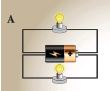
.JPG)
.JPG)
.JPG)
2.
Small amounts of electrical current are measured in milliampere (mA). How many milliampere are there in 0.25 A ?
2.5 mA
25 mA
250 mA
2500 mA
3.
In the circuit shown, which switches (L, M or N) must be closed to light up the bulb?
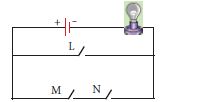
switch L only
switch M only
Switch M and N only
either switch L or switches M and N
4.
In the circuit diagram below, 10 units of electric charge move past point x every second What is the current in the circuit _______
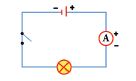
10 A
1 A
10 V
1 V
5.
The electrical conductivity of the semiconductor is in between a conductor and an insulator.
6.
The representation of the electric current is A.
7.
In a parallel circuit, the electric components are divided into branches.
8.
The fuse wire does not melts whenever there is overload in the wiring.
9.
Electron flow is in the same direction to conventional current flow.
10.
milli ampere: micro ampere : : 10-3A : ------
11.
Copper : conductor : : Wood : ---------------
12.
Water : pipe : : Electric current :-------------
13.
Name few insulators.
14.
Define fuse.
15.
Name the device used to generate electricity.
16.
Define electrical conductivity.
17.
Differentiate parallel and serial circuits.
18.
Define an electric current.
19.
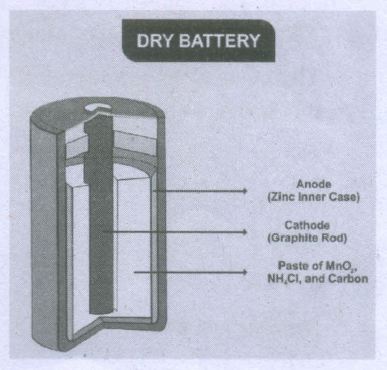
Explain the construction and working of a dry cell.
20.
A student made a circuit by using an electric cell, a switch, a torch bulb (fitted in the bulb holder) and copper connecting wires. When he turned on the switch, the torch bulb did not glow at all. The student checked the circuit and found that all the wire connections were tight.
What could be the possible reason for the torch bulb not glowing even when the circuit appears to be complete?
1.
(b)
2.
(c)
250 mA
3.
(d)
either switch L or switches M and N
4.
(a)
10 A
5.
True
6.
False.
The representation of the electric current is 'I'.
7.
True
8.
False.
The Fuse wire melts whenever there is overload in the wiring.
9.
False.
Electron flow is in the opposite direction to conventional current flow.
10.
10-6A
11.
Insulator
12.
Metals
13.
Wood, Glass, Plastic, Rubber are some examples of insulator.
14.
Fuse is a safety device which is used in household wiring and in many appliances.
15.
Electric cell is the device used to generate electricity.
16.
Electrical conductivity is the measure of a material's ability to conduct an electric current. It is commonly represented by the Greek letter σ(sigma). The S.I Unit of electrical conductivity is Siemens/meter(S/m).
17.
| S.No | Porollel circuit | Series circuit |
| 1. | Connected by branches | Single loop connection |
| 2. | Bulbs brighter | Bulbs dimmer |
| 3. | Each bulb fully powered | Bulbs share power |
| 4. | All bulbs stay glow if one goes out | All bulbs go out if one goes out |
18.
The flow of electric charges constitute an electric current. An electric current is measured by the amount of electric charge moving per unit time at any point in the circuit
19.
(i) Dry cells are normaly used in small devices such as remote control for T.V., torch, camera and toys.
A dry cells is a portable form of a leclanche cell. It consists of zinc vessel which acts as a negative electrode or anode the vessal contains a moist paste of saw dusts saturated with a solution of ammonium chloride and zinc chloride. The ammonium chloride acts as an electrolyte.
(ii) Electrolytes are substances that become ions in solution and acquire the capacity to conduct electricity.
(iii) The purpose of zinc chloride is to maintain the moistness of the paste being highly hygroscopic. The carbon rod covered with a brass cap is placed in the middle of vessel. It acts as positive electrode or cathode.
(iv) It is surrounded by a closely packed mixture of charcoal and manganese dioxide (MnO2) in a muslin bag. Here MnO2 acts as depolarizer. The zinc vessel is sealed at the top with pitch or shellac. A small hole is provided in it to allow the gases formed by the chemical action to escape. The chemical action inside the cell is the same as in leclanche cell
20.
1) The electric cell produce weak energy.
2) The bulb filament is broken. (dead)
3) The both wires are connected to the same terminal of the cell.
4) Battery or cell is dead.

7th Standard Syllabus & Materials
7th Standard
TN 7th English T1 - Supplementary - On Monday Morning Important Questions And Answers Study Material - QB365 Set A
NEW7th Standard
TN 7th English T1 - Prose - Eidgah Important Questions And Answers Study Material - QB365 Set A
NEW7th Standard
TN 7th Social Science T1 - ECO - Production Important Questions And Answers Study Material - QB365 Set A
NEW7th Standard
TN 7th Social Science T1 - GEO - Interior of the Earth Important Questions And Answers Study Material - QB365 Set A



Tamilnadu Stateboard 7th Standard Subjects
Tamilnadu Stateboard Standards




